
Constituent Assembly & Its Criticism - Indian Polity Notes
Constituent Assembly of India held its first meeting on 9 December 1946, reassembling on 14 August 1947 as a sovereign body. The main objective of the Constituent Assembly was to prepare a draft for the Constitution of the country. The assembly takes 2 years, 11 months, and 18 days to draft the Constitution. Constitution formulated by the constituent assembly still stands strong today but was subjected to several criticism as well. This topic is important from both UPSC Preliminary as well as mains examination perspective.
|
Table of Contents |
Constituent Assembly of India – Historical Background
- In 1934, M N Roy proposed the idea of a constituent assembly.
- The demand was taken up by the Congress Party in 1935 as an official demand.
- The British accepted this in the August Offer of 1940.
- Elections were held for the formation of the constituent assembly under the Cabinet Mission plan of 1946.
- The members of this assembly were elected indirectly, i.e., by the members of the provincial assemblies using the method of a single transferable vote (Proportional representation).
Objective
- The Constituent Assembly's goal was to draft an acceptable Constitution as the only way for India's self-determination principle to be implemented.
- To draft a constitution that will allow for the appropriate transfer of sovereign power from British to Indian hands.
|
Constitution empowers those who traditionally have been deprived of it and gives vulnerable people the power to achieve collective good. Rajeev Bhargava
|
Constituent Assembly - Provisions
- Section 8 of the Indian Independence Act of 1947 established the Assembly.
- The Constituent Assembly of India was established in accordance with the provisions of the Cabinet Mission Plan of May 1946.
- The Assembly was made up of 389 members who represented provinces (292), states (93),Chief Commissioner Provinces (3), as well as Balochistan (1)
- On December 9, 1946, the Assembly convened for the first time and elected Dr. Sachhidannand Sinha, the Assembly's oldest member, as Provisional President.
- Dr. Rajendra Prasad was elected as the Assembly's permanent Chairman on December 11, 1946.
- The Assembly was to be composed of proportional representation from existing provincial legislatures and princely states.
- The Assembly was to be divided into three sections: Punjab &the North-West, Bengal-Assam, and the rest of India.
- The constitutions were to be drafted for the Indian Union, each Section, and each of the Provinces within them.
- The Muslim League, which had won the majority of the 80 Muslim seats and dominated two smaller Sections, chose not to participate, and as a result, the Assembly never convened separately in sections.
- Following the passage of the Indian Independence Act by the British Parliament, it was decided that members who wanted to keep their seats in the provincial legislature would vacate their seats in the Assembly.
- However, several members of the provincial legislature continued to attend and participate in the Assembly until a provision was made in the Constitution itself prohibiting this.
- The declaration of Partition of India caused the greatest change in membership.
- Following an initial lack of interest, the princely states began negotiating their representation with a committee of the Assembly.
- Hundreds of princely states were grouped into larger associations over time, and provisions were made for them to elect their representatives to the Assembly.
- New members continued to join up until the Assembly's final day. Until the very end, Hyderabad did not send a representative.
- According to records, the Assembly's maximum membership near the end of its tenure was 307.
- Several non-members assisted the Assembly in developing the Constitution.
- Outside the Assembly, prominent public figures were asked to serve on committees formed by the Assembly to focus on specific features or segments.
- These committees were responsible for much of the constitution's development, both procedurally and substantively.
- Resolutions were moved and adopted after discussions to establish committees as needed.
- The Constituent Assembly established 13 committees to draft the Constitution.
- A seven-member committee prepared a draft of the Constitution based on the reports of these committees.
- The draft Constitution was published in January 1948, and the public had eight months to discuss it and propose amendments.
- Following the receipt of comments in response to the Draft Constitution of February 1948, the so-called Special Committee was formed to determine the next course of action.
- After the draft was discussed by the people, the press, the provincial assemblies, and the constituent Assembly in light of the suggestions received, it was finally adopted and signed by the President of the Assembly on November 26, 1949.
- Following the authentication of the Constitution's copies, the Constituent Assembly was naturally dissolved, with its Chairperson elected President of India and its staff diverted to other avenues.
- However, the majority of the Assembly continued to function as the provisional Parliament of India until the first general elections were held.
- This provisional Parliament did, in fact, make the first amendment to the Indian Constitution in the summer of 1951.
Constituent Assembly – Criticism
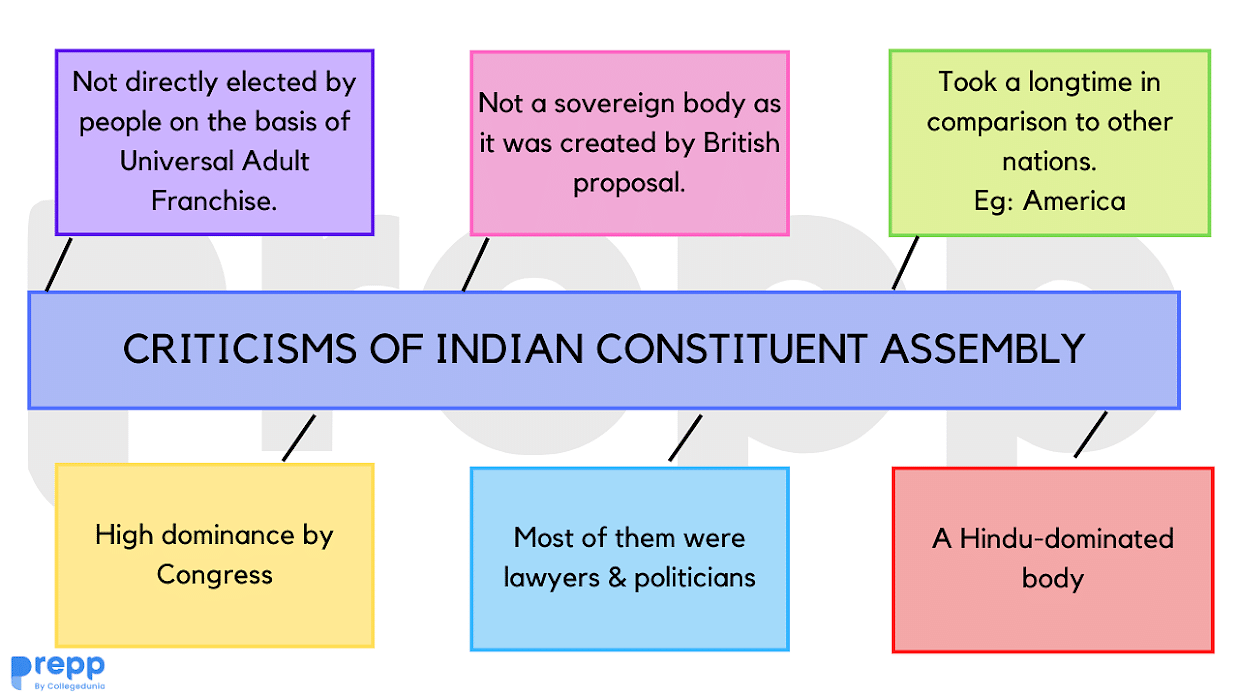
The critics have criticized the Constituent Assembly on various grounds.
- Not a Representative Body: The Constituent Assembly was not a representative body, according to opponents, because its members were not directly elected by the people of India using the universal adult franchise.
- Not a Sovereign Entity: Critics said that the Constituent Assembly was not a sovereign body because it was established by British government suggestions. They further claimed that the Assembly met with the authorization of the British government.
- Time-consuming: Critics claim that the Constituent Assembly took an excessive amount of time to draft the Constitution. They claimed that the framers of the American Constitution finished their work in just four months.
- Congress-dominated Constituent Assembly: Critics said that the Congress party dominated the Constituent Assembly. 'The Constituent Assembly was a one-party assembly in an essentially one-party society,' said Granville Austin, a British constitutional expert. The Congress was the Assembly, and India was the Congress.'
- Lawyer - Politician Domination: The Constituent Assembly was likewise dominated by attorneys and politicians, according to detractors. They argued that other aspects of society were not adequately reflected. This, they believe, is the primary cause for the Constitution's volume and complication of language.
- Hindu-dominated: Some critics claim that the Constituent Assembly was Hindu-dominated. Lord Viscount Simon referred to it as "a Hindu body." Winston Churchill, likewise, stated that the Constituent Assembly represented "just one large community in India."
Conclusion
The foregoing criticisms, however, do not reflect the genuine nature of the Constituent Assembly. Despite the fact that it was indirectly elected, the Constituent Assembly was made up of people from all walks of life in India. Given the difficulty of enacting a constitution for a country like India, the lengthy procedure was reasonable. The constitution's secular clauses, as well as the constitution's long-term viability, demonstrate that the constitution did not offer any overt or covert favour to the main religion of the state.
FAQs
Question: What was the purpose of the Constituent Assembly in India?
Answer: The Constituent Assembly was established to draft the Constitution of independent India. Its primary purpose was to frame a comprehensive and inclusive legal and administrative document that would serve as the supreme law of the land, ensuring democracy, justice, and equality. The Assembly played a crucial role in laying the foundation for India's political structure, rights of citizens, and guiding principles for governance.
Question: How was the Constituent Assembly formed?
Answer: The Constituent Assembly was formed under the Cabinet Mission Plan of 1946. It comprised 389 members representing British India and the princely states. Members were elected indirectly by the provincial assemblies using a proportional representation system, ensuring representation of various communities, including minorities and weaker sections.
Question: Who was the Chairman of the Constituent Assembly?
Answer: Dr. Rajendra Prasad was the Chairman of the Constituent Assembly. He presided over the sessions and guided the discussions. The Assembly also had notable members like Dr. B.R. Ambedkar, who chaired the Drafting Committee, contributing significantly to the structure and content of the Indian Constitution.
Question: What were some criticisms faced by the Constituent Assembly?
Answer: The Constituent Assembly faced criticism for being undemocratic, as its members were not directly elected by the people but by provincial assemblies. It was also viewed as unrepresentative due to the absence of direct representation from the masses and certain communities. Additionally, some critics argued that it had an elitist composition, limiting broader public participation.
Question: When did the Constituent Assembly complete the drafting of the Constitution?
Answer: The Constituent Assembly completed the drafting of the Constitution on November 26, 1949. This day is commemorated as Constitution Day in India. The Constitution came into effect on January 26, 1950, marking the establishment of India as a republic.
MCQs
1. Under which plan was the Constituent Assembly of India formed?
A) Cripps Mission
B) Cabinet Mission Plan
C) Mountbatten Plan
D) Simon Commission
Answer: (B) See the Explanation
Explanation: The Constituent Assembly was established under the Cabinet Mission Plan of 1946 to draft a Constitution for independent India, ensuring representation from various communities.
2. Who was the Chairman of the Drafting Committee of the Constituent Assembly?
A) Jawaharlal Nehru
B) Dr. Rajendra Prasad
C) Dr. B.R. Ambedkar
D) Sardar Vallabhbhai Patel
Answer: (C) See the Explanation
Explanation: Dr. B.R. Ambedkar was the Chairman of the Drafting Committee, playing a pivotal role in shaping the Constitution of India and addressing key issues of equality and social justice.
3. What date is celebrated as Constitution Day in India?
A) August 15
B) January 26
C) November 26
D) October 2
Answer: (C) See the Explanation
Explanation: November 26 is celebrated as Constitution Day to mark the day when the Constituent Assembly adopted the Constitution of India in 1949.
4. How many members did the Constituent Assembly initially have?
A) 299
B) 389
C) 250
D) 315
Answer: (B) See the Explanation
Explanation: The Constituent Assembly initially had 389 members, representing both British India and the princely states. The number reduced after the partition, which led to the formation of Pakistan.
5. What was one major criticism of the Constituent Assembly?
A) It was too democratic
B) It lacked legal experts
C) It was not directly elected by the people
D) It had excessive foreign influence
Answer: (C) See the Explanation
Explanation: The Constituent Assembly was criticized for not being directly elected by the people, as its members were chosen by the provincial legislatures, making it appear undemocratic to some observers.
GS Mains Questions and Model Answers
Q1: Discuss the significance of the Constituent Assembly in shaping modern India. How did it ensure representation and inclusivity during the drafting process?
Answer: The Constituent Assembly was vital in shaping the democratic framework of modern India. Established under the Cabinet Mission Plan, it comprised members from various regions, communities, and backgrounds, striving for inclusivity. Key leaders like Dr. B.R. Ambedkar, Jawaharlal Nehru, and Sardar Patel contributed to creating a Constitution that upheld fundamental rights and democratic values. Despite criticisms of elitism and indirect elections, the Assembly included representatives of minorities and marginalized sections, ensuring diverse perspectives were considered. The debates and discussions that occurred laid the foundation for a robust democratic system that respected unity in diversity. The Assembly’s commitment to a secular and inclusive Constitution has had a long-lasting impact on India's governance and social fabric.
Q2: Analyze the criticisms faced by the Constituent Assembly. How valid were these criticisms in light of its achievements?
Answer: The Constituent Assembly faced criticisms for being undemocratic as its members were not directly elected by the populace but chosen by provincial assemblies. This led to perceptions of elitism and limited mass representation. However, these criticisms must be viewed in the context of the time, when direct elections were logistically difficult due to colonial rule and the lack of an established electoral system. Despite these challenges, the Assembly succeeded in drafting a comprehensive Constitution that balanced the interests of diverse social and regional groups. The final document incorporated significant public consultation and set the stage for a democratic and independent nation. While the criticisms had merit, the achievements of the Assembly in creating a foundational legal framework outweigh these limitations.
Q3: Evaluate the role of Dr. B.R. Ambedkar in the Constituent Assembly. How did his contributions shape the Indian Constitution?
Answer: Dr. B.R. Ambedkar, as the Chairman of the Drafting Committee, played an instrumental role in shaping the Indian Constitution. His deep understanding of law and social issues influenced the inclusion of fundamental rights and provisions that addressed social inequalities. Ambedkar advocated for a Constitution that ensured justice, liberty, and equality for all citizens, emphasizing the protection of marginalized communities. His foresight in incorporating measures like the reservation system, fundamental rights, and directive principles of state policy laid a foundation for social justice and reform. Ambedkar’s contributions were crucial in embedding a vision of inclusive democracy and securing rights for disadvantaged groups, making him a pivotal figure in the Assembly's success.
Previous Year Questions on Constituent Assembly
1. UPSC CSE Prelims 2022:
Question: Who was the President of the Constituent Assembly of India?
A) Jawaharlal Nehru
B) Dr. B.R. Ambedkar
C) Sardar Patel
D) Dr. Rajendra Prasad
Answer: (D)
Explanation: Dr. Rajendra Prasad served as the President of the Constituent Assembly, overseeing the discussions and proceedings during the drafting of the Indian Constitution.
2. UPSC CSE Mains 2021 (GS Paper 2):
Question: "Critically assess the role of the Constituent Assembly in ensuring a balance between the representation of diverse communities and effective decision-making. How did it address the challenges of inclusivity?"
Answer: The Constituent Assembly played a crucial role in balancing diverse community representation and effective decision-making. Formed through indirect elections, it included representatives from various regions, religions, and social backgrounds, ensuring that minority voices were heard. Leaders like Dr. B.R. Ambedkar and Sardar Patel advocated for provisions that protected the rights of marginalized communities. The Assembly’s debates reflected the complexities of creating a unified yet diverse nation. Despite criticisms of limited direct representation, the Assembly’s achievements in drafting a Constitution that promoted equality, secularism, and democracy showcased its ability to address inclusivity challenges. It laid the foundation for a pluralistic society where varied interests were harmonized within a democratic framework.
*email: contactus@prepp.in
Download the PREPP App and attempt FREE IAS Exam Mock Tests and get complete study material!


Comments