Enactment of the Indian Constitution - Making of the Indian Constitution - Indian Polity Notes
The process through which the Constitution is agreed upon and made official is referred to as enactment. Constitutional enforcement entails putting the Constitution's laws and processes into action. On 26,1949, people of India represented by the Constituent Assembly adopted and enacted the Constitution of India. On 26 January 1950, the Constitution came into force and India became a republic. The UPSC Indian Polity and Governance Syllabus include the Enactment of the Constitution which is described in this article.
|
Table of Contents |
Enactment of the Constitution - Historical Background
- In 1922, the general meeting of Annie Besant decided to convene a constitution framing convention.
- The Indian Commonwealth Bill of 1925 was introduced to the British Parliament. Considered as one of India's greatest constitutional efforts.
- In 1928, the Motilal Nehru report was released, which was considered the first major attempt towards a full-fledged constitution.
- 1930-32: during this time, three round tables were held on constitutional reform.
- 1934: Proposal for the establishment of the Constituent Assembly, presented by M.N. Roy for the first time.
- 1937-39: The Working Committee of the Congress asked the Constituent Assembly on several occasions to adopt a constitution during this period.
- August 1940: The British government granted this request.
- The 1942 Cripps mission failed due to non-compliance with the requirements of the Congress and the Muslim League for Constituent Assembly.
- 1945: Shimla Conference
- Jan-May 1946: Finally, the Constituent Assembly was created on the recommendation of the Cabinet Mission.
|
On 26, 1949, people of India represented by the Constituent Assembly adopted and enacted the Constitution of India.
|
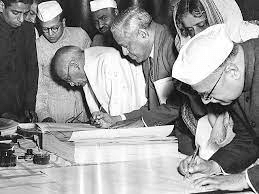
Enactment of the Indian Constitution
- November 1946: The Assembly formed in November 1946 and met for the first time on Dec 9, 1946, and on Dec 13, 1946, Jawaharlal Nehru presented an objective resolution.
- January 1947: Objective Resolution was passed.
- August 1947: Indian Independence Act, 1947
- November 1947: They met for the first time as legislatures.
- 4 Nov 1948-Nov 9 1948: First reading of the final draft of the Constitution
- 15 Nov 1948-Oct 17 1940: Second reading of the draft of the constitution.
- 14 November 1949: Third reading of the draft
- 26 November 1949: The draft Constitution was passed and signed by the members.
- January 1950: Constitution came into force on 26 Jan1950 and India became a republic.
- The Constituent Assembly was elected to formulate India's constitution, held its first meeting on December 9, 1946, in the Constitution Hall (now known as the Central Hall of the Parliament House).
- Members were indirectly elected by members of the Provincial Legislative Assembly. The total number of members of the Constituent Assembly was 389.
- However, due to the division under the Mountbatten Plan of June 3, 1947, a separate Constituent Assembly was created for Pakistan. Representatives from several provinces that no longer existed turned into the reduction of the membership of the Council to 299.
- The Constituent Assembly reconvened on August 14, 1947, as the sovereign Constituent Assembly for the Dominion of India.
- On August 29, 1947, the Constituent Assembly established a Drafting Committee, chaired by Dr. B.R. Ambedkar, to prepare the draft constitution for India.
Conclusion
Enactment of the constitution symbolizes a nation's commitment to principles, providing a stable framework for governance. It encapsulates shared values, guides future generations, and serves as a resilient tool for justice and unity. The Constitution is a testament to the enduring spirit of democracy, fostering a pursuit of a more just and inclusive society.
FAQs
Question: What is the significance of the enactment of the Indian Constitution?
Answer: The enactment of the Indian Constitution on January 26, 1950, marked the transition of India from a British Dominion to a Sovereign Republic. It laid down the framework for governance, established fundamental rights and duties, and defined the structure of the government and its relationship with the people.
Question: Who played a major role in the drafting of the Indian Constitution?
Answer: Dr. B.R. Ambedkar, as the Chairman of the Drafting Committee, played a pivotal role in drafting the Indian Constitution. He, along with other members of the Constituent Assembly, contributed to creating a comprehensive legal and governance document that reflects India's socio-political aspirations.
Question: How long did it take to frame the Indian Constitution?
Answer: The Constituent Assembly took approximately 2 years, 11 months, and 17 days to draft the Indian Constitution, starting from December 9, 1946, and completing it on November 26, 1949. It came into effect on January 26, 1950.
Question: What was the objective of the Constituent Assembly?
Answer: The Constituent Assembly's primary objective was to frame a Constitution for India that would ensure justice, liberty, equality, and fraternity among its citizens. It sought to establish a democratic republic based on the rule of law and guarantee fundamental rights and socio-economic justice.
Question: Why is January 26 celebrated as Republic Day in India?
Answer: January 26 is celebrated as Republic Day in India to commemorate the date when the Indian Constitution came into effect in 1950. This day signifies India's transition to a fully sovereign republic with a constitutionally governed democratic system.
MCQs
- The Indian Constitution was enacted on:
A) August 15, 1947
B) January 26, 1950
C) November 26, 1949
D) January 1, 1950
Answer: (B) See the Explanation
The Indian Constitution came into effect on January 26, 1950, marking India's transition to a Republic.
- The Drafting Committee of the Indian Constitution was chaired by:
A) Jawaharlal Nehru
B) Sardar Vallabhbhai Patel
C) Dr. B.R. Ambedkar
D) Rajendra Prasad
Answer: (C) See the Explanation
Dr. B.R. Ambedkar was the Chairman of the Drafting Committee and played a key role in framing the Constitution.
- The Constituent Assembly of India first met on:
A) August 15, 1947
B) January 26, 1950
C) December 9, 1946
D) January 1, 1949
Answer: (C) See the Explanation
The Constituent Assembly held its first meeting on December 9, 1946.
- The Indian Constitution guarantees fundamental rights to:
A) Citizens only
B) Both citizens and non-citizens, depending on the specific right
C) Foreign nationals only
D) The government
Answer: (B) See the Explanation
Fundamental rights in India apply to citizens and, in certain cases, non-citizens as well.
- The Indian Constitution became effective on January 26, 1950, to coincide with:
A) The anniversary of India's independence
B) The anniversary of the Lahore Session of 1929, which declared Purna Swaraj
C) Gandhi's birth anniversary
D) The adoption of the United Nations Charter
Answer: (B) See the Explanation
January 26 was chosen to honor the 1930 Lahore Session, where the demand for complete independence (Purna Swaraj) was made.
GS Mains Questions and Model Answers
Q1: Explain the role and significance of the Constituent Assembly in the making of the Indian Constitution.
Answer: The Constituent Assembly was responsible for drafting the Indian Constitution, a task it undertook from December 9, 1946, to November 26, 1949. It consisted of prominent leaders, legal experts, and social reformers representing diverse communities and regions of India. The Assembly debated and deliberated on issues such as federal structure, fundamental rights, minority representation, and socio-economic reforms. Dr. B.R. Ambedkar, as the Chairman of the Drafting Committee, played a key role in shaping the document. The Assembly's work led to the creation of a comprehensive and inclusive Constitution that reflected India's aspirations for justice, liberty, equality, and fraternity, laying the foundation for democratic governance and the rule of law.
Q2: Discuss the importance of January 26, 1950, in Indian history.
Answer: January 26, 1950, holds immense historical significance as it marks the day when the Indian Constitution came into effect, transforming India into a sovereign, democratic republic. This date was chosen to honor the Purna Swaraj resolution passed in the Lahore Session of 1929, symbolizing India's commitment to complete independence and self-governance. The enactment of the Constitution established a framework for governance, guaranteed fundamental rights, and laid the groundwork for socio-economic development. Republic Day is celebrated annually to reaffirm the values and principles enshrined in the Constitution, reflecting India's unity, diversity, and commitment to democracy.
Q3: Analyze the challenges faced by the Constituent Assembly while framing the Indian Constitution.
Answer: The Constituent Assembly faced several challenges while framing the Indian Constitution. These included balancing regional and cultural diversity, addressing minority rights, and ensuring equitable representation. The Assembly had to create a federal structure suitable for a large and diverse country while maintaining national unity. It also had to resolve complex issues related to social justice, fundamental rights, and socio-economic inequalities. The influence of colonial laws, the need to incorporate lessons from other constitutions, and the pressures of Partition added further complexity. Despite these challenges, the Assembly produced a comprehensive Constitution that has endured as the foundation of Indian democracy.
Previous Year Questions on Indian Constitution
1. UPSC CSE 2020
Question: Evaluate the role of Dr. B.R. Ambedkar in the drafting of the Indian Constitution.
Answer: Dr. B.R. Ambedkar, as the Chairman of the Drafting Committee of the Constituent Assembly, played a pivotal role in framing the Indian Constitution. Known as the "Father of the Indian Constitution," he ensured the inclusion of fundamental rights, socio-economic justice, and safeguards for marginalized communities. Ambedkar emphasized constitutional morality, equality before the law, and social reforms. His contributions to federalism, parliamentary democracy, and the principles of liberty, equality, and fraternity laid a strong foundation for India's governance. His vision and expertise were instrumental in creating a document that remains relevant and adaptable to the changing needs of Indian society.
2. UPSC CSE 2019
Question: Discuss the significance of the adoption and enactment dates of the Indian Constitution.
Answer: The Indian Constitution was adopted on November 26, 1949, and came into effect on January 26, 1950. The adoption date symbolizes the completion of the drafting process and the culmination of intense deliberations by the Constituent Assembly. January 26 was chosen as the enactment date to honor the Lahore Session of 1929, which called for Purna Swaraj (complete independence). This date marked India's transition to a sovereign republic with a constitutionally governed democratic system. The dual significance of these dates reflects the aspirations of India's freedom struggle and the foundational values of justice, liberty, equality, and fraternity enshrined in the Constitution.
*email: contactus@prepp.in
Download the PREPP App and attempt FREE IAS Exam Mock Tests and get complete study material!

Full Test - 04: UPSC CSE Prelims CSAT (Paper-II)
Full Test - 03: UPSC CSE Prelims CSAT (Paper-II)
UPSC CSE Prelims 2026 GS Paper 1 Question Paper (24-May-2026)
UPSC CSE Prelims 2026 CSAT Paper 2 Question Paper (24-May-2026)

17 February 2025 | The Hindu Must Read Articles | Current Affairs

16 February 2026 | The Hindu Must Read Articles | Current Affairs

13 February 2026 | The Hindu Must Read Articles | Current Affairs









Comments