Sources of the Indian Constitution - Indian Polity Notes
Several sources inspired the drafting of the Indian Constitution. Various legislations passed during British Rule like the Government of India Act of 1858, the Indian Councils Acts, the Government of India Acts of 1919 and 1935, and the Indian Independence Act of 1947 etc laid the foundation of the modern constitution. The framers of the Indian Constitution drew inspiration from various legal and political systems around the world. Indian Constitution has borrowed many features from various other countries like Australia, Canada, Ireland, Japan, Russia, United Kingdom, United States, Germany, South Africa, and France etc and adapted according to the needs of the multicultural Indian society. The makers of the constitution tried to fetch the best from the other constitutions and also invented many features which are unique to India. This article explains the Sources of the Indian Constitution which is important for UPSC Indian Polity Preparation.
Table of Contents
Indian Constitution
- The Indian Constitution, initially known as the Bharatiya Samvidhana, has been in force since January 26, 1950.
- The Indian constitution is the longest written constitution, and one element that contributes to this is that it was derived from a variety of sources.
- The Constituent Assembly reviewed several constitutions and developed one that incorporated all of the aspects that were most suitable to India's diversity.
- Dr. B R Ambedkar correctly said that it was drafted after "ransacking" the existing constitution of the world.
- When the Constituent Assembly framed the Constitution, it had 395 articles. Today, it has 448 articles.
- This clearly reflects that the constitution has been gradually modified in order to adapt itself to the political exigencies and the aspiration to effect social and economic amelioration of Indian society from time to time.
|
Sources of the Indian Constitution represent a remarkable synthesis of colonial experiences, and global insights, creating a constitutional framework that stands as a beacon of democracy. |
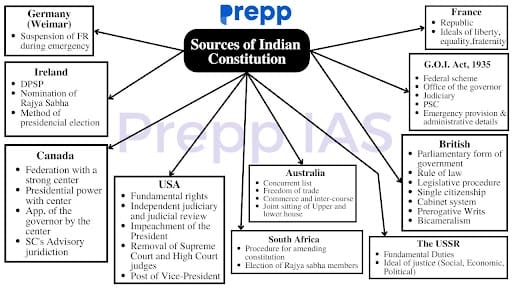
Sources of the Indian Constitution
- Fathers of the Constitution filtered through various constitutions around the world and tailored them to the specific needs and aspirations of the Indian people.
Government of India Act 1935
- The Constitution derives directly from the Government of India Act of 1935 from which many of the provisions are copied almost textually.
- Articles 256, 351, 352, 353, 356 are carbon copies of sections 126, 107, 102 and 93 of 1935 Act respectively.
- Office of Governor: According to Article 153, each state must have a governor who has administrative authority over the state.
- The judiciary:The judiciary is empowered by the Constitution to ensure rule of law and to safeguard rights of the individual.
- The judiciary is organised in a hierarchical system, with the Supreme Court at the top, followed by the High Courts subordinate courts.
- Public Service Commission:The British founded the Public Service Commission in India, and it is still an important element of the administrative system today. Which was later incorporated into the constitution.
- Emergency provisions:Emergency provisions were introduced by the Government of India Act 1935, which is found in Part 18 of the Indian Constitution,elaborated in Articles from 352 to 360. The president has the authority to declare a state of emergency in respect of whole country or state or any specific territory due to situations such as war, aggression, or other threats.
Influence of Foreign Constitutions
An analysis of the Indian Constitution reveals that it has been substantially influenced by well framed constitutions of some of the developed democracies of the world.
British Constitution
- Parliamentary system: The Parliamentary system of Government which provides for the constitutional head of the state and also real head of the Government is an import from Great Britain.
- Cabinet System: This is a system in which the Cabinet's existence, including the election of the Prime Minister, is dependent on legislative confidence in the Cabinet.
- Legislative Procedure: Any form of being presented before the house of parliament to enact or pass it as an act or legislation is referred to as legislative procedure.
- Parliamentary Privileges: These are some of the powers and immunities granted to cabinet ministers under Article 105 as a privilege. Article 194 also applies to members of the state legislative assembly.
- Speaker of the Lok Sabha: The speaker of the Lok Sabha like his counterpart in Great Britain is neutral in politics in the House. He is to be non-partisan.
- Like the U.K., India has opted for the concept of Rule of Law. Equality before law prevails in both the countries.(Article 14).
- Dicey provides the rule of law, which states that the law is superior. In India, the rule of law also applies, but any law that violates basic rights is ruled void. It is mentioned in article 13.
- Writs: Writs are the most crucial tool for citizens to use when their fundamental and other rights are violated.
- Article 32 and Article 226 empower the Supreme Court and High Courts respectively to issue writs in case of violation of Fundamental Rights.The idea of writ Jurisdiction has been taken from British Constitution.
- Single citizenship fosters a sense of solidarity since each citizen is just Indian and nothing else. In contrast to the United States, which has a dual citizenship system, Indian citizens must take just one citizenship.
The US Constitution
- Preamble: It was based on the preamble of the United States Constitution as well as the concept of a written constitution. The United States was the first to include a preamble in its constitution. "We the people" declares that the people are the true wellspring of the Constitution.
- Fundamental Rights: Not just India, but many other countries have adopted the concept of fundamental rights from the United States, which is the most significant aspect of our constitution. It is a constitutionally given right in the United States.
- Federalism: The spirit of federalism has been inspired by United States Constitution. The United States of America is a confederation of numerous states that create a large nation. The United States of America is a real federation, whereas India is a quasi-federation.
- Separation of powers: The doctrine of separation of powers was drawn from the United States Constitution, which was derived from the doctrines of Montesquieu.
- The separation of powers is a fundamental principle of the Indian Constitution.It clearly delineates the powers and functions of the three branches of government: Legislature, Executive, and Judiciary. The separation of powers is aimed at preventing the abuse of power.
- But in place of strict separation of powers, India follows the doctrine of Checks and Balances.
- Equal protection of the law: The US Constitution inspired the idea of equal protection of the law for all people under Article 14.
- Impeachment of the President: Article 61 of the Indian constitution, which provides for the formal removal of the president by impeachment, was likewise borrowed from the US constitution.
- Judicial Review: The Supreme Court and the High Court have conducted extensive judicial reviews of the constitutional amendment.
- Post of Vice-President: While the duties of the vice president are similar in both India and the United States, the power and scope vary. The Vice President of the United States wields more influence than India's Vice President.
Canadian Constitution
- Form of federalism:The spirit of federalism was inspired by the US constitution, but the form of federalism was adopted from Canadian Constitution,where most of the residuary powers are vested in the Union.
- Advisory Jurisdiction: Supreme Court’s Advisory Jurisdiction (Article 143): The president can seek advice from the Supreme Court on any statute.
- Divisions of power: Article 246 deals with the 7th Schedule of the Indian Constitution that mentions three lists named as Union List, State List and Concurrent List which specify the divisions of power.
- The division of subjects between the centre and the units and provision of lists is to a great extent on Canadian lines.
- Both constitutions provide for the lists of legislative powers, central and provincial. The residuary powers have been given to the centre.
- Governor of a State: The President shall appoint the Governor of a State by warrant under his hand and seal (Article 155). To be eligible for appointment as Governor, a person must be an Indian citizen over the age of 35. (Article 157)
Australian Constitution
- Concurrent List: The Concurrent List, also known as List-III (Seventh Schedule), is a list of 52 items (albeit the last item is numbered 47) included in the Seventh Schedule of the Indian Constitution.
- It covers the authority that must be examined by both the federal and state governments.
- Intercourse and commerce: In the public interest, Article 302 enables parliament to impose limits on the freedom of trade, commerce, and intercourse between one state and another, or within any part of India's territory.
- Article 304 empowers state legislatures to control trade and commerce, subject to Article 303.
- Joint sitting of the two Houses of Parliament: The Indian Parliament is divided into two chambers.
- The President convenes a joint session of Parliament (Article 108), which is presided over by the Speaker or, in his absence, the Deputy Speaker of the Lok Sabha or, in his absence, the Deputy-Chairman of the Rajya Sabha.
- The method of resolution of disputes between the centre and the states has also been taken from Australia (Article 251)
Irish Constitution
- Directive Principles of State Policy: Part IV of the Indian Constitution addresses the State Policy Directive Principles (DPSP).
- The rules in this Part cannot be enforced by any court, but these concepts are vital to the country's government, and it is the State's obligation to adopt these principles in establishing laws.
- Nomination of Rajya Sabha members: The appointment of renowned individual’s as Rajya Sabha members. According to Article 80 (Part V) of the Constitution, the President has the authority to nominate 12 members to the Council of States (Rajya Sabha).
- Individuals having special knowledge or practical experience in the fields such as literature, science, art and social service are nominated.
- Method of Election of the President: The Constitution states that the President of India is to be elected indirectly by an electoral college using a single transferable vote system and a secret ballot, in accordance with the system of proportional representation.
Constitution of Japan
- The phrase “procedure established by law” has been mentioned in Article 21 of the Indian Constitution.It has been inspired by Japanese Constitution. It means if a law has been passed by the Parliament by following the proper procedure, then it will be a valid law.
- Following this doctrine implies that an individual can be deprived of his life or individual freedom in accordance with the legal procedure.
French Constitution
- The ideals of Republic in the Preamble: This term refers to a government in which no one owns public authority as a proprietary right.
- A democratic republic, as opposed to a monarchy, in which the head of state is appointed on a hereditary basis for life or until abdication, is an institution in which the head of state is chosen, directly or indirectly, for a definite tenure.
- Thus, India has a President who is elected and serves a definite term.
- The ideals of Liberty in the Preamble: This demonstrates that Indian people have no arbitrary constraints in terms of what they think, how they express themselves, and how they seek to put their beliefs into action.
- Ideals of Equality in the Preamble: This assumes that no segment of society is given special treatment and that individuals are given equal opportunity without discrimination. Before the law, everyone is equal.
- Fraternity principles in the Preamble: This speaks to a feeling of brotherhood and a sense of belonging to the nation among its family. It retains mental as well as geographical components of National Integration.
- It prohibits regionalism, communalism, casteism, and other forms of state solidarity.
Weimar Constitution of Germany
- Suspension of Fundamental Rights during Emergency: Article 352 declares a national emergency.
- Numerous Fundamental Rights of Indian residents may be suspended during a national emergency.
- During a National Emergency (Article 359), the President can issue a proclamation that certain fundamental rights can be suspended. However, rights under Articles 20 and 21 cannot be suspended even during a National Emergency.
South African Constitution
- The procedure for amending the Constitution: Part XX of the Indian Constitution only mentions one item, Article 368, which deals with constitutional modification.
- According to this article, Parliament may incorporate, change, or abolish any provision of the constitution in accordance with the method established for this purpose.
- Rajya Sabha members are elected: Rajya Sabha members are elected by the elected members of the Legislative Assemblies of States and Union territories using a single transferable vote by means of proportional representation.(open Ballot system)
USSR Constitution (Russia)
- Fundamental Duties: The Fundamental Duties are regarded as the moral responsibility of all people to encourage patriotism and protect India's unity. Individuals and the nation are both affected by the obligations outlined in Part IV-A of the Constitution.
- The ideal of justice: In the Preamble, the aim of justice (social, economic, and political) is stated.
- As stated in the Indian constitution's preamble, justice implies that all individuals, regardless of race, caste, religion, gender, or reputation, would be treated as equals before the law.
Sources of the Indian Constitution at Glance
| SOURCES | FEATURES BORROWED |
|---|---|
| Government of India Act, 1935 |
|
| British Constitution |
|
| US Constitution |
|
| Irish Constitution |
|
| Canadian Constitution |
|
| Australian Constitution |
|
| Weimar Constitution of Germany |
|
| USSR |
|
| French Constitution |
|
| South African Constitution |
|
Conclusion
As we reflect on the sources of the Indian Constitution, it becomes evident that the document is not a static creation but a living document that continues to evolve with the changing needs and aspirations of the people. In essence, the sources of the Indian Constitution represent a remarkable synthesis of ancient wisdom, colonial experiences, and global insights, creating a constitutional framework that stands as a beacon of democracy and pluralism in the modern world.
FAQs
Question: What is the primary source of the Indian Constitution?
Answer: The Government of India Act of 1935 serves as the main source of the Indian Constitution, providing its federal structure, office of the governor, and judiciary system.
Question: Which country’s constitution influenced the fundamental rights in India?
Answer: The US Constitution heavily influenced India’s fundamental rights, promoting individual freedoms and equality.
Question: From which country did India adopt the Directive Principles of State Policy?
Answer: India adopted the Directive Principles of State Policy from the Irish Constitution, which promotes social and economic justice.
Question: What is the significance of the preamble in the Indian Constitution?
Answer: The preamble, inspired by the US Constitution, outlines India’s aspirations, including justice, liberty, equality, and fraternity.
Question: Which feature of the Indian Constitution was borrowed from the Canadian Constitution?
Answer: The federal system with a strong center and the division of powers between the union and states were borrowed from the Canadian Constitution.
MCQs
1. Which constitution influenced India’s federal system?
A. US
B. Australia
C. Canada
D. Ireland
Answer: (C) See the Explanation
Explanation: The Indian federal system, with a strong central authority, was borrowed from Canada.
2. From which constitution did India borrow the concept of Judicial Review?
A. France
B. US
C. Germany
D. UK
Answer: (B) See the Explanation
Explanation: The concept of judicial review was borrowed from the US Constitution, ensuring the judiciary can review laws.
3. Which constitution influenced the Indian President's impeachment process?
A. Irish
B. Canadian
C. US
D. British
Answer: (C) See the Explanation
Explanation: The procedure for the impeachment of the President was borrowed from the US Constitution.
4. The concept of Fundamental Duties in the Indian Constitution was borrowed from which country?
A. France
B. USSR
C. Germany
D. UK
Answer: (B) See the Explanation
Explanation: The Fundamental Duties were inspired by the USSR Constitution.
5. What is the source of the Directive Principles of State Policy in the Indian Constitution?
A. UK
B. USA
C. Ireland
D. Australia
Answer: (C) See the Explanation
Explanation: The Directive Principles were borrowed from the Irish Constitution.
GS Mains Questions and Model Answers
Q1: Discuss the importance of the Government of India Act of 1935 as a source for the Indian Constitution.
Answer: The Government of India Act of 1935 provided the federal structure, judicial systems, and emergency provisions, forming the foundation of the Indian Constitution. This Act’s administrative framework ensured smooth governance, particularly in the allocation of powers between the union and the states. Articles like the office of the governor and federal schemes were directly taken from this Act.
Q2: Analyze how India’s Constitution reflects the ideals of liberty, equality, and fraternity as borrowed from the French Constitution.
Answer: The ideals of liberty, equality, and fraternity are central to the Preamble of the Indian Constitution, directly inspired by the French Revolution. These ideals ensure that no section of society is discriminated against, fostering national unity. The provisions on equality before law (Article 14), freedom of expression (Article 19), and a commitment to secularism reflect these principles in the Indian context.
Q3: Evaluate the influence of the US Constitution on India’s political and judicial systems.
Answer: The US Constitution influenced various facets of India’s political and judicial systems, such as the independent judiciary, judicial review, and fundamental rights. India adopted the Presidential impeachment process, the separation of powers, and the system of checks and balances to ensure accountability and governance integrity. The Bill of Rights in the US Constitution significantly shaped the Fundamental Rights enshrined in Part III of the Indian Constitution.
Previous Year Questions on Indian Constitution and Borrowed Features
1. UPSC CSE Prelims
Question: The Directive Principles of State Policy in the Indian Constitution were borrowed from which country?
A. UK
B. Ireland
C. USA
D. Canada
Answer: B
Explanation: The Directive Principles of State Policy were borrowed from the Irish Constitution, which was influenced by the Spanish Constitution.
2. UPSC CSE Mains
Question: Discuss how the Government of India Act of 1935 served as the foundation for the Indian Constitution.
Explanation: The Government of India Act of 1935 laid the groundwork for India's federal system, providing the structural framework for governance. It introduced federal schemes, provincial autonomy, and public service commissions, many of which were integrated directly into the Indian Constitution. This Act’s emergency provisions and office of the governor were also adapted to meet post-independence challenges, ensuring stability in governance.
*email: contactus@prepp.in
Download the PREPP App and attempt FREE IAS Exam Mock Tests and get complete study material!

Full Test - 04: UPSC CSE Prelims CSAT (Paper-II)
Full Test - 03: UPSC CSE Prelims CSAT (Paper-II)
UPSC CSE Prelims 2026 GS Paper 1 Question Paper (24-May-2026)
UPSC CSE Prelims 2026 CSAT Paper 2 Question Paper (24-May-2026)

17 February 2025 | The Hindu Must Read Articles | Current Affairs

16 February 2026 | The Hindu Must Read Articles | Current Affairs

13 February 2026 | The Hindu Must Read Articles | Current Affairs









Comments