Three-tier Government - Indian Polity Notes
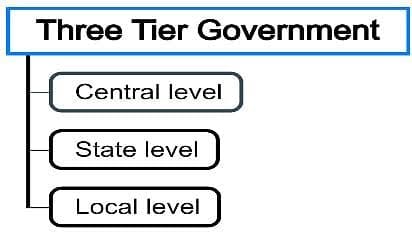
India is a federal republic divided into three levels of government: central, state, and local. Federalism is a form of governance in which authority and power are divided between a central authority and the country's component entities. There are two or more levels of governance in federalism. Following the adoption of the 73rd and 74th constitutional amendments, India now has a three-tiered government. A governing concept that outlines the relationship between the national government and its constituent entities at the state and local levels. This article explains the Three-tier Government which is important for UPSC Indian Polity Preparation.
|
Table of Contents |
What does a Three-tier government mean?
- Different tiers of government govern the same citizens, but each tier has its own jurisdiction in its own specific matters of legislation, taxation, and administration.
- The jurisdictions of the respective levels of government are explained in the Constitution. Therefore the existence and authority of every tier of government is constitutionally guaranteed.
- The Constitution originally provided for a two-tier system of government, the Union Government or what we call the Central Government, representing the Union of India and the State Government.
- Later, the third tier of federalism was also added in the form of Panchayats and Municipalities. Just like any federation, these different tiers enjoy separate jurisdiction.
- Four tiers of government systems generally provide Gram Parishad as a fourth tier, this type of government system can be seen in the Bangladeshi government.
- Five tier system of government is seen in the American federal system.
|
"India's three-tier system: Panchayats, Municipalities, and States, a symphony of governance harmonizing local empowerment with national vision."
|
Need for Three-tier Government in India
- The Government of India Act 1935 divided the government into Federal (Central) and Provincial levels.
- The division of powers on subjects such as the Federal List and the Provincial List in the 1935 Act gave way to Schedule 7 in the Constitution.
- However, there were a lot of residuary topics that were not covered in the concurrent list where both the central government and the states have the power to make laws and rules.
- Therefore, many committees set up by the government to look into granting powers to the grassroots levels such as the village Panchayats recommended another tier of government.
- The Balwant Rai Mehta Committee emphasized the need for “Democratic Decentralisation” and provided a framework for the third tier of government.
- Further committees like L M Singhvi Committee, GVK Rao Committee, and others emphasized on Constitutionalisation of Panchayat Raj for effective implementation of it and make grass root level democracy a reality.
Constitutional Provisions and Amendments
- Article 245 of the Indian constitution mentions that:
- Parliament has the authority to enact laws for extraterritorial operations as well as legislation for the entire country or any part of it.
- The state legislature has the authority to enact laws that apply to the entire state or just a portion of it.
- Thus both the Union as well as the states have their own territorial jurisdictions.
- Article 246 of the Indian constitution mentions that:
- Parliament has the exclusive authority to enact legislation on the topics listed in the union list (List I of the 7th schedule)
- The state has the authority to enact laws on the topics included in the state list (List II of the 7th schedule)
- Both the state and the union government have the authority to enact legislation on the topics included in the concurrent list (List III of the 7th schedule)
- Therefore, the legislative power is distributed by territory and a list of items in Schedule 7 of the Constitution.
- The 73rd Amendment Act, 1992 of the Constitution has added a new part IX consisting of 16 Articles and the Eleventh Schedule to the Constitution.
- The 73rd Amendment envisages the Gram Sabha due to the foundation of the Panchayat Raj System to perform functions and powers entrusted to it by the State Legislatures.
- It added Articles 243 to 243O.
- The 74th Amendment Act, 1992 of the Constitution has added a new part IX-A consisting of 18 Articles and the Twelfth Schedule to the Constitution.
- The 74th Amendment envisages the Municipalities and other urban local bodies due to the foundation of the Local bodies System to perform functions and powers entrusted to them by the State Legislatures.
- It added Articles 243P to 243ZG.
Significance of the Three-tier Government
Central Level
- A centralized body is required to make laws regarding issues that are common across the country such as defense, foreign relations, and allocation of common resources.
- The central government acts as a facilitator and the guardian for ensuring unity in the country.
State Level
- A state-level government is needed to ensure that issues that can be managed at the state level are legislated at that level and ensure there is a division of powers based on jurisdiction mentioned in Articles 245 and 246.
- Topics such as local infrastructure, health care, and Agriculture which can be legislated at the state levels are kept under the purview of the state governments.
Local Body Level
- Our Constitution recognizes the necessity for decentralization. There have been various attempts since then to decentralize authority to the level of villages and municipalities.
- Panchayats in villages and municipalities in urban areas have been established in all states. However, these were directly controlled by state governments.
- To construct development infrastructures, such as roads and transportation.
- To create and preserve community assets.
- Promote agricultural development through controlling and managing minor irrigation and water management, as well as soil conservation and land enhancement.
- To encourage social forestry and animal husbandry, as well as dairy and poultry production.
- To encourage the growth of village industries.
- Monitor and control education and health at the local level.
Challenges
- Overlapping Jurisdiction: The division of lists under Schedule 7 and Schedule 11 and 12 are not exclusive from each other. They consist of overlapping topics regarding topics such as the regulation of gambling and betting.
- Concurrent List: This list provides an upper hand in case there is legislation by both centers as well as the state on a particular topic.
- Residuary Powers: Once again the power lies with the centre regarding residuary power rather than adding it to the existing lists or envisaging equal powers to all three levels.
- Grass-Root Level is not so democratic: The Local bodies or the third tier depend on the states to devolve power as well as funds. This has made them dependent on states rather than act as a constitutional or independent body.
- Issue of Coordination: Ensuring effective coordination and communication between the central government and lower tiers can be a challenge, especially in large and diverse countries.
- Resource Allocation: Balancing the distribution of resources among regions and localities to address disparities and promote equitable development.
- Policy Consistency: Striving for consistency in policies that may affect different regions differently while considering local needs and priorities.
- Limited Resources: Local governments often face financial constraints, limiting their ability to provide essential services and infrastructure.
Conclusion
The Indian government is federal in nature, although it has certain characteristics of a unitary administration. The concept of separation of powers is adhered to by the Union, the states, and municipal bodies (varies by state), although not in the strict sense. The notion of power distribution is generally followed in India. As a result, India is a separate federal country. For convenience, it is referred to as a Quasi-Federal Country. Lower-tier bodies must be given additional authority to really embody the concepts of "Grass Root Democracy" and "Democratic Decentralisation."
FAQs
Q1: What is meant by the three-tier system of government in India?
Answer: The three-tier system of government in India refers to the division of governance into three levels: the central government, the state governments, and the local governments (panchayats and municipalities). This system ensures decentralization and better governance at all levels of administration.
Q2: Which constitutional amendments established the three-tier government system in India?
Answer: The 73rd and 74th Constitutional Amendments of 1992 established the three-tier system of government in India, empowering local self-governments at the rural (Panchayati Raj) and urban (Municipalities) levels.
Q3: What is the role of Panchayati Raj institutions in the three-tier system?
Answer: Panchayati Raj institutions function at the rural level and are responsible for local governance, planning, and development. They empower local communities to participate in decision-making and ensure the implementation of government schemes at the grassroots level.
Q4: How does the three-tier government system promote decentralization?
Answer: The three-tier government system promotes decentralization by delegating powers and responsibilities to local governments, enabling decision-making at the grassroots level. This ensures better governance, increased public participation, and efficient delivery of services.
Q5: What are the key features of the 73rd Constitutional Amendment related to the three-tier government?
Answer: The 73rd Constitutional Amendment introduced a three-tier Panchayati Raj system at the village, intermediate, and district levels, providing for direct elections, the establishment of Gram Sabhas, reservation of seats for SC/ST and women, and devolution of powers and responsibilities to the local bodies.
MCQs
- The three-tier system of government in India was established by which of the following amendments?
a) 61st and 62nd Amendments
b) 72nd and 73rd Amendments
c) 73rd and 74th Amendments
d) 75th and 76th Amendments
Answer: (C) See the Explanation
- What is the primary role of local self-governments under the three-tier system?
a) National defense
b) Local governance and development
c) International relations
d) Trade and commerce
Answer: (B) See the Explanation
- Which level of the three-tier government is responsible for governance in urban areas?
a) Gram Panchayat
b) Municipalities
c) State governments
d) Zila Parishad
Answer: (B) See the Explanation
- Which article of the Indian Constitution deals with the establishment of Panchayats?
a) Article 243
b) Article 324
c) Article 368
d) Article 79
Answer: (A) See the Explanation
- What is the minimum reservation percentage for women in Panchayati Raj institutions as per the 73rd Amendment?
a) 25%
b) 33%
c) 40%
d) 50%
Answer: (B) See the Explanation
GS Mains Questions and Model Answers
Q1: Discuss the significance of the three-tier system of government in promoting decentralization and local governance in India.
Answer: The three-tier system of government, established by the 73rd and 74th Constitutional Amendments, plays a vital role in promoting decentralization and local governance in India. It creates three levels of government—central, state, and local—empowering Panchayats and municipalities to govern at the grassroots level. By devolving powers to local self-governments, the system encourages public participation, strengthens democracy, and ensures efficient service delivery. This structure allows for the implementation of development projects tailored to local needs and priorities, making governance more responsive to citizens. The establishment of Gram Sabhas, reservation of seats for marginalized groups, and direct elections to local bodies further enhance inclusivity and accountability in governance.
Q2: Analyze the impact of the 73rd and 74th Constitutional Amendments on local governance in India.
Answer: The 73rd and 74th Constitutional Amendments have had a transformative impact on local governance in India by institutionalizing Panchayati Raj and Municipalities, respectively. These amendments provided constitutional recognition to local self-governments and devolved powers related to planning, development, and administration to these bodies. The amendments introduced direct elections to Panchayats and municipalities, established Gram Sabhas for village-level participation, and ensured the reservation of seats for women and marginalized communities. This has led to greater democratization at the grassroots level and improved the delivery of public services. Despite challenges such as lack of adequate funds and capacity, the amendments have empowered local governments to play a crucial role in rural and urban governance.
Q3: Evaluate the role of Panchayati Raj institutions in enhancing grassroots democracy and development in rural India.
Answer: Panchayati Raj institutions (PRIs) have significantly enhanced grassroots democracy and development in rural India by empowering local communities to participate in governance and decision-making processes. Established by the 73rd Constitutional Amendment, PRIs operate at three levels—village, intermediate, and district—ensuring a decentralized approach to governance. They are responsible for implementing development programs, maintaining public infrastructure, and promoting social justice. The direct election of members, along with provisions for women and SC/ST representation, has made PRIs more inclusive. Additionally, Gram Sabhas provide a platform for villagers to voice their concerns and influence decision-making. However, challenges such as inadequate financial resources, capacity constraints, and political interference continue to limit the full potential of PRIs in driving rural development.
Previous Year Questions on Three-tier Government
1. UPSC CSE 2017
Question: Discuss the significance of the 73rd and 74th Constitutional Amendments in empowering local self-government institutions in India.
Answer: The 73rd and 74th Constitutional Amendments of 1992 hold great significance in empowering local self-government institutions in India. These amendments provided constitutional status to Panchayati Raj institutions (PRIs) and urban local bodies (Municipalities), ensuring their autonomy and functionality. By introducing direct elections, reservation of seats for women and marginalized groups, and granting powers related to planning and development, the amendments transformed the structure of local governance. They facilitated grassroots democracy, enabling citizens to participate directly in governance through Gram Sabhas and municipal bodies. Furthermore, the devolution of funds, functions, and functionaries empowered these institutions to play a crucial role in local administration. These reforms have strengthened local governance, although challenges such as inadequate financial resources and capacity-building still persist.
2. UPSC CSE 2018
Question: Analyze the role of local self-government institutions in promoting decentralized development in India.
Answer: Local self-government institutions, including Panchayati Raj institutions (PRIs) and urban local bodies (Municipalities), are key drivers of decentralized development in India. These institutions bring governance closer to the people by allowing local communities to participate in decision-making and development processes. Through the 73rd and 74th Constitutional Amendments, these bodies have been empowered with responsibilities related to planning, implementation of schemes, and maintenance of public infrastructure. Decentralization ensures that development is aligned with local needs, leading to more efficient service delivery and resource utilization. Local governments also play a vital role in promoting social justice by ensuring representation of marginalized groups. However, the effectiveness of local self-government institutions in promoting decentralized development is often limited by financial constraints, administrative inefficiencies, and political interference, which require continuous reform and capacity-building efforts.
*email: contactus@prepp.in
Download the PREPP App and attempt FREE IAS Exam Mock Tests and get complete study material!

Full Test - 04: UPSC CSE Prelims CSAT (Paper-II)
Full Test - 03: UPSC CSE Prelims CSAT (Paper-II)
UPSC CSE Prelims 2026 GS Paper 1 Question Paper (24-May-2026)
UPSC CSE Prelims 2026 CSAT Paper 2 Question Paper (24-May-2026)

17 February 2025 | The Hindu Must Read Articles | Current Affairs

16 February 2026 | The Hindu Must Read Articles | Current Affairs

13 February 2026 | The Hindu Must Read Articles | Current Affairs









Comments