Federal and Unitary Features of Indian Constitution - Indian Polity Notes
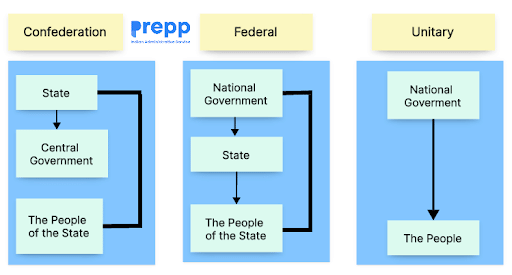
Indian Constitution provides for a federal system with a unitary bias. The Union List subjects are governed by the Central government, whereas the State List is governed by the states. States in India, unlike states in the United States, do not have the power to write their own constitutions. The term "unitary bias" comes from the fact that the Central Government has residuary powers.

The Indian federal system is based on the Canadian model. The UPSC Indian Polity and Governance Syllabus include the Federal Features and Unitary Features of the Indian Constitution. In this article, we will discuss Federal Features as well as some Unitary features.
|
Table of Contents |

|
Indian Constitution leans in favour of a strong Centre, a feature that militates against the concept of strong federalism.
|
Federal Features - Indian Constitution
The federal features of the Constitution of India are given below:
Written Constitution:
Features of the Indian Constitution is not only a written document but also the longest constitution in the world. It specifies the structure, organisation, powers and functions of both the central and state governments and prescribes the limits within which they must operate. Thus, it avoids misunderstandings and disagreements between the two.
Dual Polity:
The constitution establishes a dual polity that includes the union at the centre and states at the periphery. Each is endowed with sovereign powers to be exercised in the field assigned to them respectively by the Constitution.
Bicameralism:
The constitution provides for a bicameral legislature in which an upper house (Rajya Sabha) and a lower house (Lok Sabha). Rajya Sabha represents the states of the Indian Union, whereas The Lok Sabha represents the people of India as a whole.
Division of Powers:
The Constitution divided the powers between the Center and the states in terms of the Union List, State List, and Concurrent List in the Seventh Schedule.
Supremacy of the Constitution:
The Constitution is the supreme law of the country. The laws made by the Center and the states should be in conformity with Provision. Otherwise, they may be declared invalid by the Supreme or High Court through its power of judicial review.
Rigid Constitution:
The division of powers established by the Constitution as well as supremacy of the constitution can be maintained only if the method of its amendment is rigid. It is necessary for both houses to agree to amend the constitution. Federal provisions can be amended only by special majority of the parliament along with the approval of half of the state legislatures.
Independent judiciary:
The constitution establishes an independent judiciary headed by the Supreme Court for two purposes: one, to protect the supremacy of the constitution, and two, to settle the disputes between the Centre and states or between the states.
Unitary features - Indian Constitution
Besides the above federal features, the Indian constitution also possesses the following unitary features:
Strong Centre:
The division of powers is in favor of the center and unequal from a federal point of view. Firstly, the Union list contains more subjects than the state list, secondly, the more important subjects have been included in the union list and the Centre has overriding authority over the concurrent list.
Single constitution:
The constitution of India embodies not only the constitution of the Centre but also those of the states. Both the Centre and the States must operate within this single frame.
States not indestructible:
Unlike in other federations, the states in India have no right to territorial integrity. The parliament can change the area, boundaries, or name of any state.
Emergency provisions:
The emergency provisions are contained in Part XVIII of the Constitution of India, from Articles 352 to 360. In the emergency provisions, the central government becomes all-powerful and the states go into total control of the Centre.
Single citizenship:
Single citizenship means one person is a citizen of the whole country. The constitution deals with citizenship from Articles 5 and 11 in Part 2.
All India services:
In India, there are all India services [IAS, IPS and IFS] which are common to both the Centre and the states. These services violate the principle of federalism under the Constitution. The members of these services are recruited and trained by the Centre which also possess ultimate control over them.
Appointment of governor:
The governor is appointed by the president. He also acts as an agent of the Centre. Through him, the Centre exercises control over the states.
Integrated election machinery:
The election commission conducts elections for central and state legislatures. But the Election Commission is constituted by the president and the states have no say in this matter.
No equality of state representation:
The states are given representation in the upper house on the basis of population. Hence, the membership varies from 1 to 31.
Integrated Judiciary:
The term Integrated Judiciary refers to the fact that rulings made by higher courts bind lower courts. The Supreme Court of India incorporates all lower courts, from the Gram Nyayalayas to the High Courts. The Supreme Court is at the very top.
Integrated Audit Machinery:
The Comptroller and Auditor-General of India has an organization that is run by officials from the Indian Audit and Account Services, a central service that is responsible for not just the Union Government's accounts and auditing, but also the accounts and auditing of the States. CAG’s appointment and removal is done by President without consulting the states.
Veto Over State Bills:
The governor has the authority to hold certain types of bills passed by the state legislature for presidential consideration. The President has the authority to refuse to sign such bills not only in the first instance but also in the second. As a result, the President has absolute (rather than suspensive) veto power over state legislation. However, in the United States and Australia, states are independent within respective fields, and no such reservation exists.
From the above, it is clear that India has deviated from the traditional federal systems like the USA and incorporated a large number of unitary features, tilting the balance of power in favor of the Centre. K C where described the constitution of India as “quasi-federal”.
Supreme Court Important Decision Related To Federal And Unitary Features Of Indian Constitution - System Of Government
In S R Bommai case 1994, the Supreme Court laid down that the constitution is federal and characterized federalism as its ‘basic features’. In the Bommai case SC said that states have an independent constitutional existence. They are not satellites or agents of the Centre. Within the sphere allotted to them, the states are supreme.
In Kuldeep Nayyar vs Union of India, the Supreme Court held that federalism is a fundamental feature of the Constitution of India and is unique in its nature and is tailored to the specific needs of the country.
Conclusion
The framers recognized the unparalleled diversity within India, absent in any other federal system. They acknowledged the need for a cohesive force to bind the distinct powers of individual units, preventing administrative collapse. Simultaneously, a system of checks on the central government's authority was crucial, achieved through the delegation of powers to states for managing their internal affairs. The uniqueness of the Indian Constitution lies in its innovative blend of unitary and federal characteristics, coining the term "union of states" to aptly describe its distinctive nature.
|
|
|
|---|---|
| Indian Polity UPSC Notes | Federal Features of the Constitution |
| Unitary Features of Indian Constitution | Parliamentary System |
| Federal System | Centre-State Relations |
| Inter-State Relations | Comparing Features of Federal and Unitary Governments |
FAQs
Question: What is the federal structure of the Indian Constitution?
Answer: The Indian Constitution provides for a federal system where powers are divided between the central and state governments. It follows a dual structure of governance.
Question: What are the unitary features of the Indian Constitution?
Answer: Unitary features include a strong central government, the power of the center to intervene in state matters, single citizenship, and an integrated judiciary.
Question: How does the Indian Constitution balance federalism and unity?
Answer: The Constitution balances federalism with a strong unitary bias to maintain national unity, especially in times of emergency, while allowing state autonomy.
Question: Which part of the Constitution outlines the division of powers?
Answer: The Seventh Schedule of the Indian Constitution outlines the division of powers between the Union and State governments through three lists: Union, State, and Concurrent.
Question: How does the Constitution ensure the supremacy of the central government?
Answer: The Constitution gives the central government control over key areas like defense, foreign affairs, and communications, ensuring national interests take precedence.
MCQs
- Which of the following is a federal feature of the Indian Constitution?
a) Single citizenship
b) Division of powers between the center and states
c) Appointment of Governors by the President
d) Integrated judiciary
Answer: (B) See the explanation
Division of powers between the Union and state governments is a hallmark of federalism. Other features like single citizenship and an integrated judiciary show the unitary bias of the Constitution.
- Which schedule of the Indian Constitution deals with the division of powers between the Union and States?
a) Fifth Schedule
b) Seventh Schedule
c) Tenth Schedule
d) Sixth Schedule
Answer: (B)See the explanation
The Seventh Schedule contains three lists (Union, State, and Concurrent) that define the subjects under the jurisdiction of the Union and state governments.
- Which of the following is NOT a unitary feature of the Indian Constitution?
a) Appointment of Governors by the central government
b) Flexibility of the Constitution
c) Bicameral legislature at the center
d) Single citizenship
Answer: (C) See the explanation
Bicameralism refers to having two houses in Parliament, which is a feature of federalism to ensure representation of states at the central level.
- Which Article empowers the Parliament to legislate on a subject in the State List during a national emergency?
a) Article 249
b) Article 356
c) Article 368
d) Article 352
Answer: (A) See the explanation
Article 249 allows Parliament to legislate on state subjects if the Rajya Sabha passes a resolution declaring it necessary in the national interest.
- The Indian Constitution is often described as "quasi-federal." This means it:
a) Has no federal features
b) Is entirely unitary
c) Combines federal and unitary characteristics
d) Is fully federal
Answer: (C) See the explanation
India’s Constitution is often called quasi-federal because, while it has federal features like the division of powers, it also has strong unitary elements, especially during emergencies.
GS Mains Questions and Model Answers
Q 1: Examine the federal structure of the Indian Constitution and how it balances the power between the center and the states.
Answer: The Indian Constitution divides powers between the center and states through the Seventh Schedule. Federal features include an independent judiciary, a bicameral legislature, and elected state governments. However, the unitary features—such as the center's ability to legislate on state matters during emergencies and appoint governors—ensure national unity, balancing federalism and central authority.
Q 2. Discuss the role of the Seventh Schedule in maintaining the federal character of the Indian Constitution.
Answer: The Seventh Schedule divides legislative subjects into three lists—Union, State, and Concurrent—ensuring that the center and states have distinct areas of governance. While the Union List grants the center significant powers over national issues like defense and foreign policy, the State List preserves state autonomy over local matters such as police and public health, maintaining a federal structure.
Q 3. Analyze how the emergency provisions in the Indian Constitution impact its federal nature.
Answer: The emergency provisions under Articles 352, 356, and 360 allow the center to assume greater control during times of crisis. These provisions can temporarily convert the federal system into a unitary one, overriding state autonomy. While this ensures national security and stability, it can weaken the federal balance, especially if misused for political purposes.
Previous Year Questions on Federal and Unitary Features of Indian Constitution
1. UPSC CSE Mains 2017 (GS Paper 2):
Question: Discuss the federal and unitary features of the Indian Constitution and how they maintain the balance between the two.
Answer: The Indian Constitution balances federalism with a unitary bias. Federal features include the division of powers, bicameralism, and an independent judiciary. Unitary features include a strong center, single citizenship, and the central government's ability to intervene in state matters during emergencies. This quasi-federal structure allows flexibility for national unity while preserving state autonomy.
2. UPSC CSE Mains 2018 (GS Paper 2):
Question: What makes the Indian Constitution flexible yet federal in nature?
Answer: The Indian Constitution is flexible because it allows for amendments under Article 368, enabling changes to adapt to evolving needs. However, it retains federalism through the distribution of powers between the center and states under the Seventh Schedule, while maintaining a strong unitary structure during emergencies or national crises.
3. UPSC CSE Prelims 2016:
Question: The Indian Constitution provides for:
A. Unitary form of government
B. Federal form of government
C. Quasi-federal form of government
D. Confederal form of government
Answer: C
India is described as quasi-federal because the Constitution has both federal and unitary features. It divides powers between the center and the states but allows strong central authority in times of national interest or emergency.
*email: contactus@prepp.in
Download the PREPP App and attempt FREE IAS Exam Mock Tests and get complete study material!

Full Test - 04: UPSC CSE Prelims CSAT (Paper-II)
Full Test - 03: UPSC CSE Prelims CSAT (Paper-II)
UPSC CSE Prelims 2026 GS Paper 1 Question Paper (24-May-2026)
UPSC CSE Prelims 2026 CSAT Paper 2 Question Paper (24-May-2026)

17 February 2025 | The Hindu Must Read Articles | Current Affairs

16 February 2026 | The Hindu Must Read Articles | Current Affairs

13 February 2026 | The Hindu Must Read Articles | Current Affairs









Comments