Inter-State Council (Article 263) - Indian Polity Notes
Inter-State Council was established under Article 263 of the Constitution through a Presidential Order on 28th May 1990. It is a mechanism which was constituted to support Centre-State and Inter-State coordination and cooperation. The members of the Inter-State Council consist of Chief Ministers of all states, Chief Ministers of Union Territories having a Legislative Assembly and Administrators of UTs not having a Legislative Assembly. The UPSC Indian Polity and Governance Syllabus includes Inter-State Council – Inter-State Relations which is described in this article.
|
Table of Contents |
Inter State Council - Constitutional Provisions
- The power of the President to set up Inter-State Councils may be exercised not only for advising upon disputes, but also for the purpose of investigating and discussing subjects in which some or all of the States or the Union and one or more of the States, or the Union have a common interest for the better coordination of policy and action.
- The Inter-State Council was established under Article 263 of the Constitution through a Presidential Order in 1990 following the recommendations of the Sarkaria Commission.
- The Inter-State Council is a constitutional body.
- While Article 131 allows for the judicial resolution of interstate conflicts by vesting the Supreme Court with exclusive authority.
- Article 262 provides for the adjudication of one such type of issue by an extrajudicial tribunal.(Inter-state river water disputes)
- While Article 263 provides for the prevention of inter-State disputes by investigation and recommendations by an administrative body.
|
Inter-state Council is a mechanism which was constituted to support Centre-State and Inter-State coordination and cooperation.
|
Inter State Council - Composition
- The council is chaired by the prime minister.
Its members include:
- Chief Ministers of the States & Union territories having Legislative Assemblies.
- Administrators of Union territories do not have Legislative Assemblies.
- Governors of States under President's Rule.
- Six Ministers of Cabinet rank in the Union Council of Ministers to be nominated by the Prime Minister and two Ministers of Cabinet rank in the Union Council of Ministers to be nominated by the Prime Minister as permanent invitees.
How is the Inter-State Council different from the GST Council & Finance Commission?
- GST Council Comprised of finance ministers from both the central and state governments.whereas the Inter-State Council Consists of chief ministers and heads of UTs.
- Finance Commission comprises technocrats and experts in finance.
- While the GST Council focuses on GST-related matters and the Finance Commission on fiscal allocations, the Inter-State Council primarily addresses disputes between states and fosters collaboration on common interests.
|
|
|
|---|---|
| Inter-State Water Disputes | Zonal Councils |
| Legislative Relations | Trends in Centre-State Relations |
| Financial Relations | Administrative Relations |
Duties of Inter-State Council
- According to Article 263, President can establish Inter-State Council if deemed necessary in the public interest.
- Investigate and advise on potential disputes between States
- To inquire into and discuss matters of common interest to some or all States or Union to one or more States.
- Make recommendations on any such issue, especially recommendations for better coordination of policy and action on any specific issue.
- Acts as a tool for cooperation, coordination and the evolution of public policy.
Current Status of Inter-State Council
- Interstate council has been constituted with the objective of discussing or investigating policies, subjects of common interest, and disputes among states.
- The interstate council is proposed to meet thrice a year. Inter-State Council has had just 12 meetings since it was set up in 1990. There was a gap of a decade between the 10th meeting in 2006 and the 11th meeting in 2016, and the council met again in 2017.
Meeting of Inter-State Council
- Inter-State Council was established on the recommendations of the Sarkaria Commission.
- The Standing Committee of Inter-State Council comprises the Union Home Minister as the Chairman and five Union ministers of Cabinet rank and nine chief ministers as members nominated by the Chairman.
10th meeting of the Inter-State Council
The 10th meeting of the Inter-State Council was held in 2006. The UPA government had convened just two meetings in its 10-year tenure.
11th meeting of the Inter-State Council
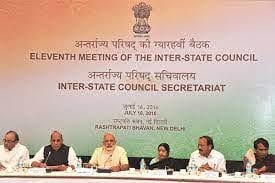
- The 11th meeting of the Inter-State Council was held in 2016 under the Chairmanship of the Prime Minister at Rashtrapati Bhawan, New Delhi. The following Agenda items were discussed:
- Consideration of the recommendations of the Punchhi Commission on Centre-State Relations.
- Use of Aadhaar as an identifier for providing subsidies; benefits and public services.
- Improving Quality of Education with a focus on improving learning outcomes, incentivizing better performance, etc.
- Internal Security with focus on intelligence sharing and coordination for combating Terrorism/Insurgency and Police Reforms & Police Modernization
Other Types of Council
Zonal Council
The idea of creation of Zonal Councils was mooted by the first Prime Minister of India, Pandit Jawahar Lal Nehru in 1956 when during the course of debate on the report of the States Reorganisation Commission, he suggested that the States proposed to be reorganized may be grouped into four or five zones having an Advisory Council “to develop the habit of cooperative working” among these States.
*To know about Zonal Councils click this link Zonal Councils - Inter State Relations-Indian Polity UPSC Notes
National Development Council
- It was set up in 1952.
- It is an apex body for decision-making and deliberations on development matters.
- It is presided over by the Prime Minister of India and comprises of Union Ministers, Chief Ministers of all the States and UTs, Administrators of Union Territories and Members of Planning Commission.
- The functions of the Council are:
- To prescribe guidelines for the formulation of the National Plan including the assessment of resources for the Plan;
- To consider the National Plan as formulated by the Planning Commission;
- To consider important questions of social and economic policy affecting national development;
- To review the working of the Plan from time to time and recommend such measures as are necessary for achieving the aims and targets set out in the National Plan.
Conclusion
The grim reality is that the Inter-State Council has only met 12 times since its establishment in 1990. The council met in November 2017 after a ten-year hiatus. If the Inter-State Council is to become an effective organization for resolving inter-state conflicts, it must first establish a regular meeting schedule.
|
|
|
|---|---|
| Indian Polity UPSC Notes | Parliamentary System |
| Federal System | Centre-State Relations |
| Inter-State Relations | Comparing Features of Federal and Unitary Governments |
| State Legislature | State Government |
FAQs
Question: What is the Inter-State Council?
Answer: The Inter-State Council is a constitutional body established under Article 263 of the Indian Constitution. It serves as a forum for discussing policies, conflicts, and matters of common interest between the central and state governments.
Question: What are the main functions of the Inter-State Council?
Answer: The Inter-State Council's functions include investigating inter-state disputes, making recommendations for better coordination, and discussing common policies. It aims to foster cooperation among states and between the center and states.
Question: Who chairs the Inter-State Council?
Answer: The Inter-State Council is chaired by the Prime Minister of India, with members including chief ministers of all states and union territories with legislatures, as well as central ministers nominated by the Prime Minister.
Question: How often does the Inter-State Council meet?
Answer: Although it is recommended for the council to meet annually, its meetings have historically been infrequent, often held based on necessity rather than a regular schedule.
Question: What was the role of the Sarkaria Commission regarding the Inter-State Council?
Answer: The Sarkaria Commission recommended the establishment of the Inter-State Council to facilitate coordination and resolve inter-state disputes. It was constituted in 1990 based on these recommendations.
MCQs
1. The Inter-State Council was established under which Article of the Constitution?
A) Article 262
B) Article 131
C) Article 263
D) Article 312
Answer: (C) See the Explanation
Explanation: Article 263 of the Indian Constitution provides for the establishment of an Inter-State Council to facilitate coordination among states and between the center and states.
2. Who is the Chairperson of the Inter-State Council?
A) President of India
B) Prime Minister
C) Chief Justice of India
D) Home Minister
Answer: (B) See the Explanation
Explanation: The Inter-State Council is chaired by the Prime Minister, as per the constitutional setup for managing inter-state relations.
3. Which Commission recommended the establishment of the Inter-State Council?
A) Sarkaria Commission
B) Punchhi Commission
C) Rajamannar Committee
D) Fazl Ali Commission
Answer: (A) See the Explanation
Explanation: The Sarkaria Commission recommended setting up the Inter-State Council to improve center-state and inter-state coordination.
4. What is one of the main functions of the Inter-State Council?
A) Adjudicating inter-state disputes
B) Investigating and advising on inter-state matters
C) Controlling state budgets
D) Appointing governors
Answer: (B) See the Explanation
Explanation: The Inter-State Council investigates and advises on disputes and policies that involve multiple states or the center and states.
5. How frequently is the Inter-State Council expected to meet?
A) Once a year
B) Once every five years
C) Monthly
D) As needed
Answer: (A) See the Explanation
Explanation: Although the council is expected to meet annually, meetings have been irregular and infrequent, often based on necessity.
GS Mains Questions and Model Answers
Q1: Describe the composition and significance of the Inter-State Council in India. How does it facilitate inter-state and center-state relations?
Answer: The Inter-State Council, under Article 263, is chaired by the Prime Minister and includes chief ministers, UT heads, and Union Cabinet Ministers. It addresses inter-state issues, fosters coordination, and ensures policy alignment between the center and states. By offering a forum for dialogue, it promotes collaborative solutions to disputes, supporting federal harmony and enhancing policy coherence across India's diverse states, crucial for India's federal structure.
Q2: Evaluate the role of the Inter-State Council in resolving inter-state disputes. How effective has it been in recent years?
Answer: The Inter-State Council aims to mitigate disputes through cooperative discussion, focusing on issues impacting multiple states or involving the center. Although its creation was pivotal, its efficacy has been limited by infrequent meetings and implementation issues. Recent calls for more regular engagement reflect the need for an active, solution-oriented council to fulfill its mandate of fostering federal unity effectively.
Q3: Discuss the recommendations of the Sarkaria Commission regarding the Inter-State Council. Why were these recommendations significant?
Answer: The Sarkaria Commission emphasized the Inter-State Council's role in resolving disputes and enhancing center-state relations. It recommended a structured platform for regular dialogue on policies affecting all states, fostering unity. This vision underlines the council’s critical role in strengthening India's federalism, particularly as economic and social policies require inter-state coordination to achieve cohesive national growth.
Previous Year Questions on Inter-State Council
1. UPSC CSE Prelims 2020:
Question: Under which Article is the Inter-State Council established in India?
A) Article 261
B) Article 262
C) Article 263
D) Article 264
Answer: (C)
Explanation: Article 263 provides for the establishment of the Inter-State Council, tasked with investigating and advising on inter-state disputes and matters of common interest.
2. UPSC CSE Mains 2021 (GS Paper 2):
Question: "Assess the effectiveness of the Inter-State Council as a mechanism for promoting cooperative federalism in India."
Answer: The Inter-State Council has fostered dialogue and policy alignment, supporting cooperative federalism. However, infrequent meetings and limited execution have affected its potential. Strengthening the council's role and regularizing its meetings could enhance its impact in promoting effective federalism and addressing inter-state conflicts.
*email: contactus@prepp.in
Download the PREPP App and attempt FREE IAS Exam Mock Tests and get complete study material!

Full Test - 04: UPSC CSE Prelims CSAT (Paper-II)
Full Test - 03: UPSC CSE Prelims CSAT (Paper-II)
UPSC CSE Prelims 2026 GS Paper 1 Question Paper (24-May-2026)
UPSC CSE Prelims 2026 CSAT Paper 2 Question Paper (24-May-2026)

17 February 2025 | The Hindu Must Read Articles | Current Affairs

16 February 2026 | The Hindu Must Read Articles | Current Affairs

13 February 2026 | The Hindu Must Read Articles | Current Affairs









Comments