Trends in Centre-State Relations - Indian Polity Notes
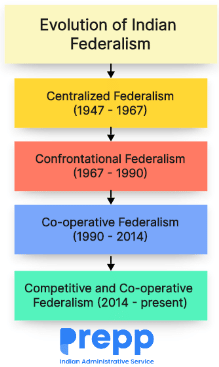
The evolution of Center-State Relations can be split into four separate periods, the first phase began in 1950 and continued for 17 years, and the final phase began in 1989 and is still ongoing.
In 1983, the Indian government created the Sarkaria Commission to resolve disagreements between the Central Government and the State Governments.
The founders of the Indian Constitution envisioned a strong centre and federalism as a functional tool for the establishment of an Indian nation and a strong bonding state. The UPSC Indian Polity and Governance Syllabus includes Trends in Centre-State Relations which is described in this article.
The study of this period can be divided into four phases at various time intervals.
- The early phase (1950-67)
- The second phase(1967-77)
- The third phase (1977-89)
- The final phase (1989-onwards)
|
Table of Contents |
Trends In Centre-State Relations - The Early Phase (1950-67)(Central Dominance)
- This phase was completely dominated by the Centre where the Party system was perhaps the most important intervening aspect that has a significant impact on the functioning of a federal political system.
- The Congress party, under Nehru's charismatic leadership, dominated both at the centre and in the states throughout this period.
- The conflicts in center-state relations were settled at the leadership level as an internal affair.
- The Planning Commission and the National Development Council (NDC) were the Centre's vehicles of state supremacy, both constituted by executive resolutions.
- The Planning Commission was tasked with regulating social services such as education, medicine, health, agriculture, collaboration, social welfare, and industrial housing, all of which were state subjects.
- The NDC was viewed as a testing of cooperative federalism.
- The Indian National Congress formalized the concept of consultation, accommodation, and consensus for balancing rivals within the system.
- As a result, both the legitimacy of the provincial authority structure in administering its affairs and the function of Central mediation are safeguarded.
- As a result, the first phase of Indian Federalism was characterized by central dominance over the states, which even surrendered part of their powers to the centre.
- The Zonal Councils were established as advisory organizations under the States Reorganization Act to enhance cooperative federalism in the development of standard policies in socioeconomic concerns.
- They were, however, constituted within the framework of a system of central dominance over the states.
|
The evolution of Center-State Relations can be split into four separate periods, the first phase began in 1950 and continued for 17 years, and the final phase began in 1989 and is still ongoing. |
Trends In Centre-State Relations - The Second Phase(1967-77) 42nd Constitutional Amendment
- The fourth general election changed the country's federal dynamics drastically, reducing the Congress party's massive majority to a mere majority at the centre while losing over half of the Indian states to the opposition or coalitions.
- It resulted in a significant shift in the nature of the relationship between the centre and the states.
- The growth of assertiveness on the part of states, and the center's response to such assertiveness by proving its effective power, marked this era.
- The Congress party attempted to reclaim political power by manipulating defections and using every other available means, including Article 356.
- For ex: In the case of Rajasthan, the Governor advocated imposing the president's rule to prevent the formation of a government by a coalition of opposition parties. The Assembly has been adjourned. Meanwhile, defections were managed by the Congress party, which eventually constituted the government.
- The Union-state struggle reached its apex between 1967 and 1971 where the government even refused to acknowledge non-Congress state government's assertions of rights.
- However, the most important element during this time was the emergence of regional forces to fill the void left by the Congress party's downfall.
- Mrs. Gandhi exploited Congress supremacy to strengthen the centre, and the controversial 42nd Amendment to the Constitution strengthened the centre at the expense of the states. This path of centralization culminated in the terrible Emergency of 1975-77.
| Other Relevant Links | |
|---|---|
| Anandpur Sahib Resolution | Rajamannar Committee |
| Punchhi Commission | Sarkaria Commission |
Trends In Centre-State Relations - The Third Phase (1977-89) Sarkaria Commission
- For the first time since independence, the Congress lost power at the centre in the 1977 election which brought Janata Party to power.
- Janata Party advocated for decentralisation of economic and political authority.
- However, the government's first step was to dissolve nine state governments headed by the Congress, claiming that they had lost people's trust as evidenced by their performance in the 10th Lok Sabha elections.
- The 44th Amendment Act also repealed Article 357(A), which allowed the central government to deploy the army and paramilitary forces to cope with any serious law and order issue in the states.
- In the 1980 midterm elections, Congress regained control and dismissed the Janta party governments in nine states, citing the same bogus rationale as its predecessor.
- Regional parties demanding more autonomy formed governments in numerous states, including Andhra Pradesh, Tamil Nadu, Karnataka, West Bengal, and others.
- To support the desire for additional autonomy, the four southern states announced the formation of a regional council.
- As a result of all of this, the Sarkaria Commission was established to investigate the center-state relationship.
- Due to political imperatives, the Rajiv Gandhi government attempted to form alliances with regional parties, as shown in the Rajiv-Longwal pact and the Assam accord.
- He also attempted to concentrate power by convening a meeting of District Magistrates to deal directly with them, thus circumventing state administrations.
- He did the same thing when he introduced the Panchayati Raj Bill and the Jawahar Rojgar Yojana.
Trends In Centre-state Relations - The Final Phase (1989-onwards)(multiparty System Era)
- The general election of 1989 was a major turning point in Indian politics, bringing a new age of multiparty politics and beginning off the path of further federal principle.
- With the defeat of the Congress party, this election marked the end of one-party rule at the centre and the start of a coalition administration.
- Regional parties became an important part of the federal cabinet and began to exert themselves more forcefully at the national level.
- This trend of greater federal principle can be categorised into: Political Federalism and Economic Federalism.
Political Federalism
- The introduction of the multiparty system ushered in a revolutionary transformation in Indian politics that has continued since then.
- Although in 1989 elections, no single political party has been able to win a clear majority in the centre, hence coalition and minority governments have become the trend.
- Regional parties have become an integral part of every coalition cabinet and, as a result, have begun to play a prominent role.
- Over the past half-century of coalition and minority governments, regional parties such as Tamil Nadu's DMK and Bihar's RJD have asserted their interests more openly.
- The regional leaders now have a greater influence in policy decisions and aligning national priorities with their regional interests as a result of the coalition era.
- The multiparty system that has replaced the Congress as the once-dominant party has developed a similar institutional way of regional conflict resolution within a national framework, despite the decline of the Congress as the once-dominant party.
- The federal cabinet, on the other hand, has diverged from the traditional Westminster model, which was characterized by fragmentation and a weakening of the principle of collective responsibility.
Frictional Areas In Centre-state Relations
- Administration of All-India Services (IAS, IPS, and IFS).
- Utilization of electronic media for political ends.
- Appointment of inquiry commissions into the chief ministers' conduct;
- Financial sharing between Centre and states.
- The Centre's encroachment on the State List.
- Mode of governor appointment and removal.
- Governors' discriminatory and partisan conduct.
- Imposition of the President's Rule for political purposes.
- Central forces deployed in states to preserve law and order.
- Discrimination in state financial allocations.
- Misuse of Central agencies like CBI,ED etc.
Committees
- Administrative Reforms Commission (ARC)
In 1966, the Central Government appointed a six-member ARC chaired by Morarji Desai and submitted its final report in 1969 with 22 Recommendations. The most important recommendations are as follows:
- Creation of an Inter-State Council under Article 263 of the Constitution.
- Appointment of governors with vast experience in public life and administration, as well as a nonpartisan approach.
- Transferring greater financial resources to the states in order to minimize their reliance on the Centre.
- Sarkaria Commission
In 1983, the Central Government appointed a three-member commission chaired by S Sarkaria. The most important recommendations are as follows:
- The institution of All-India Services should be strengthened more, and more such services should be created.
- When the president refuses to sign state bills, the grounds for his decision should be notified to the state administration.
- Under Article 263, a permanent Inter-State Council should be established.
- Before passing legislation on a Concurrent List item, the Centre should confer with the states.
- The Centre should have the authority to deploy its military forces without the permission of the states. However, it is preferable if the states are consulted.
- Punchhi Commission
In 2007, the Central Government appointed a commission chaired by M. Punchhi and submitted its reports in 2010. The most important recommendations are as follows:
- Recommendations for the 73rd and 74th amendments, as well as the Sixth Schedule.
- Recommendations regarding environmental concerns and resource sharing, particularly with regard to rivers and minerals
- When the president refuses to sign a state legislation bill, the reasons for his decision must be communicated to the state government within six months.
- The individual appointed as Governor shall not have been involved in active politics, even at the local level, for at least a couple of years prior to his appointment.
- For the post of Governor, the doctrine of pleasure should be repealed and the constitution amended. The governor should not be removed at the discretion of the Union government.
Conclusion
The Supreme Court ruled in SR Bommai vs Union of India (1994) that federalism is an element of the Constitution's basic framework. However, because of the strong unitary inclination and, in particular, the way it has evolved over time, many constitutional scholars refer to Indian federalism as a "federation without federalism," "a Union of Unequal States," or "Quasi-Federal In Nature."
| Other Relevant Links | |
|---|---|
| Indian Polity UPSC Notes | Legislative Relations |
| Financial Relations | Administrative Relations |
| Indian Parliament | Parliamentary System |
| Federal System | Centre-State Relations |
FAQs
Question: What are the three types of Centre-State relations in India?
Answer: The three types of Centre-State relations in India are Legislative relations, Administrative relations, and Financial relations. These categories define the division of powers and responsibilities between the central and state governments.
Question: What is the role of Article 356 in Centre-State relations?
Answer: Article 356, also known as President's Rule, allows the Centre to take control of a state's administration if it is deemed that the government of the state cannot be carried out in accordance with the provisions of the Constitution. However, its misuse in the past has led to criticism and demands for its reform.
Question: How does the Finance Commission affect Centre-State financial relations?
Answer: The Finance Commission is a constitutional body that determines the distribution of tax revenues between the Centre and the States. It recommends how funds should be allocated to maintain a fiscal balance and ensure equitable distribution of resources across states.
Question: What is the concept of cooperative federalism?
Answer: Cooperative federalism refers to the collaborative relationship between the Centre and the States, where both levels of government work together to formulate policies and implement national schemes. Institutions like the GST Council and NITI Aayog reflect this principle.
Question: What role does the Inter-State Council play in Centre-State relations?
Answer: The Inter-State Council, established under Article 263 of the Indian Constitution, is a platform for dialogue and coordination between the Centre and the States. It helps resolve inter-state disputes and promote cooperation on various policy matters.
MCQs
1. Which Article of the Indian Constitution allows the imposition of President's Rule in a state?
A) Article 352
B) Article 356
C) Article 360
D) Article 365
Answer: B See the Explanation
Explanation: Article 356 allows the Centre to impose President's Rule in a state if it is unable to function according to constitutional provisions. This has been a contentious issue in Indian politics, as it has sometimes been used to dismiss state governments.
2. Which institution is responsible for determining the distribution of taxes between the Centre and States?
A) Finance Commission
B) Planning Commission
C) NITI Aayog
D) National Development Council
Answer: A See the Explanation
Explanation: The Finance Commission, established under Article 280 of the Constitution, recommends the distribution of tax revenues between the Centre and States to ensure equitable financial relations and balanced development.
3. Which body reflects the principle of cooperative federalism in India?
A) NITI Aayog
B) Rajya Sabha
C) Central Vigilance Commission
D) Supreme Court
Answer: A See the Explanation
Explanation: NITI Aayog is an institution that embodies cooperative federalism by providing a platform where the Centre and the States work together on policy matters, unlike its predecessor, the Planning Commission, which was more centralised.
4. What is the primary function of the Inter-State Council?
A) Resolve disputes between states
B) Allocate taxes
C) Implement national policies
D) Appoint judges
Answer: A See the Explanation
Explanation: The Inter-State Council, created under Article 263, helps resolve disputes between states and facilitates cooperation between the Centre and the States on matters of common interest.
5. Which amendment is known for centralizing power in Centre-State relations?
A) 42nd Amendment
B) 44th Amendment
C) 73rd Amendment
D) 101st Amendment
Answer: A See the Explanation
Explanation: The 42nd Amendment, passed during the Emergency in 1976, increased the power of the Centre over the States, particularly in times of emergency. It shifted several subjects from the State List to the Concurrent List, giving more control to the Centre.
GS Mains Questions and Answers
Q1: Discuss the impact of the 42nd Amendment on Centre-State relations in India.
Answer: The 42nd Amendment, passed during the Emergency in 1976, is often seen as a significant move towards centralization in Indian federalism. It shifted several subjects from the State List to the Concurrent List, expanding the Centre’s legislative power. It also gave the Centre more control during national emergencies, weakening the autonomy of the States. Although some provisions were reversed by the 44th Amendment, the 42nd Amendment is a landmark in Centre-State relations due to its lasting effects on the federal structure of India.
Q2: How does cooperative federalism enhance Centre-State relations in India? Provide examples.
Answer: Cooperative federalism is a model where the Centre and the States work together to formulate policies and implement schemes. This concept is reflected in institutions like NITI Aayog and the GST Council, which involve both levels of government in decision-making. Cooperative federalism ensures that states have a say in national policies, leading to better governance and more efficient implementation. The GST reform, where both the Centre and the States jointly decided tax rates and revenue sharing, is a prime example of cooperative federalism at work.
Q3: Evaluate the role of the Finance Commission in maintaining fiscal federalism in India.
Answer: The Finance Commission is a crucial institution in maintaining fiscal federalism in India by recommending how tax revenues should be divided between the Centre and the States. Established under Article 280 of the Constitution, the Finance Commission ensures an equitable distribution of resources based on factors like population, income levels, and fiscal discipline. This helps reduce regional disparities and promotes balanced development across the country. The Finance Commission also recommends grants-in-aid to weaker states, thereby supporting them in providing essential services to their citizens.
Previous Year Questions on Trends in Centre-State Relations
1. UPSC CSE Prelims 2019:
Question: Which Article of the Indian Constitution provides for the establishment of the Inter-State Council?
A) Article 246
B) Article 280
C) Article 263
D) Article 312
Answer: C
Explanation: Article 263 of the Constitution provides for the establishment of the Inter-State Council to promote cooperation between states and the Centre and resolve inter-state disputes.
2. UPSC CSE Mains 2020 (GS Paper 2):
Question: "Cooperative federalism is essential for the smooth functioning of a federal system." Discuss in the context of Indian governance.
Answer: Cooperative federalism in India is crucial for effective governance in a diverse country. It fosters a collaborative approach where both the Centre and the States work together to address national challenges, as seen in the functioning of NITI Aayog and the GST Council. These platforms ensure that states have a voice in the policy-making process, leading to better implementation of schemes and policies. Cooperative federalism helps balance regional interests with national objectives, promoting inclusivity and unity in governance.
*email: contactus@prepp.in
Download the PREPP App and attempt FREE IAS Exam Mock Tests and get complete study material!
UPSC IAS : CSAT - Mini Live Test

Live Test : UPSC CSE Prelims CSAT (Paper-II) (Oct 14 - 17)
Full Test - 04: UPSC CSE Prelims CSAT (Paper-II)
Full Test - 03: UPSC CSE Prelims CSAT (Paper-II)
UPSC CSE Prelims 2026 GS Paper 1 Question Paper (24-May-2026)
UPSC CSE Prelims 2026 CSAT Paper 2 Question Paper (24-May-2026)

17 February 2025 | The Hindu Must Read Articles | Current Affairs

16 February 2026 | The Hindu Must Read Articles | Current Affairs

13 February 2026 | The Hindu Must Read Articles | Current Affairs









Comments