Legislative Relations Between Centre and states - Indian Polity Notes
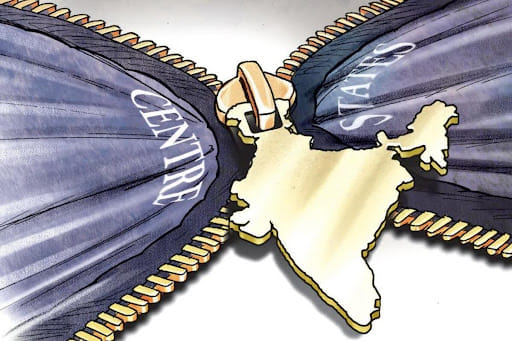
Legislative relations between the Centre (the Union government) and the states in India are outlined in the Constitution of India. The Indian Constitution divides the legislative powers between the Centre and the states through three lists: the Union List(foreign affairs, defence, railways), the State List(education, protection of forests, wild animals) and the Concurrent List (Police, Public Order, Roadways, Health). Articles 245 to 254 in part XI of the Indian Constitution deal with the distribution of legislative powers between the Union and the states. The UPSC Indian Polity and Governance Syllabus includes Legislative Relations Between Centre and states which is described in this article.
|
Table of Contents |

Legislative Relations Between Center And States
- The distribution of powers (legislative, administrative and financial) between the Center and the states in the Indian Constitution is based on the scheme provided in the Government of India Act 1935.
- The distribution of power adopted in the Government of India Act of 1935 continues till the present.
- The Indian Constitution divides the legislative power between the federal government and the states with regard to both the territory and the subjects of legislation, much like any other federal constitution.
- There are four aspects in the Centre states legislative relations, viz.
- Territorial extent of Central and state legislation;
- Distribution of legislative subjects;
- Parliamentary legislation in the state field; and
- Centre’s control over state legislation.
|
Articles 245 to 254 in part XI of the Indian Constitution deal with the distribution of legislative powers between the Union and the states.
|
Territorial extent of Central and State Legislation
- The parliament can make laws for the whole or any part of the territory of India.
- A state legislature can make laws for the whole or any part of the state territory.
- The Parliament alone can make extraterritorial legislations. Thus, the laws of the parliament are also applicable to Indian citizens and their property outside India.
- However, the constitution imposes certain restrictions on the plenary territorial jurisdiction of the parliament.
- The president can make regulations for the peace, progress and good government of the four Union territories- Andaman and Nicobar, Lakshadweep, Dadra and Nagar Haveli and Daman and Diu and Ladakh.
- The governor is empowered to direct that an act of parliament does not apply to a scheduled area in their state.
- The Governor and the President have the power to enforce any law of the Parliament in the tribal districts having a special status in Schedule 6 states such as Mizoram, Assam, Manipur and Tripura.
Distribution of Legislative Subjects
- Under Article 246, a three-tier arrangement has been made in the Constitution regarding the division of legislative subjects between the Center and the States. Which is kept in the Seventh Schedule. There are three types of lists- Union list, State list and Concurrent list.
- The Parliament has exclusive powers to make laws with respect to any of the matters enumerated in the Union List. This list has at present 100 subjects.
- The state legislature has in normal circumstances, the power to make laws with respect to any of the matters enumerated in the state list. This has at present 66 subjects.
- Both the Parliament and the State Legislature can make laws regarding the Concurrent List. Presently there are 52 subjects in the list, which were originally 47.
- The power to make laws with respect to residuary subjects is vested in the parliament.
Parliament Legislations in the State field
Following are the situations in which Parliament makes laws for the states.
- When the Rajya Sabha passes a resolution: If the Rajya Sabha declares that it is necessary in the national interest that Parliament should make laws on a matter in the state list, then the parliament becomes competent to make laws on that matter. Such a resolution must be supported by two-third of the members present and voting.
- During a national emergency: According to Article 250, in case of emergency in the country, Parliament can make laws on a subject in the State List; which shall apply to the whole or any part of the territory.
- When states make a request: According to Article 252 when two or more states pass a resolution in their respective legislatures that Parliament can make laws on subjects in the state list. So the Parliament gets the power to make laws for the state, on the subjects of the state list.
- To implement international agreement: According to Article 253, Parliament can make laws on subjects in the State List for the purpose of giving effect to an international treaty or agreement.
- During president's rule: Under Article 356, President's rule is imposed in a state. When this happens, all the powers of the Legislature come to the Parliament. In other words, the Parliament also has the power to make laws on the subjects of the State List.
Centre's Control over State Legislation
Besides the Parliament's power to legislate directly on the state subjects under exceptional situations, the Constitution empowers the Centre to exercise control over the state’s legislative matters in the following ways:
- The Governor can reserve certain types of state bills for the recommendation of the President.
- Bills on certain subjects in the State List can be brought after getting assent from the President. Such as Bills restricting freedom of trade and commerce etc.
- In case of a financial emergency, the President can order to preserve money or finance bills passed by the Legislature.
|
|
|
|---|---|
| Administrative Relations | Financial Relations |
| Inter state Water Disputes | Trends in Centre-State Relations |
Sarkaria Commission On Centre State Legislative Relations
- The Union's powers on concurrent subjects should focus on areas requiring uniform policy and action for the national interest, while allowing states to manage details within the framework of Union law.
- Federal legislation on concurrent list subjects should involve seeking input from states through inter-state Councils.
- Parliament's enactment of laws under Article 252(1), in response to the requests from two or more states, should be temporary, with a specific duration not exceeding three years.
- Resolutions from states regarding the creation or abolition of Legislative Councils should be presented to Parliament within reasonable time.
Conclusion
The allocation of legislative powers between the Union and the States unmistakably indicates a deliberate emphasis on empowering Parliament over the states in legislative domain. This inclination toward centralization diverges from typical federal principles, prioritizing national unity over traditional features of a federal constitution.
|
|
|
|---|---|
| Indian Polity UPSC Notes | Parliamentary System |
| Federal System | Centre-State Relations |
| Inter-State Relations | Comparing Features of Federal and Unitary Governments |
| State Legislature | State Government |
FAQs
Question: What is the Union List in the Seventh Schedule?
Answer: The Union List contains subjects on which only the Parliament can legislate. It includes defense, foreign affairs, and banking.
Question: What are residuary powers in the Indian legislative structure?
Answer: Residuary powers refer to subjects not mentioned in the Union, State, or Concurrent Lists. These powers rest exclusively with the Centre.
Question: What happens in case of a conflict between Union and State laws on a subject in the Concurrent List?
Answer: In case of a conflict, the law made by the Parliament prevails over the State law.
Question: What subjects are included in the State List?
Answer: The State List includes subjects like police, public health, prisons, and agriculture, on which only the State Legislatures can legislate.
Question: How does the Indian Constitution ensure legislative coordination between Centre and States?
Answer: The Constitution provides a clear division of powers through the Union List, State List, and Concurrent List. The role of the Rajya Sabha and mechanisms like inter-state councils further facilitate legislative coordination.
MCQs
1. Which of the following subjects falls under the Union List?
A. Agriculture
B. Defense
C. Police
D. Public health
Answer: (B) See the Explanation
Defense is a subject in the Union List, where only the Parliament can legislate.
2. What happens if both the Centre and the State legislate on a subject in the Concurrent List?
A. State law prevails
B. Union law prevails
C. Both laws apply equally
D. Neither law applies
Answer: (B) See the Explanation
In case of a conflict, the Union law prevails over the State law in the Concurrent List.
3. Which list includes subjects like police, public health, and agriculture?
A. Union List
B. State List
C. Concurrent List
D. Residuary powers
Answer: (B) See the Explanation
Subjects like police, public health, and agriculture fall under the State List, on which only State Legislatures can legislate.
4. Which body has residuary powers in India’s legislative structure?
A. State Legislature
B. Rajya Sabha
C. Parliament
D. Inter-state Council
Answer: (C) See the Explanation
The Parliament holds residuary powers to legislate on subjects not mentioned in the Union, State, or Concurrent Lists.
5. Which of the following subjects falls under the Concurrent List?
A. Education
B. Banking
C. Atomic energy
D. Public order
Answer: (A) See the Explanation
Education is a subject in the Concurrent List, where both the Centre and the States can legislate.
GS Mains Questions and Model Answers
Q1: Discuss the importance of the Seventh Schedule in maintaining a balance between the legislative powers of the Centre and the States.
Answer: The Seventh Schedule of the Indian Constitution plays a crucial role in maintaining the balance between the legislative powers of the Centre and the States. By categorizing subjects into the Union List, State List, and Concurrent List, the Constitution ensures a clear division of powers. This division allows the Centre to legislate on subjects of national importance, while the States handle matters of regional significance. The Concurrent List allows for cooperation and flexibility, while residuary powers vested in the Parliament ensure the Centre's supremacy in case of unforeseen legislative issues. This balance is essential for the federal structure of India and ensures that the States have autonomy in specific areas while the Centre can address matters of national interest.
Q2: Analyze the role of residuary powers in the Indian legislative system. How do they affect the Centre-State relationship?
Answer: Residuary powers refer to legislative subjects not mentioned in the Union List, State List, or Concurrent List. In India, residuary powers are vested with the Parliament, granting the Centre the authority to legislate on such matters. This provision ensures that the Centre can address new and evolving challenges that were not envisioned at the time of framing the Constitution. While this strengthens the Centre’s role in maintaining national unity, it sometimes creates friction in the Centre-State relationship, as States may feel their autonomy is being undermined. However, the vesting of residuary powers in the Centre is essential for ensuring effective governance in areas that require uniform laws across the country.
Q3: Evaluate the significance of the Concurrent List in the Indian federal system. How does it facilitate cooperation between the Centre and States?
Answer: The Concurrent List plays a critical role in India’s federal system by allowing both the Centre and the States to legislate on the same subjects. It includes matters of shared concern, such as education, marriage, bankruptcy, and forests, which require joint attention. This arrangement promotes cooperative federalism, encouraging the Centre and the States to collaborate on policy formulation and implementation. In the event of conflicting laws, the law made by the Parliament prevails, ensuring consistency across the country. However, States can also introduce context-specific legislation to address regional needs, making the Concurrent List a flexible tool that fosters both unity and diversity in governance.
Previous Year Questions from Legislative Relations Between Centre and states
1. UPSC CSE Prelims 2020
Question: Which of the following is an example of fold mountains?
A. Vindhya Range
B. Aravalli Range
C. Himalayas
D. Western Ghats
Answer: C
Explanation: The Himalayas are fold mountains, formed by the collision of the Indian and Eurasian tectonic plates.
2. UPSC CSE Mains 2019 (GS Paper 1)
Question: Explain the process of formation of fold mountains and their significance in the global climatic system.
Explanation: Fold mountains are formed by the collision of tectonic plates at convergent boundaries, which results in the folding and uplifting of the earth’s crust. They play a crucial role in the global climatic system by influencing wind patterns, precipitation, and temperature. For example, the Himalayas block cold winds from Central Asia, protecting the Indian subcontinent from extreme cold. Additionally, fold mountains contribute to water cycles by acting as sources of major rivers, which sustain life and ecosystems downstream.
*email: contactus@prepp.in
Download the PREPP App and attempt FREE IAS Exam Mock Tests and get complete study material!

Full Test - 04: UPSC CSE Prelims CSAT (Paper-II)
Full Test - 03: UPSC CSE Prelims CSAT (Paper-II)
UPSC CSE Prelims 2026 GS Paper 1 Question Paper (24-May-2026)
UPSC CSE Prelims 2026 CSAT Paper 2 Question Paper (24-May-2026)

17 February 2025 | The Hindu Must Read Articles | Current Affairs

16 February 2026 | The Hindu Must Read Articles | Current Affairs

13 February 2026 | The Hindu Must Read Articles | Current Affairs









Comments