Administrative Relations Between Centre and State - Indian Polity Notes
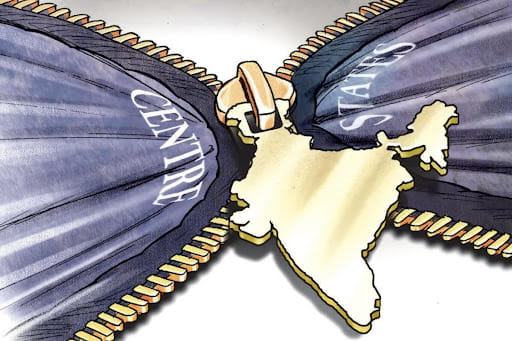
Articles 256 to 263 in Part XI of the Constitution deal with the administrative relations between the Centre and the states. Under Article 263, the President is empowered to constitute an Inter-State Council to investigate and discuss matters of common interest between Centre and State. The Constitution of India is a federal system based on the principle of division of powers. This means that all the powers conferred by the constitution such as legislative, executive and financial powers are divided between the centre and the states. The UPSC Indian Polity and Governance Syllabus includes Administrative Relations between centre and states which is described in this article.
|
Table of Contents |

Administrative Relations Between Centre and State - Distribution Of Executive Powers
- The Executive Authority of the Centre extends across the entire country. The executive power of a state extends to matters over which the state legislature has sole legislative jurisdiction.
- In respect of matters on which both the Parliament and the state legislatures have power of legislation (i.e The subjects enumerated in the Concurrent List), the executive power rests with the states except when a Constitutional provision or a parliamentary law specifically confers it on the Centre.
- Therefore, a law on a concurrent subject, though enacted by the Parliament, is to be executed by the states except when the Constitution or the Parliament has directed otherwise.
|
|
|
|---|---|
| Legislative Relations | Financial Relations |
| Inter state Water Disputes | Trends in Centre-State Relations |
|
Articles 256 to 263 in Part XI of the Constitution deal with the administrative relations between the Centre and the states.
|
Directions To The States
The Centre has the authority to provide states instructions on how to execute their executive power in the following areas:
- The construction and maintenance of means of communication by the state;.
- Provision of suitable facilities for children from linguistic minority groups in the state to receive instruction in their mother tongue at the primary level of school.
- The formulation and implementation of specific plans for the welfare of the state's Scheduled Tribes.
- In certain situations, the coercive sanction underlying the Central Directions under Article 365 also applies.
Related Concerns
- Distribution of legislative authority between the federal government and the states is unbalanced.
- As a result, the Centre cannot delegate legislative authority to the states, and a single state cannot ask Parliament to pass legislation on a state issue. In general, executive power is distributed in the same way as legislative power is distributed.
- However, such a strict divide in the executive branch may result in occasional clashes between the two. As a result, the Constitution allows for interstate delegation of executive duties to reduce rigidity and avoid impasse.
Cooperation Between The Centre And States
- Any disagreement or complaint regarding the use, distribution, or control of waters of any interstate river and river valley can be adjudicated by the Parliament.
- The President can create an Inter-State Council (under Article 263) to investigate and discuss topics of mutual interest between the Centre and the states. In 1990, such council was established.
- The Centre and each state's public acts, records, and judicial processes are to be granted full faith and credit throughout India.
- The Parliament has the authority to appoint an appropriate authority to carry out the constitutional provisions relating to interstate trade, commerce, and intercourse.
Obligations Of States And The Centre
- The Constitution imposes two limitations on state executive power in order to provide the Centre with adequate room to exercise its executive power unrestrictedly.
- As a result, every state's executive power must be exerted in such a way that it:
(a) ensures compliance with Parliament's legislation and any existing law that applies in the state, and
(b) does not obstruct or prejudice the exercise of executive power by the Centre in the state.
- The former puts a general requirement on the state, whilst the latter imposes a specific obligation on the state not to obstruct the Centre's executive power.
- Thus, Article 365 states that if a state fails to comply with any orders issued by the Centre, the President may declare that a situation has developed in which the state's administration cannot be carried out in line with the Constitution's provisions.
- It signifies that the President's rule can be imposed in the state under Article 356 in such a case.
All-India Services
- The Centre and the states each have their own public services, referred to as the Central and State Services, respectively.
- There are other all-India services such as IAS, IPS, and IFS. The Centre and the states share control of these services.
- The central government retains ultimate control, but state governments retain direct control.
- On the basis of a Rajya Sabha resolution, Article 312 of the Constitution allows the Parliament to form new All-India Services.
Public Service Commission
- The following are the Centre-state relations in the subject of public service commissions:
- Though appointed by the governor of the state, the Chairman and members of a state public service commission can only be removed by the President.
- On the request of the state legislatures, Parliament can create a Joint State Public Service Commission for two or more states. The president appoints the chairman and members of the JSPSC.
- On the request of the state governor and with the President's consent, the Union Public Service Commission can fulfill the needs of a state.
- The UPSC aids states in developing and implementing joint recruitment strategies for any services that need candidates with particular qualifications.
Integrated Judicial System (IJS)
- The Integrated Judicial System (IJS) is a multi-jurisdictional system
- There is no dual system of justice administration in India, despite the fact that it has a dual polity.
- The president, in collaboration with the Chief Justice of India and the governor of the state, appoints the judges of a state high court. The president has the power to transfer and remove them.
- A common high court for two or more states can be established by Parliament.
Relations During Emergencies
- During a national emergency (as defined by Article 352), the Centre has the authority to issue executive orders to a state on any subject.
- When a state-imposed President's Rule (under Article 356), the President can assume the functions of the state government and the powers vested in the Governor or any other executive authority in the state.
- During a financial emergency (under Article 360), the Centre can direct states to follow financial propriety canons and provide other required directives, such as reducing the pay of state employees.
Conclusion
The Indian Constitution's goal is to create either collaborative or cooperative federalism. The States are given certain autonomy through the distribution of powers between the Centre and the States to guarantee that the administration at the local level stays efficient. In order to preserve a balance, the Centre exercises its power over the States at the same time.
|
|
|
|---|---|
| Indian Polity UPSC Notes | Parliamentary System |
| Federal System | Centre-State Relations |
| Inter-State Relations | Comparing Features of Federal and Unitary Governments |
| State Legislature | State Government |
FAQs
Question: What are the key articles governing administrative relations between the Centre and states in India?
Answer: The key articles governing administrative relations between the Centre and states are Articles 256 to 263 of the Indian Constitution, which outline the power distribution, cooperation, and mechanisms for resolving disputes between the two levels of government.
Question: What is the role of Article 256 in Centre-State relations?
Answer: Article 256 empowers the Centre to direct states to ensure the implementation of laws passed by Parliament. This ensures that central laws are enforced uniformly across all states.
Question: What are All-India Services, and how do they impact Centre-State administrative relations?
Answer: All-India Services like the IAS, IPS, and IFS are recruited and controlled by the Centre but serve both the Centre and states. These services ensure uniform standards in administration and governance across India.
Question: How does the Inter-State Council facilitate Centre-State cooperation?
Answer: The Inter-State Council, established under Article 263, facilitates dialogue between the Centre and the states on administrative, economic, and social issues, promoting cooperation and coordination in governance.
Question: Can the Centre take over state functions in any circumstance?
Answer: Yes, under Article 258, the President can entrust certain Union functions to the states. Additionally, in cases of breakdown of constitutional machinery in a state, the Centre can impose President's Rule under Article 356.
MCQs
1. Under which Article of the Indian Constitution can the Union government issue directions to states?
A. Article 256
B. Article 370
C. Article 246
D. Article 312
Answer: (A) See the Explanation
Article 256 empowers the Union government to issue directions to state governments to ensure the implementation of laws passed by Parliament.
2. Which article allows the President to entrust state governments with Union functions?
A. Article 258
B. Article 312
C. Article 263
D. Article 275
Answer: (A) See the Explanation
Article 258 allows the President to entrust state governments with certain functions of the Union, ensuring cooperation between the Centre and the states.
3. What is the purpose of Article 263 of the Indian Constitution?
A. To impose President's Rule in states
B. To ensure cooperation through Inter-State Councils
C. To create separate state governments
D. To assign Union taxes to states
Answer: (B) See the Explanation
Article 263 provides for the establishment of Inter-State Councils to ensure coordination between the Centre and the states on matters of mutual interest.
4. Which of the following services is considered an All-India Service?
A. Indian Revenue Service (IRS)
B. Indian Administrative Service (IAS)
C. Indian Postal Service
D. Indian Foreign Service
Answer: (B) See the Explanation
The Indian Administrative Service (IAS) is one of the All-India Services, along with the Indian Police Service (IPS) and the Indian Forest Service (IFS), recruited and controlled by the Centre but serving both the Centre and states.
5. In case of disputes between the Centre and a state, who can refer the issue to the Supreme Court for an advisory opinion?
A. The Prime Minister
B. The President
C. The Chief Justice of India
D. The Governor
Answer: (B) See the Explanation
The President of India can refer disputes between the Centre and a state to the Supreme Court for an advisory opinion under Article 143 of the Constitution.
GS Mains Questions and Model Answers
1. Discuss the administrative relations between the Centre and states under the Indian Constitution. How do these provisions ensure both cooperation and control?
Answer: Administrative relations between the Centre and states in India are governed by Articles 256 to 263 of the Constitution. These provisions ensure a balance between cooperation and control. Article 256 allows the Centre to issue directions to states for the implementation of laws, while Article 257 ensures that states exercise their powers without hindering the authority of the Centre. Mechanisms like Inter-State Councils (Article 263) promote cooperation, while All-India Services ensure uniformity in governance across states. These provisions enable a federal structure with a strong central influence to maintain unity and integrity.
2. Examine the significance of the Inter-State Council in promoting Centre-State cooperation.
Answer: The Inter-State Council, established under Article 263 of the Indian Constitution, plays a crucial role in promoting Centre-State cooperation. It acts as a platform for dialogue and consultation on matters of mutual interest, such as economic policies, social welfare, and administrative issues. By facilitating discussions between the Centre and the states, the council helps in resolving disputes and ensuring coordinated policy implementation. The council strengthens federalism by fostering collaborative governance, which is essential for India's diverse and complex political structure.
3. Analyze the role of All-India Services in maintaining uniformity in administration across the Centre and states.
Answer: All-India Services like the Indian Administrative Service (IAS), Indian Police Service (IPS), and Indian Forest Service (IFS) play a vital role in maintaining administrative uniformity across the Centre and states. Recruited by the Centre, these officers serve both the Union and state governments, ensuring that governance standards remain consistent across India. Their dual control by the Centre and states allows for a cohesive administrative framework that bridges the gap between different levels of government. By providing leadership in key administrative roles, these services help implement national policies effectively while addressing local issues.
Previous Year Questions on Centre-State Relations
1. UPSC CSE Prelims 2018
Question: Which Article of the Indian Constitution provides for the establishment of an Inter-State Council?
A. Article 256
B. Article 257
C. Article 263
D. Article 258
Answer: C
Explanation: Article 263 provides for the establishment of Inter-State Councils to promote coordination between the Centre and states on matters of common interest.
2. UPSC CSE Mains 2020 (GS Paper 2)
Question: "The Indian Constitution provides a federal system with a strong unitary bias." Discuss this statement in the context of Centre-State administrative relations.
Answer: The Indian Constitution establishes a federal system, but it also incorporates unitary features to ensure national unity and stability. The administrative relations between the Centre and the states, governed by Articles 256 to 263, reflect this unitary bias. The Centre has the authority to issue directions to states (Article 256) and can ensure compliance through measures such as President's Rule in case of a breakdown in constitutional machinery. While federalism allows states autonomy, the Constitution empowers the Centre to ensure uniformity and control when necessary, highlighting the unitary tilt in Indian federalism.
*email: contactus@prepp.in
Download the PREPP App and attempt FREE IAS Exam Mock Tests and get complete study material!
UPSC IAS : CSAT - Mini Live Test

Live Test : UPSC CSE Prelims CSAT (Paper-II) (Oct 14 - 17)
Full Test - 04: UPSC CSE Prelims CSAT (Paper-II)
Full Test - 03: UPSC CSE Prelims CSAT (Paper-II)
UPSC CSE Prelims 2026 GS Paper 1 Question Paper (24-May-2026)
UPSC CSE Prelims 2026 CSAT Paper 2 Question Paper (24-May-2026)

17 February 2025 | The Hindu Must Read Articles | Current Affairs

16 February 2026 | The Hindu Must Read Articles | Current Affairs

13 February 2026 | The Hindu Must Read Articles | Current Affairs









Comments