Centre-state Relations - Indian Polity Notes
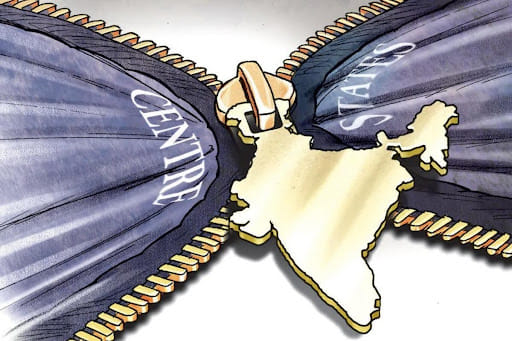
Centre-State relations constitute the core of federalism in India and they are regulated by the provisions of the Constitution. The federal system must function with the harmony and cooperation between the central government and each state. The Indian Constitution's Part XI expressly addresses center-state relations. Legislative and administrative relations have been separated. Part XII also contains rules about financial relationships. This article explains the Centre-State Relations which is important for UPSC Indian Polity Preparation.
Table of Contents

Centre-State Relationship
- The federal system of the Indian Constitution divides all authorities (legislative, executive, and financial) between the Centre and the states.
- There is no separation of judicial power, however, because the Constitution established an integrated judicial system to enforce both federal and state laws.
- Though the Centre and the states are preeminent in their respective sectors, maximum harmony and cooperation between them is required for the federal system to function effectively.
- The Indian constitution splits all legislative, executive, and financial authorities between the centre and the states.
- For the federal system to function effectively, there must be maximum harmony and coordination between the centre and the states. As a result, the Constitution includes several clauses to assure this.
- Relations between the centre and the states can be broken down into three categories:
- Legislative relations
- Administrative relations
- Financial relations
|
"Centre-State relations are the cornerstone of India's federal structure, ensuring that power and responsibility are shared equitably, fostering a spirit of collaboration and unity amidst diversity” |
Legislative Relations
The legislative relations between the union and states are divided into four categories:
- Territorial extent of central and state legislation
- Distribution of legislative subjects
- Parliamentary legislation in the state field
- Centre’s control over state legislation
Territorial Extent Of Central And State Legislation
- Parliament has the power to enact laws that apply to all or part of India's territory (territory includes union, state, UT)
- The state legislature can enact laws that apply to the entire state or only a portion of it. State laws are not applicable outside of the state unless there is a sufficient relationship between the state and the item.
- Only Parliament has the authority to enact "extraterritorial" legislation.
- Situations in which Parliamentary laws are inapplicable
- For the Andaman and Nicobar Islands, Daman and Diu, Dadra and Nagar Haveli, and Lakshadweep, the President can issue regulations that have the same effect as laws passed by parliament.
- The governor has the authority to order that an act of parliament does not apply to a designated territory in the state, or that it apply with defined modifications and exceptions.
- An act of Parliament can also be directed by the Governor of Assam to not apply or to apply with specific modifications. In Meghalaya, Tripura, and Mizoram, the President has the same authority.
Distribution Of Legislative Subjects
- The constitution divides the subjects into three categories: union list, state list, and concurrent list.
- When it comes to the union list, Parliament has sole authority.
- Under normal circumstances, the state legislature has sole authority to enact laws concerning the items listed in the state list.
- On the issues listed in the concurrent list, both the state and the federal government can pass legislation.
- Parliament has the authority to enact legislation having a residuary topic.
- The union list takes priority over the state list, and the concurrent list takes priority over the state list.
- In the event of a disagreement between central law and state law on a topic listed in the concurrent list, the central law takes precedence. If, on the other hand, the state law has been reserved for the president's consideration and has received his consent, the state law takes precedence in the state. Nonetheless, parliament has the power to overturn state law by passing a law on the subject.
Parliamentary Legislation In The State Field
Under the following five extraordinary circumstances, the Constitution authorizes Parliament to pass legislation on any issue mentioned in the state list:
- If the Rajya Sabha passes a resolution with the backing of two-thirds of the members present and voting, allowing parliament to create a law in the best interests of the country on an issue specified in the state list. A year is the duration of such a resolution. A resolution like this can be renewed as many times as you like, but not for more than a year at a time. After six months have passed after the resolution was passed, the laws enacted under it are no longer in effect. However, a state may pass legislation on the same subject, but if there is a conflict between state and union legislation, the latter takes precedence.
- When a proclamation of national emergency is in effect, the Parliament has the authority to legislate on any issue listed in the state list. After six months of national emergency, the laws enacted under this cease to be effective. State law can make a law on the subject as well, but if there is any discrepancy, the union law will prevail.
- When a state requests Parliament by passing a resolution to that effect, Parliament is given the authority to legislate on the issues listed in the resolution. Once this resolution is passed, the state relinquishes all rights in that area.
- To enforce international agreements, Parliament can legislate laws on the topics listed in the state list.
- During the period when the President's rule is in effect, Parliament gains the authority to adopt a law on a state concern. Even when the president's term ends, the laws enacted during this time will remain in effect. The state, on the other hand, can later pass legislation to modify or repeal the act as it deems fit.
Centre’s Control Over State Legislation
The Constitution gives the federal government the authority to exert influence over the state's legislative affairs in the following ways:
- The governor has the authority to reserve certain types of measures passed by the state legislature for presidential consideration. The president has complete control over them.
- Only with the President's prior approval can bills on specific topics listed in the state list be filed in the state legislature. Inter-state trade and commerce, for example.
In the event of a financial emergency, the president might request that a state set aside money bills and other financial bills for his consideration.
| Other Relevant Links | |
|---|---|
| Legislative Relations | Administrative Relations |
| Financial Relations | Trends in Centre-State Relations |
Administrative Relations
- Based on the allocation of legislative powers, the executive power has been shared between the centre and the states.
- On matters over which it has exclusive jurisdiction (union list), as well as the exercise of rights, authority, and jurisdiction conferred on it by any treaty or agreement, the centre's power extends to the entire country.
- The state's jurisdiction extends to the topics included in the state list.
- The executive power in matters relating to the concurrent list is vested in the states.
- States' obligations to the centre:
- The executive power of the state must be exercised in such a way that the laws passed by Parliament are followed.
- And not to obstruct or prejudice the exercise of a state's executive power.
- These instructions are coercive (Article 365), as any failure to follow them could result in the employment of Article 356.
- The Centre has been given the authority to give states guidance in the following situations:
- Construction and maintenance of communication systems that the government has determined to be of national or military importance.
- Measures to be done to ensure the safety of the state's railways
- Provision of suitable facilities for instruction in the mother language to students from linguistic minority groups at the primary level of school
- The development and implementation of specific plans for the welfare of the ST in the various states.
- Article 365's coercive sanction behind central directives is also relevant in this scenario.
- Mutual delegation of functions: The constitution allows for intergovernmental delegation of executive powers to reduce rigidity and avoid a deadlock situation.
- The president may assign the executive duties of the union to the state government with the permission of the state government.
- With the agreement of the federal government, the governor may assign the state's executive functions to the union.
- This mutual delegation may be conditional or unconditional.
- The constitution also allows the state to delegate executive powers to the union without the state's permission. However, Parliament, not the President, makes such delegations. However, a state's executive power cannot be delegated in the same way.
- Cooperation between the centre and the states: To ensure cooperation and coordination between the centre and the states, the following provisions have been incorporated.
- Any disagreement or complaint relating to the usage, distribution, and control of waters of any interstate river and river valleys can be adjudicated by Parliament.
- The President has the authority to form an Inter-state council to research and discuss issues of mutual interest between the centre and the states.
- Public acts, records, and judicial processes of the centre and each state are to be granted full faith and credit throughout India.
- Parliament has the authority to appoint an appropriate authority to carry out the constitutional provisions relating to interstate trade, commerce, and intercourse.
All India Services
- Indian Administrative Service (IAS) and Indian Police Service (IPS) succeeded the colonial Indian Civil Service (ICS) and Indian Police (IP) in 1947.
- The Indian Forest Service (IFS) was established in 1966 as the country's third all-India service.
- Article 312 of the Indian constitution empowers Parliament to establish an all-India service if the Rajya Sabha passes a resolution to that effect.
- These three services combine to form a unified service with common rights and status, as well as pay schedules that are consistent across the country.
- Importance of All India Services
- Assist in maintaining a high level of administration in both the federal government and the states.
- Assist in ensuring that the administrative system is uniform across the country.
- They improve interaction, cooperation, coordination, and joint action between the centre and the states on problems of mutual interest.
Public Service Commission
The following are the centre-state relations in this field:
- The governor appoints the chairman and members of the state public service commission, but they can only be fired by the President.
- If two or more states request it, Parliament might create a combined public service commission; in such circumstances, the President picks the chairman and members of the state public service commission.
- On the request of the governor and with the President's consent, UPSC can assist the state public service commission.
- The UPSC aids states in developing and implementing joint recruitment strategies for any services that need candidates with particular qualifications.
Integrated Judicial System
- Despite India's dual polity, an integrated judicial system has been established.
- This single judicial system is responsible for enforcing both federal and state laws.
- The President of India, in collaboration with the Chief Justice of India and the governor of the state, appoints the justices of a high court. The President has the authority to remove or transfer them.
- The establishment of common high courts for two or more states has been allowed by Parliament.
Relations During Emergency
- During a national emergency, the centre can give state instructions on any subject.
- The president can assume the functions of the state government and the powers conferred by the governor or any other executive authority in the state during his presidency.
- During a financial emergency, the centre can order states to follow financial propriety canons, and the President can issue other essential directives, such as reducing the wages of state employees and high court judges.
Financial Relations
Allocation Of Taxing Powers
- Parliament has sole authority to collect taxes on the subjects listed in the Union list.
- The state legislature has sole authority to levy taxes on the subjects listed in the state list.
- Both the union and the state have the authority to charge taxes on the items included on the concurrent list.
- The Parliament has the residuary power of taxing.
The restriction placed by the constitution on taxation power of the state
- A state legislature has the authority to tax professions, trades, callings, and occupations. However, no single person's total annual payment should exceed Rs 2500.
- Taxes on the sale or purchase of products can be imposed by a state (other than a newspaper). However, the state's ability to levy a sales tax is limited by four factors:
- There can be no tax on sales or purchases made outside of the states.
- No tax can be levied on sales or purchases made during the import or export process.
- In the course of interstate trade and commerce, no tax can be imposed on the sale or purchase.
- A tax levied on the sale or purchase of commodities recognized by the Parliament to be of special importance in interstate trade and commerce is subject to the Parliament's limits and requirements.
- The state cannot levy a tax on the sale of electricity if it is consumed by or sold to the centre, or if it is consumed in the construction, maintenance, or operation of any railway by or sold to the railway company for the same purpose.
- A state can levy a fee on water or power sold to an interstate river authority constituted by Parliament to governor develop the river. Such imposition, on the other hand, can be carried out by a statute that has acquired the President's consent.
Distribution Of Tax Revenues
- The centre imposes taxes, but the state collects and appropriates them (Article 268). The proceeds from this are deposited in the state's consolidated fund. Stamp duty, for example, and excise duty
- The federal government levies and collects taxes, while the states are responsible for collecting them (article 269). Taxes on the sale or purchase of items (other than newspapers) in interstate commerce are an example. The proceeds from this are deposited in the state's consolidated fund.
- Taxes are levied and collected by the federal government, but they are split between the federal government and the states (Article 270). All taxes, excluding those stated above, surcharges, and cess, fall into this group. The President decides on how these taxes are distributed based on the Finance Commission's recommendation.
- The surcharges on taxes and levies alluded to in Articles 269 and 270 can be imposed by Parliament at any time. Surcharge proceeds are directed solely to the centre.
- State-imposed, collected, and retained taxes include: These are the taxes that are solely the responsibility of the states. In the state list, they are listed. Taxes on agricultural income, alcohol excise duty, taxes on professions, ceilings, and so on.
Distribution Of Non-tax Revenues
- The centre: The following are the main non-tax revenue streams for the centre:
- Postal and telegraph services;
- Railroads
- Banking
- Broadcasting
- Coinage and currency
- Central public sector enterprise
- Escheat and lapse.
- The following are the states: The following are the principal non-tax revenue streams for states:
- Irrigation
- Forests
- Fisheries
- State public sector enterprise
- Escheat and lapse.
- Grants- in- Aid to the states:
- The Constitution allows the state to receive grants-in-aid from the federal government. Statutory grants and discretionary grants are the two forms of grants-in-aid.
- Statutory grants:
- Article 275 of the Constitution authorizes the parliament to offer grants to states in need of financial help, rather than to all states.
- For different states, these sums may differ. Every year, these funds are charged to India's Consolidated Fund.
- These are distributed to the states depending on the Finance Commission's recommendations.
- Discretionary grants:
- Both the centre and the states are empowered under Article 282 to issue any grants for any public purpose, even if it falls outside of their legislative jurisdiction.
- The centre is under no duty to provide these grants, and the decision is entirely up to it.
- Other grants
- The Constitution allowed for a one-time donation for a specific purpose. For example, grants instead of export duties on jute and jute products for the states of Assam, Bihar, Odisha, and West Bengal.
- Based on the Finance Commission's suggestion, these grants were to be distributed for ten years from the start of the constitution.
Important Recommendations On Centre – State Relations
Administrative Reforms Commission
- Article 263 of the constitution mandates the formation of an inter-state council.
- Appointment of governors with extensive public service experience and nonpartisan attitudes
- States have been given the most power.
- More financial resources should be transferred to the states to lessen their reliance on the federal government.
- Deployment of central armed forces in states at their request or on their initiative.
- The Rajamannar committee, which was constituted by the Tamil Nadu government, offered several recommendations to remedy the power imbalance between the centre and the state.
- Punjab made similar proposals to resolve these disparities in the Anandpur Sahib Resolution, while West Bengal made similar recommendations in a memorandum.
- In 1983, the government established the Sarkaria Commission and in 2007, the Punchhi Commission to assess the situation of center-state relations.
Sarkaria Commission Recommendation
- Setting up a permanent Inter-State Council
- Article 356 should only be utilized when necessary.
- It is necessary to strengthen the institution of all-India service.
- The parliament should retain residuary power.
- When the President vetoes state bills, the reasons should be revealed to the states.
- The Centre should have the right to deploy its armed forces without the approval of the states. It is desirable, however, that the states be consulted.
- The procedure for consulting the chief minister when appointing the state government should be spelled out in the constitution.
- Governors should be allowed to finish their five-year terms.
- The position of Commissioner for Linguistic Minorities should be filled.
Punchhi Commission
- Governors are given a five-year tenure and are removed through the impeachment procedure.
- In subjects entrusted to the states, the Union should use the utmost caution in establishing Parliamentary primacy.
- It stipulated several requirements to be considered when appointing governors:
- He should be well-known in some fields.
- He should be a non-resident of the state.
- He should be a non-political figure who is not involved in local politics.
- He should not have been involved in politics in the recent past.
- The government should be given a five-year term limit.
- The procedure for impeachment of the president could be extended to governors as well.
- The Governor should insist on the Chief Minister demonstrating his majority on the floor of the House, and he should set a time restriction for this.
- When deciding situations involving the President's rule, keep the Bommai case rules in mind.
- The Inter-State Council should be used more frequently to promote center-state cooperation.
Conclusion
Centre-State relations are the cornerstone of India's federal structure, ensuring that power and responsibility are shared equitably, fostering a spirit of collaboration and unity amidst diversity, and driving the nation towards comprehensive and inclusive development.
FAQs
Question: What is the basis of the legislative division of powers between the Centre and the States in India?
Answer: The legislative division of powers between the Centre and States in India is based on three lists in the Seventh Schedule of the Constitution: the Union List, the State List, and the Concurrent List.
Question: What role does the Finance Commission play in Centre-State financial relations?
Answer: The Finance Commission is responsible for recommending the division of tax revenue between the Centre and States and providing grants to states in need. It plays a crucial role in maintaining fiscal balance between different levels of government.
Question: How does the Centre exert administrative control over the States?
Answer: The Centre can exert administrative control over the States through the Governor, who acts as a representative of the Centre in the State, and by giving directions to States to ensure compliance with Union laws.
Question: What happens to the Centre-State relationship during a National Emergency?
Answer: During a National Emergency, the federal structure of the Constitution becomes more unitary, and the Centre assumes more powers, including the ability to legislate on subjects in the State List.
Question: What is the Concurrent List, and how does it affect the Centre-State relationship?
Answer: The Concurrent List contains subjects on which both the Centre and States can legislate. In case of a conflict between Central and State laws on a Concurrent List subject, the Central law prevails.
MCQs
1. Which of the following subjects is included in the Union List?
A. Police
B. Agriculture
C. Defense
D. Public Health
Answer: (C) See the Explanation
The Union List includes subjects of national importance such as Defense, Foreign Affairs, and Atomic Energy, which are under the exclusive control of the Central Government.
A. Resolving disputes between the Centre and States
B. Recommending the distribution of tax revenue between the Centre and States
C. Legislating on matters of national importance
D. Maintaining law and order in the country
Answer: (B) See the Explanation
The Finance Commission recommends the distribution of tax revenue between the Centre and States and provides financial grants to ensure fiscal balance across different levels of government.
A. National Emergency
B. State Emergency
C. Financial Emergency
D. Natural Disaster
Answer: (D) See the Explanation
Natural disasters do not affect the federal structure of India, whereas National Emergency, State Emergency, and Financial Emergency give the Centre more control over State matters.
A. Union List only
B. Concurrent List only
C. State List only
D. Both State List and Concurrent List
Answer: (D) See the Explanation
During a National Emergency, the Centre’s legislative powers extend to both the State List and Concurrent List, allowing it to make laws on subjects usually reserved for the States.
A. To mediate disputes between States
B. To legislate on matters of national interest
C. To provide grants to States
D. To recommend financial policies
Answer: (A) See the Explanation
The Inter-State Council is established to mediate disputes between States and to promote cooperation and coordination between the Centre and States on various issues.
GS Mains Questions and Model Answers
Q1: Discuss the legislative relations between the Centre and States in India. How does the Seventh Schedule help maintain the federal structure?
Answer: The legislative relations between the Centre and States in India are governed by the Seventh Schedule of the Constitution, which divides powers into three lists:
- The Union List (97 subjects) grants the Centre exclusive power to legislate on matters of national importance like Defense, Foreign Affairs, and Banking.
- The State List (66 subjects) grants States the authority to legislate on matters of local and regional significance like Police, Agriculture, and Public Health.
- The Concurrent List (47 subjects) allows both the Centre and States to legislate on subjects like Education, Marriage, and Criminal Law. In case of a conflict, the Central law prevails.
The distribution of powers helps maintain a balance between national unity and regional autonomy, promoting cooperative federalism while ensuring the Centre retains authority over key issues of national interest.
Q2: Analyze the role of the Finance Commission in promoting fiscal federalism in India.
Answer: The Finance Commission plays a crucial role in promoting fiscal federalism by ensuring a fair and equitable distribution of financial resources between the Centre and the States. It recommends how taxes collected by the Centre should be shared with the States, taking into account factors like population, income levels, and developmental needs.
The Finance Commission also suggests grants-in-aid to states facing fiscal challenges and promotes policies that ensure states have adequate resources to meet their responsibilities. This helps maintain a balance between the financial autonomy of states and the national interest, fostering cooperative federalism.
Q3: What are the challenges in the Centre-State administrative relationship in India? Suggest measures to improve coordination between the two levels of government.
Answer: The Centre-State administrative relationship in India faces several challenges, including:
- Over-centralization: The Centre often exercises significant control over state administration, particularly through the office of the Governor, which can create friction.
- Lack of coordination: Policies initiated by the Centre may not align with state priorities, leading to conflicts.
- Financial dependence: States often rely on central grants, limiting their fiscal autonomy.
To improve coordination, measures such as strengthening the role of the Inter-State Council, promoting cooperative federalism through platforms like NITI Aayog, and enhancing decentralized planning can help foster a more harmonious Centre-State relationship.
Previous Year Questions on Centre-state Relations
1. UPSC CSE Prelims 2020
Question: The division of powers between the Centre and the States in the Indian Constitution is based on the:
A. Montagu-Chelmsford Reforms
B. Government of India Act, 1935
C. Morley-Minto Reforms
D. Cabinet Mission Plan
Answer: B
Explanation: The division of powers between the Centre and the States in the Indian Constitution is based on the Government of India Act, 1935, which introduced federalism by creating lists of subjects for separate legislation by the Centre and the Provinces.
2. UPSC CSE Mains 2019 (GS Paper 2)
Question: Discuss how the distribution of legislative and administrative powers between the Centre and States affects Indian federalism.
Explanation: The distribution of legislative and administrative powers between the Centre and States is essential to the functioning of Indian federalism. The Seventh Schedule of the Constitution divides powers into the Union List, State List, and Concurrent List, ensuring that both levels of government can function within their areas of jurisdiction.
However, conflicts arise in areas like Concurrent List subjects, where Central laws often override State laws, and during emergencies, when the Centre assumes more control. Additionally, the role of the Governor and financial dependence of States on Central grants can create tensions. Ensuring greater autonomy for States while fostering cooperation is key to the success of federalism in India.
*email: contactus@prepp.in
Download the PREPP App and attempt FREE IAS Exam Mock Tests and get complete study material!

Full Test - 04: UPSC CSE Prelims CSAT (Paper-II)
Full Test - 03: UPSC CSE Prelims CSAT (Paper-II)
UPSC CSE Prelims 2026 GS Paper 1 Question Paper (24-May-2026)
UPSC CSE Prelims 2026 CSAT Paper 2 Question Paper (24-May-2026)

17 February 2025 | The Hindu Must Read Articles | Current Affairs

16 February 2026 | The Hindu Must Read Articles | Current Affairs

13 February 2026 | The Hindu Must Read Articles | Current Affairs









Comments