Indian Parliament – Indian Polity Notes
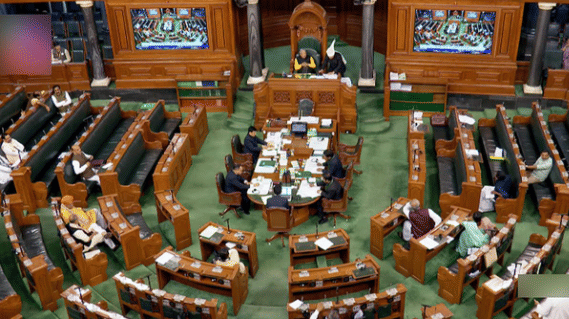
Parliament is India's supreme legislative body. The Indian Parliament is made up of the President and two Houses: Rajya Sabha (Council of States) and Lok Sabha (House of the People). The President has the authority to convene and prorogue either House of Parliament, as well as to dissolve Lok Sabha. On January 26, 1950, India's Constitution went into effect.
| To Read update on this topic: |
|
Table of Contents |
What is Parliament?
- The Union government's legislative organ is the Parliament.
- Due to the adoption of the parliamentary form of government, it holds a pre-eminent and central position in the Indian democratic political system.
- It is also known as the 'Westminster' model of government.
|
"The Indian Parliament is the cornerstone of our democracy, embodying the will of the people and the essence of our constitutional values.” |
Constitutional Provisions
- Part V of the Constitution containing articles 79 to 122 deals with the Parliament's organization, composition, duration, officers, procedures, privileges, powers, and so on.
- Article 79 of the Constitution describes the structure of parliament. It states that the Parliament is made up of the President and two houses, the Lower House or House of People and the Upper House or Council of States.
Structure of Indian Parliament and its Components
- As per the constitution, the Indian Parliament is divided into three parts: the President, the Council of States, and the House of the People.
- The Council of States and the House of People adopted the Hindi names 'Rajya Sabha' and 'Lok Sabha' in 1954, respectively.
- The Upper House (Second Chamber or House of Elders) is the Rajya Sabha, and the Lower House in the Lok Sabha (First Chamber or Popular House).
- The former represents the Indian Union's states and union territories, while the latter represents the people of India as a whole.
- Despite the fact that the President of India is not a member of either House of Parliament and does not attend its meetings, he is an integral part of the Parliament.
- This is due to the fact that a bill passed by both Houses of Parliament cannot become law unless it receives the President's assent.
- He also performs certain functions related to Parliamentary proceedings, such as summoning and pro-roguing both Houses, dissolving the Lok Sabha, addressing both Houses, issuing ordinances when they are not in session, and so on.
- The interdependence of the legislative and executive branches is emphasized in the parliamentary form of government.
- As a result, we have the 'President-in-Parliament,' similar to the 'Crown-in-Parliament' in Britain.
- The two houses sit separately and are constituted on different principles.
Significance of the Parliament
- The Parliament debates matters of national and international importance. In this regard, the opposition plays a vital role in ensuring that the country is aware of alternative opinions.
- The parliamentary system of governance allows people from a wide range of ethnic, racial, linguistic, and ideological backgrounds to participate in the formulation of laws and policies.
- A Parliament is frequently referred to as a "mini-nation" and in a democracy, the Parliament is responsible for debating important issues before legislation or resolutions are passed.
- The Parliament has the authority to change, reduce, or expand the boundaries of states and UTs.
- The House of the People also serves as a source of information. When members of the Houses demand information, ministers are obligated to disclose it.
Conclusion
Parliament is a critical political and constitutional institution that serves as the foundation for values such as democracy and people's representation and is thus critical to achieving the constitutional goals.
FAQs
Question: What are the main functions of the Indian Parliament?
Answer: The Indian Parliament has several key functions, including making laws, controlling the executive, approving the budget, representing the electorate, and deliberating on matters of national importance. It also plays a crucial role in amending the Constitution and supervising the administration through various parliamentary committees.
Question: What is the composition of the Indian Parliament?
Answer: The Indian Parliament is a bicameral legislature consisting of two houses: the Lok Sabha (House of the People) and the Rajya Sabha (Council of States). The President of India is also an integral part of Parliament. The Lok Sabha represents the people, while the Rajya Sabha represents the states.
Question: How is a bill passed in the Indian Parliament?
Answer: A bill is introduced in either house of Parliament. It goes through several stages: introduction, debate, committee scrutiny, and voting. If passed by both houses, it is sent to the President for assent. Once the President signs it, the bill becomes law.
Question: What is the role of the Rajya Sabha in India's legislative process?
Answer: The Rajya Sabha, or the Council of States, represents the states and union territories of India. It reviews and suggests changes to legislation passed by the Lok Sabha. While it cannot initiate money bills, it plays a critical role in providing a second opinion and ensuring the interests of states are represented in the legislative process.
Question: What are the exclusive powers of the Lok Sabha?
Answer: The Lok Sabha has exclusive powers over financial matters, including the approval of money bills. It also has the power to pass a motion of no-confidence against the government, which can lead to its dismissal. In most cases, the decisions of the Lok Sabha take precedence over the Rajya Sabha.
MCQs
1. Which of the following is NOT a function of the Indian Parliament?
A) Lawmaking
B) Approving the budget
C) Controlling the judiciary
D) Deliberating national issues
Answer: C See the Explanation
Explanation: The Indian Parliament does not control the judiciary, which is an independent organ of government. Its functions include lawmaking, approving the budget, and discussing important national issues.
2. Which house of the Indian Parliament represents the states?
A) Lok Sabha
B) Rajya Sabha
C) Vidhan Sabha
D) Legislative Council
Answer: B See the Explanation
Explanation: The Rajya Sabha, also known as the Council of States, represents the states and union territories of India in the Parliament.
3. Who is the presiding officer of the Lok Sabha?
A) Vice President
B) Prime Minister
C) Speaker
D) President of India
Answer: C See the Explanation
Explanation: The Speaker is the presiding officer of the Lok Sabha, responsible for maintaining order during debates and ensuring the smooth conduct of parliamentary business.
4. Which of the following statements is true regarding the passage of a money bill in India?
A) It can be introduced in either house
B) It can be introduced only in the Lok Sabha
C) It requires the approval of the Rajya Sabha
D) It is introduced by the President
Answer: B See the Explanation
Explanation: A money bill can only be introduced in the Lok Sabha, and once passed by the Lok Sabha, the Rajya Sabha can only suggest amendments but cannot reject it.
5. Which constitutional article deals with the composition of the Rajya Sabha?
A) Article 80
B) Article 110
C) Article 324
D) Article 368
Answer: A See the Explanation
Explanation: Article 80 of the Indian Constitution deals with the composition of the Rajya Sabha, detailing the number of representatives from each state and union territory.
GS Mains Questions and Answers
Q1: Discuss the significance of the bicameral structure of the Indian Parliament.
Answer: The bicameral structure of the Indian Parliament, comprising the Lok Sabha and the Rajya Sabha, ensures a balance between the representation of the people and the states. The Lok Sabha, elected directly by the people, represents popular will, while the Rajya Sabha ensures the states' voices are heard in the legislative process. This structure prevents the dominance of a single entity and ensures federal representation in Parliament. The Rajya Sabha provides checks on the Lok Sabha's powers, particularly in non-financial matters, helping maintain a balance in lawmaking.
Q2: Analyze the role of the Rajya Sabha in India's federal structure.
Answer: The Rajya Sabha plays a crucial role in India's federal structure by representing the interests of the states and union territories in the legislative process. Unlike the Lok Sabha, which represents the people, the Rajya Sabha serves as a forum for states to voice their concerns on national issues. It helps prevent the central government from overriding state interests and serves as a check on legislation passed by the Lok Sabha. Additionally, the Rajya Sabha plays a vital role in reviewing, amending, and debating laws, ensuring a more comprehensive legislative process.
Q3: Examine the powers and limitations of the Lok Sabha in the legislative process of India.
Answer: The Lok Sabha holds significant powers in the legislative process, including the ability to introduce and pass bills, especially money bills, which cannot be rejected by the Rajya Sabha. It also has the exclusive right to approve the budget and financial proposals. Additionally, the Lok Sabha can pass a motion of no-confidence against the government, leading to its dismissal. However, the Lok Sabha's decisions are subject to review by the Rajya Sabha, and while the Rajya Sabha cannot veto money bills, it can delay or suggest amendments to other legislation, providing a check on the Lok Sabha's powers.
Previous Year Questions on Indian Parliament
1. UPSC CSE Prelims 2020:
Question: In the context of the Indian Parliament, the term 'Money Bill' is described under which article of the Constitution?
A) Article 110
B) Article 112
C) Article 123
D) Article 368
Answer: A
Explanation: Article 110 of the Indian Constitution defines a Money Bill and lays down the provisions regarding its passage in Parliament.
2. UPSC CSE Mains 2019 (GS Paper 2):
Question: Discuss the role of parliamentary committees in enhancing the efficiency of the Indian legislative process.
Answer: Parliamentary committees are essential in enhancing the efficiency of the Indian legislative process by providing detailed scrutiny of bills, policies, and budgets. These committees consist of members from both houses, and they allow for more focused discussions and expert opinions on complex issues. Standing Committees, Select Committees, and Joint Committees ensure that laws are well-researched and debated before they are passed. They help reduce the burden on the Parliament's floor, improve transparency, and ensure that the executive is held accountable. Thus, parliamentary committees play a pivotal role in refining the legislative process and improving governance.
*email: contactus@prepp.in
Download the PREPP App and attempt FREE IAS Exam Mock Tests and get complete study material!

Full Test - 04: UPSC CSE Prelims CSAT (Paper-II)
Full Test - 03: UPSC CSE Prelims CSAT (Paper-II)
UPSC CSE Prelims 2026 GS Paper 1 Question Paper (24-May-2026)
UPSC CSE Prelims 2026 CSAT Paper 2 Question Paper (24-May-2026)

17 February 2025 | The Hindu Must Read Articles | Current Affairs

16 February 2026 | The Hindu Must Read Articles | Current Affairs

13 February 2026 | The Hindu Must Read Articles | Current Affairs









Comments