Vice President - Union Executive - Indian Polity Notes
Vice-President of India is the second highest office under Article 63 - 71, Part V of the Constitution of India. He is accorded a rank next to the President in the official warrant of precedence. The Vice-President, like the President, is elected indirectly rather than directly by the people. The model for the office of the vice-president of India is borrowed from the American Vice-President. Vice-President also serves as ex officio Chairman of Rajya Sabha.Since August 11, 2022, Jagdeep Dhankhar is serving as India's current Vice president.
There have been questions on the topic of the Vice-President in the UPSC exams earlier. This article explains about the Vice-President, Election, Conditions of Office and Power and functions are useful for Prelims 2024 preparation and UPSC Mains 2024 as well.
Table of Contents
Vice President - Election
- Indirect election: The Vice-President is indirectly elected not directly by the people.
- He is elected by the members of an electoral college consisting of the members of both the Lok Sabha and Rajya Sabha.
- System of proportional representation by means of the single transferable vote and the voting done by secret ballot.
- Electoral college of the Vice-President: Elected and nominated members from Lok Sabha and Rajya Sabha only. It does not include the members of the state legislative assemblies.
- Any disputes related to the election of Vice-President are inquired into and decided by the Supreme Court whose decision is final.
- Election to the office of the Vice-President is conducted by the Election Commission of India.
- The election of the next Vice-President is to be held within 60 days of the expiry of the term of office of the outgoing VicePresident.
|
Vice-President of India is the second highest office under Article 63 - 71, Part V of the Constitution of India. |
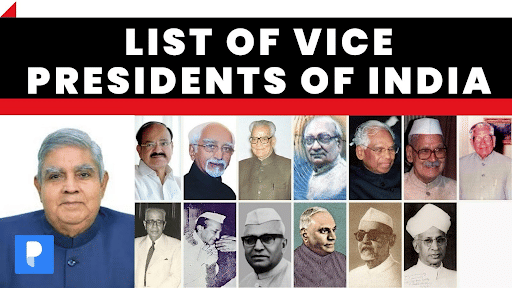
Vice-President of India
| Qualifications |
|
| Oath or Affirmation of the Vice-President |
|
| Conditions of Office |
|
| Terms of Office |
|
| Vacancy | A vacancy in the Vice-President’s office can occur in any of the following ways:
|
| Salary and allowance |
|
Power And Functions Of The Vice-president
- Vice-President acts as the ex-officio chairman of the Rajya Sabha and his powers and functions are similar to those of the speaker of the Lok Sabha.
- In the event of the president's inability to work due to any reasons or a vacancy in the office of the president due to any reason he can act as the president.
- The office was created to maintain continuity in the Indian state, however this is only for 6 months till the next president is elected.
- The Vice President while discharging duty as President, should not preside over Rajya Sabha.
- The Vice-President does not execute the responsibilities of Rajya Sabha Chairman while serving as President or discharging the obligations of President
- During this time, such responsibilities are carried out by the Deputy Chairman of the Rajya Sabha.
Removal Of Vice-president
- A formal impeachment like in the case of the President of India is not required for the removal of Vice-President
- VP can be removed from his office by a resolution raised only in Rajya sabha, passed by effective majority i.e. greater than 50% of (Total membership – Vacancy) & agreed upon by simple majority i.e. greater than 50 % of total voting members of the Lok sabha.
- Prior to passing the resolution in Rajya sabha, a 14 days notice should be served to the Vice-President.
Constitutional Provisions at Glance
- Part V of the Constitution of India discusses the office of the Vice-President of India. Articles 63 to Article 73 deal with the qualifications, election and removal of Vice-President of India.
| Article 63 | states that there shall be a Vice-President of India |
| Article 64 | states that the Vice-President shall be the ex-officio Chairman of the Rajya Sabha |
| Article 65 | states that the Vice-President shall act as President in the event of the occurrence of any vacancy in the office of the President due to death, resignation or removal. |
| Article 66 | deals with provision of Election of the Vice-President. |
| Article 67 | mentions the Term of Office of Vice-President. |
| Article 68 | states about the Vacancy of office of the Vice-President. |
| Article 69 | deals with Oaths & Affirmation by the Vice-President. |
| Article 71 | deals with matters relating to, or connected with, the election of a President and Vice-President. |
Comparison of Vice-President of India with Vice-President of USA
| Aspect | Vice-President of India | Vice-President of USA |
|---|---|---|
| Constitutional Role | Second highest office after President of India | Second-highest officer in the executive branch of the federal government after President |
| Tenure | Five-year term | Five-year term |
| Succession | Acts as President until new President assumes charge. | Assumes presidency until end of term. |
| Election Process | Indirect election by Parliament's electoral college | President and Vice-President are elected in the same election |
| Powers and Responsibilities | Ceremonial functions, limited executive authority | Significant executive authority, advisor to President |
| Role in the Legislature | Serves as the ex-officio Chairman of the Rajya Sabha. | Serves as President of the Senate. |
Conclusion
Vice President plays a crucial role in ensuring the smooth functioning of the Indian Parliament, presides over the Rajya Sabha, and represent the nation on various occasions. Beyond these formal duties, the Vice President serves as a symbol of continuity, stability, and unity within the diverse fabric of Indian society.
FAQs
Q1: What are the qualifications required to become the Vice President of India?
Answer: To become the Vice President of India, a person must be a citizen of India, be at least 35 years old, and be qualified to be elected as a member of the Rajya Sabha. Additionally, the person must not hold any office of profit under the government.
Q2: How is the Vice President of India elected?
Answer: The Vice President of India is elected by an electoral college consisting of members of both houses of Parliament (Lok Sabha and Rajya Sabha). The election is held using the system of proportional representation through a single transferable vote.
Q3: What is the role of the Vice President in the Indian Parliament?
Answer: The Vice President of India serves as the ex-officio Chairman of the Rajya Sabha (Council of States). In this capacity, the Vice President presides over the sessions of the Rajya Sabha and ensures its orderly functioning.
Q4: What happens if the office of the Vice President becomes vacant?
Answer: If the office of the Vice President becomes vacant due to resignation, removal, or death, an election must be held within six months to fill the vacancy. During this interim period, the Deputy Chairman of the Rajya Sabha or another designated official may perform the duties of the Chairman of the Rajya Sabha.
Q5: Can the Vice President act as the President of India?
Answer: Yes, the Vice President can act as the President of India if the office of the President becomes vacant due to resignation, death, removal, or incapacity. The Vice President serves as the Acting President until a new President is elected.
MCQs
- Who is the ex-officio Chairman of the Rajya Sabha?
a) President of India
b) Prime Minister
c) Vice President
d) Speaker of the Lok Sabha
Answer: (C) See the Explanation
- What is the minimum age required to be elected as the Vice President of India?
a) 25 years
b) 30 years
c) 35 years
d) 40 years
Answer: (C) See the Explanation
- How is the Vice President of India elected?
a) Directly by the people
b) By members of the Rajya Sabha only
c) By an electoral college of members of both houses of Parliament
d) By the President of India
Answer: (C) See the Explanation
- In the absence of the President of India, who performs the duties of the President?
a) Prime Minister
b) Chief Justice of India
c) Speaker of the Lok Sabha
d) Vice President
Answer: (D) See the Explanation
- Which article of the Indian Constitution deals with the election of the Vice President?
a) Article 52
b) Article 63
c) Article 64
d) Article 66
Answer: (D) See the Explanation
GS Mains Questions and Model Answers
Q1: Discuss the role and responsibilities of the Vice President of India as the ex-officio Chairman of the Rajya Sabha.
Answer: As the ex-officio Chairman of the Rajya Sabha, the Vice President of India plays a crucial role in ensuring the smooth functioning of the upper house of Parliament. The Vice President presides over the sessions of the Rajya Sabha, maintaining order and discipline during debates. The Chairman ensures that parliamentary procedures are followed, allowing members to speak and participate in discussions while preventing disruptions. Additionally, the Chairman is responsible for interpreting the rules of the Rajya Sabha and making rulings on points of order. However, unlike the Speaker of the Lok Sabha, the Vice President does not vote in the Rajya Sabha except in the case of a tie, where the casting vote becomes decisive. The Vice President also represents the Rajya Sabha in official functions and interactions with the executive and judiciary, thus playing an essential role in maintaining the balance of power in India's federal structure.
Q2: Evaluate the significance of the electoral process used to elect the Vice President of India.
Answer: The electoral process for the Vice President of India, as outlined in Article 66 of the Constitution, reflects the importance of ensuring a balanced representation of both houses of Parliament in the selection of the country's second-highest constitutional office. The Vice President is elected by an electoral college consisting of members from both the Lok Sabha and the Rajya Sabha, using the system of proportional representation through a single transferable vote. This system ensures that the Vice President is elected by a broad consensus of elected representatives, making the process democratic and inclusive. The role of the Vice President as the ex-officio Chairman of the Rajya Sabha further justifies the involvement of both houses in the election process, as the Vice President must effectively manage and maintain the decorum of the upper house. This method of election reinforces the Vice President's position as a neutral figure who can function impartially, especially in the case of presiding over the Rajya Sabha.
Q3: Analyze the constitutional provisions related to the vacancy in the office of the Vice President and the powers exercised during such situations.
Answer: The Constitution of India provides clear guidelines regarding the vacancy in the office of the Vice President. Under Article 65, when the office of the President of India becomes vacant due to death, resignation, removal, or incapacity, the Vice President serves as the Acting President until a new President is elected. During this period, the Vice President exercises all the powers and functions of the President, ensuring the continuity of governance. If the office of the Vice President itself becomes vacant due to similar reasons, an election must be conducted within six months to fill the vacancy. The Deputy Chairman of the Rajya Sabha, or another designated member, performs the duties of the Chairman of the Rajya Sabha during the interim period. These provisions ensure that there is no disruption in the functioning of the highest offices of the state, maintaining constitutional order and stability in the event of a vacancy.
Previous Year Questions on Vice President
1. UPSC CSE 2019
Question: Discuss the role of the Vice President of India as the ex-officio Chairman of the Rajya Sabha.
Answer: As the ex-officio Chairman of the Rajya Sabha, the Vice President of India holds a significant role in managing the legislative proceedings of the upper house of Parliament. The Vice President’s primary responsibility in this capacity is to preside over Rajya Sabha sessions, ensuring that debates are conducted in an orderly manner, and that parliamentary rules are adhered to. The Vice President maintains decorum, allowing members to express their views while preventing unnecessary interruptions. Unlike the Speaker of the Lok Sabha, the Vice President does not participate in debates or vote, except in the case of a tie, where the Chairman’s casting vote becomes crucial. The Chairman’s role is vital in managing the legislative business of the Rajya Sabha, interpreting procedural rules, and facilitating constructive discussions. This position strengthens the federal structure by providing a neutral figure to manage the legislative process.
2. UPSC CSE 2020
Question: Evaluate the importance of the Vice President’s role in the Indian parliamentary system.
Answer: The Vice President’s role in the Indian parliamentary system is integral, both as the second-highest constitutional office and as the ex-officio Chairman of the Rajya Sabha. The Vice President’s primary function is to ensure the smooth functioning of the Rajya Sabha by presiding over its sessions and maintaining order during debates. This role is crucial in upholding the dignity of the upper house, which represents the states in India’s federal structure. The Vice President’s impartiality and authority ensure that legislative processes in the Rajya Sabha are conducted efficiently, allowing for meaningful deliberations on national policies. Additionally, the Vice President serves as a check on the executive, ensuring that the government’s actions are scrutinized in the upper house. In the event of a vacancy in the office of the President, the Vice President’s role becomes even more critical as they assume the responsibilities of the President, ensuring continuity in governance.
*email: contactus@prepp.in
Download the PREPP App and attempt FREE IAS Exam Mock Tests and get complete study material!
Live Test : UPSC IAS : GS - Indian Geography - Subject Knowledge Test

Live Test : UPSC CSE Prelims CSAT (Paper-II) (Oct 08 - 11)
Full Test - 04: UPSC CSE Prelims CSAT (Paper-II)
Full Test - 03: UPSC CSE Prelims CSAT (Paper-II)
UPSC CSE Prelims 2026 GS Paper 1 Question Paper (24-May-2026)
UPSC CSE Prelims 2026 CSAT Paper 2 Question Paper (24-May-2026)

17 February 2025 | The Hindu Must Read Articles | Current Affairs

16 February 2026 | The Hindu Must Read Articles | Current Affairs

13 February 2026 | The Hindu Must Read Articles | Current Affairs









Comments