Prime Minister (Article 75) - Indian Polity Notes
Prime Minister is referred to as the de facto executive as he is the real executive authority. Article 75 says that the Prime Minister shall be appointed by the president. The Prime Minister can be a representative of either House of the Parliament.According to the conventions of the parliamentary form of government, the President must designate the leader of the majority party in the Lok Sabha as Prime Minister. The Council of Ministers, headed by the Prime Minister, is collectively responsible to the Lok Sabha. There have been questions on the topic of the Prime Minister in the UPSC exams earlier. This article explains about the Role, Election, Conditions of Office, Power and functions of the Prime Minister. These nuances are important for upcoming UPSC Prelims as well as the Mains 2024 Exam.
|
Table of Contents |

Prime Minister of India
- The prime minister is both the head of government and the real executive of the Indian system.
- Article 74 states that “There shall be a Council of Ministers with the Prime Minister at the head to aid and advise the President.”
- Article 75 mentions three things:
- The President appoints the PM and other ministers are appointed by the President on the advice of the PM
- Ministers hold their office during the pleasure of the President;
- The Council of Ministers is collectively responsible to the Lok Sabha.
- Article 78 states that the Prime Minister communicates all decisions made by the council of members to the President.
- The President can also refer issues for the consideration of the council of members.
|
Article 75 of the Indian Constitution pertains to the appointment and responsibilities of the Prime Minister of India |
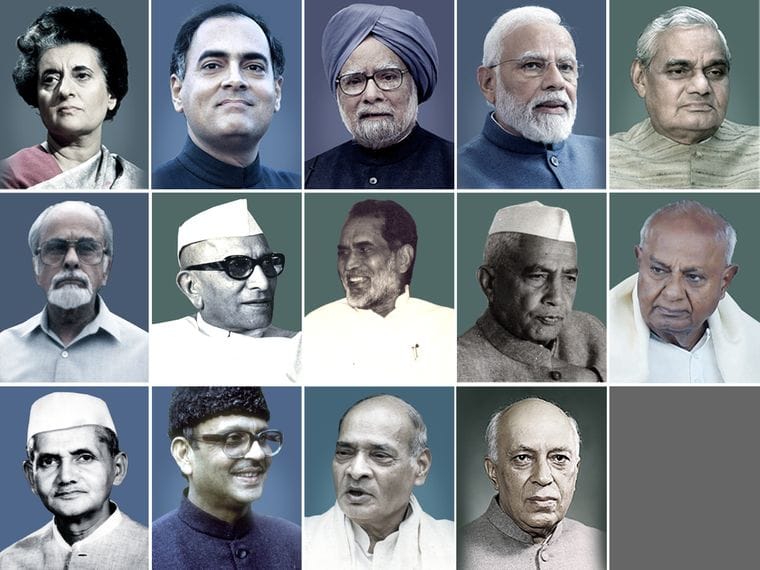
Prime Minister - Union Executive - Appointment
- Indirect election: The Prime Minister is appointed by the President.
- The President must designate the leader of the majority party in the Lok Sabha as Prime Minister in line with the norms of the parliamentary form of government.
- However, if no party has a clear majority in the Lok Sabha, the President may use his own discretion in selecting and appointing the Prime Minister.
- In such a case, the President normally selects the Prime Minister as the leader of the largest party or coalition in the Lok Sabha and instructs him to seek a vote of confidence in the House within a month.
- The President used this discretion for the first time in 1979, when Neelam Sanjiva Reddy (then President) named Charan Singh (the coalition leader) as Prime Minister following the fall of the Janata Party administration led by Morarji Desai.
- There is one further case in which the president may have to use his discretion in selecting and appointing the Prime Minister.
- However, if the governing party elects a new leader after the death of an existing Prime Minister, the President has no choice but to appoint him as Prime Minister.(Appointed Rajiv Gandhi as PM after the death of Indira Gandhi, by then President Zail Singh).
- According to the Constitution, the Prime Minister may serve in either of the two Houses of Parliament.
- Three Prime Ministers, for example, were Rajya Sabha members: Indira Gandhi (1966), Deve Gowda (1996), and Manmohan Singh (2004).
Prime Minister of India - Details
|
Qualifications |
|
|
Oath or Affirmation of the Vice-President |
|
|
Terms of Office |
|
|
Salary and allowance |
|
Power And Functions Of The Prime Minister
With Respect to the Council of Minister
- The PM recommends a person to the President for appointment as ministers.
- Portfolio allocation: The Prime Minister has the ability to appoint Ministers to portfolios.
- Chairman of the Cabinet: The Prime Minister presides over Cabinet sessions as the chairman of the Cabinet.
- If there is a significant difference of opinion among the members, he has the authority to enforce his decision.
- The PM can ask for the resignation of any minister.
- He guides, directs, controls and coordinates the activities of all the ministers.
- If the PM resigned from his office the Council of Ministers get collapsed.
- Representative: The Prime Minister is the country's official representative at high-level international gatherings.
In relation with the President
- Chief Advisor: The PM acts as a principal channel of communication between the President and Council of Ministers.
- He serves as the President's chief advisor.
- The PM has to communicate the decision of the Council of Ministers relating to administration of affairs of the Union and proposal for legislation to the President.
- The PM advises the President regarding appointment of the various important officials like Attorney General, CAG, Chairman and member of the UPSC, Chairman and member of the Finance Commision and so on.
With Respect to the Parliament
- The Prime Minister is the leader of the lower house.
- PM can recommend the President with regard to summoning and proroguing of the sessions of the Parliament.
- He can recommend the dissolution of the Lok Sabha at any time to the President.
- He announces government policies on the floor of the House
Some other functions and powers of the PM
- The PM is the chairman of Niti Aayog, NDC, National Integration Council, National Water Resource Council and Inter-State council.
- The PM also acts as chief spokesman of the Union government.
Constitutional Provisions at Glance
| Article 74 | Council of Ministers to aid and advise President |
| Article 75 | Other provisions as to Ministers |
| Article 77 | Conduct of business of the Government of India |
| Article 78 | Duties of the Prime Minister with respect to the furnishing of information to the President. |
| Article 88 | Rights of Ministers and Attorney-General to take part in the proceeding of the Houses. |
Comparison Between Indian and British Prime Minister
| Aspect | Prime Minister of India | Prime Minister of the United Kingdom |
|---|---|---|
| Appointment | Appointed by the President of India. | Appointed by the Monarch, on the recommendation of the majority party in the House of Commons. |
| Selection Process | Usually the leader of the majority party in the Lok Sabha, or leader of the majority coalition in case of a coalition government. | Leader of the majority party in the House of Commons, or leader of the majority coalition in case of a coalition government. |
| Oath of Office | Takes an oath or affirmation from the President. | Takes an oath of office, usually before the Monarch or the House of Commons. |
| Membership of the House | In India, the prime minister can be a member of either House of the Parliament. | In Britain, the prime minister should be a member of the House of Commons(Lower House) |
| Opportunity for non-members | In India, a person who is not a Member of Parliament can also become Prime Minister but for a maximum period of six months | Members of Parliament alone can be appointed as Prime Minister in Britain. |
Conclusion
India's Prime Minister occupies a central position in the nation's political framework, serving as the head of government and wielding significant power and responsibility. Over the years, Prime Ministers have left their indelible mark on India's socio-economic and political landscape, shaping policies, fostering international relations, and navigating complex domestic issues. Whether it be crafting strategies for economic development, ensuring national security, or promoting social welfare, the Prime Minister's leadership is pivotal in addressing the diverse needs and aspirations of India's vast population.
FAQs
Question: What are the primary functions of the Prime Minister in India?
Answer: The Prime Minister of India is the head of the Union Executive and plays a critical role in decision-making. The PM acts as the chief advisor to the President, leads the Council of Ministers, oversees the functioning of various ministries, represents the country in international forums, and is responsible for implementing laws and policies passed by Parliament.
Question: How is the Prime Minister of India appointed?
Answer: The Prime Minister of India is appointed by the President of India. Usually, the leader of the majority party or coalition in the Lok Sabha (House of the People) is invited to form the government and is appointed as Prime Minister.
Question: What is the difference between the Prime Minister and the President of India?
Answer: The President of India is the ceremonial head of the state, while the Prime Minister is the head of the government. The President performs functions like signing bills into law, but the real executive powers are vested in the Prime Minister and the Council of Ministers, who run the day-to-day operations of the government.
Question: What role does the Prime Minister play in the Cabinet system?
Answer: The Prime Minister is the leader of the Cabinet, responsible for selecting ministers, chairing Cabinet meetings, and guiding the Cabinet in policy formulation. The PM also acts as a liaison between the President and the Cabinet.
Question: Can the Prime Minister be removed from office?
Answer: Yes, the Prime Minister can be removed if they lose the confidence of the majority in the Lok Sabha. A vote of no confidence can be introduced in the Lok Sabha, and if passed, the Prime Minister must resign.
MCQs
1. Who appoints the Prime Minister of India?
A) Chief Justice of India
B) President of India
C) Vice-President of India
D) Speaker of Lok Sabha
Answer: B See the Explanation
Explanation: The Prime Minister of India is appointed by the President. Typically, the leader of the majority party in the Lok Sabha is invited to form the government and is appointed as the Prime Minister.
2. Which body does the Prime Minister head in India?
A) Lok Sabha
B) Supreme Court
C) Union Executive
D) Election Commission
Answer: C See the Explanation
Explanation: The Prime Minister is the head of the Union Executive and leads the Council of Ministers in the day-to-day functioning of the government.
3. Which of the following can lead to the resignation of the Prime Minister?
A) Vote of no confidence
B) Impeachment by the President
C) Removal by the Supreme Court
D) Dissolution of Lok Sabha
Answer: A See the Explanation
Explanation: The Prime Minister must resign if they lose the confidence of the Lok Sabha. This can happen if a vote of no confidence is passed against the Prime Minister and the government.
4. What is the tenure of the Prime Minister in India?
A) 5 years
B) 6 years
C) No fixed tenure
D) 4 years
Answer: C See the Explanation
Explanation: The Prime Minister does not have a fixed tenure. They serve as long as they have the confidence of the majority in the Lok Sabha.
5. Who presides over Cabinet meetings in India?
A) President
B) Speaker
C) Vice-President
D) Prime Minister
Answer: D See the Explanation
Explanation: The Prime Minister presides over Cabinet meetings and leads the Cabinet in policy discussions and decision-making.
GS Mains Questions and Answers
Q1: Discuss the powers and functions of the Prime Minister of India and their significance in the Union Executive.
Answer: The Prime Minister of India is the leader of the Union Executive and holds significant authority in the functioning of the government. The PM advises the President on key matters, heads the Council of Ministers, and is responsible for overseeing the functioning of ministries. The Prime Minister also represents India on international platforms, leads policy formulation, and ensures the implementation of laws. Their role is crucial in maintaining the stability of the government and ensuring effective governance.
Q2: Evaluate the role of the Prime Minister in maintaining the balance of power between the executive and the legislature in India.
Answer: The Prime Minister plays a key role in maintaining the balance of power between the executive and the legislature. As the leader of the executive, the PM ensures that policies are implemented and that the government functions smoothly. At the same time, the PM is accountable to the legislature, particularly the Lok Sabha. The Prime Minister must maintain the confidence of the Lok Sabha to stay in power, ensuring a system of checks and balances between the two branches of government.
Q3: Analyze the process of appointment and removal of the Prime Minister of India and its impact on parliamentary democracy.
Answer: The Prime Minister is appointed by the President of India, usually as the leader of the majority party or coalition in the Lok Sabha. The PM's tenure depends on maintaining the confidence of the majority in the Lok Sabha. If the PM loses this confidence, a vote of no confidence can be passed, leading to their resignation. This process reinforces the principles of parliamentary democracy, ensuring that the executive remains accountable to the legislature.
Previous Year Questions on the Prime Minister and Union Executive
1. UPSC CSE Prelims 2019:
Question: Who among the following is the leader of the Union Executive in India?
A) President
B) Chief Justice
C) Prime Minister
D) Speaker
Answer: C
Explanation: The Prime Minister is the leader of the Union Executive and holds real executive power in India.
2. UPSC CSE Mains 2020 (GS Paper 2):
Question: Discuss the role of the Prime Minister in the effective functioning of the Union Executive in India.
Answer: The Prime Minister plays a central role in the effective functioning of the Union Executive. As the head of the government, the PM coordinates between various ministries, leads policy formulation, and ensures that laws passed by the legislature are implemented. The PM also represents India in diplomatic affairs and is instrumental in maintaining the stability and accountability of the government.
*email: contactus@prepp.in
Download the PREPP App and attempt FREE IAS Exam Mock Tests and get complete study material!

Full Test - 04: UPSC CSE Prelims CSAT (Paper-II)
Full Test - 03: UPSC CSE Prelims CSAT (Paper-II)
UPSC CSE Prelims 2026 GS Paper 1 Question Paper (24-May-2026)
UPSC CSE Prelims 2026 CSAT Paper 2 Question Paper (24-May-2026)

17 February 2025 | The Hindu Must Read Articles | Current Affairs

16 February 2026 | The Hindu Must Read Articles | Current Affairs

13 February 2026 | The Hindu Must Read Articles | Current Affairs









Comments