Council of Ministers (Article 74) - Indian Polity Notes
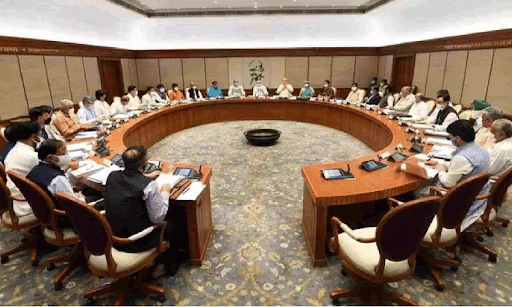
The Council of Ministers, as delineated in Article 74 of the Constitution,is a pivotal body with the Prime Minister at its helm to aid and advise the President who shall, in the exercise of his functions, act in accordance with such advice. The Council of Ministers is made up of the Prime Minister and other Ministers. Cabinet Ministers, Ministers of State, and Deputy Ministers are the three types of ministers. Article 75 deals with the appointment,oath,salaries and allowances of the Ministers.The UPSC Indian Polity and Governance Syllabus includes Council Of Ministers - Union Executive which is described in this article.
Table of Contents
- Historical Background
- Constitutional Provisions
- Formation Of Council Of Ministers
- Qualification Of Minister
- Disqualification Of Minister Due To Defection
- Participation Of Minister In Parliamentary Proceeding
- Salary Of Minister
- Strength Of Council Of Ministers
- Term Of Office Of Council Of Ministers
- Categories Of Ministers
- Power Of Council Of Ministers
- Responsibility Of Council Of Ministers
- Difference Between Council of Ministers and Cabinet
- Conclusion
- FAQs
- MCQs

Council Of Ministers - Union Executive - Historical Background
- The Indian Constitution has borrowed the British Parliamentary form of Government in which the real executive of the Indian Union is the Council of Ministers headed by the Prime Minister, which actually exercises the executive authority, theoretically vested by the Constitution, in the President.
- The ministerial portfolio system was started by Lord Canning in Indian Councils Act 1861.
|
“The Council of Ministers sink and swim together, emphasising the collective responsibility of the Council of Ministers.” “If there are 15ministers, every one of them becomes an indivisible part of the whole Cabinet. The Premier speaks for himself and his Cabinet, and the Ministers for the Cabinet and the Premier.” Shri Mahavir Tyagi |
Council Of Ministers - Union Executive - Constitutional Provisions
| Article 74 |
|
| Article 75 |
|
| Article 77 |
|
| Article 78 | It shall be the duty of the Prime Minister:
|
| Article 88 |
|
Formation Of Council Of Ministers
- The process of formation of the Council of Ministers begins with the appointment of the Prime Minister by the President.
- While appointing the Prime Minister, the President has little opportunity to exercise his own discretion. He has to appoint the leader of the party which secures a majority in the Lok Sabha.
- When no party has a clear majority,in such a situation the President may exercise his discretion.
- Other Ministers are appointed by the President on the advice of the Prime Minister.President can appoint only those persons as ministers who are recommended by the Prime Minister.
Qualification Of Minister
- Minister must be a member of either House of Parliament.
- If a person who is not a member of either House of the Parliament is appointed as a Minister, He/She has to get himself/herself elected to either House of Parliament within six months,otherwise he ceases to be a minister.
Disqualification Of Minister Due To Defection
Also, if a member of Parliament has been disqualified on the ground of defection, he would not be eligible to become a Minister. But if he again gets elected in the next freshly held Parliamentary election then he will be eligible to become a minister.
Participation Of Minister In Parliamentary Proceeding
- The Ministers may be chosen from members of either House.
- A Minister who is a member of one House has a right to speak in and to take part in the proceedings of the other House though he has no right to vote in the house of which he is not a member.
Salary Of Minister
The salaries and allowances of ministers are such as the Parliament may from time to time determined by law.(The salaries and Allowances of Ministers Act 1952). Each minister is entitled to the same pay and allowances as a member of Parliament.
Strength Of Council Of Ministers
- Its size and classification are not mentioned in the Constitution.
- Its size is determined by the Prime Minister according to the exigencies of the time and requirements of the situation.
- But as per 91st Constitutional Amendment Act, 2003, it should not exceed 15% of the total strength of the Lok Sabha.
Term Of Office Of Council Of Ministers
- Article 75(2) specifically provides that the ministers shall hold office during the pleasure of the President.
- The Prime Minister may call for the resignation of any ministers at any time. In case the Minister refuses, the Prime Minister may advise the President to dismiss the Minister.
- When the Prime Minister resigns, the whole Council of Ministers resigns with him.
- As a result, a minister's tenure is not fixed. He/She continues in office as long as the Council of Ministers enjoys the confidence of the Lok Sabha.
Categories Of Ministers
- Council of Ministers is not a single body but a composite body, consisting of ministers of different ranks. The constitution does not classify the members of the Council of Ministers into different ranks. The classification is done informally following British practice.
Cabinet Minister
- They are experienced Ministers who hold very important portfolios like Home, Finance, Defence, Agriculture, Foreign Affairs, etc.
- Their number varies from time to time but it is generally in the range of 15 to 20.
- A Cabinet Minister always heads a Ministry and is given independent charge of it, unless he is appointed a Minister without portfolio. He attends the meeting of the Cabinet on his own right and is generally assisted by a Minister of State or a Deputy Minister or both.
Minister of State
- A Minister of State may be given independent charge of a Ministry.
- He cannot attend the meetings of the Cabinet on his own right but can attend if invited.
Deputy Minister
- A Deputy Minister is a junior member of the Council of Minster and not given independent charge of any department.
- He is put under the charge of either minister of the cabinet rank or that of the Minister of State so that he gets proper training.
- He does not attend a Cabinet meeting.
Power Of Council Of Ministers
Executive Power
- The Council of Ministers exercises all of the President of India's executive functions.
- The Cabinet develops the policies that will be presented to Parliament for approval. It obtains Parliamentary approval for these measures and then implements them. It manages the Union's administration in accordance with authorized policies. All government departments are coordinated and controlled by the Cabinet/Prime Minister. The Cabinet is in charge of formulating foreign policy as well as all domestic policies deemed important for the country's overall development.
- The Council of Ministers is collectively responsible to the Lok Sabha for all of its policies and decisions
Emergency Power
- The President always acts on the recommendation of the Prime Minister and his Council of Ministers when he exercises Emergency Powers.
- Only with the Cabinet's approval the President declare an emergency. In accordance with the Prime Minister's and his Council of Ministers' advice, he takes all necessary steps to address the emergency.
Legislative Power
- Despite the fact that the Union's legislative powers are in the hands of Parliament, the Council of Ministers plays an essential role in the legislative process. Ministers are members of the Parliament as well as heads of government ministries. They participate fully and actively in the legislative process.
- They are the ones who introduce and pilot the majority of the bills. The Parliament spends 95 percent of its time dealing with governmental business, which is overseen by ministers. Because the ministry has the backing of the majority in Parliament, a measure that is not backed by the Council of Ministers cannot be passed.
- If the Lok Sabha passes a bill that the Council of Ministers does not support or rejects a bill that the Council of Ministers supports, or rejects the Cabinet's budget, it is considered a vote of no confidence in the government, and the whole Council of Ministers resigns. While doing so, the Prime Minister/Cabinet might recommend to the President that the Lok Sabha be dissolved.
Responsibility Of Council Of Ministers
Collective Responsibility
- The basic principle of Parliamentary form of Government is the principle of collective responsibility.
- As per Article 75,Council of Ministers is collectively responsible to the Lok Sabha.It means all the ministers own joint responsibility to the Lok Sabha for their acts of omission and commission.
- They swim or sink together,which means they work as a team.
- When a no confidence motion is passed against a Council of Minister, all the ministers have to resign including those who have membership of Rajya Sabha.
- If any minister disagrees with a cabinet decision he has to resign.For example,In 1953, B.R. Ambedkar resigned due to disagreements with his colleagues over the Hindu Code Bill,Arif Mohammed resigned due to his objection to the Muslim Women (Protection of Rights on Divorce) Act in 1989.
Individual Responsibility
- Article 75 includes the principle of individual responsibility along with collective responsibility.
- Individual responsibility means that the President can remove a minister even at a time when the council of ministers enjoys the confidence of the Lok Sabha.
- However, such removal would only occur on the advice of the Prime Minister. If the Prime Minister is unhappy with a minister's performance, he/she can ask the Minister to resign or advise the President to dismiss him/her.
No Legal Responsibility
- The system of legal responsibility is not prescribed in the Indian Constitution.
- In Britain, every of the King for any public act is countersigned by a minister.
- If the order is in violation of any law, the minister would be held responsible and would be liable in the court.
- The king can not be sued in any court but a minister can be.
- In India, an order of the President for a public act should not be countersigned by a minister. It is left to the President to make rules as to how his orders are to be authenticated.
- Further the courts are barred from inquiring into the nature of advice rendered by the ministers.
Position of the Council of Ministers
- In the Indian political system, the Council of Ministers has a significant and central role as the real and powerful executive.
- The Council of Ministers really exercises all of the President of India's powers.
- The Cabinet is the most powerful entity in the Council of Ministers. All of these powers are exercised by the central institution. The Cabinet is in charge of directing, supervising, and controlling the creation of national policies as well as the administration's operations.
- As the maker of all policies, the director of administration and the supreme coordinator of government activity, the Cabinet enjoys an enviable position. It is indeed the steering wheel of the ship of the state. It is the centre of power and the most powerful institution of the Indian political system.
Judgement related to Council of Ministers
- S.R. Chauhan vs State of Punjab (2001): Supreme Court held that a non-member cannot be re-appointed without being elected. However, a Non-member can also become a part of the council of ministers for a maximum of 6 months.
- K.M. Sharma vs Devi Lal & Ors(1990)
- The oath by Devi Lal as Deputy Prime Minister in 1990 was challenged as being unconstitutional as the Constitution provides only for the Prime Minister and other ministers.
- The Supreme Court upheld the oath as valid and stated that describing a person as Deputy PM is descriptive only and such description does not confer on him any powers of PM.
- Description of a minister as Deputy Prime Ministers or any other type of minister such as minister of state or deputy minister of which there is no mention in the Constitution does not vitiate the oath taken by him so long as the substantive part of the oath is correct.
Difference Between Council of Ministers and Cabinet
| Council of Ministers | Cabinet |
|---|---|
| A larger body of about 60 to 70 ministers | A small body of 15 to 20 ministers |
| Includes all three categories of ministers ie. Cabinet Ministers, Minister of State(Independent Charge), and Deputy Ministers. | Includes Cabinet Ministers only. |
| Vested all powers but in theory | It exercises the powers of the Council of Ministers in reality. |
| Its functions are determined by the Cabinet. | It directs the Council of Ministers by taking policy decisions which are binding on all ministers. |
| Implements the decision taken by the Cabinet. | Supervises the implementation of its decisions by the Council of Ministers. |
| It has Constitutional status | Added through the 44th Constitutional Amendment in Article 352. |
| It does not meet as a body to transact government business. | It meets regularly as a body to transact government business. |
Conclusion
The Council of Ministers in India stands as a cornerstone of the governance framework, as enshrined in Article 74 of the Constitution. With the Prime Minister leading this body, it serves as a crucial advisory mechanism to the President, ensuring that executive decisions are made in a consultative manner. Its significance lies in its role as a platform for diverse perspectives, fostering consensus-driven decision-making for the betterment of the country and its citizens.
FAQs
Question: What is the Council of Ministers in the Indian government?
Answer: The Council of Ministers is a body of ministers in the Indian government, headed by the Prime Minister. It includes three categories: Cabinet Ministers, Ministers of State, and Deputy Ministers, and is responsible for advising the President of India and assisting in executive functions.
Question: How is the Council of Ministers appointed?
Answer: The President of India appoints the Council of Ministers on the advice of the Prime Minister. The ministers must be members of Parliament or get elected within six months of their appointment.
Question: What is the role of the Cabinet within the Council of Ministers?
Answer: The Cabinet is the core decision-making body within the Council of Ministers. It consists of senior ministers who head important ministries, and it formulates major policies and decisions regarding the administration and governance of the country.
Question: What is the principle of collective responsibility in the context of the Council of Ministers?
Answer: The principle of collective responsibility means that all members of the Council of Ministers are collectively responsible to the Lok Sabha (the lower house of Parliament). If a vote of no-confidence is passed against the government, all ministers, including the Prime Minister, must resign.
Question: What is the difference between a Cabinet Minister and a Minister of State?
Answer: A Cabinet Minister heads an important ministry and is part of the core decision-making Cabinet. A Minister of State may either assist a Cabinet Minister or have independent charge of a smaller ministry, but they are not part of the core Cabinet.
MCQs
- Who heads the Council of Ministers in India?
a) The President
b) The Prime Minister
c) The Speaker of the Lok Sabha
d) The Chief Justice of India
Answer: (B) See the Explanation
The Prime Minister is the head of the Council of Ministers and leads the executive branch of the Indian government.
- Which article of the Indian Constitution mentions the Council of Ministers' collective responsibility?
a) Article 75
b) Article 52
c) Article 356
d) Article 123
Answer: (A) See the Explanation
Article 75 of the Indian Constitution mentions that the Council of Ministers is collectively responsible to the Lok Sabha.
- The difference between Cabinet Ministers and Ministers of State lies in:
a) Their constitutional duties
b) Their level of seniority and importance in decision-making
c) Their salary structure
d) Their role in judiciary matters
Answer: (B) See the Explanation
Cabinet Ministers are senior and part of the core decision-making body, while Ministers of State assist them or manage smaller ministries independently.
- What happens if the Council of Ministers loses the confidence of the Lok Sabha?
a) Only the Prime Minister resigns
b) The President dismisses the ministers
c) The entire Council of Ministers, including the Prime Minister, must resign
d) New elections are automatically held
Answer: (C) See the Explanation
If the Council of Ministers loses the confidence of the Lok Sabha, the entire government must resign, as they are collectively responsible to the House.
- Who has the authority to appoint the Council of Ministers in India?
a) The Prime Minister
b) The Lok Sabha
c) The President
d) The Supreme Court
Answer: (C) See the Explanation
The President of India appoints the Council of Ministers on the advice of the Prime Minister.
GS Mains Questions and Model Answers
Q1: Critically analyze the role of the Council of Ministers in the functioning of a parliamentary democracy in India.
Explanation: This question requires a critical analysis of how the Council of Ministers operates within the framework of India's parliamentary democracy. The answer should discuss the constitutional provisions that outline the Council’s roles and responsibilities, the principle of collective responsibility, and how the Council functions in collaboration with the legislature. The answer should also highlight the role of the Prime Minister in leading the Council and discuss the checks and balances provided by the parliamentary system, such as votes of no-confidence and question hours.
Q2: Examine the constitutional and political significance of the Cabinet in the governance of India.
Explanation: This question asks for an examination of the Cabinet’s significance in the governance of India. The answer should focus on the Cabinet’s role in policy-making, decision-making, and implementing the executive powers of the government. It should discuss how the Cabinet exercises control over critical ministries, its influence over national security and economic decisions, and its accountability to the Lok Sabha.
Q3: “The Council of Ministers, headed by the Prime Minister, is the real executive authority in India.” Discuss this statement in light of the Indian Constitution.
Explanation: This question requires a discussion of how the Council of Ministers, led by the Prime Minister, holds the real executive power in India. The answer should examine the constitutional provisions that vest executive powers in the Council, its relationship with the President, and the role of the Prime Minister in leading the government. The answer should also explore the collective responsibility of the Council of Ministers to the Lok Sabha and how it influences policy and administration.
Previous Year Questions on Council of Ministers - Union Executive
1. UPSC CSE 2019
Q1: Explain the principle of collective responsibility with reference to the Council of Ministers.
Answer: The principle of collective responsibility, as outlined in Article 75 of the Indian Constitution, means that the entire Council of Ministers is accountable to the Lok Sabha for all decisions taken by the government. If the government loses the confidence of the Lok Sabha through a vote of no-confidence, all ministers, including the Prime Minister, must resign. This principle ensures that the executive remains answerable to the legislature and prevents individual ministers from functioning autonomously without the backing of the government as a whole.
2. UPSC CSE 2018
Q2: Discuss the role of the Cabinet within the Council of Ministers in the Indian political system.
Answer: The Cabinet, consisting of the most senior ministers, plays a central role in the Indian political system. It is the highest decision-making authority within the government, formulating policies and decisions on critical matters such as national security, economic reforms, and foreign affairs. The Cabinet meets regularly to discuss issues and make decisions that guide the functioning of the government. While the Council of Ministers includes all categories of ministers, it is the Cabinet that holds the most significant influence and responsibility in governing the country.
*email: contactus@prepp.in
Download the PREPP App and attempt FREE IAS Exam Mock Tests and get complete study material!

Live Test : UPSC CSE Prelims CSAT (Paper-II) (Oct 08 - 11)
Full Test - 04: UPSC CSE Prelims CSAT (Paper-II)
Full Test - 03: UPSC CSE Prelims CSAT (Paper-II)
UPSC CSE Prelims 2026 GS Paper 1 Question Paper (24-May-2026)
UPSC CSE Prelims 2026 CSAT Paper 2 Question Paper (24-May-2026)

17 February 2025 | The Hindu Must Read Articles | Current Affairs

16 February 2026 | The Hindu Must Read Articles | Current Affairs

13 February 2026 | The Hindu Must Read Articles | Current Affairs









Comments