Union Cabinet - Indian Polity Notes
Union Cabinet is the highest decision-making authority in India’s government system. It includes some of the most experienced ministers chosen by the Prime Minister. It is the chief policy-formulating body of the central government.
|
Table of Contents |

Definition of Cabinet
- The Council of Ministers has an interior body called the Cabinet.
- It acts in the Council of Ministers' name and exercises all of the Council's functions.
- It is the central directing instrument of government in legislation as well as in administration.
- It consists of 15-18 members, who are the senior most and in fact most effective ministers of the council.
| Composition of Cabinet |
|
| Appointment of Cabinet Minister |
|
| Qualification of Cabinet Minister |
|
| Disqualification of Cabinet Minister | Defection:
|
| Term of Office of Cabinet |
|
| Cabinet Meetings |
|
|
“The Cabinet is the steering wheel of the ship of the state” - Ramsay Muir “The Cabinet is the pivot around which the whole political machinery revolves” -Sir John Marriott |
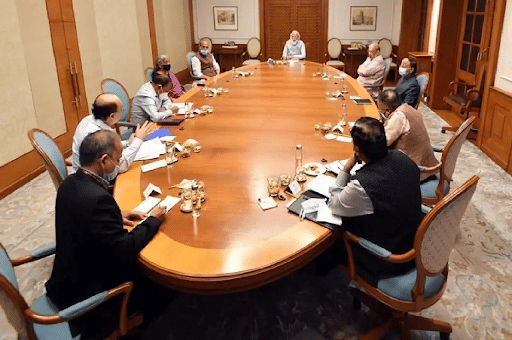
Role of Cabinet
- It is the Cabinet which controls the Parliament and governs the country.
- The Cabinet ministers are the members of the Cabinets, while a Minister of State may attend a Cabinet meeting when matters pertaining to his department are to be discussed.
- Cabinet decides major questions of policies. Its decisions are binding on all ministers.
- The various government departments carry out the cabinet’s policy decision by administering the law and devising measures for enactment as law by Parliament.
- Higher-ranking appointments, such as constitutional authorities and senior secretariat administrators, are under the control of the Cabinet.
- The Cabinet is in charge of all international policy and affairs.
- It is the Cabinet and not the Council of Ministers who advises the President, its advice is binding on him.
Powers And Functions Of Union Cabinet
- The primary functions of the Cabinet is to formulate the policies of the government for the good governance of the country, have it accepted by the legislature and carry on the executive function of the state as per the constitution and the laws.
| Power and Function | Description |
|---|---|
| Executive Power |
|
| Emergency Power |
|
| Legislative Power |
|
| Financial Power |
|
| Other Power |
|
The Cabinet Committee
- To relieve the Cabinet of some burden of work, a Cabinet committee has been set up.
- N. Gopalaswamy on the machinery of Government 1949, recommended setting up a standing committee of Cabinet over defined fields, with appropriate strengthening of the secretariat and other organs of these committees.
- These were the instruments to ‘organise co-ordination on a decentralised basis’. The cabinet committee should cover between them all important areas of governmental activities.
- It is also essential that they meet regularly so that sustained attention is given to complex problems and the progress of implementing important policies and programs is kept under constant review.
- Some important committees are:
| Committees | Description |
|---|---|
| Political Affairs Committee |
|
| Economic Affairs Committee |
|
| Committee on Parliamentary Affairs |
|
| Appointment Committee |
|
Position of the Cabinet
- No other authority has the same power as the cabinet, as long as it has a majority in the house. The primary institution wields all of these authorities.
- The Cabinet enjoys a predominant position in administration.
- As the maker of all policies, the director of administration and the supreme coordinator of government activity, the Cabinet is the efficient part of the government.
- It is indeed the steering wheel of the ship of the state. It is the centre of power and the most powerful institution of the Indian political system.
Kitchen Cabinet/inner-cabinet
- The cabinet, which is led by the prime minister and includes 15 to 20 of the most important ministers, is the highest decision-making body. However, a much smaller body known as the "inner Cabinet" or "Kitchen Cabinet" has emerged as the true power center.
- This informal group includes the Prime Minister and two to four powerful colleagues in whom he has confidence and with whom he can discuss any issue.
- It provides advice to the prime minister on important political and administrative issues and assists him in making important decisions.
- It not only includes cabinet ministers, but also outsiders such as the prime minister's friends and family.
- Kitchen Cabinet is the informal and non-constitutional body (extra-constitutional).
- The ‘kitchen cabinet' notion is not unique to the Indian political and administrative structure; it also exists in the United States and the United Kingdom.
Examples
- Y. B. Chavan, Uma Shanker Dixit, Fakhruddin Ali Ahmed, Dr. Karan Singh, and others were part of Indira Gandhi's "Inner Cabinet," which became known as the "Kitchen Cabinet."
- L. K. Advani, George Fernandes, M. M. Joshi, Pramod Mahajan, and others made up A. B. Vajpayee's "inner cabinet."
Merits and Demerits of Kitchen cabinet
| Merits | Demerits |
|---|---|
|
|
|
|
|
Difference Between Cabinet & Council Of Minister
| Council of Minister | Cabinet | |
|---|---|---|
| Size | It can consist of more than 70. | It varies in number from 15 to 30. |
| Members | It consists of all categories of Ministers in the Parliament i.e., Cabinet Ministers and Ministers of State and also Ministers of State with independent charge. | It consists of Senior Ministers only. |
| Meeting | It rarely meets. | It meets as frequently as possible. |
| Role in policies and Programmes | No role | It determines the policies and programs of the Government |
| Collective Responsibility | It enforces collective responsibility to the lower houses of the parliament | It enforces the collective responsibility of the council to its members |
| Constitutional Status | It is a constitutional body | It was conferred the status of a constitutional body after the passing of the 44th Constitutional Amendment Act of 1978 |
Conclusion
The English Constitution leaves the whole Cabinet system to convention, with the Crown having full authority and Ministers being nothing more than servants of the Crown. It was not initially included in the Indian Constitution, but it was introduced by the 44th Amendment in Article 352. Through its collective wisdom and diverse expertise, it endeavors to address the multifaceted challenges facing the country while fostering development, welfare, and progress. However, there are areas where improvements can be made to ensure greater transparency, efficiency, and inclusivity in its functioning.
FAQs
Question: Is the decision of the Cabinet binding on all ministers?
Answer:
Cabinet decides major questions of policies. Its decisions are binding on all ministers.
Question: What is an Inner Cabinet?
Answer:
Kitchen Cabinet is the informal and non-constitutional body (extra-constitutional), unlike the Council of Ministers which has constitutional status.
It includes not only cabinet ministers but also outsiders such as the prime minister's friends and family.
Question: What is the composition of the Cabinet?
Answer:
The composition of the cabinet is flexible. It is for the Prime Minister to determine from time to time the compositions of the Cabinet, though due to the relative importance of certain departments, their ministers are invariably its members.
Question: What is Cabinet?
Answer:
The Union Cabinet is a smaller executive body that serves as India's top decision-making body. It is the Council's effective policy-making organ. Some of the most experienced ministers are in the Cabinet. As a result, the Prime Minister solicits their feedback on critical subjects.
Question: What is the Committee on Parliamentary Affairs?
Answer:
One of the six cabinet committees in operation is the Committee on Parliamentary Affairs. It oversees the progress of government business in Parliament. It is presided over by the Union Home Minister.
UPSC Mains Practice Questions:
|
MCQs
Question: Which of the following is/are true regarding the Cabinet?
- The Inner Cabinet is smaller than the Kitchen Cabinet.
- Kitchen cabinet may consist of family and friends too.
Which of the statements given above is/are correct?
(a) 1 only
(b) 2 only
(c) Both
(d) None
Answer: (b) See the Explanation
- The Inner Cabinet is also known as the Kitchen Cabinet. Hence statement 1 is incorrect.
- Kitchen Cabinet not only includes cabinet ministers, but also outsiders such as the prime minister's friends and family. Hence statement 2 is correct.
- Therefore (b) is the correct option.
Question: When the annual Union Budget is not passed by the Lok Sabha? (UPSC CSE-2011)
(a) The Budget is modified and presented again
(b) The Budget is referred to the Rajya Sabha for suggestions
(c) The Union Finance Minister is asked to resign
(d) The Prime Minister submits the resignation of the Council of Ministers.
Answer: (d) See the explanation
- If the annual union budget is not passed by the Lok Sabha, it is tantamount to no confidence motion. So, the govt submits the resignation of his council of ministers.
- Therefore (d) is the correct option.
Question: Consider the following statements:(UPSC 2022)
- The Constitution of India classifies the ministers into four ranks viz. Cabinet Minister, Minister of State with Independent Charge, Minister of State and Deputy Minister.
- The total number of ministers in the Union Government, including the Prime Minister, shall not exceed 15 percent of the total number of members in the Lok Sabha.
Which of the statements given above is/are correct?
(a) 1 only
(b) 2 only
(c)Both 1 and 2
(d)Neither 1 nor 2
Answer: (b) See the Explanation
Article 74 provides that there shall be a Council of Ministers with the Prime Minister at the head to aid and advise the President who shall, in the exercise of his functions, act in accordance with such advice.The constitution does not classify the members of the Council of Ministers into different ranks. The classification is done informally following British practice. Statement 1 is incorrect
91st Constitutional Amendment Act, 2003 made amendment in Article 75. According to this amendment, the total number of ministers, including the Prime Minister, in the Council of Ministers shall not exceed 15% of the total strength of the Lok Sabha.Therefore statement 2 is correct.
Therefore (b) is the correct answer.
Question: Out of the following statements, choose the one that brings out the principle underlying the Cabinet form of Government:(UPSC 2017)
(a) An arrangement for minimizing the criticism against the Government whose responsibilities are complex and hard to carry out to the satisfaction of all.
(b) A mechanism for speeding up the activities of the Government whose responsibilities are increasing day by day.
(c) A mechanism of parliamentary democracy for ensuring collective responsibility of the Government to the people.
(d) A device for strengthening the hands of the head of the Government whose hold over the people is in a state of decline.
Answer: (c) See the Explanation
Parliamentary system of government is the one in which the executive is responsible to the legislature for its policies and acts. The Constitution of India provides for a parliamentary form of government, both at the Centre and in the states.The parliamentary form of government is also known as Westminister model of government, responsible government or Cabinet government.
Therefore (c) is the correct answer.
*email: contactus@prepp.in
Download the PREPP App and attempt FREE IAS Exam Mock Tests and get complete study material!

Full Test - 04: UPSC CSE Prelims CSAT (Paper-II)
Full Test - 03: UPSC CSE Prelims CSAT (Paper-II)
UPSC CSE Prelims 2026 GS Paper 1 Question Paper (24-May-2026)
UPSC CSE Prelims 2026 CSAT Paper 2 Question Paper (24-May-2026)

17 February 2025 | The Hindu Must Read Articles | Current Affairs

16 February 2026 | The Hindu Must Read Articles | Current Affairs

13 February 2026 | The Hindu Must Read Articles | Current Affairs









Comments