Cabinet Committees - Indian Polity Notes
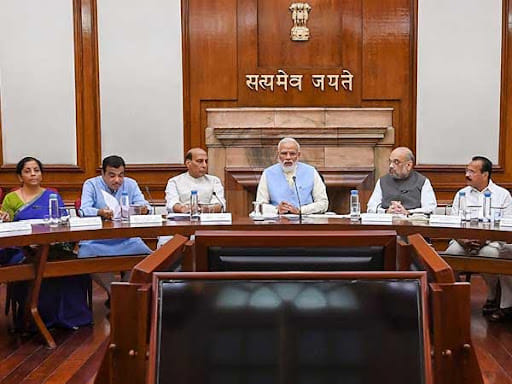
Cabinet Committee is a high-level decision-making body composed of important Cabinet Ministers who deliberate on specific policy matters and provide crucial inputs on major policy issues to the Cabinet. It is an organizational device to reduce the enormous workload of the Cabinet which also facilitates in-depth examination of policy issues and effective coordination. Cabinet Committees are extra-constitutional bodies but are established under Rules of Business. The UPSC Indian Polity and Governance Syllabus includes the Cabinet Committees which are described in this article.
|
Table of Contents |
Cabinet Committees - Features
- They are extra-constitutional in emergence. That is, they are not mentioned in the Constitution. However, the Rules of Business provide for their establishment.
- They are of two types – Standing and Ad hoc. The former is permanent while the latter is temporary.
- The ad hoc committees are constituted from time to time to deal with special problems.
- They are set up by the Prime Minister according to the exigencies of the time and requirements of the situation are disbanded after their task is completed. Hence, their number, nomenclature, and composition vary from time to time.
- The membership of cabinet committees varies from three to eight and usually include only Cabinet Ministers. However, the non-cabinet Ministers are not debarred from their membership.
- They not only include the Ministers in charge of subjects covered by them but also include other senior Ministers.
- They are mostly headed by the Prime Minister. Sometimes other Cabinet Ministers also act as their Chairman. But, in case the Prime Minister is a member of a committee, he invariably presides over it.
- They not only sort out issues and formulate proposals for the consideration of the Cabinet but also take decisions. However, the Cabinet can review their decisions.
|
Cabinet committees are the engines that drive effective governance, where expertise meets strategy, and decisions are crafted with precision and foresight. |
List of Cabinet Committees
At present there are 8 Cabinet Committees:
- Cabinet Committee on Political Affairs.
- Cabinet Committee on Economic Affairs.
- Appointments Committee of the Cabinet.
- Cabinet Committee on Security.
- Cabinet Committee on Parliamentary Affairs.
- Cabinet Committee on Accommodation.
- Cabinet Committee on Investment and Growth.
- Cabinet Committee on Employment and Skill Development.
Cabinet Committees - Functions
Cabinet Committee on Political Affairs.
- It addresses problems related to Centre-state relations.
- It also examines economic and political issues that require a wider perspective but have no internal or external security implications.
Cabinet Committee on Economic Affairs.
- It is supposed to review economic trends, problems and prospects for evolving a consistent and integrated economic policy, coordinate all activities requiring policy decisions at the highest level, deal with fixation of prices of agricultural produce and prices of essential commodities.
- It considers proposals for investment of more than Rs 1,000 crore, deals with industrial licensing policies and reviews rural development and the Public Distribution System.
Appointments Committee of the Cabinet.
- It makes appointments to posts of the three service chiefs, Director General of Military Operations, chiefs of all Air and Army Commands, Director General of Defence Intelligence Agency, etc.
- It decides on all important empanelments and shifts of officers serving on Central deputation.
Cabinet Committee on Security.
- It deals with issues relating to law and order, internal security and policy matters concerning foreign affairs with internal or external security implications and also goes into economic and political issues related to national security.
- It considers all cases involving capital defence expenditure more than Rs 1,000 crore and also issues related to the Department of Defence Production and the Department of Defence Research and Development, Services Capital Acquisition plans and schemes for procurement of security-related equipment.
Cabinet Committee on Parliamentary Affairs.
- It draws the schedule for Parliament sessions and monitors the progress of government business in Parliament.
- It scrutinises non-government business and decides which official Bills and resolutions are to be presented.
- Of all the Cabinet Committees, the most powerful is the Political Affairs Committee, often described as a Super-Cabinet.
Cabinet Committee on Accommodation.
- It determines the guidelines or rules with regard to the allotment of government accommodation.
- It also takes a call on the allotment of government accommodation to non-eligible persons and organizations as also the rent to be charged from them.
- It can consider the allotment of accommodation from the General Pool to Members of Parliament.
- It can consider proposals for shifting existing Central Government Offices to locations outside the capital.
- Currently, the Cabinet Committee on Accommodation is headed by the Home Minister and the Cabinet Committee on Parliamentary Affairs is the Defence Minister.
Cabinet Committee on Investment and Growth.
- It will identify key projects required to be implemented on a time-bound basis, involving investments of Rs 1,000 crore or more, or any other critical projects, as may be specified by it, with regard to infrastructure and manufacturing.
- It will prescribe time limits for giving requisite approvals and clearances by the ministries concerned in identified sectors and will also monitor the progress of such projects.
Cabinet Committee on Employment and Skill Development
- It is supposed to provide direction to all policies, programs, schemes and initiatives for skill development aimed at increasing the employability of the workforce for effectively meeting the emerging requirements of the rapidly growing economy and mapping the benefits of demographic dividend.
- It is required to enhance workforce participation, foster employment growth and identification, and work towards the removal of gaps between requirements and availability of skills in various sectors.
- It will set targets for expeditious implementation of all skill development initiatives by the ministries and periodically review the progress in this regard.
- The Cabinet Committees except for Cabinet Committee on Accommodation and Cabinet Committee on Parliamentary Affairs is headed by Prime Minister.
Criticism Of Cabinet Committees
- Sometimes, they are established on very trivial issues.
- Non-cabinet ministers are rarely appointed and memberships depend more on political considerations.
Cabinet Committees In News
- The Cabinet Committee on Economic Affairs, chaired by the Prime Minister has approved the increase in the Minimum Support Prices (MSP) for all mandated Rabi Crops for Marketing Season 2024-25. It is in line with the recommendation of the Commission of Agricultural Costs and Prices (CACP), a statutory body that advises the government on the pricing policy for major farm produce.
- The Cabinet Committee on Economic Affairs has approved a new Central Sector Scheme “PM Vishwakarma” with a financial outlay of Rs.13,000 crore. The scheme aims to strengthen and nurture the Guru-Shishya parampara or family-based practice of traditional skills by artisans and craftspeople, to ensure that the Vishwakarmas are integrated with the domestic and global value chains.
Conclusion
Cabinet Committees have been described as the ‘engine-room of government’. As the workload of the government increases, decisions taken here have the same status as those taken in full cabinet, with only the most important referred back to Cabinet for confirmation. Thus, Cabinet Committees hold an important position in Indian Democracy.
FAQs
Question: What are Cabinet Committees?
Answer: Cabinet Committees are small groups of ministers that are tasked with addressing specific government functions or issues that require collective decision-making. They help in dividing the workload of the Cabinet and provide detailed consideration of specific areas such as economic affairs, political matters, or national security. These committees may either be standing or ad-hoc, depending on the needs of the government.
Question: How many types of Cabinet Committees are there?
Answer: There are two types of Cabinet Committees: standing committees, which are permanent, and ad-hoc committees, which are temporary and created to deal with specific tasks or issues. Standing committees deal with issues of ongoing importance, while ad-hoc committees are dissolved once their specific objective has been achieved.
Question: What is the role of the Cabinet Committee on Economic Affairs (CCEA)?
Answer: The Cabinet Committee on Economic Affairs (CCEA) is responsible for making decisions on economic policies and issues that have significant financial implications. This includes approving large infrastructure projects, foreign direct investments, and policies related to sectors like agriculture, industry, and finance. The CCEA is one of the most important committees in the Cabinet.
Question: Who appoints the members of the Cabinet Committees?
Answer: The Prime Minister of India appoints the members of the Cabinet Committees. The composition of these committees usually includes senior ministers from various ministries depending on the specific focus of the committee. The Prime Minister may also be a member or chairperson of some key committees.
Question: What is the significance of the Cabinet Committee on Security (CCS)?
Answer: The Cabinet Committee on Security (CCS) is one of the most critical committees responsible for matters related to national security, defense, and internal security. It deals with policy matters concerning defense procurement, nuclear energy, and other issues related to the country’s security. The Prime Minister typically chairs the CCS, and it includes ministers from the defense, home, finance, and external affairs ministries.
MCQs
1. Which of the following is a function of the Cabinet Committee on Economic Affairs (CCEA)?
A) Managing internal security
B) Approving large infrastructure projects
C) Overseeing national defense
D) Conducting foreign diplomacy
Answer: B See the Explanation
Explanation: The CCEA deals with economic issues, including the approval of large infrastructure projects, foreign direct investments, and policy matters related to finance, industry, and agriculture.
2. Who chairs the Cabinet Committee on Security (CCS)?
A) Home Minister
B) Finance Minister
C) Prime Minister
D) Defense Minister
Answer: C See the Explanation
Explanation: The Prime Minister chairs the Cabinet Committee on Security (CCS), which deals with matters related to national security, defense, and nuclear policies.
3. Which of the following is NOT a standing Cabinet Committee?
A) Cabinet Committee on Political Affairs
B) Cabinet Committee on Economic Affairs
C) Cabinet Committee on Sports
D) Cabinet Committee on Security
Answer: C See the Explanation
Explanation: The Cabinet Committee on Sports does not exist. However, the Cabinet Committee on Political Affairs, Economic Affairs, and Security are important standing committees of the Cabinet.
4. What is the purpose of Cabinet Committees in the Indian political system?
A) To manage local government matters
B) To divide the workload of the Cabinet and make collective decisions on specific issues
C) To oversee the judiciary
D) To conduct foreign relations
Answer: B See the Explanation
Explanation: Cabinet Committees are designed to divide the workload of the Cabinet by focusing on specific issues that require collective decision-making, such as economic affairs or national security.
5. Which of the following is true about ad-hoc Cabinet Committees?
A) They are permanent and have no time limits
B) They are temporary and created to deal with specific issues
C) They manage foreign policy
D) They are responsible for approving the Union Budget
Answer: B See the Explanation
Explanation: Ad-hoc Cabinet Committees are temporary and created for a specific purpose or issue. Once the issue is resolved, these committees are dissolved.
GS Mains Questions and Answers
Q1: Discuss the significance of Cabinet Committees in the Indian political system. How do they help in the decision-making process of the government?
Answer: Cabinet Committees play a vital role in the Indian political system by streamlining the decision-making process of the government. These committees are small groups of ministers that focus on specific areas such as economic affairs, national security, and political issues. By dividing the workload of the Cabinet, these committees allow for more in-depth deliberation on key policy matters and ensure timely decisions.
Cabinet Committees, especially standing ones like the Cabinet Committee on Economic Affairs (CCEA) and the Cabinet Committee on Security (CCS), handle matters that are critical for the smooth functioning of the government. These committees bring together ministers from relevant ministries, promoting inter-departmental coordination and allowing for specialized attention to issues. Additionally, they help in reducing the burden on the Cabinet by addressing issues at a more granular level before escalating them to the full Cabinet for final approval.
In summary, Cabinet Committees enhance efficiency, allow for focused decision-making, and ensure that key policy matters receive the necessary attention without overwhelming the entire Cabinet.
Q2: Analyze the role of the Cabinet Committee on Economic Affairs (CCEA) in shaping India’s economic policies.
Answer: The Cabinet Committee on Economic Affairs (CCEA) plays a crucial role in shaping India’s economic policies by focusing on matters related to economic development, investment approvals, and financial policies. The CCEA is responsible for approving large-scale infrastructure projects, making decisions on foreign direct investments (FDI), and resolving issues related to industries such as agriculture, energy, and manufacturing.
In addition to managing key sectors, the CCEA oversees the implementation of major economic reforms and policies that have significant financial implications. Its decisions often influence government spending, investment in critical sectors, and the overall direction of the country’s economic growth. The CCEA’s role is instrumental in ensuring that India’s economic policies align with its broader developmental goals, making it a key player in the decision-making process of the government.
Q3: Evaluate the importance of the Cabinet Committee on Security (CCS) in managing national security issues in India.
Answer: The Cabinet Committee on Security (CCS) is one of the most important Cabinet Committees in India, responsible for managing national security and defense-related issues. The CCS deals with matters related to defense procurement, nuclear policies, and internal security, ensuring that the government is prepared to handle both external and internal threats.
The CCS plays a key role in decision-making on military strategy, border security, and counter-terrorism efforts. It includes top ministers such as the Prime Minister, Defense Minister, Home Minister, and Finance Minister, ensuring that all aspects of national security are addressed in a holistic manner. In times of crisis, the CCS provides timely guidance and strategic direction, making it a cornerstone of India’s national security apparatus.
Previous Year Questions on Cabinet Committees
1. UPSC CSE Prelims 2020:
Question: Which of the following Cabinet Committees is responsible for approving large infrastructure projects?
A) Cabinet Committee on Political Affairs
B) Cabinet Committee on Security
C) Cabinet Committee on Economic Affairs
D) Cabinet Committee on Parliamentary Affairs
Answer: C
Explanation: The Cabinet Committee on Economic Affairs (CCEA) is responsible for approving large infrastructure projects and other economic policies with significant financial implications.
2. UPSC CSE Mains 2019 (GS Paper 2):
Question: "Cabinet Committees play a crucial role in the governance and administration of India." Discuss with reference to their structure, functions, and significance.
Answer: Cabinet Committees are an integral part of India’s governance system. They are small groups of ministers tasked with focusing on specific areas of government functioning, such as economic affairs, political issues, and national security. The structure of these committees allows for more detailed and efficient decision-making by dividing the Cabinet’s workload. Standing committees, such as the Cabinet Committee on Economic Affairs (CCEA) and the Cabinet Committee on Security (CCS), address ongoing issues, while ad-hoc committees are created to deal with specific, temporary matters.
Cabinet Committees provide a forum for ministers to deliberate on important matters in detail before making collective decisions. They ensure that crucial issues receive specialized attention and are discussed comprehensively before being presented to the full Cabinet for approval. This system enhances the overall efficiency of the government and ensures that the country’s governance and administration are streamlined and effective.
*email: contactus@prepp.in
Download the PREPP App and attempt FREE IAS Exam Mock Tests and get complete study material!

Full Test - 04: UPSC CSE Prelims CSAT (Paper-II)
Full Test - 03: UPSC CSE Prelims CSAT (Paper-II)
UPSC CSE Prelims 2026 GS Paper 1 Question Paper (24-May-2026)
UPSC CSE Prelims 2026 CSAT Paper 2 Question Paper (24-May-2026)

17 February 2025 | The Hindu Must Read Articles | Current Affairs

16 February 2026 | The Hindu Must Read Articles | Current Affairs

13 February 2026 | The Hindu Must Read Articles | Current Affairs









Comments