Parliamentary Committees - Indian Parliament - Indian Polity Notes
Parliamentary committees play a crucial role in scrutinizing government actions, policies, and expenditures and assist in ensuring transparency and accountability in governance. They are of two kinds; Standing Committees and Ad hoc Committees. The composition and authority of parliamentary committees vary depending on their mandate. The UPSC Indian Polity and Governance Syllabus includes the topic Parliamentary Committees which is described in this article.
Table of Contents
- Parliamentary Committee
- Constitutional Provisions about Parliamentary Committees
- Classification of Parliamentary Committees
- Why There Is a Need for Parliamentary Committees?
- Challenges Faced by Parliamentary Committees
- Steps Need to be Taken to Increase the Effectiveness of Parliamentary Committees
- Conclusion
- FAQs
- MCQs

What is Parliamentary Committee?
- Parliamentary Committee is defined as a committee that is appointed or elected by the House or nominated by the Speaker or Chairman and which works under the direction of the Speaker of Lok Sabha or Chairman of Rajya Sabha.
- They present their report to the respective Houses.
- Consultative committees are not the parliamentary Committees though they also consist of members of Parliament as they do not fulfill the above given conditions.
|
“Democracy is not about making speeches. It is about making committees work.” “Parliamentary democracy would be incomplete without Parliamentary committees, and scrutiny of public accounts by the people’s representatives plays an important role in ensuring accountability, which is central to governance.” Honourable Former President Ram Nath Kovind |
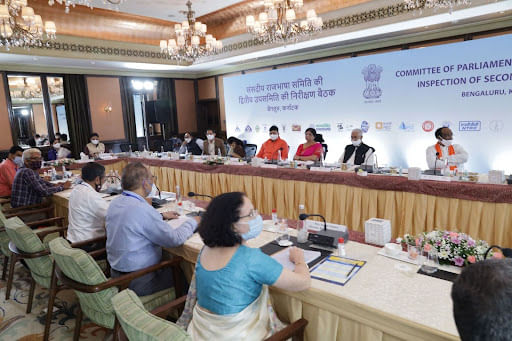
Constitutional Provisions about Parliamentary Committees
- We find mention of these committees at different places in the Constitution of India but no specific provisions have been given about their composition, tenure, functions etc. All these matters are dealt by the rules of the two Houses.
- Article 105 is about the powers and privileges of the Houses of Parliament and of the members and committees thereof.
Classification of Parliamentary Committees
- Parliamentary Committees are of two types: Standing Committees and Ad hoc Committees.
Standing Committees
- They are permanent and regular committees that are constituted from time to time in pursuance of the provisions of an Act of Parliament or Rules of Procedure and Conduct of Business in Lok Sabha.
- The work of these Committees is of continuous nature.
- Financial Committees, Departmentally Related Standing Committees and Committees to scrutinize and control are examples of Standing Committees.
a) Financial Committees
| Areas of comparison | Public Accounts Committee | Estimates Committee | Committee on Public Undertakings |
|---|---|---|---|
| Set up first | 1921 | 1950 | 1964 |
| Strength | 22 (15LS + 7RS) | 30 | 22 (15LS + 7RS) |
| Appointment | Elected as per the principle of proportional representation. | Elected by Lok Sabha only as per the principle of proportional representation. | Elected as per the principle of proportional representation. |
| Minister | Can not be elected as member of the Committee | Can not be elected as member of the Committee | Can not be elected as member of the Committee |
| Tenure | 1 year | 1 year | 1 year |
| Chairman | From opposition parties | Invariably from ruling party | From amongst members which are drawn from Lok Sabha |
| Functions | Examines annual audit reports of the CAG. | Examines the estimates included in the budget and suggest ‘economies’ in public expenditure. | Examines the reports and accounts of Public Undertakings. |
b) Departmental Standing Committees (24)
On the recommendations of the Rules Committee of the Lok Sabha,17 Departmental Standing Committees were set up in 1993. In 2004, their number was increased to 24. They assist the Parliament to ensure better financial accountability of the executive. Each consists of 31 nominated members (21 from Lok Sabha and 10 from Rajya Sabha)
| Committees under Rajya Sabha | Committees under Lok Sabha |
|---|---|
|
|
| Committees to Inquire |
|
| Committees to Scrutinize and Control |
|
| Committees Relating to the Day-to-Day Business of the House |
|
| House-Keeping committees or Service committees |
|
Ad hoc Committees
- Ad hoc Committees are appointed for a specific purpose and they cease to exist when they finish the task assigned to them and submit a report.
- They can be further divided into two categories: Inquiry Committees and Advisory Committees.
- Inquiry Committees
- Inquiry Committees are constituted from time to time, either by the two Houses on a motion adopted or by the Speaker or Chairman to inquire into and report on specific subjects.
- Committee on Members of Parliament Local Area Development Scheme (MPLADS), Joint Committee on Bofors Contract, Joint Committee on Fertilizer Pricing and Joint Committee on Stock Market Scam are some of the examples of Inquiry Committees.
- Advisory Committees
- They include select or joint Committees on bills, which are appointed to consider and report on particular bills.
Why There Is a Need for Parliamentary Committees?
- Assistance to Parliament in its Functioning: The functions of the Parliament are varied, complex and voluminous. Moreover, it has neither enough time nor expertise to make detailed scrutiny of legislation. Therefore it assists the Parliament in the discharge of its duties.
- Scrutiny and Oversight: Committees provide a forum for detailed examination and scrutiny of proposed legislation and government policies. Therefore they serve as a crucial mechanism for holding the executive accountable.
- Expertise and Specialization: Committees often consist of members with expertise or experience in specific areas, allowing for in-depth discussions and informed decision-making on complex issues.
- Investigation and Inquiry: Committees can conduct inquiries and investigations into matters of public interest, such as government spending, alleged misconduct, or policy failures.
- Public Engagement: Committees provide a platform for public engagement and participation in the legislative process. They often invite submissions from stakeholders, experts, and the general public, allowing diverse perspectives to be considered in decision-making.
- Efficiency and Focus: By delegating specific tasks to committees, parliament can operate more efficiently and focus on broader legislative priorities. Committees can conduct detailed examinations of issues without burdening the entire legislative body with the minutiae of every issue.
- Cross-Party Cooperation: Committees often operate on a cross-party basis, fostering cooperation and consensus-building among members with different political affiliations. This can lead to more balanced and well-rounded decision-making.
Challenges Faced by Parliamentary Committees
- Resource Constraints: Parliamentary committees often face resource constraints in terms of staff, budget, infrastructure and research support.
- Overlapping Jurisdiction: There can be overlapping jurisdiction among different committees, leading to confusion and duplication of efforts.
- Political Interference: Pressure from political parties or government officials may influence the agenda, composition, or findings of the committees.
- Lack of Expertise: Committees may lack the necessary expertise and experience to effectively scrutinize complex policy matters or technical issues.
- Non-Attendance of Members: Low attendance rates may result in quorum issues and compromise the quality of deliberations and decision-making.
- Limited Powers: Parliamentary committees in India often have limited powers compared to their counterparts in other countries. Their ability to summon witnesses, compel the production of documents, or enforce recommendations may be constrained, reducing their effectiveness.
- Implementation of Recommendations: Even if committees make valuable recommendations, these are not binding on the Executive. Resistance from government agencies, lack of follow-up mechanisms, or changing political priorities can hinder the translation of recommendations into concrete actions.
- Decline in Referral of Bills to Parliamentary Committees: As per data from PRS, during the 17th Lok Sabha, only 14 Bills have been referred to the Parliamentary Committees as compared to 71% and 60% in the 15th and 14th Lok Sabha respectively.
Steps Need to be Taken to Increase the Effectiveness of Parliamentary Committees
- Provide adequate resources to parliamentary committees, including staff support, research facilities, and funding, to enable them to carry out their functions effectively.
- Empowering them to summon witnesses, compel the production of documents, or enforce recommendations.
- The National Commission to Review the Working of the Constitution (NCRWC) has recommended that India should also follow the British practice of referring of all bills except money bills automatically to the parliamentary committees.
- Encourage non-partisanship in the functioning of parliamentary committees to promote objective scrutiny and evaluation of government policies and actions.
Conclusion
Parliamentary committees play a pivotal role in the democratic governance structure of India. They serve as vital instruments for scrutinizing government actions, reviewing policies, and ensuring accountability. However, to maximize their effectiveness, it is imperative to enhance their resources, independence, public visibility, and participation.
FAQs
Q1: What are parliamentary committees?
Answer: Parliamentary committees are sub-groups formed within the Parliament of India to assist in the legislative process. They focus on specific areas such as finance, health, and education, enabling detailed examination and discussion of issues beyond the capabilities of the full House.
Q2: What is the significance of parliamentary committees in the legislative process?
Answer: Parliamentary committees play a crucial role in scrutinizing legislation, ensuring accountability of the executive, and facilitating informed decision-making. They gather evidence, conduct inquiries, and provide recommendations, which help improve the quality of laws and policies.
Q3: What are the main types of parliamentary committees in India?
Answer: The main types of parliamentary committees in India include standing committees, ad hoc committees, and joint committees. Standing committees are permanent and focus on specific subjects, while ad hoc committees are temporary and formed for a particular purpose. Joint committees consist of members from both Houses of Parliament.
Q4: How are members appointed to parliamentary committees?
Answer: Members of parliamentary committees are appointed based on their expertise and interest in specific areas. The Speaker of the Lok Sabha and the Chairman of the Rajya Sabha nominate members, often considering party representation and seniority.
Q5: What are some challenges faced by parliamentary committees in India?
Answer: Challenges faced by parliamentary committees include limited time for discussions, insufficient resources, and a lack of participation from members. Additionally, political pressures and party affiliations can influence the effectiveness of committee recommendations and their implementation.
MCQs
- What is the primary function of parliamentary committees?
a) To draft new laws
b) To conduct detailed examinations of policies
c) To represent the public in Parliament
d) To oversee the judiciary
Answer: (B) See the Explanation
- Which of the following is a type of standing committee?
a) Public Accounts Committee
b) Joint Select Committee
c) Ad hoc Committee
d) Legislative Assembly Committee
Answer: (A) See the Explanation
- How are the chairpersons of parliamentary committees typically appointed?
a) Elected by the general public
b) Nominated by the Prime Minister
c) Appointed by the Speaker of the Lok Sabha or the Chairman of the Rajya Sabha
d) Chosen by committee members
Answer: (C) See the Explanation
- What is the term used for temporary committees formed for specific purposes in Parliament?
a) Standing committees
b) Ad hoc committees
c) Joint committees
d) Select committees
Answer: (B) See the Explanation
- Which challenge significantly affects the effectiveness of parliamentary committees in India?
a) Excessive funding
b) Over-representation of opposition
c) Limited time for discussions
d) Lack of interest in legislative matters
Answer: (C) See the Explanation
GS Mains Questions and Model Answers
Q1: Evaluate the role of parliamentary committees in enhancing the accountability of the executive in India.
Answer: Parliamentary committees play a pivotal role in enhancing the accountability of the executive in India by providing a platform for scrutiny and oversight. These committees review policies, budgets, and administrative actions taken by the government, thereby ensuring transparency and accountability. By examining the execution of government programs, they can identify inefficiencies and suggest improvements. Furthermore, committee reports often highlight issues of public concern, pushing the government to address these matters. This mechanism helps to bridge the gap between the legislature and the executive, fostering a system of checks and balances essential for a healthy democracy. The work of committees contributes to informed legislative processes and enhances public trust in governance by ensuring that government actions are subject to thorough examination and critique.
Q2: Discuss the challenges faced by parliamentary committees in India and suggest measures to improve their effectiveness.
Answer: Parliamentary committees in India face several challenges that hinder their effectiveness. These include limited time for discussions, insufficient resources for research, and political pressures that may influence their functioning. Additionally, the participation of members can vary, with some showing a lack of interest in committee work. To improve effectiveness, measures such as enhancing training for committee members, increasing staff support, and providing better resources for research can be implemented. Furthermore, establishing clear timelines for the completion of reports and fostering a culture of accountability within committees can encourage more active participation. Regularly reviewing the performance of committees can also help identify areas for improvement, ultimately leading to more robust and impactful parliamentary oversight.
Q3: Analyze the significance of joint parliamentary committees in the legislative process of India.
Answer: Joint parliamentary committees (JPCs) hold significant importance in the legislative process of India as they bring together members from both Houses of Parliament to examine specific issues comprehensively. This collaborative approach allows for diverse perspectives and expertise, fostering in-depth discussions that enhance the quality of legislative scrutiny. JPCs are particularly effective in dealing with complex issues that require detailed investigation, such as policy implementation and major national concerns. Their ability to conduct hearings, gather evidence, and make informed recommendations contributes to more balanced and equitable legislation. Moreover, the formation of JPCs reflects a commitment to collaborative governance and collective accountability, essential elements in a democratic system. Their reports often influence public policy and legislative decisions, demonstrating their critical role in shaping the direction of governance in India.
Previous Year Questions on Parliamentary Committees
1. UPSC CSE Prelims 2022
Question: Which of the following statements is true regarding parliamentary committees in India?
a) They cannot summon witnesses.
b) They consist of members from only one house of Parliament.
c) They play a role in examining the budget.
d) They are formed only during the budget session.
Answer: c) They play a role in examining the budget.
Explanation: Parliamentary committees are instrumental in examining the budget and other financial matters, providing detailed scrutiny and recommendations for legislative processes.
2. UPSC CSE Mains 2020
Question: Discuss the importance of the Public Accounts Committee in the Indian Parliament.
Answer: The Public Accounts Committee (PAC) is vital for ensuring governmental accountability and transparency in India. It reviews the public expenditure and the audit reports presented by the Comptroller and Auditor General (CAG), scrutinizing the financial activities of the government. The PAC examines whether funds have been utilized effectively and in accordance with the law, thereby identifying irregularities and inefficiencies. Its recommendations play a crucial role in improving financial governance and public resource management. By holding the executive accountable for its financial decisions, the PAC helps to reinforce the principles of democratic governance and fiscal responsibility. The committee’s work ensures that the government remains answerable to the Parliament and, by extension, to the public, thereby enhancing public trust in governmental operations.
*email: contactus@prepp.in
Download the PREPP App and attempt FREE IAS Exam Mock Tests and get complete study material!

Full Test - 04: UPSC CSE Prelims CSAT (Paper-II)
Full Test - 03: UPSC CSE Prelims CSAT (Paper-II)
UPSC CSE Prelims 2026 GS Paper 1 Question Paper (24-May-2026)
UPSC CSE Prelims 2026 CSAT Paper 2 Question Paper (24-May-2026)

17 February 2025 | The Hindu Must Read Articles | Current Affairs

16 February 2026 | The Hindu Must Read Articles | Current Affairs

13 February 2026 | The Hindu Must Read Articles | Current Affairs









Comments