Budgetary process in parliament - Indian Polity Notes
Budgetary process in Parliament generally starts in the third quarter of the financial year. It consists of four distinct stages budget preparation, budget authorization, budget execution and accountability. As per Article 112 of the Constitution, the Budget or the Annual Financial Statement contains the estimated receipts and expenditures of the Government of India.
This article will help you to understand the nuances of budgetary process which is important for the UPSC IAS exam.
Table of Contents

Budget in Parliament
- The budget is a statement of receipts and expenditures of the Government of India in a financial year, which begins on 1 April and ends on 31 March of the following year.
- The Constitution of India refers budget as the "annual financial statement under Article 112 of the Consitution.
- The term "budget" appears nowhere in the Constitution. It is the popular name for 'annual financial statement.
- Overall the budget contains the following elements
- Estimates of revenue and capital receipts
- Ways and means to raise the revenue
- Estimates of expenditure
- Details of the actual receipts and expenditures of the closing financial year and reasons for any deficit or surplus
- Economic and financial policy of the upcoming year
- The central government merged the Railway Budget with the Union Budget, from the financial year 2017-18. In 1924, the Railway Budget was separated from the General Budget on the recommendations of the Acworth Committee Report.
- The Department of Economic Affairs under the Ministry of Finance is responsible for the preparation of the Union Budget.
|
Article 112 mandates the President to present before Parliament a statement of estimated receipts and expenditure of the Government of India for every financial year, known as the Union Budget. |
Constitutional Provisions about Budgetary Process
| Article | Subject Matter |
|---|---|
| Article 112 | Mandates the President to present before Parliament a statement of estimated receipts and expenditure of the Government of India for every financial year, known as the Union Budget. |
| Article 113 | No demand for a grant shall be made except on the recommendation of the President. |
| Article 114 | No money shall be withdrawn from the Consolidated Fund of India except under appropriation made by law. |
| Article 115 | Allows Parliament to provide for supplementary, additional, or excess grants for government expenditure during the financial year beyond what was originally budgeted. |
| Article 116 | Empower Parliament to make grants in advance for part of the financial year if the budget process is not completed before the beginning of the financial year. It covers temporary provisions for government expenditure. |
| Article 117 | Categorizes financial bills into three types and specifies the procedures for introducing and passing these bills in Parliament. |
| Article 118 | Specifies the procedure for the introduction and passing of financial bills, ensuring proper parliamentary scrutiny and approval. |
Budget Making Process in Parliament
The budget goes through the following six stages in the Parliament
- Presentation of the budget
- General Discussion
- Scrutiny by departmental committees
- Voting on demands for grants
- Passing on appropriation bill
- Passing of finance bill
Presentation of the budget
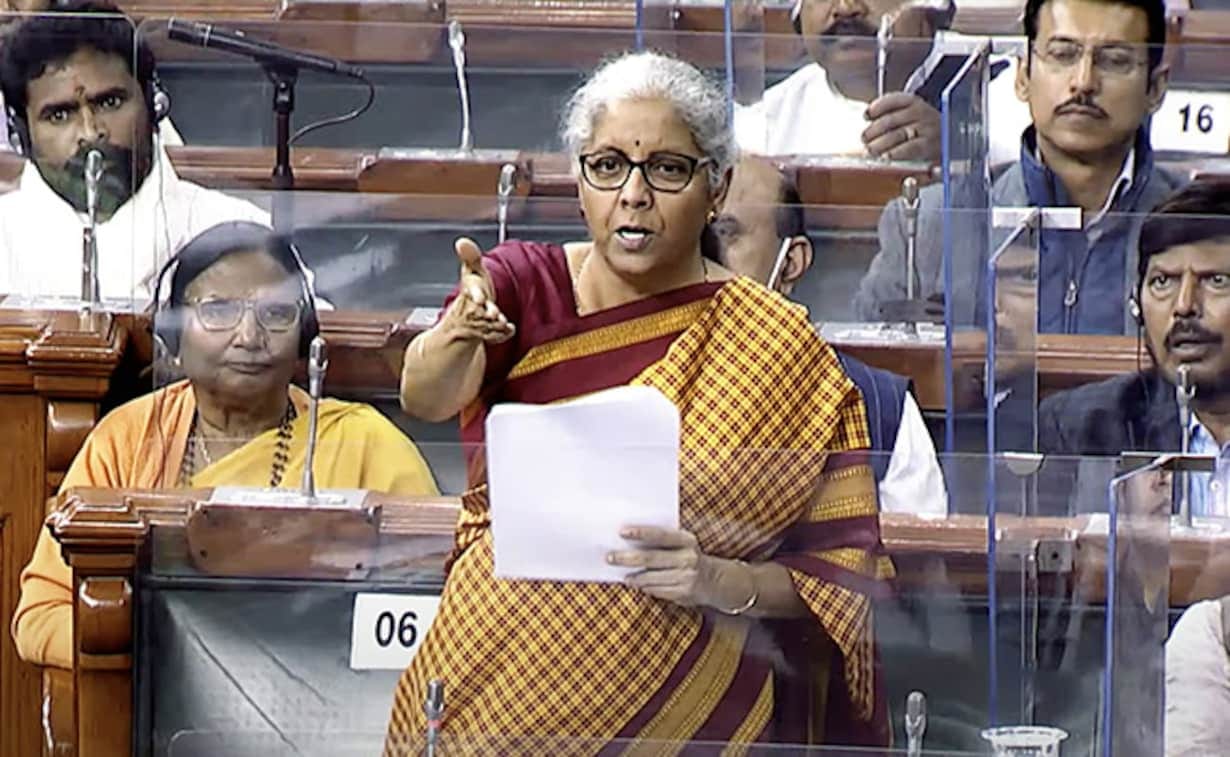
- The budget is presented to the Lok Sabha by the Finance Minister on the 1st of February.
- No discussion on the budget takes place on the day of the Presentation of the budget.
- At the end of the budget speech, the budget is laid before the Rajya Sabha, which can only discuss it and has no power to vote on the demands for grants.
- The Union Budget is currently presented through various documents, some of which are Constitutionally/statutorily mandated, while others are explanatory documents.
- List of Budget documents presented to the Parliament
- Budget Speech
- Annual Financial Statement
- Demands for Grants
- Finance Bill
- Statements mandated under the FRBM Act:
- Macro-Economic Framework Statement
- Medium-Term Fiscal Policy Statement
- Fiscal Policy Strategy Statement
- Expenditure Budget
- Receipt Budget
- Budget at a Glance
- Memorandum explaining the provisions in the Finance Bill
- Economic Survey is presented one day or a few days before the presentation of the budget.
General Discussion
- General Discussion begins after few days after its presentation. It takes place in both Houses of Parliament and lasts usually for three to four days.
- During this stage, Lok Sabha can discuss the budget as a whole or any question of principle involved therein but no cut motion can be moved nor any voting takes place at this stage.
Scrutiny by Departmental Committees
- After the general discussion on the budget, Houses are adjourned for three to four weeks.
- During this period, 24 departmental standing committees of the Parliament examine the demands for grants of the concerned ministries and prepare a report on them.
- The departmental standing committee system was established in 1993 and has made the parliamentary financial control over ministries much more in-depth and comprehensive.
Voting on Demands for Grants
- As per the reports of the departmental standing committees, The Lok Sabha takes up voting of demands for grants.
- Voting on Demands for Grants is an exclusive privilege of the Lok Sabha. Rajya Sabha has no power of voting on demands for grants.
- Voting is confined to only the votable part of the budget, expenditures charged on the Consolidated Fund of India is not submitted to the vote.
- Each demand is voted separately by the Lok Sabha. During this stage, the budget is discussed thoroughly.
- Various motions are used to scrutinise the demands for grants. Such motions are called as ‘cut motion’. They are of three types.
- Policy Cut Motion: This motion is moved to oppose a specific policy of the government. It states that the amount be reduced to 1Rupee. When a policy cut motion is adopted, it signifies that the House does not agree with the policy proposed by the government.
- Economy Cut Motion: An economy cut motion is moved to reduce the amount of demand presented by the government in the budget or reduction of items in the demand. It implies that the amount proposed in the demand is considered excessive or unnecessary.
- Token Cut Motion: A token cut motion is moved to register a specific grievance. It does not seek to reduce the amount of demand but is aimed at drawing the attention of the government to a particular issue or concern. It states that the amount of the demand be reduced by 100 rupees.
- Cut Motion upholds the principle of responsible government by probing the activities of the government. Their passage by Lok Sabha questions the parliamentary confidence in the government and may lead to its resignation.
- On the last day of the allocated days, the Speaker puts all the remaining demands to vote and disposes them even without discussion. This is called as ‘guillotine’.
Passage of Appropriation Bill
- According to Article 114 of the Consitution, no money shall be withdrawn from the Consolidated Fund of India except under appropriation made by law.
- Accordingly, an appropriation bill is introduced to provide for an appropriation out of Consolidated Fund of India , all the money required to meet the grants voted in Lok Sabha and the expenditure charged on the Consolidated Fund of India.
- No amendment can be proposed to the appropriation bill in either House of the Parliament that can vary the amount or alter the destination of grant voted or vary expenditure charged on Consolidated Fund of India.
- Appropriation bill become an Appropriation Act after it is assented to by President.
- This process takes time and usually lasts until April, but the government need money to carry on its normal activities after 31st March (the end of the financial year). To overcome this functional difficulty, the Constitution has made a provision of ‘Vote on account’. It is passed after a general discussion on budget is over, generally granted for two months.
Passing of Finance Bill:
- The Finance Bill is introduced to give effect to the financial proposals of the Government of India for the following year.
- It is subjected to all the conditions which are applicable to a Money Bill. But unlike the Appropriation Bill, the amendments seeking reduction or rejection in taxes can be moved in the case of the Finance Bill.
- According to the Provisional Collection of Taxes Act of 1931, the Finance Bill must be passed within 75 days.
- The Finance Act legalises the income side of the budget and completes the process of the enactment of the budget.
Gender Budgeting
for Gender Budgeting. |
Other Grants
-
Article 115 of the Constitution allows Parliament to provide for supplementary, additional, or excess grants for government expenditure during the financial year beyond what was originally budgeted.
Supplementary Grants
A supplementary grant is granted when the amount authorized by the Parliament through the appropriation act for a particular service for the current financial year is found to be insufficient for that year.
Additional Grants
It is granted when the need has arisen during the current financial year for additional expenditure upon some new service not contemplated in the budget for that year.
Excess Grants
- Excess grant is granted when money has been spent on any service during a financial year in excess of the amount granted for that service in the budget for that year.
- It is voted by the Lok Sabha after the financial year. Before submitting such grant for voting in Lok Sabha, it must be approved by the Public Account Committee.
Vote of Credit
- It is granted for meeting an unexpected demand upon the resources of India when on account of the magnitude or the indefinite character of the service, the demand cannot be stated with the details ordinarily given in a budget.
- Hence, it is like a blank cheque given to the Executive by the Lok Sabha.
Exceptional Grant
It is granted for a special purpose and forms no part of the current service of any financial year.
Token Grant
It is granted when funds to meet the proposed expenditure on a new service can be made available by reappropriation. Demand for the grant of a token sum (of Re 1) is submitted to the vote of the Lok Sabha and if assented, funds are made available. Reappropriation involves the transfer of funds from one head to another.
Conclusion
The budget making process in parliament is a crucial aspect of democratic governance, embodying the collective will of the people through their elected representatives. It serves as a mechanism for allocating resources towards national priorities, balancing competing interests, and ensuring fiscal responsibility. Ultimately, a well-crafted budget reflects the aspirations and needs of the populace, guiding the trajectory of the nation's economic growth and social progress.
FAQs
Question: What is the budgetary process in Parliament?
Answer: The budgetary process involves stages like preparation, presentation, discussion, scrutiny, voting on demands, and passing of bills.
Question: Which articles of the Constitution govern the budgetary process?
Answer: Articles 112 to 117 of the Indian Constitution govern the process.
Question: What is the role of the Appropriation Bill in the budgetary process?
Answer: The Appropriation Bill authorizes government expenditures for the upcoming fiscal year.
Question: What is the Finance Bill?
Answer: The Finance Bill includes provisions related to taxes and other financial proposals and must be passed for the government’s fiscal measures.
Question: What is the Vote on Account?
Answer: The Vote on Account allows the government to meet its expenses in the interim period before the full budget is passed.
MCQs
- Which of the following stages is part of the budgetary process in Parliament?
a) Execution
b) Scrutiny by departmental committees
c) Voting on demands for grants
d) All of the above
Answer: (D) See the explanation
The budgetary process includes preparation, scrutiny, voting, and passing relevant bills.
- Which Article of the Constitution mandates the presentation of the Annual Financial Statement (Budget)?
a) Article 112
b) Article 108
c) Article 74
d) Article 125
Answer: (A) See the explanation
Article 112 mandates the presentation of the Annual Financial Statement (Budget) in Parliament.
- Which of the following is not a part of the budgetary process?
a) Voting on demands for grants
b) Presentation of budget
c) Passing of Ordinances
d) General discussion on the budget
Answer: (C) See the explanation
Passing of Ordinances is not part of the budgetary process. Ordinances are laws promulgated by the President when Parliament is not in session.
- What is the maximum period for which the government can use funds under the Vote on Account without full budget approval?
a) 2 months
b) 6 months
c) 4 months
d) 3 months
Answer: (A) See the explanation
The Vote on Account permits the government to withdraw funds for a period of two months until the full budget is passed.
- Which bill is introduced to legalize government receipts and expenditure?
a) Appropriation Bill
b) Finance Bill
c) Money Bill
d) Budget Bill
Answer: (B) See the explanation
The Finance Bill is introduced to legalize the government’s proposals on receipts and expenditures, including taxation.
GS Mains Questions and Model Answers
Q1. What is the role of the Finance Bill in the Indian budgetary process?
Answer: The Finance Bill plays a crucial role in implementing the financial proposals, particularly taxes, as laid out in the budget. It is a Money Bill and must be passed by Parliament to give legal effect to the government's financial proposals, including taxes and duties.
Q2. Examine the significance of the Appropriation Bill in the Indian budgetary process.
Answer: The Appropriation Bill is essential as it allows the government to withdraw funds from the Consolidated Fund of India for specific purposes. Without passing the Appropriation Bill, the government cannot incur expenditure as it authorizes the use of funds for the financial year.
Q3. Discuss the importance of parliamentary control over public finance in India.
Answer: Parliamentary control over public finance ensures accountability, transparency, and checks on executive power. Through the budgetary process, Parliament scrutinizes government expenditure and revenue, ensuring that public funds are used effectively and lawfully.
Previous Year Questions on Budgetary process in parliament
1. UPSC CSE Prelims 2018:
Question: The Appropriation Bill passed by Parliament allows the government to:
A. Levy new taxes
B. Withdraw funds from the Consolidated Fund
C. Make changes to the existing tax structure
D. Introduce supplementary grants
Answer: B
Explanation: The Appropriation Bill grants the government legal authority to withdraw funds from the Consolidated Fund of India to meet its expenditure.
2. UPSC CSE Mains 2017 (GS Paper 2):
Question: Discuss the significance of the Finance Bill in India's budgetary process.
Answer: The Finance Bill plays a critical role in the budgetary process as it contains all legislative proposals related to taxation and revenue generation. It is essential for the government to meet its financial obligations, and it also outlines any new taxes or changes in the existing tax structure. The Finance Bill must be passed in Parliament to legalize the collection of taxes and ensure the proper functioning of the government’s financial system.
3. UPSC CSE Prelims 2017:
Question: A Vote on Account is used for which of the following purposes?
A. Temporary withdrawal of funds before the budget is passed
B. Scrutiny of government expenditure
C. Allocation of funds for defense
D. Setting up of new ministries
Answer: A
Explanation: A Vote on Account allows the government to meet its expenses by withdrawing funds from the Consolidated Fund before the budget is passed.
*email: contactus@prepp.in
Download the PREPP App and attempt FREE IAS Exam Mock Tests and get complete study material!

Live Test : UPSC CSE Prelims CSAT (Paper-II) (Oct 20 - 23)
Full Test - 04: UPSC CSE Prelims CSAT (Paper-II)
Full Test - 03: UPSC CSE Prelims CSAT (Paper-II)
UPSC CSE Prelims 2026 GS Paper 1 Question Paper (24-May-2026)
UPSC CSE Prelims 2026 CSAT Paper 2 Question Paper (24-May-2026)

17 February 2025 | The Hindu Must Read Articles | Current Affairs

16 February 2026 | The Hindu Must Read Articles | Current Affairs

13 February 2026 | The Hindu Must Read Articles | Current Affairs









Comments