Types of Bills - Indian Polity Notes
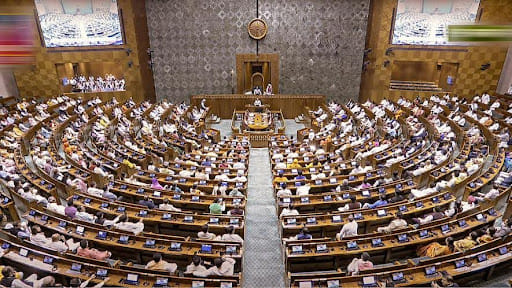
The primary role of Parliament is to enact laws that govern the country. Members of Parliament (MPs) introduce, debate, and pass bills that address various societal, economic, and political issues. Bill serves as the means through which the government translates its vision and agenda into actionable legislative measures. There are four types of Bills, namely Constitution Amendment Bills, Money Bills, Financial Bills and Ordinary Bills. A bill can only become an act if passed by both the Houses along with President’s assent. UPSC has frequently asked questions on the types of bills. This article will explain the Types of Bills in an in-depth manner.
Table of Contents

The legislative process is similar in both the Houses of the Parliament. Every bill has to pass through different stages in each House.
Classification of Bills as Public and Private Bill
They both are governed by the same procedure and pass through the same stages in the House. However, they differ in various aspects
| Public Bill | Private Bill |
|---|---|
| It is introduced in the parliament by a minister. | It is introduced by any member of the parliament other than a minister. |
| It reflects the policies of the government (ruling party). | It reflects the stand of the opposition party on policy matters. |
| It has a higher possibility of being passed by parliament. | It has a lesser chance of being passed by the parliament. Eg. Only 14 private member bills out of thousands became laws since 1952. |
| Its rejection in the Lok Sabha may lead to the resignation of the cabinet. | Its rejection by the House has no implication on the parliamentary confidence in the government. |
| Its introduction in the house requires 7 days notice. | Its introduction in the house requires one month. |
| It is drafted by the concerned department in consultation with the law department. | Its drafting is the responsibility of the members concerned. |
| Eg.Bharatiya Nyaya Sanhita, 2023 bill | Eg.The 'Prevention of Wasteful Expenditure on Special Occasions Bill' 2020. |
Private Member Bills Enacted into Law
|
|
Bills serve as the means through which the government translates its vision and agenda into actionable legislative measures. |
Other Classification of Bills
The bills introduced in the Parliament can also be classified into four categories:
- Ordinary Bills
- Money Bills
- Financial Bill
- Constitution Amendments Bill
Ordinary Bills
- Ordinary bills cover a wide range of legislative matters, including economic policies, social reforms, administrative procedures, and more. They are an essential part of the legislative process in India.
- Every bill has to pass through the following five stages before it finds a place on a statute Book.
- First Reading: A member of Parliament (MP) presents the bill, either a minister or a private member, in either house. The bill's title is read out and copies are circulated among the members. There is no debate or discussion at this stage. The introduction of the bill and its publication in the Gazette constitute the first reading of the bill.
- Second Reading: This stage involves a detailed examination of the bill. The bill is scrutinized clause by clause, and amendments can be proposed and discussed.
- Committee Stage: In some cases, bills are referred to parliamentary committees for detailed examination. These committees study the bill, take inputs from stakeholders, and submit a report to the House.
- Consideration stage: The house after receiving the bill from the select committee considers the the provisions clause by clause. Each clause is discussed and voted upon separately.
- Third Reading: This stage involves a final debate on the bill. Members can discuss the bill as a whole, but no amendments are allowed at this point.
- Voting: After the final debate, the bill is put to vote as a whole. If a majority of the members present and voting support the bill, it is passed in that house.
- Passage in the other House: If the bill is passed in one house, it is then sent to the other house where a similar process is followed. The bill must be passed in both Houses separately to become a law.
- Assent by the President: Once passed by both Houses, the bill is sent to the President of India for assent. The President can either give assent, withhold assent, or send the bill back to Parliament for reconsideration. If the President gives assent, the bill becomes law. President enjoys only a ‘suspensive veto’ over an Ordinary Bill.
Money Bill
- Article 110 of the Indian Constitution deals with the definition of a money bill.
- A bill shall be deemed to be a money bill if it contains ‘only’ provisions dealing with all or any of the following matters, namely:
- Imposition, abolition, remission, alteration or regulation of any tax
- Borrowing of money by the government
- Custody of Consolidated Fund of India or Contingency Fund of India, payment of money into or the withdrawal of money from any such Fund
- Appropriation of money out of the consolidated fund of India
- Declaration of any expenditure to be expenditure charged on the Consolidated Fund of India or the increasing of the amount of any such expenditure
- Receipt of money on account of Consolidated Fund of India or Public Accounts of India
- Any matter incidental to any of the matters specified above.
- Bill regarding imposition of fines, demand of fees charged for services rendered, imposition or abolition of any tax by local authorities will not be deemed as money bill.
- If any question arises whether a Bill is a Money Bill or not, the decision of the Speaker of the Lok Sabha shall be final.
- There shall be endorsed on every Money Bill when it is transmitted to the Rajya Sabha under article 109, and when it is presented to the President for assent under article 111.
- A money bill can be introduced only in Lok Sabha, and only with the President's recommendation.
- Money bill is considered as a government’s bill and, therefore introduced by the minister only.
- Rajya Sabha has restricted power regarding to the money bill. It can not reject or amend money bills, It can only make recommendations. It must return the bill within 14 days. Lok Sabha can either accept or reject the recommendations of the Rajya Sabha.
- If the Rajya Sabha does not return the bill to the Lok Sabha within 14 days, the bill is deemed to have passed by both the houses in the form originally passed by the Lok Sabha.
- The President may either give or withhold assent to the Money Bill, but can not return the bill for consideration of the Houses. Generally, President gives his assent to a money bill as it is introduced in the Parliament with his prior permission.
Financial Bills
- Financial bills are the bills which deal with fiscal matters, that is, revenue or expenditure.
- Financial bills are of three types
- Money Bills(Article 110)
- Financial Bill-I (Article 117(1))
- Financial Bill-II (Article 117(3))
- It implies that money bills are type of financial bill, Only those financial bills are money bills which contain exclusively those matters mentioned under Article 110.
- Financial bill-I and financial bill-II have been elaborated in Article 117 of the Constitution.
Financial Bill-I: Article 117 (1)
- It includes not only the matters mentioned in Article 110 but also other matters of general legislation.
- Financial bill (I) is similar to a money bill in two aspects a) both of them can only be introduced in Lok Sabha and not Rajya Sabha b) both bills can be introduced only on the President's recommendations.
- In all other aspects, a finance bill (I) follows the same parliamentary process as an ordinary bill. It means it can be rejected or amended by the Rajya Sabha.
- In case of disagreement between two Houses, President can summon a joint sitting to resolve deadlock.
Financial Bill-II : (Article 117(3))
- A financial bill-II contains provisions involving expenditure from the Consolidated Fund of India but does not include any of the items listed in Article 110.
- It is considered as an ordinary bill and governed by the same legislative process as an ordinary bill.
- The only special feature of the bill is the recommendation of the President is not required at the introduction stage but is required at the consideration stage. It means without the President’s recommendation about the consideration of the bill to the House, it can not pass it.
- In case of disagreement between two Houses, President can summon a joint sitting to resolve deadlock.
- Just like the ordinary bill, the President can either give assent, withhold assent, or send the bill back to Parliament for reconsideration.
Constitutional Amendments Bill
- Since its adoption in 1950, the Constitution has been amended several times to address the changing needs and aspirations of Indian society. The procedure for amending the Constitution is laid out in Article 368 of the Indian Constitution.
- A constitutional amendment bill can be introduced in either house of the Indian Parliament and not in the state legislature.
- It can be introduced by any member of the Parliament, either from the government or by a private member and does not require prior permission of the President.
- The bill must be passed by both houses of Parliament by a special majority.(a majority of the total membership of the House and majority of two-thirds of the members of the House present and voting.
- No provision of a joint sitting of the two Houses in case of disagreement.
- If the amendment affects the federal structure of the Constitution, it must also be ratified by the legislatures of at least half of the Indian states.
- President must give his assent to the bill, He can neither withhold nor return the bill for reconsideration. The 24th Constitutional Amendment Act 1971 made it mandatory for the President to give his assent to the Constitutional Amendment bills.
- After the President’s assent, the bill becomes an Act ie. Constitutional Amendment Act.
Money Bill vs Constitutional Amendment Bill
| Difference | Money Bill | Constitutional Amendment Bill |
|---|---|---|
| Article | Article 110 | Article 368 |
| Definition | Primarily deals with matters related to taxation, government spending, borrowing, or financial administration | It seek to amend the provision in the Constitution of India |
| Introduced by | Only by a Minister | By minister or by a private member |
| Introduced In | Lok Sabha only | Lok Sabha or Rajya Sabha |
| Prior Approval by the President | Required | Not required |
| Certification of a Speaker | Speaker decide whether bill is money bill or not | The classification of this Bill does not require the Speaker's approval. |
| The Role of the Rajya Sabha | The Rajya Sabha has no authority to reject or amend the Money Bill. | Equal power like Lok Sabha |
| Joint Sitting | No provision for a joint sitting | No provision for a joint sitting |
| Note: In case of Constitutional Amendment Bill President must give his assent to the bill, he cannot withhold or return the bill |
Conclusion
The classification of bills in the Indian Parliament is not merely a bureaucratic exercise but a reflection of the intricate workings of democracy. From Constitutional amendments to Ordinary Bills and Money Bills, each category serves a distinct purpose in addressing the diverse needs and challenges of the Indian populace. While government-sponsored bills often dominate the legislative agenda, the inclusion of Private Member Bills underscores the importance of individual voices and diverse perspectives in shaping policy outcomes. As India continues to evolve and confront new challenges, the adaptability and responsiveness of its legislative framework will be crucial in meeting the evolving needs of society.
FAQs
Question: What is an Ordinary Bill?
Answer: An Ordinary Bill deals with any subject that is not related to finance or constitutional amendments. It can be introduced in either house of Parliament and requires approval from both houses and the President to become law.
Question: How is a Money Bill different from a Financial Bill?
Answer: A Money Bill exclusively deals with financial matters like taxation, borrowing, and expenditure, while a Financial Bill includes other provisions in addition to financial matters. A Money Bill can only be introduced in the Lok Sabha, whereas Financial Bills may have different procedures depending on their category.
Question: What is a Constitutional Amendment Bill?
Answer: A Constitutional Amendment Bill seeks to amend the Constitution and requires a special majority in both houses of Parliament for its passage. It can be introduced in either house and does not require the President’s recommendation.
Question: What is the role of the Rajya Sabha in passing a Money Bill?
Answer: The Rajya Sabha has limited powers regarding a Money Bill. It can suggest amendments but must return the bill within 14 days. The Lok Sabha may accept or reject these amendments, and the Rajya Sabha cannot delay the bill beyond the 14-day period.
Question: How does a Private Member Bill differ from a government bill?
Answer: A Private Member Bill is introduced by MPs who are not part of the government (Ministers), while a government bill is introduced by a Minister. Private Member Bills rarely become law but can push for reforms or bring attention to important issues.
MCQs
1. Which type of bill requires a special majority for its passage?
A. Ordinary Bill
B. Money Bill
C. Financial Bill
D. Constitutional Amendment Bill
Answer: (D) See the Explanation
A Constitutional Amendment Bill requires a special majority for passage, meaning it must be approved by two-thirds of the members present and voting, along with a simple majority of the total membership of the house.
2. Who can introduce a Money Bill in Parliament?
A. Any Member of Parliament
B. The President
C. A Minister in the Lok Sabha
D. A Private Member
Answer: (C) See the Explanation
A Money Bill can only be introduced in the Lok Sabha by a Minister, with the prior recommendation of the President.
3. How much time does the Rajya Sabha have to return a Money Bill to the Lok Sabha?
A. 30 days
B. 14 days
C. 7 days
D. 21 days
Answer: (B) See the Explanation
The Rajya Sabha has a maximum of 14 days to return a Money Bill to the Lok Sabha. If the bill is not returned within this period, it is deemed to have been passed by both houses.
4. What happens if there is a disagreement between the Lok Sabha and Rajya Sabha on an Ordinary Bill?
A. The President intervenes
B. The bill is rejected
C. A joint sitting of both houses is called
D. The Lok Sabha's decision prevails
Answer: (C) See the Explanation
If there is a disagreement between the Lok Sabha and Rajya Sabha on an Ordinary Bill, a joint sitting of both houses may be called to resolve the issue.
5. Which of the following is a characteristic of a Private Member Bill?
A. It is introduced by a Minister
B. It can only be introduced in the Lok Sabha
C. It is introduced by an MP who is not a Minister
D. It always becomes law
Answer: (C) See the Explanation
A Private Member Bill is introduced by an MP who is not a Minister. It reflects the views of non-government members and often addresses issues not part of the government’s legislative agenda.
GS Mains Questions and Model Answers
1. Discuss the differences between Money Bills, Financial Bills, and Ordinary Bills with respect to their passage in Parliament.
Answer: Money Bills, Financial Bills, and Ordinary Bills have distinct characteristics and procedures for their passage in Parliament.
Money Bills deal exclusively with taxation, borrowing, and expenditure and can only be introduced in the Lok Sabha with the President's recommendation. The Rajya Sabha can suggest amendments but must return the bill within 14 days. The Lok Sabha is not bound to accept these amendments, and the Rajya Sabha cannot delay the passage beyond the 14-day period.
Financial Bills can also be introduced only in the Lok Sabha, but unlike a Money Bill, they include provisions beyond financial matters and follow the same procedure as an Ordinary Bill.
Ordinary Bills can be introduced in either house and require approval from both the Lok Sabha and the Rajya Sabha. If there is a disagreement, a joint sitting of both houses may be called to resolve the issue.
2. Analyze the role of the Rajya Sabha in the legislative process, particularly in relation to Money Bills and Ordinary Bills.
Answer: The Rajya Sabha plays a critical role in the legislative process in India, particularly in reviewing and amending bills passed by the Lok Sabha. For Ordinary Bills, the Rajya Sabha has the power to accept, amend, or reject the bill, and in case of a disagreement between the two houses, a joint sitting may be called.
However, the Rajya Sabha has a limited role concerning Money Bills. It can suggest amendments but must return the bill within 14 days, and the Lok Sabha may choose to accept or reject these amendments. The Constitution limits the Rajya Sabha’s powers over Money Bills to ensure that financial legislation is primarily controlled by the directly elected Lok Sabha.
3. Evaluate the significance of Private Member Bills in the Indian legislative process.
Answer: Private Member Bills play an important, though often symbolic, role in the Indian legislative process. These bills, introduced by MPs who are not part of the government, allow non-ministerial members to propose legislative reforms and raise issues that may not be part of the government’s agenda. While Private Member Bills rarely become law, they serve as a platform for debate on important issues, influencing public opinion and government policies. For instance, several significant laws, including the Shah Bano Case (1985) and discussions on women’s rights, were brought to light through Private Member Bills. Although they seldom lead to direct legislative changes, they help push the government towards necessary reforms.
Previous Year Questions on Bills in Parliament
1. UPSC CSE Prelims 2019
Question: Which of the following statements is true regarding Money Bills?
A. Money Bills can be introduced in either house of Parliament
B. The Rajya Sabha can amend Money Bills
C. The President’s recommendation is required for the introduction of a Money Bill
D. Money Bills do not require the President’s assent
Answer: C. A Money Bill can only be introduced in the Lok Sabha and requires the President's recommendation. While the Rajya Sabha can suggest amendments, it cannot amend the bill, and the Lok Sabha is not obliged to accept these suggestions.
2. UPSC CSE Mains 2017 (GS Paper 2)
Question: "Money Bills have been a subject of controversy in the Indian parliamentary system. Discuss the constitutional provisions regarding Money Bills and critically analyze their role in the Indian legislative process."
Answer: Money Bills, defined under Article 110 of the Constitution, deal exclusively with financial matters like taxation, borrowing, and expenditure. A Money Bill can only be introduced in the Lok Sabha with the President's recommendation, and the Rajya Sabha can only recommend changes within 14 days. This limited role of the Rajya Sabha in financial legislation has often been a point of controversy, with critics arguing that it undermines the bicameral nature of Indian Parliament. However, the Constitution provides these powers to the Lok Sabha as it is the directly elected house, ensuring that decisions on public finance are made by representatives of the people. Nonetheless, instances where non-financial bills have been classified as Money Bills have sparked debates about the misuse of this provision by the government to bypass scrutiny by the Rajya Sabha.
*email: contactus@prepp.in
Download the PREPP App and attempt FREE IAS Exam Mock Tests and get complete study material!

Live Test : UPSC CSE Prelims CSAT (Paper-II) (Oct 20 - 23)
Full Test - 04: UPSC CSE Prelims CSAT (Paper-II)
Full Test - 03: UPSC CSE Prelims CSAT (Paper-II)
UPSC CSE Prelims 2026 GS Paper 1 Question Paper (24-May-2026)
UPSC CSE Prelims 2026 CSAT Paper 2 Question Paper (24-May-2026)

17 February 2025 | The Hindu Must Read Articles | Current Affairs

16 February 2026 | The Hindu Must Read Articles | Current Affairs

13 February 2026 | The Hindu Must Read Articles | Current Affairs









Comments