Unitary Features of the Indian Constitution - Indian Polity Notes
A unitary system has a single central government with complete power, whereas a federal system divides power between national and local levels of government. India is a federal republic. However, the word "federation" is never used in the constitution. Instead, India is referred to as a "Union of States." In this article, we will discuss regarding the Unitary Features of the Indian Constitution which will be helpful for UPSC exam preparation.
Table of Contents
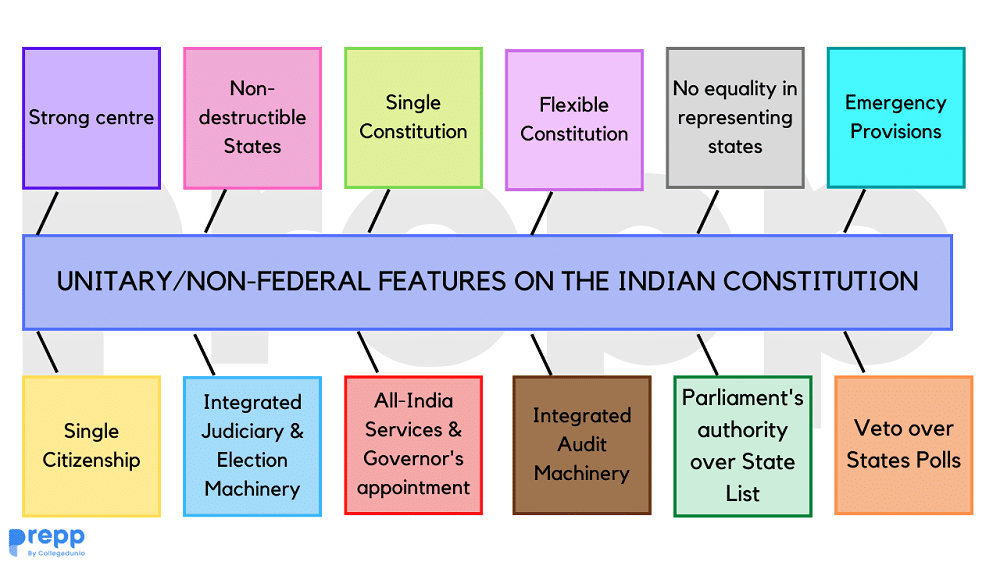
Unitary features on the Indian constitution
Nature of the Indian Constitution
- While drafting the Constitution, the authors kept in mind that India has a unique kind of diversity that cannot be found elsewhere, particularly in federal countries.
- As a result, some kind of power was required to bind the individual powers of the units, or else the administration would disintegrate.
- Also, some kind of check on the power of central government was required, which was created by granting powers to units (states) to deal with matters concerning their own affairs.
- The Indian Constitution is distinctive in that it is a novel type that incorporates both unitary and federal features.
- It is referred to as a "union of states" rather than a "federation."
- The Indian Constitution's quasi-federal feature can be understood because it has long been debated whether the Indian Constitution is federal or unitary in nature.
- The Indian Constitution is neither purely federal nor purely integral. It is a harmonious blend of the two.
- The unitary features of the Constitution are used to promote national unity and overall growth.
- It prioritises the national interest, followed by the subjective and specific interests of the communities.
- The federal government is divided into two levels, each with its own set of powers and functions.
- Preventing and resolving conflicts of interest between the centre and the states is an essential component of federalism.
- It has considered the problems that the country may face in the future if the constitution is purely federal, and thus the Indian Constitution has made provisions for temporarily converting it into a unitary mode until the crisis is overcome.
| Other Relevant Links | |
|---|---|
| Emergency Provisions | Single Citizenship |
| Integrated Judiciary | All India Services |
| Appointment of Governor | Federal Features |
|
"A unitary government is one where all the powers are concentrated in the central authority, and any administrative authority exercise only the powers that the central government chooses to delegate." |

Unitary or Non-Federal Features of the Constitution
1) Strong Centre
- The division of powers favours the Centre and is highly inequitable from a federal standpoint.
- For starters, the Union List includes more subjects than the State List.
- The Union List now includes the more important subjects.
- The Centre has complete control over the Concurrent List.
- The Centre has retained residuary powers, whereas the states have them in the United States.
- As a result, the Constitution has made the Centre extremely powerful.
2) States not Indestructible
- States in India, unlike in other federations, have no right to territorial integrity.
- Any state's area, boundaries, or name can be changed unilaterally by the Parliament.
- Furthermore, it only requires a simple majority, not a special majority.
- As a result, the Indian Federation is defined as "an indestructible Union of destructible states."
- In contrast, the American Federation is described as "an indestructible Union of indestructible states."
3) Single Constitution
- In a federation, the states usually have the right to write their own constitutions separate from the one of the Centre.
- States in India, on the other hand, have no such authority.
- The Indian Constitution incorporates not only the Constitution of India but also the Constitutions of the states.
- Both the Centre and the states must work within this framework.
- The only exception was the state of Jammu and Kashmir, which had its own constitution.
4) Flexibility of the Constitution
- The process of amending the constitution is less rigid than in other federations.
- The majority of the Constitution can be amended unilaterally by Parliament, either by simple majority or by special majority.
- Furthermore, only the Centre has the authority to initiate a constitutional amendment.
- States in the United States can also propose amendments to the Constitution.
5) No Equality of State Representation
- The Rajya Sabha assigns representation to states based on population. As a result, the membership ranges from 1 to 31.
- In the United States, however, the principle of equal representation of states in the Upper House is fully recognised.
- As a result, the American Senate has 100 members, with two representatives from each state. This principle is thought to protect smaller states.
6) Emergency Provision
- The Constitution defines three types of national, state, and financial emergencies.
- During a state of emergency, the central government becomes all-powerful, and the states are completely under the control of the Centre.
- It converts the federal structure to a unitary structure without requiring a formal amendment to the Constitution.
- This type of transformation is unheard of in any other federation.
7) Single Citizenship
- Despite having a dual polity, India's Constitution, like Canada's, adopted a system of single citizenship.
- There is no separate state citizenship and only Indian citizenship.
- All citizens, regardless of state of birth or residence, have the same rights throughout the country.
- Other federal states with dual citizenship include the United States, Switzerland, and Australia.
8) Integrated Judiciary
- The Indian Constitution established an integrated judicial system, with the Supreme Court at the apex and state high courts beneath it.
- This single court system enforces both federal and state laws.
- In the United States, on the other hand, there is a dual court system in place, with the federal judiciary enforcing federal laws and the state judiciary enforcing state laws.
9) All-India Services
- In the United States, the federal government and state governments provide separate public services.
- In India, the Centre and the states each have their own public services.
- However, there are all-India services (IAS, IPS, and IFS) that are shared by the Centre and the states.
- The Centre recruits and trains the members of these services and has ultimate control over them.
- As a result, these services violate the constitutional principle of federalism.
10) Integrated Audit Machinery
- The Comptroller and Auditor-General of India audits the accounts of both the Central and state governments.
- However, the president appoints and removes him without consulting the states. As a result, this office limits the states' financial autonomy.
- The American Comptroller-General, on the other hand, plays no role in state accounting.
11) Parliament’s Authority Over State List
- Even within their limited sphere of authority, states do not have complete control.
- If the Rajya Sabha passes a resolution in the national interest, the Parliament has the authority to legislate on any subject on the State List. =
- This means that Parliament's legislative authority can be expanded without amending the Constitution.
- Notably, this can be done even when there is no emergency.
12) Appointment of Governor
- The President appoints the governor, who is the head of state. He serves at the pleasure of the President.
- He also serves as the Centre's agent. The Centre exercises control over the states through him.
- On the contrary, the American Constitution established an elected head of state. India adopted the Canadian system in this regard.
13) Integrated Election Machinery
- The Election Commission holds elections not only for the Central Legislative Assembly but also for the state legislatures.
- However, the President appoints this body, and the states have no say in the matter.
- The situation is the same when it comes to the removal of its members.
- On the other hand, the United States has separate machines for conducting federal and state elections.
14) Veto Over State Bills
- The governor has the authority to reserve certain types of bills passed by the state legislature for the President's consideration.
- The President may refuse to sign such bills not only in the first instance, but also in the second.
- As a result, the President has an absolute veto (rather than a suspensive veto) over state bills.
- However, in the United States and Australia, states are autonomous within their respective fields, and no such reservation is made.
Benefits of Unitary System
- National Unity: Unitary features play a crucial role in maintaining national unity. They prevent fragmentation and disintegration by establishing a strong central government that can intervene when required.
- Uniform Policies: Certain matters, such as national security, foreign affairs, and currency, demand uniform policies across the country. Unitary features allow the central government to establish consistent regulations.
- Efficient Governance: In situations requiring quick and coordinated responses, such as emergencies or disasters, unitary features enable the central government to act decisively without waiting for state approvals.
- Addressing National Issues: National challenges like terrorism, cyber threats, and pandemics require a unified approach. Unitary features allow the central government to take comprehensive measures to tackle such issues.
- Economic Integration: Policies related to the economy, such as taxation and trade, often require uniform regulations to promote economic integration and reduce barriers among states.
Challenges of Unitary System
- State Autonomy: While unitary features empower the central government, they can undermine the autonomy of states. States may feel their decision-making power is limited, affecting their ability to address local issues effectively.
- Diversity Concerns: India is culturally diverse, with varying regional needs and identities. Unitary policies might not adequately address these regional variations, leading to feelings of neglect or alienation.
- Political Tensions: The use of unitary features, such as President's Rule (Article 356), can lead to political tensions and accusations of misuse by the central government to undermine state governments.
- Federal Harmony: Striking the right balance between unitary and federal principles is a challenge. Overemphasis on unitary features could erode the spirit of federalism, causing conflicts between the central and state governments.
- Accountability: Concentrated power at the central level can lead to reduced accountability as decision-making becomes more distant from local communities. This can impact the responsiveness of governance.
Balancing Act
The key lies in striking a balance between unitary features and federal principles. Effective governance requires harmonious coexistence:
- Collaborative Approach: The central and state governments must collaborate to ensure the benefits of unitary features are realized without compromising state autonomy.
- Respecting Diversity: Policies should be sensitive to regional diversity and tailored to address local needs while adhering to overarching national goals.
- Transparency and Accountability: Ensuring transparency and accountability in decision-making at both levels can mitigate the challenges of concentration of power.
Conclusion
The Indian Constitution's unitary features underscore the delicate balance between a strong central authority and respect for regional autonomy. These features have played a pivotal role in maintaining unity, promoting uniformity, and addressing crises. The coexistence of federalism and unitarism ensures that India's democratic structure is robust and adaptable, catering to the nation's diverse needs while upholding its foundational principles.
FAQs
Question: What are the unitary features of the Indian Constitution?
Answer: The unitary features of the Indian Constitution include a strong central government, a single Constitution, single citizenship, the emergency provisions, and the power of the Parliament to reorganize state boundaries. These features reflect the dominance of the central government over the states in certain situations, especially during crises.
Question: How does the Indian Constitution balance unitary and federal features?
Answer: The Indian Constitution is a blend of both unitary and federal features. While it ensures a federal structure by dividing powers between the Centre and the states, it also provides unitary features like the central government’s supremacy in certain matters, especially during emergencies or in issues of national importance.
Question: Why is the Indian Constitution called "quasi-federal"?
Answer: The Indian Constitution is termed "quasi-federal" because it combines both federal and unitary elements. While it establishes a division of powers between the Centre and the states, the Centre holds more authority, especially in emergency situations, making it more unitary in practice.
Question: What role do emergency provisions play in the unitary nature of the Indian Constitution?
Answer: The emergency provisions (Articles 352, 356, and 360) allow the central government to assume control over state matters during times of national crisis. This shifts the federal balance towards a unitary system, where the central authority becomes dominant in the interest of national integrity and security.
Question: Can the Parliament alter state boundaries under the Indian Constitution?
Answer: Yes, under Article 3 of the Constitution, the Parliament has the power to alter state boundaries, rename states, or create new states. This reflects the unitary nature of the Constitution, as the Centre can reorganize states without needing their consent.
MCQs
1. Which of the following is NOT a unitary feature of the Indian Constitution?
A) Single Constitution
B) Dual citizenship
C) Emergency provisions
D) All India Services
Answer: B See the Explanation
Explanation: India follows the principle of single citizenship, not dual citizenship, making it a unitary feature. Emergency provisions, the single Constitution, and All India Services further strengthen the unitary nature of the Constitution.
2. Under which article can the Parliament reorganize the boundaries of states in India?
A) Article 1
B) Article 3
C) Article 356
D) Article 368
Answer: B See the Explanation
Explanation: Article 3 of the Indian Constitution allows the Parliament to reorganize the boundaries of states, rename them, or even create new states without the consent of the states involved.
3. What happens to the federal structure of India during a national emergency?
A) It remains unchanged
B) States gain more power
C) The system becomes unitary
D) The Constitution is suspended
Answer: C See the Explanation
Explanation: During a national emergency under Article 352, the Indian federal structure becomes unitary as the central government assumes greater control over state matters.
4. Which of the following provisions reflects the unitary bias of the Indian Constitution?
A) Federal division of powers
B) Bicameralism
C) Emergency provisions
D) Judicial review
Answer: C See the Explanation
Explanation: The emergency provisions of the Indian Constitution reflect its unitary bias, as they allow the central government to dominate state matters during times of crisis.
5. Which body has the final authority to interpret the unitary and federal nature of the Indian Constitution?
A) President of India
B) Parliament
C) Supreme Court of India
D) Union Cabinet
Answer: C See the Explanation
Explanation: The Supreme Court of India has the final authority to interpret the Constitution, including matters relating to its unitary and federal features.
GS Mains Questions and Answers
Q1: Explain the unitary features of the Indian Constitution and their significance in the governance of India.
Answer: The Indian Constitution, though federal in structure, incorporates several unitary features to ensure national unity and integrity. These include a strong central government, a single Constitution for both the Centre and the states, a unified judiciary, and emergency provisions that allow the Centre to control state matters in times of crisis. These unitary features are significant as they provide a mechanism to deal with national emergencies and ensure that state powers do not undermine the unity of the nation. This system enables India to function effectively as a single political entity while maintaining a federal structure in normal circumstances.
Q2: Discuss the impact of emergency provisions on the federal structure of India. How do they reflect the unitary nature of the Constitution?
Answer: The emergency provisions under Articles 352, 356, and 360 allow the central government to assume control over state functions during times of national or state emergencies. During a national emergency, the federal structure transforms into a unitary one, with the Centre gaining authority over state legislatures and executives. Similarly, under President’s Rule (Article 356), the Centre takes over the governance of a state. These provisions are critical for maintaining national security and stability but also reflect the unitary tilt in the Indian Constitution, as they temporarily centralize power in the hands of the Union government, overriding state autonomy.
Q3: Analyze the rationale behind the power of the Parliament to reorganize state boundaries. How does it reflect the unitary aspects of the Indian Constitution?
Answer: The power of the Parliament to reorganize state boundaries, as provided in Article 3, is a clear reflection of the unitary aspects of the Indian Constitution. This provision allows the Centre to alter the boundaries or names of states without requiring their consent, demonstrating the dominance of the central government in maintaining the territorial integrity of the nation. This is essential for addressing issues of regionalism, ensuring administrative efficiency, and responding to demands for new states. The ability to create new states or modify existing ones is crucial in managing India’s diverse political landscape, where the central government must retain the final say in territorial reorganization to maintain national unity.
Previous Year Questions on Unitary Features of the Indian Constitution
1. UPSC CSE Prelims 2020:
Question: Under which article of the Indian Constitution can the Parliament reorganize the boundaries of states?
A) Article 1
B) Article 2
C) Article 3
D) Article 4
Answer: C
Explanation: Article 3 of the Indian Constitution allows the Parliament to reorganize the boundaries of states, rename them, or even create new states without requiring the consent of the affected states.
2. UPSC CSE Mains 2019 (GS Paper 2):
Question: "The emergency provisions of the Indian Constitution convert the federal structure into a unitary one." Discuss.
Answer: The emergency provisions of the Indian Constitution, specifically Articles 352, 356, and 360, allow the central government to assume greater control over state affairs, effectively converting the federal structure into a unitary one during times of crisis. A national emergency (Article 352) gives the Centre the power to direct states, while President’s Rule (Article 356) allows the Centre to take over state administration. These provisions ensure that national security and unity are prioritized, but they also highlight the Constitution’s unitary bias by allowing the temporary centralization of power.
*email: contactus@prepp.in
Download the PREPP App and attempt FREE IAS Exam Mock Tests and get complete study material!
UPSC IAS : CSAT - Mini Live Test

Live Test : UPSC CSE Prelims CSAT (Paper-II) (Oct 14 - 17)
Full Test - 04: UPSC CSE Prelims CSAT (Paper-II)
Full Test - 03: UPSC CSE Prelims CSAT (Paper-II)
UPSC CSE Prelims 2026 GS Paper 1 Question Paper (24-May-2026)
UPSC CSE Prelims 2026 CSAT Paper 2 Question Paper (24-May-2026)

17 February 2025 | The Hindu Must Read Articles | Current Affairs

16 February 2026 | The Hindu Must Read Articles | Current Affairs

13 February 2026 | The Hindu Must Read Articles | Current Affairs









Comments