Written Constitution – Indian Polity Notes
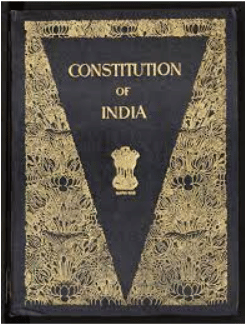
Written constitution is a formal document that outlines the fundamental principles, structures, and functions of a government. Constitutions are classified as either written (such as the American Constitution) or unwritten (such as the British Constitution). The Indian Constitution is the longest of any written constitution in the world. A written constitution is also required for a federal constitution. It would be difficult to maintain the Constitution's supremacy unless it is written.
|
Table of Contents |
What Is The Constitution?
- The vast majority of modern constitutions describe the fundamental principles of the state, the structures and processes of government, and citizens' fundamental rights in a higher law that cannot be changed unilaterally by an ordinary legislative act. This higher law is commonly known as a constitution.
A constitution is a set of fundamental legal-political rules that:
- are binding on everyone in the state, including ordinary law-making institutions;
- concern the structure and operation of government institutions, political principles, and citizens' rights;
- are based on widespread public legitimacy;
- are more difficult to change than ordinary laws (e.g., a two-thirds majority vote or a referendum is required); and
- meet the internationally recognized criteria for a democratic system in terms of representation and human rights.
| Other Relevant Links | |
|---|---|
| Bicameralism | Dual Polity |
| Division of Powers | Supremacy of the Constitution |
| Rigid Constitution | Independent Judiciary |
|
"The written nature of a constitution is the eloquent script that defines a nation's principles, ensuring that justice and governance speak through the enduring language of law." |
Concept Of Written And Unwritten Constitution
Written Constitution
- Any constitution that has been written and contains all the details in a book form that can be referenced to anytime is called a written constitution.
- It comprises duties and rights of governments and citizens, the type of constitutional order and the laws that govern and regulate the system.
- Such constitutions are flexible, meaning they can be changed over time.
- The judiciary is more powerful and can have judicial review powers to ensure the supremacy of the Constitution.
Unwritten Constitution
- The unwritten constitution is defined as the constitution in which the legal decisions, fundamental laws, and rules governing the nation are not systematically written down or incorporated into a single document.
- An unwritten constitution can be rigid, flexible, or both.
- Parliament is the supreme power in a country with an unwritten constitution.
Significance
- The Constitution is not only a written document, but it is also the world’s longest.
- It began with a Preamble, 395 Articles (divided into 22 Parts), and 8 Schedules.
- It currently consists of a Preamble, approximately 470 Articles (divided into 25 Parts), and 12 Schedules.
- It defines the structure, organization, powers, and functions of the federal and state governments, as well as the boundaries within which they must operate.
- As a result, misunderstandings and disagreements between the two are avoided.
- The written constitution has been fully drafted and passed, and the main purpose of the written constitution is its implementation.
- The written constitution is assigned to a special body which formulates and adopts the constitution and clearly defines the basic organs and institutions of government.
- Though India has a written constitution; the Indian constitution is not as rigid as the American constitution. It has incorporated the flexible nature in the procedures for amendments.
- All provisions are present in writing and are laid out with great care, so they cannot be twisted and modified based on the circumstances and emotions, ensuring consistency in decisions.
Explain With Examples
Written Constitution
- The oldest written constitution is that of the United States of America.
- It was drafted on September 17, 1787, ratified on June 21, 1788, and entered into force on March 4, 1789.
- James Madison wrote the document that served as a model for the US Constitution. He is known as one of the Founding Fathers of America.
Unwritten Constitution
- The Magna Carta is considered as the oldest unwritten form of constitution.
- It was a Bill of Rights for Nobles signed by King John of England, which came into force on June 15, 1215.
- It promised to protect the rights of the nobles from interference of the crown.
- The Magna Carta later evolved and became the unwritten constitution of the United Kingdom.
Conclusion
However, it may be emphasized that no constitution is completely written or completely unwritten. A written constitution respects certain conventions, while a so-called unwritten constitution contains some written rules.
FAQs
Question: What is the significance of the written Constitution of India?
Answer: The written Constitution of India serves as the supreme law of the country, establishing the framework for governance and ensuring the protection of fundamental rights. Adopted on January 26, 1950, it lays down the political structure, the powers of different branches of government, and the rights of citizens. It is the longest written constitution of any sovereign nation and is detailed in its provisions, ensuring a clear distinction of powers between the central and state governments. Its significance lies in its ability to provide a legal framework that upholds democracy, justice, and equality in India.
Question: How does the Indian Constitution ensure the separation of powers?
Answer: The Indian Constitution establishes the separation of powers by dividing the government into three distinct branches: the Legislature (Parliament), the Executive (Prime Minister and Council of Ministers), and the Judiciary (Supreme Court and High Courts). Each branch has defined powers and functions that are independent of one another. This separation ensures a system of checks and balances where no branch becomes too powerful, thereby safeguarding democratic governance and maintaining the rule of law.
Question: What are the key features of the Indian Constitution?
Answer: The Indian Constitution incorporates several key features, including: 1. **Federal Structure**: India follows a federal system of governance, where powers are divided between the central and state governments. 2. **Parliamentary System**: It establishes a parliamentary system of government, where the executive is accountable to the legislature. 3. **Fundamental Rights**: The Constitution guarantees fundamental rights to all citizens, ensuring protection from discrimination and promoting equality. 4. **Directive Principles of State Policy**: These principles guide the government in creating laws and policies aimed at social welfare and economic justice. 5. **Secularism**: The Constitution ensures that India remains a secular state, where no religion is favored by the government.
Question: What is the significance of the Preamble of the Indian Constitution?
Answer: The Preamble of the Indian Constitution serves as an introductory statement that reflects the ideals and philosophy of the Constitution. It declares India to be a Sovereign, Socialist, Secular, Democratic Republic, and emphasizes the values of Justice, Liberty, Equality, and Fraternity. It also highlights the source of the Constitution's authority, which comes from "We, the people of India." The Preamble thus serves as a guiding light, reflecting the vision and goals of the Indian state.
Question: How does the Indian Constitution provide for the amendment of its provisions?
Answer: The Indian Constitution provides a flexible system for amendments through Article 368. Amendments can be made by Parliament, with certain provisions requiring a special majority of both houses. Some amendments may also require the consent of the state legislatures. This flexibility ensures that the Constitution can adapt to changing circumstances, while still maintaining its core principles. Amendments are made to address social, political, and economic changes and to respond to the needs of the times.
MCQs
1. Which of the following is a key feature of the Indian Constitution?
A) It is a unitary constitution
B) It provides for a presidential system
C) It provides a federal system of governance
D) It does not recognize fundamental rights
Answer: (C) See the Explanation
Explanation: The Indian Constitution establishes a federal system of governance, with powers divided between the central and state governments, making it distinct from a unitary system.
2. Who is known as the principal architect of the Indian Constitution?
A) Dr. Rajendra Prasad
B) Jawaharlal Nehru
C) Dr. B.R. Ambedkar
D) Sardar Vallabhbhai Patel
Answer: (C) See the Explanation
Explanation: Dr. B.R. Ambedkar is regarded as the principal architect of the Indian Constitution due to his significant role in drafting it and his contribution to shaping its provisions.
3. Which part of the Indian Constitution deals with Fundamental Rights?
A) Part III
B) Part II
C) Part IV
D) Part V
Answer: (A) See the Explanation
Explanation: Part III of the Indian Constitution deals with Fundamental Rights, guaranteeing various rights such as the right to equality, freedom of speech, and protection against discrimination.
4. Which article of the Indian Constitution allows the President to promulgate ordinances during Parliament's recess?
A) Article 123
B) Article 356
C) Article 370
D) Article 368
Answer: (A) See the Explanation
Explanation: Article 123 of the Indian Constitution allows the President to promulgate ordinances when Parliament is not in session, provided there is an urgent need for legislation.
5. What is the maximum time allowed for the promulgation of an ordinance by the President of India?
A) Six months
B) Three months
C) One year
D) Two months
Answer: (A) See the Explanation
Explanation: An ordinance promulgated by the President under Article 123 must be approved by Parliament within six weeks of reassembling. If not, the ordinance ceases to be valid.
GS Mains Questions and Model Answers
Q1: Explain the concept of a "Written Constitution." How does the Indian Constitution, as a written document, provide a structure for governance?
Answer: A "Written Constitution" is a formal document that lays down the framework of government, including the powers of various branches of government, the rights of citizens, and the procedures for governance. The Indian Constitution is a written document that establishes a clear structure for governance by detailing the powers of the Executive, Legislature, and Judiciary. It outlines the rights of citizens and contains provisions for their protection, ensuring a system of checks and balances. By codifying these provisions, the Constitution ensures that the rule of law is upheld, and it guides the functioning of all institutions within the country.
Q2: Discuss the role of Fundamental Rights in the Indian Constitution. How do they contribute to the democratic functioning of the country?
Answer: Fundamental Rights are enshrined in Part III of the Indian Constitution and are crucial in safeguarding individual liberties. They include rights like equality before the law, protection from discrimination, and freedom of speech. These rights empower citizens to challenge unjust laws, ensuring that the government does not overstep its boundaries. By guaranteeing these rights, the Constitution fosters democracy by promoting fairness, justice, and equality. They also ensure that every individual has the freedom to express opinions, practice religion, and participate in the democratic process without fear of persecution.
Q3: How does the Indian Constitution adapt to changing circumstances? Discuss the provisions for its amendment and the role of judicial review in interpreting the Constitution.
Answer: The Indian Constitution provides a mechanism for adaptation through its amendment provisions in Article 368. Amendments can be made to address evolving social, economic, and political realities. Some provisions require a simple majority in Parliament, while others require a special majority. Additionally, the Constitution allows for judicial review, where the judiciary has the power to interpret the Constitution and declare laws or actions of the government unconstitutional if they violate the Constitution's principles. This ensures that the Constitution remains a living document capable of addressing contemporary issues while preserving its core values.
Previous Year Questions on Written Constitution
1. UPSC CSE Prelims 2020:
Question: What is the primary feature of a "written" Constitution?
A) It is flexible and can be easily changed
B) It is unwritten and based on conventions
C) It is a formal and codified document
D) It does not deal with the rights of citizens
Answer: (C)
Explanation: A "written" Constitution is a formal and codified document that outlines the structure of government, the distribution of powers, and the rights of citizens.
2. UPSC CSE Mains 2019 (GS Paper 2):
Question: "Evaluate the role of the Indian Constitution in shaping the governance system. Discuss how it balances federalism and democracy."
Answer: The Indian Constitution establishes a federal structure of governance, distributing powers between the central and state governments, while maintaining a strong central authority. The Constitution balances federalism and democracy by ensuring that the democratic process is upheld at both the central and state levels, while also providing mechanisms like the Parliament and the judiciary to resolve disputes between these levels. This balance is vital in ensuring the unity of the nation while promoting local governance and addressing regional concerns.
Question: Consider the following statements
- An unwritten constitution can be rigid, flexible, or both.
- Parliament is the supreme power in a country with an unwritten constitution.
Which of the above statements is/are correct
(a) 1 only
(b) 2 only
(c) Both 1 and 2
(d) Neither 1 nor 2
Answer: (c) See the Explanation
The unwritten constitution is defined as the constitution in which the legal decisions, fundamental laws, and rules governing the nation are not systematically written down or incorporated into a single document. An unwritten constitution can be rigid, flexible, or both. Parliament is the supreme power in a country with an unwritten constitution.
*email: contactus@prepp.in
Download the PREPP App and attempt FREE IAS Exam Mock Tests and get complete study material!
UPSC IAS : CSAT - Mini Live Test

Live Test : UPSC CSE Prelims CSAT (Paper-II) (Oct 20 - 23)
Full Test - 04: UPSC CSE Prelims CSAT (Paper-II)
Full Test - 03: UPSC CSE Prelims CSAT (Paper-II)
UPSC CSE Prelims 2026 GS Paper 1 Question Paper (24-May-2026)
UPSC CSE Prelims 2026 CSAT Paper 2 Question Paper (24-May-2026)

17 February 2025 | The Hindu Must Read Articles | Current Affairs

16 February 2026 | The Hindu Must Read Articles | Current Affairs

13 February 2026 | The Hindu Must Read Articles | Current Affairs









Comments