Salient Features of the Indian Constitution – Indian Polity Notes
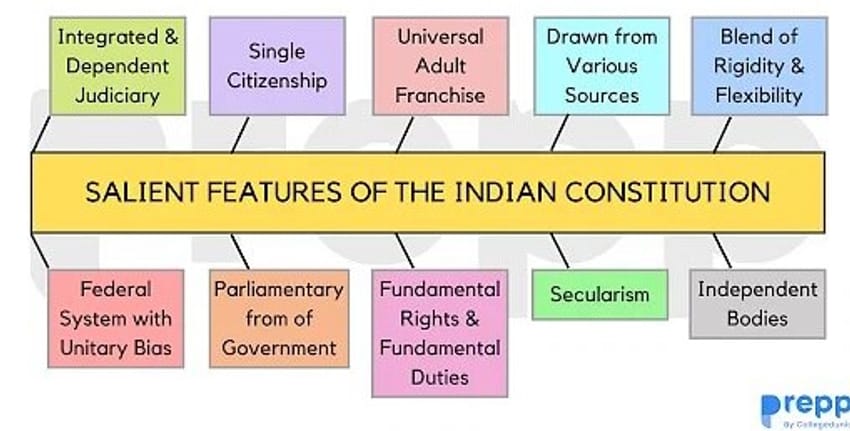
Indian Constitution is characterized by a set of salient features that reflect the commitment to built just and equitable society. After researching all prior constitutions, Indian Constitution was adopted.Though the Indian Constitution has borrowed some of its provisions from different Constitutions of the world, it is unique in its content and spirit.
Key features include
- Blend of rigidity and flexibility,
- Federal system with a Unitary bias,
- Parliamentary form of Government,
- Integrated and Independent Judiciary,
- Fundamental Rights,
- Directive Principles of State Policy,
- Fundamental Duties,
- Secularism and
- Universal Adult Franchise.
The topic “Salient Features of the Indian Constitution” is an important part of the UPSC/IAS Preliminary and mains Exam’s Indian Polity and Governance Syllabus which is discussed in this article in detail.
Salient Features of the Indian Constitution - Indian Polity Notes : Download PDF
|
Table of Contents
|
|
Blend of rigidity and flexibility, Federal system with a Unitary bias, Parliamentary form of Government, Integrated and Independent Judiciary, and Fundamental Rights are some of the key features of the Indian Constitution. |
The Salient Features Of The Indian Constitution
The list salient features of Indian Constitution is discussed below:
Lengthiest Written Constitution
- The Indian Constitution is one of the lengthiest constitutions in the world. There are 12 schedules and 448 articles in our Constitution.
- The reasons for its lengthy nature can be summarised as follows:
- Incorporated not only principles of governance but also detailed administrative provisions.
- Influence of the Government of India Act 1935
- Single constitution for both centre and states
- Dominance of legal luminaries in the Assembly.
- Therefore detailed provisions even for the matters of ordinary legislation have made the Constitution lengthy.
Drawn From Various Sources
- Indian Constitution has borrowed most of its provisions from other constitutions as well as the Government of India Act of 1935.
- Dr. B.R. Ambedkar proudly declared that the Indian Constitution was drafted after "ransacking all known Constitutions of the World.
- The structural elements of the Constitution are heavily influenced by the Government of India Act of 1935. The philosophical part ( Fundamental Rights, Directive Principles of State Policy) is inspired by American and Irish constitutions, respectively.
- Government of India Act of 1935 is the source of the Federal Scheme, Judiciary, Governors, Emergency Powers, Public Service Commissions, and the majority of administrative details.
- Other provisions of the constitutions are drawn from countries like Australia, Canada, Ireland, Japan, Russia, United Kingdom, United States, Germany, South Africa, and France.
Blend Of Rigidity And Flexibility
The Indian Constitution is neither completely rigid nor completely flexible. But it is a mix of both. Article 368 provides for two types of amendments -
- Amendment through a special majority, i.e. two-thirds majority of the members of each House present and voting, and a majority (50%) of the total membership of each House.
- Some other provisions can be amended by a special majority of the Parliament and with the ratification by half the states.
- At the same time, some of the provisions of the Constitution can be amended by simple majority like ordinary laws.
Federal System With A Unitary Bias
- Indian Constitution establishes federal system of government with strong centre. The term federation is nowhere mentioned in the Constitution. Article 1 describe India as Union of States.
- Union of States implies two things,one is Indian Federation is not a result of agreement by the states, second,no state can secede from the Federation.
| Unitary Features of the Constitution | Federal Features of the Constitution |
|---|---|
| Strong Centre | Division of powers between centre and states |
| Single Constitution | Two Government |
| Single Citizenship | Written Constitution |
| Flexibility of the Constitution | Supremacy of the Constitution |
| Integrated Judiciary | Independent Judiciary |
| Appointment of state governor by Centre | Bicameralism |
| All India Services | Rigidity of the Constitution |
| Extraordinary powers with Centre during Emergency | - |
Parliamentary Form Of Government
- The Constitution makers preferred a parliamentary system of government. Our newly formed democracy could not afford any confrontations between the executive and the legislature.
- The parliamentary form of Government is based on the principle of Co-operation and Co-ordination between the legislative and executive organs.
- The real executive power thus vests with the Council of Ministers with the Prime Minister as the head.
- The Council of Ministers is collectively responsible to the Lok Sabha. The same is true of the relationship between the Governors and the Council of Ministers in the States. therefore, it is one of the important salient feature of Indian constitution.
- Even though the Indian Parliamentary system is heavily influenced by British Parliamentary system but there are certain fundamental differences. Indian Parliament is not a sovereign body like British Parliament, Indian state has an elected head(republic)while the British state has hereditary head(monarchy)
Integrated And Independent Judiciary
- Indian Constitution has established an integrated and independent Judiciary.
- Integrated judiciary implies Supreme Court at the top,below it there are High Courts at state level and hierarchy of subordinate courts at lower level.
- Integrated system of courts enforces both the central as well as the state laws.
- Constitution has made various provisions to ensure the independence of the judiciary: security of tenure of the judges, expenses charged on the Consolidated Fund of India,power to punish for Contempt, separation of the Judiciary from the Executive,ban on practise after retirement etc,
Fundamental Rights
Fundamental Rights promote the idea of political democracy. They act as a check on arbitrary legislative and executive powers.They are justiciable in nature.A citizen can approach the Supreme Court directly in case of violation of Fundamental Rights
The Indian Constitution guarantees 6 Fundamental Rights:
- Right to Equality (Article 14-18)
- Right to Freedom (Article 19-22)
- Right against Exploitation (Article 23-24)
- Right to Freedom of Religion (Article 25-28)
- Cultural and Educational Rights (Article 29-30)
- Right to Constitutional Remedies (Article 32)
Directive Principles Of State Policy
- Part IV of the Indian Constitution deals with the Directive Principles of State Policy.It is the duty of every State to apply these principles while making any new legislation.
- They can be classified into three broader categories:Socialistic,Gandhian and Liberal-intellectual.
- Directive Principles of State Policy pramotes idea of social and economic democracy.They seek to establish Welfare state in India.
- They impose moral obligations on state to take measures for their enforcement.
- They are basically instructions to the legislature and executive that have to be followed while framing new legislation.
Fundamental Duties
- The Swaran Singh Committee of 1976 added a list of 11 Fundamental Duties in the constitution by adding a new Part-IVA and Article 51A in constitution.
- The 11 Fundamental Duties act as a moral obligation on every citizen of India and these Fundamental Duties are non-justiciable in nature i.e., one cannot move to court if someone is not obliging their duty as a citizen of India.
- The Fundamental Duties serve as the remainder to the citizens that while enjoying their rights,they have also to be conscious of their duties which they owe to the nation and fellow citizens.
Secularism
- The Constitution of India stands for a secular state ie.Equal respect and equal treatment to all religions.
- It also does not uphold any particular religion as the official state religion. The Western concept of secularism connotes a complete separation between religion and the State.
- This concept is inapplicable in the Indian situation where the society is multireligious.
- Hence, the Indian Constitution embodies the positive concept of secularism, i.e. giving equal respect to all religions and protecting all religions equally.
Universal Adult Franchise
- The concept of Universal Adult Franchise/Adult suffrage allows every citizen of India who is above eighteen years the right to vote in democratic elections.
- Any adult who is eligible to vote should not be discriminated against on the basis of gender, caste, and religion.
- The voting age was reduced to 18 years from 21 years in 1989 by the Constitutional Amendment Act of 1988.
- Universal Adult Franchise has broaden the base of democracy,uphold the idea of equality in real sense and has enhanced the prestige of common people.
- Article 326 of the Indian Constitution guarantees this right.
Single Citizenship
- Despite the fact that the Indian Constitution is federal and envisions a dual polity (Centre and states), it only provides for one citizenship, namely Indian citizenship.
- In India, all citizens, regardless of the state of birth or residence, enjoy the same political and civil rights of citizenship across the country, and no distinction is made between them.
- Despite the constitutional guarantee for single citizenship and equal rights for all citizens, India has seen sectarian riots,class clashes,casteism,linguism and ethnic conflicts
- This indicates that the Constitution's long-held objective of creating a cohesive and integrated Indian nation has not been completely realised.
Independent Bodies
- The Indian Constitution establishes some independent bodies in addition to the legislative, executive, and judicial institutions of the government (both central and state).
- They are referred as the bulwarks of the democratic system of the Government.
- They are as follows:
- Election Commission.
- Comptroller and Auditor-General of India.
- Union Public Service Commission.
- State Public Service Commission.
Conclusion
The Indian Constitution encapsulates principles of justice, liberty, equality, and fraternity. Its federal structure harmonizes a strong central authority with state autonomy, fostering unity in diversity. The inclusion of Directive Principles reflects a commitment to socio-economic justice, while fundamental rights safeguard individual freedoms. Constitution's adaptability through amendments ensures relevance in evolving societal contexts. With its visionary approach, it stands as a testament to the framers' wisdom, providing a stable and enduring framework for India's democratic journey.
FAQs
Question: What is the significance of the Indian Constitution?
Answer: The Indian Constitution provides the legal and institutional framework for the functioning of the government and ensures fundamental rights, duties, and the division of powers.
Question: What is the nature of the Indian Constitution?
Answer: The Indian Constitution is both rigid and flexible, allowing amendments while retaining core principles.
Question: What does the term 'Secular State' signify in the Indian Constitution?
Answer: The Indian Constitution ensures secularism, meaning equal treatment of all religions by the state.
Question: What are the key features of the Indian Constitution?
Answer: The Indian Constitution features federalism, parliamentary democracy, fundamental rights, directive principles, and judicial independence.
Question: How is the Indian Constitution a blend of flexibility and rigidity?
Answer: The Constitution is flexible as it can be amended easily, but also rigid in that certain provisions require a special majority or state ratification to change.
MCQs
- Which feature of the Indian Constitution ensures that no religion is given special preference?
a) Sovereignty
b) Secularism
c) Federalism
d) Socialism
Answer: (B) See the Explanation
Secularism in the Indian Constitution means the state treats all religions equally and does not favor or discriminate against any religion.
- The Indian Constitution is often described as a 'bag of borrowings.' Which feature was borrowed from the UK?
a) Fundamental Rights
b) Parliamentary System
c) Directive Principles of State Policy
d) Federalism
Answer: (B) See the Explanation
The Indian parliamentary system, including the role of the Prime Minister and the cabinet, is modeled on the British system.
- Which part of the Indian Constitution enshrines the Directive Principles of State Policy?
a) Part III
b) Part IV
c) Part V
d) Part IX
Answer: (B) See the Explanation
The Directive Principles of State Policy are outlined in Part IV of the Indian Constitution and serve as guidelines for the state to ensure social and economic justice.
- Which feature of the Indian Constitution allows both the center and states to make laws on certain subjects?
a) Judicial Review
b) Federalism
c) Sovereignty
d) Fundamental Duties
Answer: (B) See the Explanation
Federalism in the Indian Constitution ensures a division of powers between the central and state governments, with both having authority over concurrent subjects.
- Which part of the Indian Constitution deals with Fundamental Rights?
a) Part III
b) Part IV
c) Part VI
d) Part IX
Answer: (A) See the Explanation
Part III of the Indian Constitution enshrines Fundamental Rights, protecting citizens against state actions and ensuring personal freedoms and equality.
GS Mains Questions and Model Answers
Q1: Discuss the flexibility and rigidity of the Indian Constitution in the context of constitutional amendments.
Answer: The Indian Constitution is often referred to as a blend of flexibility and rigidity. It allows for amendments through a simple majority for non-fundamental changes and a special majority for significant provisions, making it flexible. However, certain critical provisions, such as those involving federal principles, require not just a special majority in Parliament but also ratification by at least half the state legislatures, making the Constitution rigid in key areas. This balance ensures the adaptability of the Constitution while safeguarding its core principles.
Q2: Evaluate the role of the Directive Principles of State Policy in promoting social and economic democracy.
Answer: The Directive Principles of State Policy aim to ensure social and economic democracy by guiding the state in formulating policies that promote welfare, reduce inequality, and improve living standards. Though non-justiciable, these principles have been critical in influencing laws related to labor rights, land reforms, and healthcare. Over time, several amendments, including those related to education and employment, have drawn inspiration from these principles, helping bridge economic disparities and uplift marginalized sections of society.
Q3: Examine the role of fundamental rights in safeguarding individual liberty in India.
Answer: Fundamental Rights, enshrined in Part III of the Indian Constitution, act as a shield against arbitrary state actions, protecting individual liberty. Rights like freedom of speech, equality before the law, and the right to constitutional remedies ensure that citizens can challenge state overreach. However, reasonable restrictions on these rights, such as for public order or national security, ensure a balance between individual freedom and the broader public interest. Judicial review by the courts further safeguards these rights, reinforcing democratic values.
Previous Year Questions on Salient Features of the Indian Constitution
1. UPSC CSE Prelims 2018:
Question: Which of the following features of the Indian Constitution ensures division of powers between the Center and the States?
A. Parliamentary form of government
B. Federalism
C. Presidential system
D. Judicial review
Answer: B
Explanation: Federalism is the feature that divides legislative, executive, and financial powers between the Center and States, as enshrined in the Indian Constitution.
2. UPSC CSE Mains 2016 (GS Paper 2):
Question: Critically examine the significance of the Parliamentary System in the context of Indian governance.
Answer: The Parliamentary System in India allows for a close relationship between the executive and legislature, where the government is directly accountable to the elected representatives in Parliament. It promotes collective responsibility and faster legislative action. However, it may also lead to instability in case of fragmented mandates and coalition politics. Additionally, the domination of the majority party in the executive can sometimes undermine the checks and balances provided by the legislature. Despite these challenges, it is effective in maintaining democratic accountability.
3. UPSC CSE Prelims 2016:
Question: The Secular nature of the Indian state means:
A. The state recognizes all religions
B. The state promotes all religions equally
C. The state does not recognize any religion as official
D. The state discriminates against no religion
Answer: D
Explanation: Secularism in India means the state does not promote or discriminate against any religion, ensuring equal respect and treatment for all faiths.
*email: contactus@prepp.in
Download the PREPP App and attempt FREE IAS Exam Mock Tests and get complete study material!

Full Test - 04: UPSC CSE Prelims CSAT (Paper-II)
Full Test - 03: UPSC CSE Prelims CSAT (Paper-II)
UPSC CSE Prelims 2026 GS Paper 1 Question Paper (24-May-2026)
UPSC CSE Prelims 2026 CSAT Paper 2 Question Paper (24-May-2026)

17 February 2025 | The Hindu Must Read Articles | Current Affairs

16 February 2026 | The Hindu Must Read Articles | Current Affairs

13 February 2026 | The Hindu Must Read Articles | Current Affairs









Comments