Synthesis of Parliamentary Sovereignty and Judicial Supremacy – Indian Polity Notes
Parliamentary sovereignty means parliament is superior to the executive and judicial branches of government and so has the authority to make or repeal any law it sees unfit. Judicial supremacy is the doctrine that the Supreme Court should be viewed as the authoritative interpreter of the Constitution and its decisions as binding on the other branches and levels of government, until and unless constitutional amendment overrules them. The founders of the Indian Constitution advocated for a proper synthesis of the British notion of parliamentary sovereignty with the American principle of judicial supremacy. This article explains the Synthesis of Parliamentary Sovereignty and Judicial Supremacy which is important for UPSC Indian Polity Preparation.
|
Table of Contents |

What is Parliamentary Sovereignty?
- Sovereignty embodies the idea that there must be some absolute power of final decision in every system of government.
- The person or body making such a decision must be legally competent to make the decision and practically capable of enforcing it.
- Parliamentary sovereignty means the supremacy of the legislature, i.e., parliament over all other government bodies, including the executive and the judiciary.
- However, in India, Parliament sovereignty is not there but rather there is constitutional sovereignty.
- By granting the judiciary the power of judicial review and the Parliament the sovereign power of amending the Constitution with certain constraints, the Indian Constitution makers chose a middle path between the system of American judicial supremacy and the principle of British Parliament sovereignty.
- Example: The British Parliament is sovereign, which means it has absolute power inside the state and is not limited by legislation in its authority and jurisdiction.
- The 'doctrine of Parliamentary Sovereignty' is connected with the British Parliament.
What is Judicial Supremacy ?
- Judicial supremacy is a concept that grants the highest authority to a country's judiciary.
- In such a country, whatever directives and laws are enacted by the legal system, particularly the top judicial court, are supreme.
- Judicial review entails the power of the judiciary to review legislative and judicial actions, thereby enshrining the principle of Rule of Law and upholding the separation of powers principle at the grassroots level.
- Judicial review is a powerful tool for reigning in public bodies and holding them accountable when their decisions or policies exceed the powers granted by the Constitution.
- It maintains effective checks and balances by limiting arbitrary, irrational, or unjust acts taken on behalf of the Executive and the Legislature.
- In India, the Supreme Court has the authority to exercise judicial review under Article 13 (2).
- Judicial review in India consists of three aspects:
- of legislative action
- of administrative action
- of judicial decisions.
- According to the Supreme Court, judicial review is a fundamental feature of the Constitution.
- As a result, the power of judicial review by courts is not subject to change and has effectively been removed from the realm of Parliament's power to amend or abridge.
- In exercising its judicial review power, the court would vigorously protect human rights, fundamental rights, and citizens' rights to life and liberty.
|
"In India's constitutional tapestry, Parliamentary Sovereignty and Judicial Supremacy coalesce as twin pillars, shaping a dynamic equilibrium between legislative authority and judicial oversight."
|
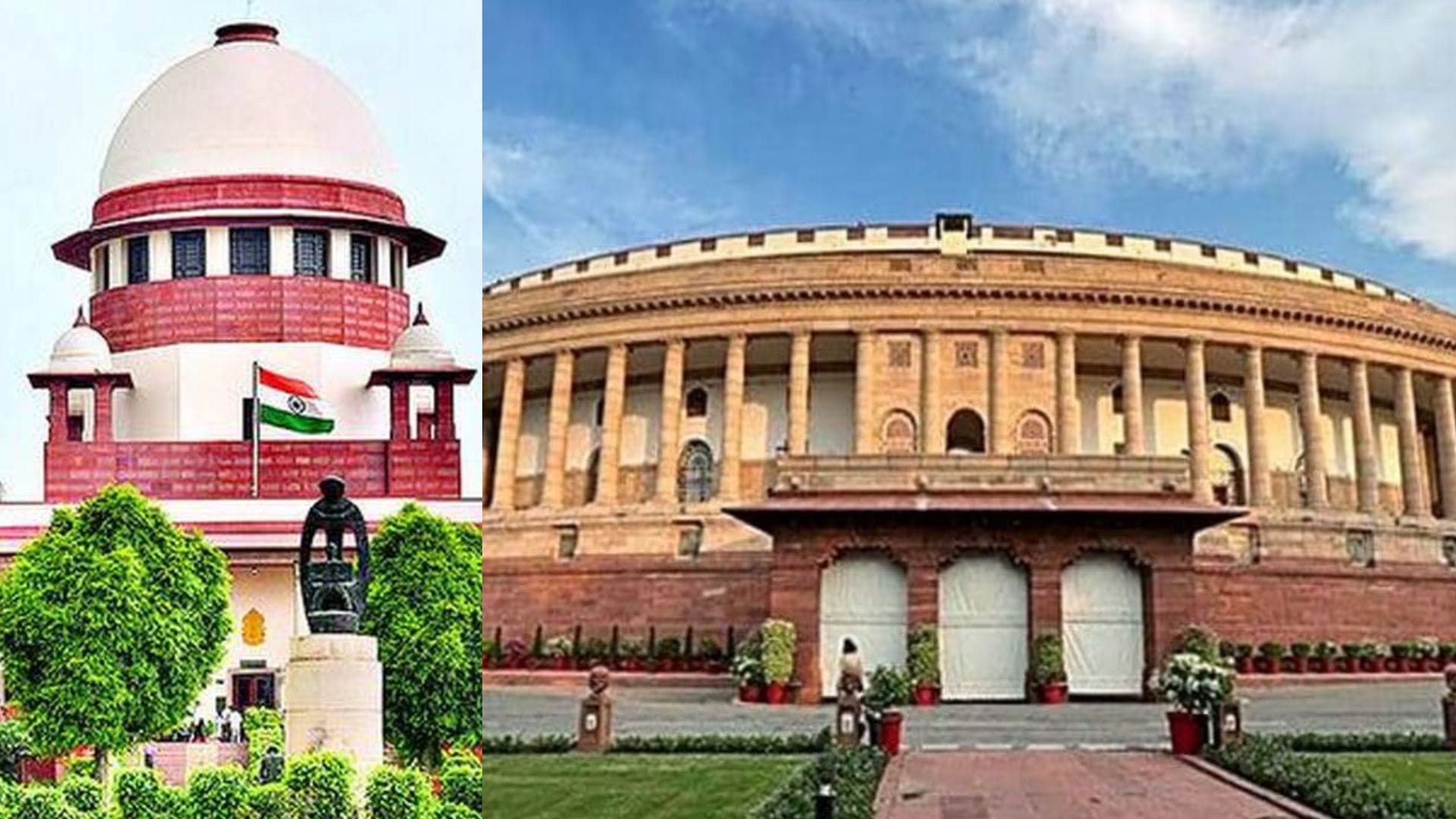
Synthesis of Parliamentary Sovereignty and Judicial Supremacy - Indian Context
- The scope of judicial review power of the Supreme Court in India is narrower than that of the US, just as the Indian parliamentary system differs from the British system.
- This is because the American Constitution guarantees 'due process of law,' as opposed to the Indian Constitution's guarantee of 'procedure established by law' (Article 21).
- The Indian Constitution's framers preferred a proper synthesis of the British principle of parliamentary sovereignty and the American principle of judicial supremacy.
- As a mixed political system, India has backed a completely unique politico-constitutional arrangement known as parliamentary federalism, which has no precedent in the history of constitution development.
- The Supreme Court, on one hand, has the power of judicial review to declare parliamentary laws unconstitutional.
- The Parliament, on the other hand, can amend the major portion of the Constitution through its constituent power under Article 368.
- Our constitution vests legislative sovereignty in the legislature and the Supreme Court with judicial review authority.
- Article 13 states that states must not pass laws that are inconsistent with Part III of the constitution and violate Fundamental Rights.Thus, the article provides a judicial review of pre-constitutional and post-constitutional laws, providing a synchronizing approach to the constitution's provisions.
- Article 368 of the Constitution provides for amendments to the Constitution, which require the introduction of such a bill in either house of Parliament by a majority of total members.In some cases, such as associated with Articles 54, 55, 73, 162, or 241 requires ratification by at least half of the states.
- The 42nd Amendment Act of 1976 tainted this delicate balance by inserting Articles 31(D), 32(A), 131(A), 144(A), 226(A), 228(A),323-A, 323-B, and 329(A).
- However, the Janata government corrected this imbalance in 1977 with the 43rd and 44th amendments, which repealed all of the preceding articles except 323-A and 323-B.
- In the Keshavananda Bharti case in 1973, the Supreme Court gained much ground for judicial review by inventing a new doctrine known as "the basic structure."
- Under the Constitution, the legislature, executive, and judiciary are to exercise their powers with checks and balances, but not in a watertight rigid mold.
Significance
- Checks and Balances:The synthesis of parliamentary sovereignty and judicial supremacy creates a system of checks and balances within the government. While Parliament holds the authority to legislate, the judiciary ensures that such legislation complies with the constitution and protects individual rights.
- Preservation of Fundamental Rights:Judicial supremacy ensures that fundamental rights enshrined in the constitution are protected from arbitrary legislative actions. The judiciary acts as a guardian of these rights and can strike down laws that violate the fundamental principles of justice, liberty, and equality.
- Constitutional Harmony:The synthesis helps in maintaining constitutional harmony by preventing any one branch of government from becoming too powerful.
- Adaptability and Evolution of Law: The synthesis allows for the adaptation and evolution of legal principles over time. Judicial supremacy allows the judiciary to interpret laws in light of changing societal norms and values,ensuring that the legal system remains relevant and just.
- Rule of Law:It reinforces the rule of law by subjecting both legislative and executive actions to legal scrutiny. No one, including the government, is above the law. This promotes a society where decisions are made within the confines of legal principles and norms.
- Protection against Authoritarianism:The synthesis acts as a safeguard against potential authoritarian tendencies of the government. Judicial supremacy ensures that governmental actions are in line with the constitution, preventing the concentration of power in any single institution.
Limitations
- The supporters of complete judicial independence argue that democracy cannot succeed in the absence of an impartial, independent, and supreme judiciary.
- As per the supporters of parliamentary supremacy, the concept of judicial supremacy which is conveyed in the form of judicial review, is discordant with a democratic government.
- The legislature is regularly repealing and amending previous laws, as well as enacting new ones.
- The judiciary is also doing its part by declaring certain laws or parts of laws unconstitutional.
- There is misperception and instability all the time. A sort of enmity and competition has on-going between the two most important organs of the government.
- The constitution rules supreme in India. Parliament's powers are defined and limited by the constitution.
- Because of India's federal system, there is a division of powers between the Union and the states. Parliament cannot pass legislation on subjects on the state list.
- Also, since the constitution is supreme, any law enacted by parliament is subject to being declared "Ultra vires" by the Supreme Court.
- Only laws that are consistent with the provisions of the constitution may be enacted by Parliament. As a result, the supremacy of the constitution limits the powers of parliament.
Some Examples
- In the verdict of the Supreme Court on the 99th Constitution Amendment Act and the National Judicial Appointments Commission (NJAC).
- The Supreme Court declared them to be ultra vires.
- This is an example of when a parliamentary act is overturned as unconstitutional on the principle of judicial review.
- According to the Supreme Court's decision on the Scheduled Castes and Scheduled Tribes (Prevention of Atrocities) Act 1989:
- The Parliament enacted Section 18A in the said Act which virtually circumvents the diktat of the judgment passed by the Supreme Court.
- These are the challenges which ‘judicial review’ keeps on facing.
Conclusion
The three pillars that support the successful operation of the government are the judiciary, the legislature, and the executive. Balance, rather than conflict, is critical to achieving ultimate public welfare and the seamless operation of the constitutional machinery. India, bears the supremacy of the Constitution, where the powers of the Parliament are circumscribed within the four walls established by the Constitution and yet provides for striking a balance between the various pillars without encroaching on each other's territory and providing effective governance.
FAQs
Q1: What is Parliamentary Sovereignty?
Answer: Parliamentary Sovereignty is the principle that Parliament has the ultimate legal authority and can create or repeal any law without legal restrictions. It underscores the supremacy of Parliament over all other institutions.
Q2: What does Judicial Supremacy entail?
Answer: Judicial Supremacy refers to the judiciary's authority to interpret laws and ensure they conform to the Constitution. It emphasizes that the judiciary has the final say on legal disputes, including those involving legislative actions.
Q3: How do Parliamentary Sovereignty and Judicial Supremacy coexist in India?
Answer: In India, Parliamentary Sovereignty exists within the framework of the Constitution, while Judicial Supremacy is upheld through the power of judicial review, allowing the Supreme Court to nullify laws that violate constitutional provisions.
Q4: What is the significance of the synthesis of these two principles?
Answer: The synthesis allows for a balance between legislative authority and the protection of fundamental rights. It ensures that while Parliament can make laws, the judiciary can invalidate those that infringe upon constitutional rights, maintaining a check on legislative power.
Q5: What are the implications of this synthesis for the Indian legal system?
Answer: This synthesis ensures that the legislative process respects constitutional mandates, fostering a robust democracy. It protects individual rights and promotes accountability in governance by enabling the judiciary to challenge parliamentary decisions when necessary.
MCQs
- Which principle asserts that Parliament has the ultimate authority in law-making?
A) Judicial Supremacy
B) Parliamentary Sovereignty
C) Constitutional Supremacy
D) Rule of Law
Answer: B) See the Explanation
Parliamentary Sovereignty indicates that Parliament holds the highest authority to enact laws without legal limitations.
- What power does Judicial Supremacy grant to the judiciary?
A) Enacting laws
B) Interpreting laws and the Constitution
C) Amending the Constitution
D) Overruling executive decisions
Answer: B) See the Explanation
Judicial Supremacy empowers the judiciary to interpret laws and ensure they align with the Constitution, thereby enforcing constitutional supremacy.
- What does the synthesis of Parliamentary Sovereignty and Judicial Supremacy in India ensure?
A) Absolute power to Parliament
B) Balanced governance respecting constitutional rights
C) Total independence of the judiciary
D) Limitations on the judiciary's powers
Answer: B) See the Explanation
The synthesis ensures that while Parliament has law-making powers, the judiciary can review and invalidate laws that violate constitutional rights, ensuring checks and balances.
- Which article of the Indian Constitution empowers the judiciary to exercise judicial review?
A) Article 14
B) Article 32
C) Article 226
D) Article 13
Answer: D) See the Explanation
Article 13 empowers the judiciary to declare any law inconsistent with the Constitution void, supporting the principle of judicial review.
- Why is the synthesis of these two principles crucial for democracy in India?
A) It promotes executive supremacy.
B) It protects individual rights and freedoms.
C) It restricts legislative power.
D) It ensures uniformity in laws.
Answer: B) See the Explanation
The synthesis is vital for democracy as it allows the judiciary to protect individual rights against arbitrary legislative actions, fostering accountability and justice.
GS Mains Questions and Model Answers
Q1: Discuss the relationship between Parliamentary Sovereignty and Judicial Supremacy in the context of the Indian Constitution.
Answer: The relationship between Parliamentary Sovereignty and Judicial Supremacy in India is characterized by a delicate balance that reflects the principles of democracy and the rule of law. While Parliament is empowered to make laws, its authority is not absolute; it is subject to the Constitution, which is the supreme law of the land. Judicial Supremacy arises from the power of the judiciary to review laws passed by Parliament to ensure they conform to constitutional mandates. This relationship fosters a system of checks and balances, preventing the misuse of legislative power and protecting fundamental rights. The judiciary acts as a guardian of the Constitution, ensuring that legislative actions do not infringe upon individual liberties, thus reinforcing the foundational principles of justice and equality in the Indian legal framework.
Q2: Analyze the implications of judicial review on Parliamentary Sovereignty in India.
Answer: Judicial review significantly impacts Parliamentary Sovereignty in India by introducing a mechanism through which the judiciary can assess the constitutionality of legislative actions. While Parliament retains the authority to enact laws, judicial review ensures that such laws are aligned with the Constitution. This process acts as a safeguard against potential overreach or arbitrary decisions by the legislature. The judiciary's ability to strike down laws that violate fundamental rights or constitutional provisions preserves the integrity of the legal system and upholds the rule of law. However, this dynamic also raises questions about the limits of legislative power and the judiciary's role in a democratic society. Thus, while Parliamentary Sovereignty is upheld, it operates within the constitutional framework, fostering accountability and respect for individual rights.
Q3: Evaluate the significance of the synthesis of Parliamentary Sovereignty and Judicial Supremacy in promoting democratic values in India.
Answer: The synthesis of Parliamentary Sovereignty and Judicial Supremacy is vital for promoting democratic values in India. It embodies the principle that while elected representatives in Parliament have the mandate to legislate, their powers are not unchecked. This balance is essential for protecting fundamental rights and ensuring that all legislative actions align with the Constitution. By empowering the judiciary to review and invalidate laws that contravene constitutional principles, this synthesis fosters an environment where individual freedoms are safeguarded against legislative excesses. Furthermore, it reinforces the notion of accountability within governance, where Parliament is answerable to the judiciary and, ultimately, to the citizens. This interplay enhances public trust in democratic institutions and ensures that governance is conducted in a manner that respects the rule of law, thereby solidifying the foundations of democracy in India.
Previous Year Questions on Synthesis of Parliamentary Sovereignty and Judicial Supremacy
1. UPSC Prelims 2019
Question: Which of the following statements best describes the concept of Judicial Supremacy in India?
Answer: Judicial Supremacy signifies that the judiciary has the final authority to interpret the Constitution and can declare laws enacted by Parliament unconstitutional if they infringe on fundamental rights.
2. UPSC Mains 2020
Question: Analyze how the relationship between Parliamentary Sovereignty and Judicial Supremacy affects the rights of citizens in India.
Answer: The relationship between Parliamentary Sovereignty and Judicial Supremacy is pivotal in safeguarding citizens' rights. Parliamentary Sovereignty allows the legislature to enact laws reflecting the electorate's will; however, Judicial Supremacy ensures that such laws adhere to constitutional provisions, particularly concerning fundamental rights. This relationship fosters a dynamic where laws must undergo judicial scrutiny, preventing potential infringements on individual liberties. For instance, when laws that may limit freedom of expression or equality before law are challenged, the judiciary acts as the guardian, upholding constitutional integrity. Thus, this interplay not only protects citizens' rights but also reinforces the ethos of democracy by ensuring that legislative actions are both representative and respectful of constitutional mandates.
*email: contactus@prepp.in
Download the PREPP App and attempt FREE IAS Exam Mock Tests and get complete study material!

Full Test - 04: UPSC CSE Prelims CSAT (Paper-II)
Full Test - 03: UPSC CSE Prelims CSAT (Paper-II)
UPSC CSE Prelims 2026 GS Paper 1 Question Paper (24-May-2026)
UPSC CSE Prelims 2026 CSAT Paper 2 Question Paper (24-May-2026)

17 February 2025 | The Hindu Must Read Articles | Current Affairs

16 February 2026 | The Hindu Must Read Articles | Current Affairs

13 February 2026 | The Hindu Must Read Articles | Current Affairs









Comments