Government of India Act 1919 (Montague-Chelmsford Reforms) - Indian Polity Notes
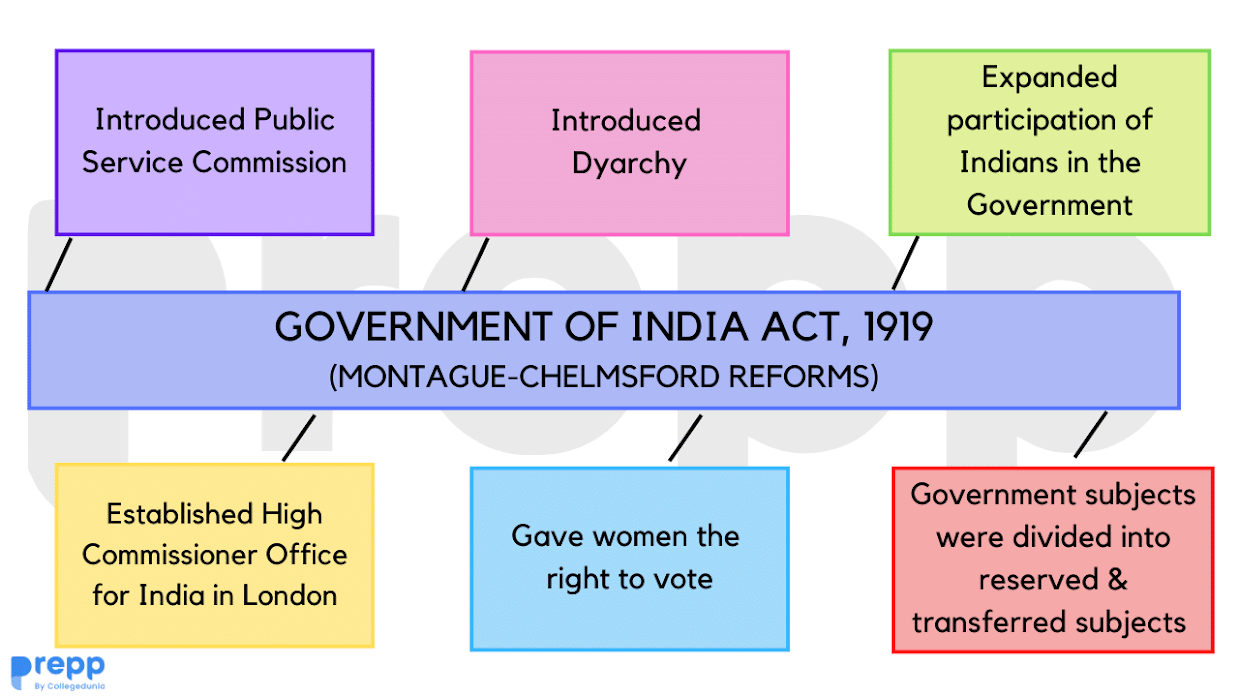
The main purpose of the Government of India Act 1919 was to expand the participation of the Indians in the government. The Government of India Act 1919 Act also provided for a Dual System of Government wherein all the government subjects were divided into two lists. The topic “Government of India Act 1919 (Montague-Chelmsford Reforms)” is an important part of the UPSC/IAS Exam Polity and Governance syllabus which is discussed in this article in detail.
|
Table of Contents |

 Government of India Act 1919
The Government of India Act (1919) - Historical Background
- The Government of India Act (1919) was based on the recommendations of a report submitted by Edwin Montagu. Edwin Montagu was the then secretary of State for India in the year 1917.
- Montagu presented this report to the Cabinet. The report outlined his aim to work towards the gradual development of free institutions in India which will lead to ultimate self-government.
- But Lord Chelmsford advised Montagu to work towards strengthening Indian participation in every aspect of government and the gradual creation of self-governing institutions instead of developing free institutions.
- Lord Chelmsford’s ideas were accepted by the Cabinet, and Edwin Montagu's plans was approved.
- This was the reason why the Government of India Act (1919) was often called the Montague-Chelmsford Reforms.
|
Government of India Act 1919, introduced Dyarchy for the executive at the level of provincial government.
|

The Government of India Act (1919) - Objective
- The primary objective of the Government of India Act (1919) was to ensure that Indians were represented in the government.
- This Act introduced reforms at both the federal and provincial levels of the government.
The Government of India Act (1919) - Key Provisions
Diarchy
- The Government of India Act (1919) introduced diarchy at the Provincial Level. Diarchy means a dual set of governments where one set of government is accountable while the other is not.
- The control over provinces was relaxed by separating subjects as ‘central subjects’ and ‘provincial subjects’.
Division of Subjects
- The provincial government's subjects were separated into two divisions: reserved subjects and transferred subjects.
- The reserved subjects were under the supervision of the British Governor of that province and the transferred subjects were assigned to the Indian Ministers of that province.
- Subjects under the Transferred List: Local self-government, public works, sanitation, industrial research, and the establishment of new companies were all in the Transferred List.
- Subjects under the Reserved List: Justice Administration, Press, Revenue, Forests, Labour Dispute Settlements, Water, Agricultural Loans, Police, and Prisons were in the Reserved List.
- The Secretary of State and the Governor-General had the authority to interfere in things covered by the reserved list, but only to a limited extent in matters covered by the transferred list.
Legislative Changes
- Legislature had no power to pass any bill without the assent of the Viceroy while on the contrary Viceroy could enact a bill without the legislature's assent
- Bicameralism was introduced in the Central Legislature by this act. The lower house was the Legislative Assembly with 145 members serving three-year terms. The upper house was the Council of States with 60 members serving five-year terms.
- Composition of Lower House: The Lower House would consist of 145 members, who were either nominated or indirectly elected from the provinces. It had a tenure of 3 years.
- 41 nominated (26 officials and 15 non-official members)
- 104 elected (52 General, 30 Muslims, 2 Sikhs, 20 Special).
- Composition Upper House: The Upper House would have 60 members. It had a tenure of 5 years and had only male members.
- 26 Nominated Members
- 34 Elected Members (20 General, 10 Muslims, 3 Europeans, and 1 Sikh).
- The legislators, under the new reforms, could now ask questions, pass adjournment motions and vote a part of the budget, but 75% of the budget was still not votable.
Electoral Provision
- The communal representation was extended to include Sikhs, Europeans, and Anglo-Indians.
- The Franchise (right of voting) was also granted but only to a limited number of people.
- There was a provision to provide the reservation to the non-Brahmins in Madras and the depressed classes were also offered nominated seats in the legislatures.
Other Provisions
- The Act provided for the establishment of a Public Service Commission in India.
- The number of Indians in The Executive Council was three out of eight.
- It established an office of the High Commissioner for India in London.
Government of India Act (1919) - Significance
- The Government of India Act (1919) expanded the election area in India and people now began to understand the significance of voting. Some women got limited voting rights, for the first time based on certain income criteria.
- Through the Government of India act, of 1919, the government for the first time showed its intention of the gradual introduction of responsible government in India.
- The concept of Self Government in provinces was introduced. The power was given to the people for administration and administrative pressure from the government was greatly reduced.
- Self-government become a government policy and so the demand of nationalists and the Home Rule League could not be termed as seditious anymore.
- Indians become aware of the process of administration which awakened towards achieving the goal of Swaraj.
Government of India Act (1919) - Defects
- As the Government of India Act (1919) represented specific castes and religions, it further developed a sense of communalism.
- The provincial ministers were not given any control over finances and over the bureaucrats.
- The ministers were often not consulted on important matters too and could be overruled by the governor on any matter that the latter considered special.
- As the governor was given the power to make decisions on all important matters related to administration, he could overrule the decisions taken by the council of ministers.
- The elected Indian ministers were given no real powers.
Conclusion
Indian Council Act of 1919, also known as the Montagu-Chelmsford Reforms, marked a significant chapter in India's constitutional evolution during the British colonial era. The Act aimed to address the growing demands for Indian representation in the governance process and sought to provide a limited form of self-government. While it fell short of fully meeting nationalist aspirations for complete independence, it did introduce certain democratic elements, such as the expansion of legislative councils and the introduction of a system of dyarchy in the provinces.
FAQs
Question: What is the Government of India Act 1919 also known as?
Answer: The Government of India Act 1919 is also known as the Montagu-Chelmsford Reforms.
Question: What was the primary feature of the Government of India Act 1919?
Answer: The act introduced the system of Dyarchy in the provinces, dividing subjects into Transferred and Reserved categories.
Question: What was the significance of the bicameral legislature introduced by the act?
Answer: The bicameral legislature at the center, comprising the Council of State and the Legislative Assembly, marked the first step toward a more representative form of governance, though significant limitations on its powers remained.
Question: Did the Government of India Act 1919 provide for universal suffrage?
Answer: No, the act expanded the franchise, but the right to vote was limited to those who met certain property, education, or taxation criteria.
Question: Why were Indian leaders dissatisfied with the Government of India Act 1919?
Answer: Indian leaders were dissatisfied because the act did not provide for full self-governance and kept significant powers in the hands of the British government.
MCQs
1. What was the primary system of governance introduced at the provincial level by the Government of India Act 1919?
A. Federalism
B. Monarchy
C. Dyarchy
D. Autocracy
Answer: (C) See the Explanation
The act introduced Dyarchy in the provinces, dividing subjects into Transferred (controlled by elected ministers) and Reserved (controlled by the Governor) categories.
2. Which of the following was a feature of the Government of India Act 1919?
A. Complete independence
B. Introduction of a bicameral legislature at the center
C. Universal adult suffrage
D. Complete abolition of British control
Answer: (B) See the Explanation
The act introduced a bicameral legislature at the center, consisting of the Council of State and the Legislative Assembly.
3. Under the Government of India Act 1919, which subjects were under the control of the British Governor in provinces?
A. Transferred subjects
B. Reserved subjects
C. Both Transferred and Reserved subjects
D. None of the above
Answer: (B) See the Explanation
Reserved subjects, such as defense and finance, were under the control of the British Governor, while elected ministers controlled Transferred subjects.
4. What was the main criticism of the Government of India Act 1919 by Indian nationalists?
A. It granted full independence
B. It limited the voting franchise to a small population
C. It abolished the monarchy
D. It ended British control over India
Answer: (B) See the Explanation
The act expanded the franchise but limited voting rights to a small portion of the population based on property, education, and taxation qualifications.
5. Who retained ultimate authority in the provincial legislative matters under the Government of India Act 1919?
A. The Indian ministers
B. The Provincial Governors
C. The Legislative Assembly
D. The local bodies
Answer: (B) See the Explanation
The Provincial Governors, appointed by the British government, retained the ultimate authority and could veto laws passed by the provincial legislatures.
GS Mains Questions and Model Answers
Q1: Discuss the significance of the Government of India Act 1919 in the development of constitutional governance in India.
Answer: The Government of India Act 1919 was a significant step in the evolution of constitutional governance in India. By introducing Dyarchy at the provincial level, it allowed for partial Indian control over certain areas like education and health while keeping critical areas like defense and finance under British control. The act also introduced a bicameral legislature at the center, promoting representative governance. However, the limitations of the act, such as the restricted franchise and continued central control, led to dissatisfaction among Indian leaders, laying the groundwork for future demands for self-governance and constitutional reforms.
Q2: Analyze the strengths and weaknesses of the Dyarchy system introduced by the Government of India Act 1919.
Answer: The Dyarchy system was a significant attempt to involve Indians in the governance of provinces. It allowed Indian ministers to manage Transferred subjects like education, health, and agriculture. However, the system had several weaknesses. The Reserved subjects, which included crucial areas like defense, law, and order, were controlled by the Governor and British officials, limiting the power of Indian ministers. The division of responsibilities created confusion, and the veto power of the Governor often negated the work of Indian ministers. Ultimately, Dyarchy was seen as an inadequate solution, and it was replaced by provincial autonomy under the Government of India Act 1935.
Q3: Evaluate the impact of the Government of India Act 1919 on Indian political and constitutional development.
Answer: The Government of India Act 1919 had a profound impact on the political and constitutional development of India. It marked a shift towards a more representative government by introducing elected legislatures at both the provincial and central levels. However, the limitations of the act, such as the restricted franchise, the veto powers of the Governor, and the division of powers under Dyarchy, led to significant dissatisfaction. Despite these limitations, the act was a precursor to more substantial reforms, including the Government of India Act 1935 and the eventual movement toward complete independence.
Previous Year Questions from Government of India Act 1919
1. UPSC CSE Prelims 2019
Question: Which system of governance was introduced in India by the Government of India Act 1919?
A. Federalism
B. Dyarchy
C. Autocracy
D. Republic
Answer: B
Explanation: The Government of India Act 1919 introduced Dyarchy in the provinces, dividing subjects into Transferred and Reserved categories.
2. UPSC CSE Mains 2020 (GS Paper 1)
Question: Discuss the significance of the Montagu-Chelmsford Reforms in the constitutional development of India.
Explanation: The Montagu-Chelmsford Reforms, enshrined in the Government of India Act 1919, were a crucial step in India's constitutional development. By introducing Dyarchy at the provincial level and expanding the franchise, the act provided for greater Indian participation in governance. However, the limitations of the reforms, such as restricted voting rights and continued central control over critical subjects, fueled discontent among Indian leaders. The act laid the foundation for future reforms, including the Government of India Act 1935, and significantly influenced the political landscape, marking an important phase in the struggle for self-governance.
*email: contactus@prepp.in
Download the PREPP App and attempt FREE IAS Exam Mock Tests and get complete study material!

Live Test : UPSC CSE Prelims CSAT (Paper-II) (Oct 08 - 11)
Full Test - 04: UPSC CSE Prelims CSAT (Paper-II)
Full Test - 03: UPSC CSE Prelims CSAT (Paper-II)
UPSC CSE Prelims 2026 GS Paper 1 Question Paper (24-May-2026)
UPSC CSE Prelims 2026 CSAT Paper 2 Question Paper (24-May-2026)

17 February 2025 | The Hindu Must Read Articles | Current Affairs

16 February 2026 | The Hindu Must Read Articles | Current Affairs

13 February 2026 | The Hindu Must Read Articles | Current Affairs









Comments