Regulating Act 1773 - Indian Polity Notes
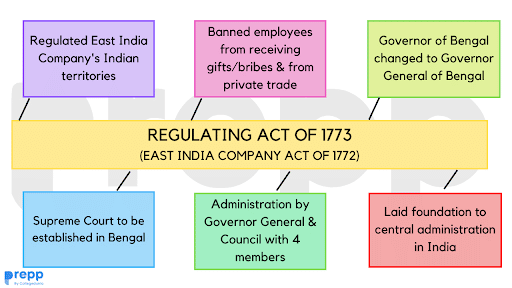
Regulating Act 1773 was an act of the British Parliament intended to regulate the management of the East India Company in India. It was the first intervention by the British government in the Company’s territorial affairs and marked the beginning of a takeover process that was completed in 1858. It was passed as a result of the Company’s mismanagement and financial problems, which required government intervention. The Regulating Act of 1773 banned the employees of East India Company from doing any kind of private trade or from receiving gifts or bribes from the "natives". The topic “Regulating Act of 1773” is an important part of the Indian Polity and Governance Syllabus which is discussed in this article in detail.
Table of Contents |
Regulating Act of 1773
|
The Regulating Act of 1773 was the first serious attempt to regulate the affairs of British East India Company in India.
|
Regulating Act (1773) - Objective
- The major goal of enacting the Regulating Act was to keep track of the Company's operations in India and England, as well as to eliminate any existing flaws.
Regulating Act, 1773 Act - Key Provisions
- Governor-General of Bengal: The post of “Governor of Bengal” was changed to “Governor-General of Bengal” and he was also given the responsibility to oversee the presidencies of Madras and Bombay.
- Four Board of Administrators: Four Board of Administrators members were selected by the Governor-General in Bengal (Philip Francis, Clavering, Monson, and Barwell).
- Warren Hastings was the first Governor-General, and he was joined by four boards of administrators.
- Only the British monarch on the recommendation of the Court of Directors could remove these.
- The five-year term for board members had to be completed by the members of the board of directors.
- High Court Inauguration: The High Court was inaugurated in Calcutta. There were four judges in total, including the Chief Justice.
- Primary & Appellate Jurisdiction: Primary and appellate jurisdiction was assigned to the Supreme Court.
- Sir Elijah Impey served as the Chief Justice, while Lemester, Chambers, and Hyde were the other judges of the court established in 1774.
- Prohibited from Bribes & Gifts: Military and civilian officers under the Company were prohibited from accepting any gifts, donations, or prizes from private businesses and Indians, according to this Act.
- Term & Members: This law established that the board of directors' term would be 4 years and the number of members would be increased to 24, with 6 members having a one-year leave of absence.
- Court of Directors: The Crown's authority was further enhanced by the "Court of Directors" via this act.
- Civil & Military Affairs: India's civil and military affairs as well as its revenues were required to be disclosed to the British Crown.
- Pay Rise: The company's officers and staff were given a pay raise.
Regulating Act 1773 - Historical Background
|
Regulating Act,1773 Act - Shortcomings
- The parliamentary control on the company proved ineffective because there was no effective mechanism to study the reports sent by the Governor-General in Council.
- The Governor-General had no veto power.
- The powers of the Supreme Court were not well defined.
- This act did not address the concerns of the Indian population who were paying revenue to the company.
- This Act did not stop corruption among the officials of the company.
Conclusion
The Regulating Act of 1773 holds special significance in the constitutional history of India. Through this act, a written constitution was introduced for the first time for the governance of the company in India. This Act was the beginning of efforts for British parliamentary controls over the administration of the Company in India. As a result, the administration of the areas under the Company's rule was no longer a private affair of the Company's merchants.
| Other Relevant Links | |
|---|---|
| Directive Principles of State Policy (DPSP) | The Preamble |
| Fundamental Rights | Indian Parliamentary System |
FAQs
Question: What was the primary objective of the Regulating Act of 1773?
Answer: The primary objective of the Regulating Act of 1773 was to regulate the administration of the East India Company in India and to address corruption and administrative inefficiency.
Question: Who was appointed as the first Governor-General of Bengal under the Regulating Act of 1773?
Answer: Warren Hastings was appointed as the first Governor-General of Bengal under the Regulating Act of 1773.
Question: What was the role of the Supreme Court established by the Regulating Act of 1773?
Answer: The Supreme Court at Calcutta, established by the Regulating Act, had jurisdiction over civil, criminal, admiralty, and ecclesiastical matters within British territories in India.
Question: How did the Regulating Act of 1773 impact the British government’s control over the East India Company?
Answer: The Regulating Act of 1773 was the first step toward the British government exercising greater control over the East India Company’s political and administrative activities by requiring the Company to report on its revenue and civil affairs to the British Parliament.
Question: Why was the Regulating Act of 1773 considered a landmark in the constitutional history of India?
Answer: The Regulating Act of 1773 was a landmark in India’s constitutional history because it was the first time the British Parliament intervened in the affairs of the East India Company, laying the foundation for the centralized administration of British territories in India.
MCQs
- Who was appointed as the first Governor-General of Bengal under the Regulating Act of 1773?
A. Lord Clive
B. Warren Hastings
C. Lord Cornwallis
D. Lord Wellesley
Answer: (B) See the Explanation
Warren Hastings was appointed as the first Governor-General of Bengal under the Regulating Act of 1773, marking a significant shift in British administrative control over India.
- What was the main purpose of establishing the Supreme Court at Calcutta under the Regulating Act of 1773?
A. To manage trade disputes
B. To oversee revenue collection
C. To serve as a legal body with jurisdiction over civil and criminal matters
D. To replace the Governor-General’s council
Answer: (C) See the Explanation
The Supreme Court at Calcutta was established under the Regulating Act to have jurisdiction over civil, criminal, admiralty, and ecclesiastical matters in British territories in India.
- What was the significance of the Regulating Act of 1773 in terms of British government control?
A. It allowed complete British control over Indian territories.
B. It was the first step towards increasing British government control over the East India Company.
C. It abolished the East India Company’s monopoly on trade.
D. It dissolved the East India Company.
Answer: (B) See the Explanation
The Regulating Act of 1773 marked the first step toward increasing the British government’s control over the East India Company’s administrative and political activities in India.
- The Regulating Act of 1773 required the East India Company to report its revenue and civil affairs to whom?
A. The British Parliament
B. The Governor-General
C. The Crown
D. The East India Company’s shareholders
Answer: (A) See the Explanation
The Regulating Act of 1773 required the East India Company to report its revenue and civil affairs directly to the British Parliament, increasing parliamentary oversight over the Company’s activities in India.
- What was one of the key reforms introduced by the Regulating Act of 1773?
A. The introduction of provincial governors
B. The establishment of the Supreme Court at Calcutta
C. The abolition of the East India Company
D. The introduction of democratic elections
Answer: (B) See the Explanation
One of the key reforms introduced by the Regulating Act of 1773 was the establishment of the Supreme Court at Calcutta, which had jurisdiction over British territories in India.
GS Mains Questions and Model Answers
Q1: Discuss the significance of the Regulating Act of 1773 in the context of British constitutional history and its impact on the administration of India.
Answer: The Regulating Act of 1773 is significant in British constitutional history as it was the first step taken by the British Parliament to intervene in the administration of the East India Company. It addressed the growing issues of corruption, inefficiency, and the lack of accountability in the Company's governance of British territories in India. The Act marked a shift toward a more centralized administration and established the position of Governor-General of Bengal, with limited authority over the Presidencies of Bombay and Madras. The creation of the Supreme Court at Calcutta further reinforced British legal authority in India, laying the groundwork for future administrative reforms that culminated in the establishment of British rule over India.
Q2: Analyze the provisions of the Regulating Act of 1773 and its role in establishing judicial and executive authority in British India.
Answer: The Regulating Act of 1773 introduced significant changes to the administrative and judicial framework of British India. It established the position of Governor-General of Bengal, who was assisted by a Council of Four, though the Governor-General could be overruled by the majority vote. The Act also created the Supreme Court at Calcutta, which had jurisdiction over civil, criminal, admiralty, and ecclesiastical matters. These provisions laid the foundation for executive and judicial authority in British India, making the British government more accountable for the East India Company’s political activities. The Act aimed to reduce corruption and improve governance by bringing the Company’s affairs under Parliamentary oversight.
Q3: Explain how the Regulating Act of 1773 set the stage for future constitutional reforms in British India.
Answer: The Regulating Act of 1773 set the stage for future constitutional reforms by establishing a centralized administrative structure and increasing British governmental control over the East India Company. The creation of the Governor-General’s office and the Supreme Court at Calcutta provided a framework for governance that was later expanded by subsequent reforms, such as the Pitt’s India Act of 1784 and the Charter Acts. These later reforms strengthened the British government’s role in Indian administration and formalized the relationship between the British Parliament and the governance of India, ultimately leading to the Government of India Acts and the establishment of British rule in India.
Previous Year Questions on Regulating Act 1773
1. UPSC CSE Prelims 2020
Question: Who was appointed as the first Governor-General of Bengal under the Regulating Act of 1773?
A. Lord Cornwallis
B. Warren Hastings
C. Lord Wellesley
D. Lord Dalhousie
Answer: B
Explanation: Warren Hastings was appointed as the first Governor-General of Bengal under the Regulating Act of 1773.
*email: contactus@prepp.in
Download the PREPP App and attempt FREE IAS Exam Mock Tests and get complete study material!

Full Test - 04: UPSC CSE Prelims CSAT (Paper-II)
Full Test - 03: UPSC CSE Prelims CSAT (Paper-II)
UPSC CSE Prelims 2026 GS Paper 1 Question Paper (24-May-2026)
UPSC CSE Prelims 2026 CSAT Paper 2 Question Paper (24-May-2026)

17 February 2025 | The Hindu Must Read Articles | Current Affairs

16 February 2026 | The Hindu Must Read Articles | Current Affairs

13 February 2026 | The Hindu Must Read Articles | Current Affairs









Comments