Indian Councils Act 1909 (Morley-Minto Reforms 1909) - Indian Polity Notes
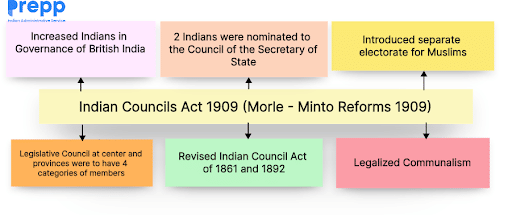
Indian Councils Act (1909) was passed by the British Parliament to increase the representation of Indians in the governance of British India. Indian Councils Act (1909) revised the Indian Councils Acts of 1861 and 1892 and introduced the concept of a separate electorate. Indian member was taken for the first time in the Executive Council of the Governor-General. The topic “Indian Councils Act (1909)” is an important part of the UPSC/IAS Exam Polity and Governance syllabus which is discussed in this article in detail.
|
Table of Contents |
Indian Councils Act 1909 (Morley-Minto Reforms 1909)
Morley–Minto Reforms 1909 - Historical Background
- Indian Council Act 1892 failed to meet the legitimate demands of the Indians.
- One of their main grievances was the difficulty Indians faced when trying to enter the civil service and administrative roles. Examinations for the services were exclusively held in Britain. British administrators' reluctance to accept Indians into the civil service only further closed administrative positions to Indians.
- At the end of the 19th century, country witnessed the horrors of famines and Plague, bringing distress and misery for thousands of people, people blamed the British Government for their misery.
- Rise and growth of extremism despite government’s repressive measures created pressure on government.
- The division of Bengal was also carried out by Lord Curzon in 1905. As a result, there was a huge uproar in Bengal.
- Following this, the British rulers realized that some improvements in the Indian government were mandatory to tackle the situation.
- The Indian National Congress (INC) also made an extra push for additional reforms and Indian self-government.
- In 1906, the INC demanded home rule for the first time.In England, Gopal Krishna Gokhale met with Morley to stress the importance of changes.
- The Simla Deputation met Lord Minto in 1906 and presented their proposal for a separate electorate for Muslims, led by Aga Khan.
- The Indian Councils Act of 1909 was passed to rally the Moderates in the Indian National Congress and Muslims to its side.
Morley–Minto Reforms 1909 - Objective
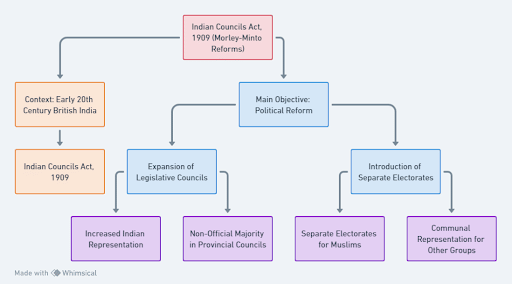
To apply the electoral principle to membership in India's imperial and local legislative councils, as well as to increase Indian participation in the governance of British India.
|
The reforms of 1909 afforded no answer and could afford no answer to Indian problems.
|
Morley–Minto Reforms 1909 - Key Provisions
- At both the federal and provincial levels, the size of legislative councils has increased.
- The Central Legislative Council is made up of individuals ranging in age from 16 to 60.
- There are 50 members in each of the Legislative Councils of Bengal, Madras, Bombay, and the United Provinces.
- Each Legislative Council of Punjab, Burma, and Assam has 30 members.
- The members who were elected did so in a roundabout way. Members of the provincial legislative councils were chosen by local governments via an electoral college. These individuals would elect members of the Central Legislative Council.
- Those who were elected included local governments, chambers of commerce, landlords, colleges, trade organisations, and Muslims.
- The bulk of provincial council members were non-official. In total, however, a non-elected majority existed due to the nomination of several non-official members.
- The Imperial Legislative Council welcomed Indians for the first time.
- Muslims had their own electorates. In some seats, only Muslims were allowed to vote, and only Muslims could vote for their representatives.
- It introduced a system of communal representation for Muslims by accepting the concept of a ‘separate electorate’.
- Under this, the Muslim members were to be elected only by Muslim voters. Thus, the Act ‘legalised communalism’, and Lord Minto came to be known as the Father of Communal Electorate.
- The budget could be debated and resolutions could be proposed. They could also discuss problems that are important to the general population. They could also inquire about the topic more.
- Foreign policy or relations with princely states could not be discussed.
- Satyendra P Sinha was named to the Viceroy's Executive Council as the first Indian member (after great pressure from Morley).
- The Secretary of State's Council on Indian Affairs has been expanded by two Indians.
Members of the federal and provincial legislative councils were to be classified into four groups:
- Members of the executive council and the Governor-General are ex officio.
- Members nominated by the Governor-General: The Governor-General has nominated government officials.
- Members who were not government officials and were nominated by the Governor-General.
- Various groups of Indians elect representatives to the board.
Morley–Minto Reforms 1909 - Significance
- It was a forward step towards the responsible association of elected Indians with the administration.
- The members for the first time got an opportunity to criticize the executives and make suggestions for the better administration of the country.
Morley–Minto Reforms 1909 - Defects
- To increase the divide between Muslims and Hindus, separate constituencies were created. In Indian politics, this system ushered in an era of unabashed communalism.
- The size of the councils was expanded, but not their functions or powers.
- Although the Provincial Councils had a non-official majority, the outcome was irrelevant because the non-official majority was invalidated by the election of nominated members.
- The Governor-General's position and veto power were not affected by the Act.
- Members were able to discuss the budget, but they were unable to make any significant changes to it.
- They could ask questions but not compel the executives to respond to the resolutions, which were more like recommendations to the government.
- Morley-Minto Reform diverted attention away from political and economic difficulties that afflicted all Indians, Hindu, and Muslim alike.
Conclusion
Indian Councils Act of 1909, also known as the Morley-Minto Reforms, marked a significant moment in India's constitutional history during the British colonial era. Enacted with the aim of introducing limited representative government, the Act expanded the legislative councils and granted increased powers to Indians in the decision-making process. However, it fell short of providing genuine self-governance and was criticized for its communal representation that reinforced religious divisions.
FAQs
Question: What was the primary objective of the Indian Councils Act 1909?
Answer: The primary objective of the Indian Councils Act 1909 was to introduce limited reforms to the legislative councils in India, aimed at increasing Indian representation while maintaining British control.
Question: What was the significance of separate electorates under the Morley-Minto Reforms?
Answer: The introduction of separate electorates for Muslims was significant because it allowed Muslims to elect their representatives separately, which institutionalized communal politics in India.
Question: How did the Indian Councils Act 1909 affect Indian representation in legislative councils?
Answer: The Act increased Indian representation in both the Imperial and Provincial Legislative Councils, allowing Indians to discuss budget matters and move resolutions, though their overall power remained limited.
Question: Who were the key architects of the Morley-Minto Reforms?
Answer: The Morley-Minto Reforms were named after John Morley, the Secretary of State for India, and Lord Minto, the Viceroy of India, who played key roles in drafting the reforms.
Question: How did the Indian Councils Act 1909 impact communal politics in India?
Answer: The introduction of separate electorates for Muslims under the Indian Councils Act 1909 laid the foundation for communal politics in India, which later contributed to the demand for separate nationhood.
MCQs
- What was a key feature of the Indian Councils Act 1909?
A. Abolition of separate electorates
B. Introduction of separate electorates for Muslims
C. Granting full independence to India
D. Complete Indian control over legislative councils
Answer: (B) See the Explanation
One of the key features of the Indian Councils Act 1909 was the introduction of separate electorates for Muslims, which allowed them to elect their representatives separately from other communities.
- Which of the following statements is true about the Indian Councils Act 1909?
A. It provided for the establishment of the Indian Parliament
B. It gave Indians the right to move resolutions in the councils
C. It abolished the role of the Viceroy
D. It introduced separate electorates for Hindus
Answer: (B) See the Explanation
The Indian Councils Act 1909 allowed Indians to move resolutions, discuss the budget, and ask supplementary questions in the legislative councils, although their powers were still limited.
- Who was the Viceroy of India during the introduction of the Indian Councils Act 1909?
A. Lord Curzon
B. Lord Ripon
C. Lord Minto
D. Lord Dufferin
Answer: (C) See the Explanation
Lord Minto was the Viceroy of India during the introduction of the Indian Councils Act 1909. Along with John Morley, he was a key figure behind the reforms.
- What was the long-term consequence of introducing separate electorates in the Indian Councils Act 1909?
A. Strengthened unity among all Indian communities
B. Led to the partition of India in 1947
C. Introduced democratic governance in India
D. Led to the establishment of the Indian National Congress
Answer: (B) See the Explanation
The introduction of separate electorates for Muslims under the Indian Councils Act 1909 laid the groundwork for communal divisions, which eventually contributed to the partition of India in 1947.
- Which of the following groups benefited from the separate electorates introduced by the Morley-Minto Reforms?
A. Hindus
B. Muslims
C. Sikhs
D. Christians
Answer: (B) See the Explanation
The Morley-Minto Reforms introduced separate electorates for Muslims, allowing them to elect their representatives separately from Hindus and other communities.
GS Mains Questions and Model Answers
Q1: Discuss the significance of the Indian Councils Act 1909 in the constitutional development of India.
Answer: The Indian Councils Act 1909, also known as the Morley-Minto Reforms, was a significant step in the constitutional development of India. While it introduced modest reforms, such as increased Indian representation in the Imperial and Provincial Legislative Councils, it fell short of meeting the demands of Indian nationalists for greater self-governance. However, the most far-reaching consequence of the Act was the introduction of separate electorates for Muslims, which laid the foundation for communal politics in India. This marked the beginning of a political divide between Hindus and Muslims, which would later contribute to the demand for a separate Muslim state. The reforms, though limited, represented the first instance of Indian participation in legislative processes, albeit under British control.
Q2: Analyze the impact of separate electorates on Indian politics following the Indian Councils Act 1909.
Answer: The introduction of separate electorates for Muslims under the Indian Councils Act 1909 had a profound and long-lasting impact on Indian politics. This move institutionalized communal representation, creating a political divide between Hindus and Muslims that would grow deeper in subsequent years. The separate electorates gave Muslims a sense of political identity and protection, but it also led to the growth of communalism in Indian politics. Over time, this policy of communal representation became one of the factors contributing to the demand for a separate Muslim state, which culminated in the partition of India in 1947. Thus, the introduction of separate electorates is seen as a major turning point in the communalization of Indian politics.
Q3: Critically evaluate the limitations of the Indian Councils Act 1909 in addressing the demands of Indian nationalists.
Answer: The Indian Councils Act 1909 was introduced as a response to growing Indian nationalist demands for greater participation in governance. However, the Act fell short of addressing the core demands of Indian nationalists, such as self-governance and responsible government. Although the Act increased Indian representation in legislative councils and allowed Indians to discuss the budget and move resolutions, the real power remained with the British authorities, as the majority of council members were still nominated. Moreover, the introduction of separate electorates for Muslims weakened the Indian nationalist movement by fostering communal divisions. While the Act represented a small step toward constitutional reform, its limited scope and communal provisions failed to satisfy the aspirations of the Indian people for meaningful political change.
Previous Year Questions on Indian Councils Act 1909
1. UPSC CSE Prelims 2020
Question: Which of the following features was introduced by the Indian Councils Act 1909?
A. Separate electorates for Muslims
B. Dominion Status for India
C. Abolition of the East India Company
D. Full Indian representation in the legislative councils
Answer: A
Explanation: The Indian Councils Act 1909 introduced separate electorates for Muslims, allowing them to elect their representatives separately, which was one of the key features of the Morley-Minto Reforms.
*email: contactus@prepp.in
Download the PREPP App and attempt FREE IAS Exam Mock Tests and get complete study material!

Full Test - 04: UPSC CSE Prelims CSAT (Paper-II)
Full Test - 03: UPSC CSE Prelims CSAT (Paper-II)
UPSC CSE Prelims 2026 GS Paper 1 Question Paper (24-May-2026)
UPSC CSE Prelims 2026 CSAT Paper 2 Question Paper (24-May-2026)

17 February 2025 | The Hindu Must Read Articles | Current Affairs

16 February 2026 | The Hindu Must Read Articles | Current Affairs

13 February 2026 | The Hindu Must Read Articles | Current Affairs









Comments