Indian Councils Act 1861 - Indian Polity Notes
Indian Councils Act (1861) was passed by the British Parliament on August 1, 1861. It transformed the Executive Council to function as a cabinet run on the portfolio system. The involvement of Indians in the legislative process was the most notable feature of this Act. The Indian Councils Act of 1861 is an important landmark in the constitutional and political history of India. This article explains the Indian Councils Act (1861) which is important for UPSC Indian Polity Preparation.
|
Table of Contents |
Indian Councils Act (1861) - Historical Background
- After the great revolt of 1857, the British Empire felt the urgent need of seeking the cooperation of its Indian subjects in the administration of India.
- In pursuit of this policy of association, three acts were enacted in 1861, 1892, and 1909.
Indian Councils Act (1861) - Reasons For Enactment
- The Government of India Act of 1858 made important changes in the manner of governance from England, but it made no significant changes to the Indian government system.
- Following the 1857 Mutiny, there was a widespread belief in England that establishing a government in India without the participation of Indians in the administration would be extremely impossible.
- The 1833 Charter Act centralized the legislative process. It had only one representative in each of the four provinces, and it failed to pass legislation that was tailored to the needs of the people.
- The Governor General in Council was failing in his legislative duties and was unable to perform effectively due to lengthy procedures that caused delays in enactment.
|
Indian Councils Act of 1861 transformed the Executive Council to function as a cabinet run on the portfolio system.
|
Indian Councils Act (1861) - Provisions
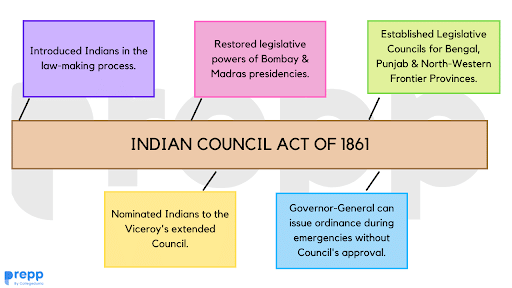
- The trend of decentralisation was initiated by this act, which restored the legislative powers of the Bombay and Madras presidencies.
- Thus, the centralising trends that began with the Regulating Act of 1773 and culminated with the Charter Act of 1833 were reversed.
- This policy of legislative devolution resulted in the grant of almost complete internal autonomy to the provinces in 1937.
- By associating Indians with the law-making process, a new beginning was made for representative institutions.
- Providing for the provision of the Viceroy nominating some Indian members to his extended council.
- Subsequently, three Indians were included in this 1862 Legislative Council - the Raja of Benaras, the Maharaja of Patiala and Sir Dinkar Rao.
- Any bill relating to public revenue or debt, the military, religion, or foreign affairs could not be passed without the Governor-General's approval.
- If necessary, the Viceroy had the authority to overrule the council.
- During emergencies, the Governor-General also had the authority to issue ordinances without the approval of the council.
- It provided for the establishment of the legislative councils for Bengal, North-Western Frontier Province and Punjab.
- It empowered the Viceroy to make rules and orders for a better and more convenient transaction of business in the council.
- It recognized the Portfolio System (introduced by Lord Canning in 1859) under which, a member of the Viceroy’s Council was made in-charge of one or more departments of the Government and was authorised to issue final orders on behalf of the Council on the matters of the concerned department.
- It also empowered Viceroy to issue ordinances, without the consent of the Legislative Council during an emergency. The ordinance will be valid for a period of 6 months.
Indian Councils Act (1861) - Significance
- The Indian Councils Act of 1861 is a watershed moment in India's constitutional and political history.
- For executive and legislative purposes, it changed the structure of the Governor General's council.
- By involving Indians in the legislative process, a fresh beginning for representative institutions was established.
Indian Councils Act (1861) - Limitations
- The Legislative Council had a limited role. It was mainly advisory. No financial decisions were allowed.
- Although the Indians were elected, there were no official conditions for the inclusion of Indians in them.
- It allowed for the allocation of administrative positions by delegating legislative powers to the presidents of Bombay and Madras.
- The Governor-General had absolute power.
Conclusion
The Indian Councils Act 1861 is an important landmark in the constitutional and political history of India. It altered the composition of the Governor General's Council for executive and legislative purposes. However, from India's point of view, the act did little to improve the influence of Indians in the Legislative Council. The role of Council was limited to advice, and no financial discussion could take place.
FAQs
Question: What was the main objective of the Indian Councils Act 1861?
Answer: The main objective of the Indian Councils Act 1861 was to restore legislative powers to the Governor-General’s Council and allow the inclusion of non-official members, including Indians, in the legislative process.
Question: How did the Indian Councils Act 1861 contribute to the legislative process in India?
Answer: The Act marked the beginning of legislative devolution in India by allowing the establishment of provincial legislative councils and involving non-official members in the law-making process, though their role was limited.
Question: What powers were granted to the Viceroy under the Indian Councils Act 1861?
Answer: The Viceroy (Governor-General) was given the power to issue ordinances in times of emergency, bypassing the legislative councils for a limited time to enact laws.
Question: Who were the non-official members introduced by the Indian Councils Act 1861?
Answer: The non-official members introduced under the Act included Indians and British civilians who were not part of the British administrative structure. However, their role was advisory in nature.
Question: How did the Indian Councils Act 1861 influence later constitutional reforms?
Answer: The Indian Councils Act 1861 laid the foundation for further constitutional reforms, such as the Indian Councils Act 1892 and the Morley-Minto Reforms of 1909, which gradually expanded the role of Indians in governance.
MCQs
- What was the main purpose of the Indian Councils Act 1861?
A. To establish the Supreme Court of India
B. To introduce legislative devolution in India
C. To abolish provincial governments
D. To introduce universal suffrage
Answer: (B) See the Explanation
The Indian Councils Act 1861 aimed at introducing legislative devolution in India by restoring the legislative councils and allowing the inclusion of non-official members in the law-making process.
- Which feature was introduced by the Indian Councils Act 1861 for the first time?
A. Indian civil services
B. Provincial legislative councils
C. National Planning Commission
D. Direct elections
Answer: (B) See the Explanation
The Indian Councils Act 1861 introduced the concept of provincial legislative councils for the first time, empowering the Governors of Bombay and Madras to form their own councils for local governance.
- What power was granted to the Viceroy by the Indian Councils Act 1861?
A. The power to dismiss elected representatives
B. The power to issue ordinances during emergencies
C. The power to control local governments
D. The power to hold elections
Answer: (B) See the Explanation
The Act gave the Viceroy (Governor-General) the authority to issue ordinances during emergencies, allowing the British administration to bypass the legislative councils and enact laws directly.
- Which constitutional reform was influenced by the Indian Councils Act 1861?
A. Indian Independence Act 1947
B. Government of India Act 1935
C. Morley-Minto Reforms 1909
D. Mountbatten Plan 1947
Answer: (C) See the Explanation
The Morley-Minto Reforms of 1909 were influenced by the Indian Councils Act 1861, as both aimed at increasing Indian participation in governance, albeit gradually.
- Who were the non-official members in the legislative councils under the Indian Councils Act 1861?
A. Elected Indian representatives
B. Indian rulers and civilians
C. British civilians and Indians not part of the government
D. Government-appointed officials
Answer: (C) See the Explanation
The non-official members in the legislative councils under the Act included British civilians and Indians who were not part of the British administrative system, but their role was largely advisory.
GS Mains Questions and Model Answers
Q1: Discuss the significance of the Indian Councils Act 1861 in the development of the legislative system in India.
Answer: The Indian Councils Act 1861 played a significant role in the development of the legislative system in India by restoring the powers of the Governor-General’s Council and introducing provincial legislative councils. For the first time, non-official members, including Indians, were included in the legislative process, marking the beginning of legislative devolution in colonial India. Although the role of these members was limited, the Act set the stage for later reforms that expanded Indian participation in governance, such as the Indian Councils Act 1892 and the Morley-Minto Reforms 1909. It was a key milestone in India’s gradual transition from absolute British rule to a more consultative governance model.
Q2: Analyze the impact of the Indian Councils Act 1861 on the administrative structure of India.
Answer: The Indian Councils Act 1861 significantly impacted India’s administrative structure by re-establishing legislative councils and allowing the Governor-General and provincial governors to include non-official members in the legislative process. The establishment of provincial legislative councils in Bombay and Madras was an important step towards decentralization and local governance. This Act empowered the provincial governors to make decisions on local matters, though major legislative authority remained with the British. The Viceroy’s power to issue ordinances further strengthened the executive branch, allowing it to bypass legislative procedures during emergencies.
Q3: Evaluate how the Indian Councils Act 1861 laid the foundation for future constitutional reforms in India.
Answer: The Indian Councils Act 1861 laid the foundation for future constitutional reforms by introducing the idea of legislative devolution and creating space for non-official members in the legislative process. Although their role was limited, the inclusion of Indians and British civilians in governance marked the beginning of a more consultative form of rule. The Act’s framework influenced subsequent reforms, such as the Indian Councils Act 1892, which expanded the powers of the legislative councils, and the Morley-Minto Reforms 1909, which introduced elected Indian members into the councils. These steps eventually led to greater Indian participation in the governance of their own country.
Previous Year Questions on Indian Councils Act 1861
1. UPSC CSE Prelims 2018
Question: What was the key feature of the Indian Councils Act 1861?
A. Introduction of direct elections
B. Establishment of provincial legislative councils
C. Formation of the Indian National Congress
D. Abolition of the Governor-General's Council
Answer: B
Explanation: The Indian Councils Act 1861 established provincial legislative councils in Bombay and Madras, marking the beginning of decentralization and local governance.
*email: contactus@prepp.in
Download the PREPP App and attempt FREE IAS Exam Mock Tests and get complete study material!

Full Test - 04: UPSC CSE Prelims CSAT (Paper-II)
Full Test - 03: UPSC CSE Prelims CSAT (Paper-II)
UPSC CSE Prelims 2026 GS Paper 1 Question Paper (24-May-2026)
UPSC CSE Prelims 2026 CSAT Paper 2 Question Paper (24-May-2026)

17 February 2025 | The Hindu Must Read Articles | Current Affairs

16 February 2026 | The Hindu Must Read Articles | Current Affairs

13 February 2026 | The Hindu Must Read Articles | Current Affairs









Comments