Charter Act 1833 - Indian Polity Notes
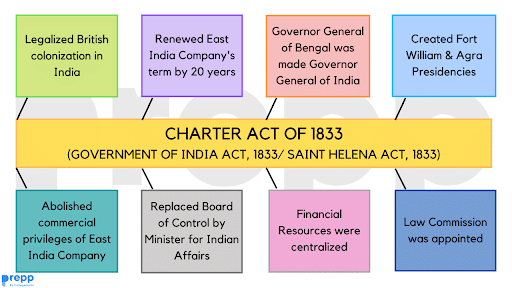
The Charter Act of 1833 was enacted by the British Parliament to renew the East India Company's Charter Act of 1813. Charter Act of 1833 ended the Company’s monopoly over trade with India except for trade in tea and trade with China.
The Charter Act 1833 or the Government of India Act 1833, also known as Saint Helena Act 1833 (this act took away the Island of Saint Helena in the southwest Atlantic from the English East India Company), is an Act of the United Kingdom Parliament.
The act was an important step in the direction of legislative centralisation. The topic “Charter Act of 1833” is an important part of the UPSC/IAS Exam Polity and Governance syllabus which is discussed in this article in detail.
|
Table of Contents |

Charter Act of 1833
The Charter Act (1833) - Historical Background
- The Charter Act of 1833 was enacted against the backdrop of significant changes that had occurred in Great Britain as a result of the Industrial Revolution.
- The principle of laissez-faire was accepted as the government's attitude toward the industrial enterprise.
- The Reform Act of 1832 was the result of the liberal movement.
- In this situation of liberalism and reform, the parliament was asked to renew the Charter in 1833.
- During the formation of the Charter Act of 1833, the political atmosphere in Britain was looking for reforms and liberal ideas.
- They agreed with Macaulay to continue the company rule but on a different basis
- However when the Whig party was in power, the bill was introduced in the parliament and the parliament was in a mood to favor reforms, free trade, and codification of laws.
- The Charter Act of 1833 was passed with the recommendations of a parliament inquiry which became a landmark in the constitutional history of India.
|
Charter Act of 1833 ended the Company’s monopoly over trade with India except for trade in tea and trade with China.
|
Charter Act (1833) - Objective
The Charter was renewed with the aim of abandoning its trade entirely and permitting Europeans to settle freely In India.
The Charter Act 1833 - Key Provisions
Office of Governor-General
- The Governor-General of Bengal was made the Governor-General of India which led to the Centralization of Administration,with exclusive legislative powers.
- The Governor-General of Bengal was elevated to the position of Governor-General of India, with exclusive legislative powers.
- Bombay and Madras presidencies were drained of their legislative powers.
- Civil and military powers were granted to India's Governor-General.
- For the first time, the Government of India was established, with authority over the entire territory possessed by the British in India.
- Lord William Bentick became the first governor-general of India
Powers of Governor-General’s Council
- The Governor-General in the council could repeal, amend and alter any laws or regulations enforced in British India
- The decision of the Governor-General will prevail at the time of dispute on any matter in the Governor-General’s Council and he can reject the majority decision
- Civil, military, and revenue matters were controlled by the Governor-General in consultation with the Council.
- Governor-General in the council was given the power to repeal, alter or amend any laws or regulations for all persons in the British territory of India however the Court of Directors was given the power of veto over any law made by the Governor-General in the council.
- The act for the first time provided for the appointment of 4th member of the Governor-General in the Council who had no power to sit or vote in the Council except for the purpose of making law.
Abolition of Commercial Privileges of the East India Company
- All the commercial Privileges of the company were abolished. This means the company could no longer enjoy its monopoly of China trade and trade of tea which it enjoyed with the Charter Act of 1813.
- The company was allowed to retain its territorial possessions as trustee for “ His Majesty, his heirs, and successors '.
Legal British Colony
- All the restrictions imposed on the entry of Europeans and British which were granted under the Charter act of 1813 were abolished
- Europeans and British could now freely acquire, hold or dispose of any property in India. They could now enjoy the freedom of travel and residence in India. India was made a British colony
Replacement of Board of Control as Minister for Indian Affairs
- The president of the Board of Control was replaced by Minister for Indian affairs
- The act contained a provision for the creation of the presidency of Agra and Fort William by the division of the Bengal presidency but this provision never came into existence.
Financial Centralization
- Centralization of financial resources was also provided by the Act.
- The power of presidential governments to raise revenues and incur expenditures was curtailed
- The Governor-General’s council took over all the financial matters including the raising of revenues and expenditures.
Formation of Law Commission
- An attempt to codify laws was made with the Charter act of 1833.
- Section 53 of the Charter act of 1833 provided for the appointment of a Commission known as the Law Commission. The main aim of the Law Commission was the codification and consolidation of Indian law.
- In a step towards codifying laws, the first Law Commission was appointed in 1834 under the chairmanship of Lord Macaulay, the other three members were J.M. Madeira, G.W. Anderson, and C.H. Cameron represented the presidencies of Calcutta, Madras, and Bombay respectively.
- The Law Commission submitted the draft of the Penal Code to the government in 1837 also called as “Macaulay Code” However the draft had to wait for full implantation till 1860 due to the revolt of 1857.
- As a result of the recommendations, the code of civil procedure was introduced in 1859 followed by the Indian Penal Code in 1860 and the Criminal Procedure Code in 1862
Attempt to Open Civil Services on the Basis of System of Merit
- The act removed restrictions as to religion, color, caste, and creed and provided for the free participation of Indians in the administration of the country.
- It has made merit the only criterion for the selection.
- The Charter Act of 1833 became the first act that made provision to freely admit the natives of India to share an administration in the country.
- The act has given the power to the Court of Directors to nominate annually 4 times as many candidates as there were vacancies through the process of competitive examination.
- It was an attempt to introduce a system of open competition for civil services. However, this system of open competition was not effectively operated in the near future.
Abolition of Slavery
- The act also provided for the diminution of slavery existing in British India.
- Governor General-in-Council was directed to adopt measures for the end of slavery prevalent In India
- Slavery was abolished in India with the act Act V of 1843
Increase in Number of Bishops
The act of 1833 increased the number of Bishops to three and made the Bishop of Calcutta the Metropolitan Bishop of India.
The Charter Act 1833 - Significance
- This act paved the way for the unification of British India and the establishment of a strong central government in this country.
- The act provided for the codification of the laws and also set aside the narrow consideration of disqualification in the administration of the country.
- The promotion of the Governor General of Bengal as Governor General of India was a major step towards consolidation and centralization of the administration of India
- This act allowed the natives of India to freely participate in the administration of the county without any restrictions as to descent, color, caste, creed, etc. Unfortunately very little was done to actualise this provision.
- The legislative functions of the Governor General in the Council were separated from the executive functions for the first time. Codification of laws also held great significance.
The Charter Act 1833 - Defects
- Over-centralization burdened the Council to such an extent that it could not devote time and attention to broad questions of principles or Matters of public importance.
- The government was not able to meet the needs, urgency, and requirements of the local government because there was no representative from the presidencies in the supreme council.
- This eventually led to dissatisfaction among the presidencies and they were indifferent toward the laws and measures introduced by the Supreme Council.
- As the central government was established at Calcutta, it was difficult for the Governor General-in-council to exercise effective control over distant presidencies, particularly because of the lack of adequate means of communication at that time.
- All the power was vested in the single authority i.e Governor-General which made the post very powerful and at times acted as an autocrat.
What is Industrial Revolution?It was the transition from old to new manufacturing processes in Europe and the United States between 1760 to 1840.
What is Laissez-faire?
|
Conclusion
The Charter Act of 1833 was one of a series of Acts enacted by the British government in order to expand its administration in India. The Act's regulations had an impact on the political system of pre-independence India. With the passage of the Charter Act of 1833, the British Crown gradually gained control of the Indian administration through the East India Company.
FAQs
Question: What was the Charter Act of 1833?
Answer: The Charter Act of 1833 was a significant legislative act passed by the British Parliament to renew the East India Company's charter for another 20 years. It marked the beginning of centralized governance in India and introduced several administrative reforms.
Question: What were the major provisions of the Charter Act of 1833?
Answer: The major provisions included making the Governor-General of Bengal the Governor-General of India, centralizing legislative powers, ending the East India Company’s commercial activities, and opening Indian Civil Services to Indians based on merit.
Question: How did the Charter Act of 1833 change the administrative structure of British India?
Answer: The Act centralized the administrative control by giving the Governor-General of Bengal control over all British territories in India, thus making him the Governor-General of India. It also made the legislative council of the Governor-General the sole law-making authority for all of British India.
Question: How did the Charter Act of 1833 impact the East India Company’s commercial activities?
Answer: The Act abolished the East India Company’s commercial operations, transforming it into a purely administrative body. This was a significant step in ending the Company’s role as a trading entity.
Question: What was the significance of opening Indian Civil Services to Indians under the Charter Act of 1833?
Answer: The Act laid the foundation for merit-based recruitment to the Indian Civil Services, allowing Indians to compete for civil service positions for the first time. Although the provision was not fully implemented until later, it marked a shift towards meritocracy.
MCQs
- Which of the following changes did the Charter Act of 1833 bring to the position of Governor-General?
a) Governor-General of Bengal became the Governor-General of India
b) Governor-General was abolished
c) Governor-General of Madras was given more powers
d) Governor-General was replaced by the Viceroy
Answer: (A) See the Explanation
The Charter Act of 1833 centralized power by making the Governor-General of Bengal the Governor-General of India, giving him control over all British territories in India.
- What was the impact of the Charter Act of 1833 on the commercial activities of the East India Company?
a) It expanded the Company’s trade activities
b) It ended the Company’s commercial functions
c) It allowed the Company to engage in trade with China
d) It restricted the Company to trading in textiles only
Answer: (B) See the Explanation
The Charter Act of 1833 abolished the East India Company’s commercial activities, transforming it into a purely administrative body.
- Which of the following was introduced by the Charter Act of 1833?
a) Dual government system
b) Federal structure
c) Centralized legislative authority
d) Federalism in provinces
Answer: (C) See the Explanation
The Charter Act of 1833 centralized legislative authority in the hands of the Governor-General’s legislative council, making it the sole law-making body for all British territories in India.
- Which of the following provisions was made regarding Indian Civil Services under the Charter Act of 1833?
a) Civil services were closed to Indians
b) Civil services were opened to Indians on a merit basis
c) Civil services were limited to British citizens
d) Civil services were abolished
Answer: (B) See the Explanation
The Charter Act of 1833 provided for the inclusion of Indians in the civil services through a competitive examination, though it wasn’t fully implemented at the time.
- How did the Charter Act of 1833 address slavery in British India?
a) It legalized slavery
b) It abolished slavery
c) It introduced laws to regulate slavery
d) It prohibited the further import of slaves
Answer: (B) See the Explanation
The Charter Act of 1833 formally abolished slavery in British India, which was a progressive step toward human rights.
GS Mains Questions and Model Answers
Q1: "The Charter Act of 1833 marked the beginning of centralized governance in British India." Discuss with reference to the provisions and impact of the Act.
Answer: The Charter Act of 1833 was a crucial step towards the centralization of governance in British India. By making the Governor-General of Bengal the Governor-General of India, it concentrated administrative authority in a single office, reducing the autonomy of regional presidencies like Madras and Bombay. The Act also created a legislative council, which became the sole legislative authority for all of British India, thus unifying law-making powers. Additionally, it abolished the commercial functions of the East India Company, transforming it into a purely administrative body. These reforms laid the foundation for a centralized system of governance, which continued until Indian independence.
Q2: Examine the social and administrative reforms introduced by the Charter Act of 1833. How did it impact the future governance of India?
Answer: The Charter Act of 1833 introduced several key social and administrative reforms. Administratively, it centralized power by making the Governor-General of Bengal the Governor-General of India and gave him exclusive legislative powers, streamlining governance across British territories. Socially, the Act abolished slavery in British India, signaling a progressive shift in British policy towards human rights. It also proposed merit-based recruitment for civil services, although this was not fully implemented until later. These reforms not only strengthened British control over India but also laid the foundation for future administrative and social changes, including the eventual introduction of Indian participation in governance.
Q3: Discuss the role of the Charter Act of 1833 in the development of modern Indian bureaucracy.
Answer: The Charter Act of 1833 played a pivotal role in the development of modern Indian bureaucracy by introducing merit-based recruitment for the Indian Civil Services. Although the competitive examination system was not fully implemented at the time, the Act laid the foundation for a professional bureaucracy that valued competence over connections. This move towards a meritocratic system eventually led to the establishment of the Indian Civil Services, which became a vital part of British administration in India. The Act’s focus on centralization also contributed to the creation of a unified administrative structure, making it easier to govern the vast and diverse territories of India.
Previous Year Questions on The Charter Act 1833
1. UPSC CSE 2018
Q1: Discuss the significance of the Charter Act of 1833 in the centralization of administration in British India.
Answer: The Charter Act of 1833 was a landmark in the centralization of administration in British India. It made the Governor-General of Bengal the Governor-General of India, concentrating administrative and legislative power in a single authority. The Act also gave the Governor-General's council exclusive legislative powers over all British territories, thus centralizing lawmaking. These changes reduced the autonomy of the Presidencies of Madras and Bombay, establishing a uniform legal and administrative framework across India. This centralization paved the way for more unified governance, which continued until Indian independence.
2. UPSC CSE 2019
Q2: Analyze the importance of the Charter Act of 1833 in laying the foundation for modern civil services in India.
Answer: The Charter Act of 1833 laid the groundwork for modern civil services in India by introducing the principle of merit-based recruitment. Although the provision to open civil services to Indians through competitive exams was not fully implemented until later, the Act marked a significant shift towards creating a professional, efficient, and impartial administrative service. This was a departure from the previous patronage-based system and set the foundation for future reforms that would ultimately lead to the establishment of the Indian Civil Service (ICS), a cornerstone of British administration in India.
*email: contactus@prepp.in
Download the PREPP App and attempt FREE IAS Exam Mock Tests and get complete study material!

Full Test - 04: UPSC CSE Prelims CSAT (Paper-II)
Full Test - 03: UPSC CSE Prelims CSAT (Paper-II)
UPSC CSE Prelims 2026 GS Paper 1 Question Paper (24-May-2026)
UPSC CSE Prelims 2026 CSAT Paper 2 Question Paper (24-May-2026)

17 February 2025 | The Hindu Must Read Articles | Current Affairs

16 February 2026 | The Hindu Must Read Articles | Current Affairs

13 February 2026 | The Hindu Must Read Articles | Current Affairs









Comments