The Pitts India Act 1784 - Indian Polity Notes
The Pitt's India Act (1784), which is named after the British prime minister William Pitt the Younger, established the dual system of control between the British government and the East India Company. Under this system, the company retained control over trade and day-to-day operations, however crucial political decisions were left to a private committee of three directors who were in constant communication with the British government. This system lasted until 1858.
Pitts India Act 1784 was passed to rectify the defects of the Regulating Act 1773. The Pitt's India Act 1784 also known as the East India Company Act 1784 was enacted by the British Parliament by placing the East India Company's administration in India under British control. The act was passed during the tenure of William Pitt the younger in 1784. The topic “Pitt's India Act 1784” is an important part of the UPSC/IAS Exam Polity and Governance syllabus which is discussed in this article in detail.

Pitts India Act 1784 - Historical Background
- After regulating Act 1773, in 1781, the Company's affairs were investigated by both a Select and a Secret Committee including Supreme Court's relationship with the Bengal Council
- The causes of the Maratha War (1775–82,1803–05, 1817–18) were investigated by the Secret Committee. The Company's Directors admitted that the war had beggared them and sought the State for another million-pound loan
- Pitt's India Act established a system in which the British East India Company and the British government shared control of India. These transformations lasted until 1858.
Why is it called the Pitt's Act, 1784?
|
The Pitts India Act 1784 – Objective
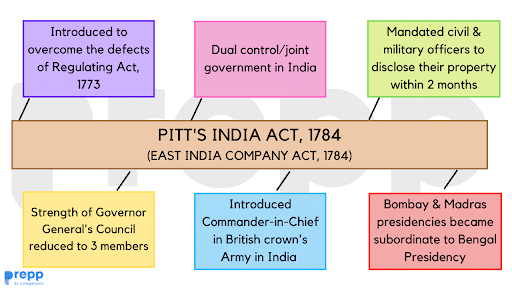
Pitt's India Act aimed to overcome the deficiencies of the 1773 Regulating Act by placing the East India Company under British government supervision in India.
Pitts India Act, 1784 – Key Provisions
- The Pitt's India Act of 1784 separated the East India Company's political and corporate activities.
- Only the Company's public affairs and administration in India were subjected to increased government monitoring. The Board of Control was formed to help the same.
- This Board of Control's members are:
- The Chancellor of the Exchequer,
- The Secretary of State, and
- Four Privy Councilors are among the six officials appointed by the King
- The Secretary of State was appointed as the Board of Control's President.
- The Company was represented by the Court of Directors, and the British government was represented by the Board of Control, in this dual system of control.
- The statute required all civil and military officers to declare their assets in India and the United Kingdom within two months of joining.
- The number of members on the Governor-council General's has been decreased to three. The Commander-in-Chief of the British Crown's army in India would be one of the three.
- The Governor-General was granted veto power.
- Madras and Bombay presidencies became subservient to the Bengal Presidency. Calcutta effectively became the capital of the British Indian colonies.
Authorities given to the Board of Directors according to Pitt's Act,1784
- The board of directors was granted complete access to the company's records. It had the authority to send Governors to India and to change them.
- The Court of Directors was supposed to represent the company, and the Board of Control was supposed to represent the Crown.
Provisions For Property Disclosure In Pitt's India Act, 1784
- Within two months of taking up their posts, all civil and military officers of the East India Company were ordered to provide the Court of Directors with a full inventory of their property in India and in Britain.
- Stipulated severe punishment for corrupt officials.
- The constitution established by Pitt's India Act remained largely unchanged until the end of the company's rule in India in 1858.
The Pitts India Act,1784 - Significance
- The Pitt's India Act created a double control system for India and continued to change until 1858.
- The territory of the company was called for the first time in India the "British possession of India." The British Government has been given full control over the affairs of the company and its management in India.
The Pitts India Act, 1784 - Defects
- The governor general may easily put his two masters against each other and act on his own initiative.
- A fractious council and the governor general's inability to veto its decisions could render him ineffective, especially if his authority to use troops has been limited.
- This was due to the fact that the limits between government monitoring and the company's powers were ill-defined and extremely subjective from the start.
- The Board of Control, the Court of Directors, and the Governor General in Council were all given jurisdiction under the statute, but no clear boundaries could be established because the issue was subjective rather than objective.
- Humanitarian appeals for better treatment of local people in British-occupied territories forced the British government to act. The Board of Control was accused of nepotism.
Conclusion
Pitt's India Act 1784 separated the East India Company's political and corporate activities. Calcutta effectively became the capital of the British Indian colonies. Madras and Bombay presidencies became subservient to the Bengal Presidency. The constitution established by Pitt's India Act remained largely unchanged until the end of British rule in India in 1858. Humanitarian appeals for better treatment of local people forced the government to act.
FAQs
Question: What was the main objective of the Pitt's India Act (1784)?
Answer: The main objective of the Pitt's India Act was to reform the administration of the East India Company by establishing a dual system of control, with the British government overseeing political matters and the Company managing commercial activities.
Question: Who was the Prime Minister responsible for the Pitt's India Act?
Answer: The Pitt's India Act was introduced by William Pitt the Younger, who was the British Prime Minister at the time.
Question: What was the role of the Board of Control under the Pitt's India Act?
Answer: The Board of Control was created to supervise the political and administrative functions of the East India Company in India, ensuring that British interests were safeguarded.
Question: How did the Pitt's India Act affect the Governor-General of Bengal?
Answer: The Pitt's India Act increased the powers of the Governor-General of Bengal, giving him authority over the other presidencies (Madras and Bombay) and centralizing British administration in India.
Question: What were the limitations of the Pitt's India Act?
Answer: The Pitt's India Act did not significantly reform the commercial operations of the East India Company, leading to continued financial mismanagement. It primarily focused on political and administrative control.
MCQs
1. Which of the following was established by the Pitt's India Act to oversee the political functions of the East India Company?
A) Court of Directors
B) Board of Control
C) Privy Council
D) Governor-General
Answer: (B) See the Explanation
Explanation: The Board of Control was established by the Pitt's India Act to supervise the political functions of the East India Company, while the Court of Directors continued to manage its commercial activities.
2. Who had increased authority over the Madras and Bombay presidencies after the Pitt's India Act?
A) The Court of Directors
B) The British Parliament
C) The Governor-General of Bengal
D) The Board of Control
Answer: (C) See the Explanation
Explanation: The Governor-General of Bengal was given increased authority over the Madras and Bombay presidencies, centralizing British administration in India.
3. Which of the following was a primary reason for the introduction of the Pitt's India Act?
A) The success of the Regulating Act of 1773
B) Financial mismanagement and corruption within the East India Company
C) The expansion of trade with China
D) The decline of British political control in India
Answer: (B) See the Explanation
Explanation: The Pitt's India Act was introduced to address the financial mismanagement and corruption within the East India Company and to ensure greater control by the British government over Indian territories.
4. Under the Pitt's India Act, which body was responsible for managing the commercial functions of the East India Company?
A) Board of Control
B) Governor-General
C) Court of Directors
D) Privy Council
Answer: (C) See the Explanation
Explanation: The Court of Directors continued to manage the commercial functions of the East India Company, but political matters were overseen by the Board of Control.
5. What was one significant outcome of the Pitt's India Act (1784)?
A) The abolition of the East India Company
B) Increased power for the British Crown in India
C) Separation of political and commercial responsibilities
D) Establishment of a federal system in India
Answer: (C) See the Explanation
Explanation: The Pitt's India Act created a dual system of control, separating political responsibilities (overseen by the British government) and commercial activities (managed by the East India Company).
GS Mains Questions and Model Answers
Q1: Discuss the significance of the Pitt's India Act of 1784 in the context of British control over India.
Answer: The Pitt's India Act of 1784 was a pivotal moment in the history of British control over India. It marked a shift in power from the East India Company to the British government by establishing a Board of Control to oversee political matters. This act laid the foundation for increased British involvement in Indian administration and reduced the autonomy of the Company in political affairs. The creation of a dual system of control also centralized authority in the hands of the Governor-General of Bengal, further consolidating British power in India. The act's significance lies in its role in initiating the process of direct British control over Indian governance, which would continue in subsequent years.
Q2: Analyze how the Pitt's India Act contributed to the centralization of administrative power in India.
Answer: The Pitt's India Act contributed significantly to the centralization of administrative power in India by increasing the authority of the Governor-General of Bengal over the Madras and Bombay presidencies. This shift reduced the independence of these presidencies, creating a more unified administrative structure under British control. The act also established the Board of Control, which allowed the British government to directly oversee political affairs in India. This centralization ensured that decisions regarding Indian governance were made in London, aligning the Company's policies with British national interests.
Q3: Evaluate the impact of the dual system of control established by the Pitt's India Act on the governance of the East India Company.
Answer: The dual system of control introduced by the Pitt's India Act had a profound impact on the governance of the East India Company. By dividing responsibilities between the Board of Control (political) and the Court of Directors (commercial), the act reduced the Company's autonomy in political matters, placing Indian administration under closer scrutiny by the British government. While the Company retained control over trade, its influence in governance was curtailed, allowing the British government to shape policies in India more effectively. This division of power laid the groundwork for future reforms that would eventually lead to the end of the Company's rule in India.
Previous Year Questions on Pitt's India Act
1. UPSC CSE Prelims 2019
Question: What was the primary aim of the Pitt's India Act of 1784?
A) To grant independence to India
B) To regulate the commercial activities of the East India Company
C) To establish British government control over the political activities of the East India Company
D) To abolish the East India Company
Answer: C
Explanation: The primary aim of the Pitt's India Act of 1784 was to establish British government control over the political activities of the East India Company through the creation of the Board of Control.
2. UPSC CSE Mains 2020 (GS Paper 1)
Question: Discuss the significance of the Pitt's India Act in shaping the future administrative structure of British India.
Answer: The Pitt's India Act of 1784 played a critical role in shaping the future administrative structure of British India by introducing a dual system of control and centralizing authority. The act gave the Governor-General of Bengal greater control over the Madras and Bombay presidencies, creating a unified administrative framework. It also established the Board of Control, allowing the British government to directly influence the political affairs of the Company. This structure laid the foundation for subsequent reforms, such as the Charter Acts, which further centralized British control and eventually led to the British Crown taking full control of India in 1858.
Download the PREPP App and attempt FREE IAS Exam Mock Tests and get complete study material!

Live Test : UPSC CSE Prelims CSAT (Paper-II) (Oct 08 - 11)
Full Test - 04: UPSC CSE Prelims CSAT (Paper-II)
Full Test - 03: UPSC CSE Prelims CSAT (Paper-II)
UPSC CSE Prelims 2026 GS Paper 1 Question Paper (24-May-2026)
UPSC CSE Prelims 2026 CSAT Paper 2 Question Paper (24-May-2026)

17 February 2025 | The Hindu Must Read Articles | Current Affairs

16 February 2026 | The Hindu Must Read Articles | Current Affairs

13 February 2026 | The Hindu Must Read Articles | Current Affairs









Comments