Government Of India Act 1858 - Indian Polity Notes
Government of India Act (1858) was passed on August 2,1858 which transferred the Company’s powers, territories and revenues to the British Crown. This act changed the designation of the “Governor General of India” to “Viceroy of India”. This significant Act was passed in the wake of the 1857 Revolt,It was sometimes referred to as the "Act for the Good Government of India." It put a stop to Pitt's India Act's Dual Government Scheme. This article explains the Government of India Act (1858) which is important for UPSC Indian Polity Preparation.
|
Table of Contents |
The Government of India Act (1858) - Historical Background
- The 1858 mutiny was crushed, but it sent shockwaves across London. It sent a message that trading firms should not be permitted to remain as a political force.
- Since 1853, many English Traders and settlers had also developed a vested interest in India and their persistent complaint was the company had been neglecting their interests.
- According to British PM Palmerson, the utter irresponsibility and the cumbersome, Complex, irrational nature of the double government were primary defects in the Company’s rule.
- Parliament approved the Government of India Act on August 2, 1858, less than a month after the 1857 revolt, which led to power transfer.
- In India, the rule of the Company was superseded by the rule of the Crown, and the Secretary of State for India was to exercise the British Crown's powers.
|
In terms of administrative structure, the government of India act of 1858, meant more continuation than change.
|
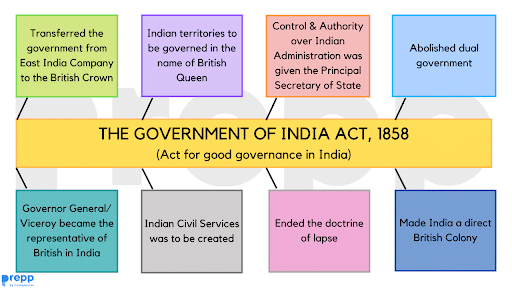
The Government of India Act (1858) - Key Provisions
- It abolished East India Company, India became a direct British Colony. Indian territories were to be governed in the name of the British queen.
- Abolished the dual government initiated by Pitt's India Act of 1784.Court of Directors and the Board of Control were scrapped.
- The powers of the Court of Directors were shifted to and vested in the Secretary of State for India.(First Secretary of State for India: Lord Stanley)
- Secretary of State was to be assisted by a Council of 15 members .The council had only an advisory role. The Secretary of State for India was made chairman of the Council.
- Secretary of State would also act as a channel of communication between the British government and Indian Administration.
- Secretary of State would have complete authority and control over the Indian Administration. He was also vested with the power to send secret dispatches to India without consulting his council.
- British Parliament could question the Secretary of State in the Parliament regarding the state of affairs in India.
- The act put an end to the doctrine of lapse
- Governor General was given the title of Viceroy,who became a direct representative of Crown.( First Viceroy of India was Lord Canning )
- All power was vested in the hands of Viceroy.Viceroys were to be assisted by an Executive Council.
- Viceroy and the Governors of the various presidencies were appointed by the Crown.
- The act put an end to the doctrine of lapse. It was also decided that the remaining Indian Princes would have their independent status provided they accept British suzerainty.
- Pardon would be granted to all the Indians who participated in the mutiny except those who had killed British subjects.
- Provision for Indian Civil Services to administer the country,which would be controlled by Secretary of states.
Secretary Of State According To The Government Of India Act, 1858
- The Secretary of State was to be a British MP and a member of the Prime Minister's cabinet.
- As a member of cabinet,was ultimately responsible to the British Parliament.
The Government Of India Act (1858) - Defects
- It was dominated by absolute Imperial control with no representation for the people of India.
- The Secretary of State was the supreme authority and had a free hand in the administration of India and was responsible only to the British parliament.
Conclusion
Government of India Act, 1858 is also known as the act of good governance.But,it did not in any way alter the system of government in India. Most of the provisions were enacted to safeguard the jewel of British empire against any future threats or rebellions.
FAQs
Question: What was the main purpose of the Government of India Act 1858?
Answer: The primary purpose of the Government of India Act 1858 was to transfer the governance of India from the East India Company to the British Crown, ensuring better administration and preventing the recurrence of uprisings like the Revolt of 1857.
Question: How did the Government of India Act 1858 change the role of the Governor-General?
Answer: The Act made the Governor-General of India the Viceroy of India, acting as the direct representative of the British Crown in India, with increased powers and responsibilities.
Question: What was the role of the Secretary of State for India as per the 1858 Act?
Answer: The Secretary of State for India was given full control over the administration of India. He was a member of the British Cabinet and was assisted by the Council of India in making decisions related to India.
Question: How did the Government of India Act 1858 impact the Indian Civil Service?
Answer: The Act laid the foundation for a merit-based Indian Civil Service (ICS), which became the backbone of British administration in India.
Question: Why was the Government of India Act 1858 enacted after the Revolt of 1857?
Answer: The Act was enacted in response to the Revolt of 1857, which highlighted the inefficiency of the East India Company’s administration. The British government wanted to centralize control to ensure better governance and prevent future rebellions.
MCQs
1. The Government of India Act 1858 was passed to transfer the administration of India from the East India Company to which of the following?
A. British Parliament
B. British Crown
C. Indian Princes
D. Indian National Congress
Answer: (B) See the Explanation
The Government of India Act 1858 transferred the administration of India from the East India Company to the British Crown, marking the beginning of direct British rule in India.
2. Who was made the direct representative of the British Crown in India after the Government of India Act 1858?
A. Secretary of State for India
B. Governor-General of India
C. Prime Minister of India
D. Chairman of East India Company
Answer: (B) See the Explanation
After the passing of the Act, the Governor-General of India became the Viceroy of India, representing the British Crown directly in India.
3. The Secretary of State for India, created under the Government of India Act 1858, was assisted by how many members in the Council of India?
A. 12
B. 15
C. 18
D. 21
Answer: (B) See the Explanation
The Secretary of State for India was assisted by a Council of India consisting of 15 members to help manage the administration of India.
4. The Government of India Act 1858 is also known for the reorganization of which of the following institutions?
A. Indian Judiciary
B. British Parliament
C. Indian Army
D. Indian National Congress
Answer: (C) See the Explanation
The Act reorganized the Indian Army after the Revolt of 1857 to ensure that the British soldiers outnumbered Indian soldiers, preventing future mutinies.
5. Which of the following roles was abolished by the Government of India Act 1858?
A. Viceroy of India
B. Court of Directors
C. Governor-General of India
D. Indian Civil Service
Answer: (B) See the Explanation
The Court of Directors, which had been responsible for overseeing the East India Company’s administration, was abolished by the Government of India Act 1858.
GS Mains Questions and Model Answers
Q1: Discuss the significance of the Government of India Act 1858 in shaping the administrative structure of British India.
Answer: The Government of India Act 1858 marked a major shift in the governance of India by transferring administrative control from the East India Company to the British Crown. This Act laid the foundation for the British Raj and centralized the administration of India under the British government. The appointment of the Secretary of State for India, who was a member of the British Cabinet, ensured closer supervision of Indian affairs by the British Parliament. The Governor-General became the Viceroy of India, directly representing the British Crown in India.
The Act also led to the reorganization of the Indian Army and the establishment of the Indian Civil Service, which became the backbone of British administration in India. The reforms introduced by the Act helped to maintain tighter control over India, but it also led to increased alienation among the Indian population due to the centralization of power in British hands.
Q2: Analyze the impact of the Government of India Act 1858 on the political and administrative framework of India.
Answer: The Government of India Act 1858 had a profound impact on the political and administrative framework of India. By abolishing the rule of the East India Company and transferring control to the British Crown, the Act established direct British rule in India. The creation of the office of the Secretary of State for India, based in London, marked the beginning of centralized British control over Indian affairs.
The Act also redefined the role of the Governor-General, who was now titled the Viceroy of India and acted as the representative of the British monarch. This change symbolized the consolidation of power under the British Crown. Furthermore, the Act led to significant reforms in the Indian Civil Service and military, ensuring that the British maintained control over key administrative and defense structures in India. The centralized and authoritarian nature of the British administration that followed the Act sowed the seeds of discontent, eventually leading to India’s freedom struggle.
Q3: Explain the reasons behind the enactment of the Government of India Act 1858 and how it aimed to prevent events like the Revolt of 1857 from recurring.
Answer: The Government of India Act 1858 was enacted in response to the Revolt of 1857, which exposed the shortcomings of the East India Company’s administration. The British government believed that the lack of direct control over Indian affairs had contributed to the rebellion, and there was a need for tighter governance to prevent future uprisings.
The Act transferred all powers from the East India Company to the British Crown, establishing a more centralized system of governance. The creation of the office of the Secretary of State for India allowed the British government to directly manage Indian affairs. The Act also restructured the Indian Army to ensure greater loyalty and prevent mutinies by maintaining a higher ratio of British soldiers to Indian soldiers. These measures were designed to prevent any future rebellions and to ensure that India remained firmly under British control.
Previous Year Questions on Government of India Act 1858
UPSC CSE Prelims 2015
Question: The Government of India Act 1858 resulted in the transfer of power from the East India Company to which of the following?
- A. British Parliament
- B. British Crown
- C. Indian Princes
- D. Governor-General
Answer: B
Explanation: The Government of India Act 1858 abolished the rule of the East India Company and transferred the administration of India to the British Crown. This act marked the beginning of direct British rule in India and ended the dual control exercised by the East India Company and the British government.
UPSC CSE Mains 2017 (GS Paper 1)
Question: Discuss the significance of the Government of India Act 1858 in shaping the administrative structure of British India and the challenges it aimed to address following the Revolt of 1857.
Explanation: The Government of India Act 1858 was a landmark in the history of British India as it marked the formal transfer of administrative control from the East India Company to the British Crown. The Act created the office of the Secretary of State for India, who was given full control over Indian affairs, along with a Council of India to assist him. The Governor-General became the Viceroy of India, directly representing the British monarch.
This Act was enacted as a result of the Revolt of 1857, which exposed the weaknesses in the Company's administration. It sought to establish a more centralized and efficient system of governance to prevent future uprisings. Additionally, the Act initiated reforms in the Indian Civil Service and the reorganization of the Indian Army to ensure British supremacy in India. The Act laid the foundation for a new phase of British imperialism in India.
UPSC CSE Prelims 2018
Question: Which of the following was a key provision of the Government of India Act 1858?
- A. Introduction of bicameralism in India
- B. Establishment of the Indian National Congress
- C. Abolition of the East India Company's rule
- D. Formation of a federal government
Answer: C
Explanation: The Government of India Act 1858 abolished the rule of the East India Company and transferred control of India to the British Crown. This marked the end of Company rule and the beginning of direct British administration in India, with the creation of the office of the Secretary of State for India and the Council of India.
UPSC CSE Mains 2018 (GS Paper 1)
Question: Analyze the impact of the Government of India Act 1858 on the relationship between the British government and the Indian princely states.
Explanation: The Government of India Act 1858 had a significant impact on the relationship between the British government and the Indian princely states. The Act transferred administrative control from the East India Company to the British Crown, and the Viceroy of India became the direct representative of the British monarch. The Act strengthened British control over the princely states through treaties and agreements, which ensured the loyalty of the princes to the British Crown.
The princely states were allowed to retain their internal autonomy as long as they accepted British supremacy. However, the Doctrine of Lapse, used by Lord Dalhousie to annex princely states, was abandoned after the enactment of the Act to avoid further resentment among Indian rulers, following the Revolt of 1857.
*email: contactus@prepp.in
Download the PREPP App and attempt FREE IAS Exam Mock Tests and get complete study material!

Full Test - 04: UPSC CSE Prelims CSAT (Paper-II)
Full Test - 03: UPSC CSE Prelims CSAT (Paper-II)
UPSC CSE Prelims 2026 GS Paper 1 Question Paper (24-May-2026)
UPSC CSE Prelims 2026 CSAT Paper 2 Question Paper (24-May-2026)

17 February 2025 | The Hindu Must Read Articles | Current Affairs

16 February 2026 | The Hindu Must Read Articles | Current Affairs

13 February 2026 | The Hindu Must Read Articles | Current Affairs









Comments