Charter Act 1813 - Indian Polity Notes
Charter act of 1813, also called the East India Company Act 1813 ended the trade monopoly of the British East India Company, However the Company's monopoly in trade with China and trade in tea and opium was continued. It asserted the Crown's sovereignty over British India by extending the trading charter for another 20 years. The topic “Charter act of 1813” is an important part of the UPSC/IAS Exam Indian Polity and Governance syllabus which is discussed in this article in detail.
|
Table of Contents |

 Charter Act of 1813
Charter Act of 1813 – Historical Background
- British tradesmen and merchants suffered as a result of Napoleon Bonaparte's Continental System in Europe (which barred the import of British goods into French allies in Europe).
- Growing popularity of new economic theories of Laissez faire also led to rise in demand for removal of trade barriers.
- As a result, they demanded a share of British trade in Asia and the end of the East India Company's monopoly, to which the company objected.
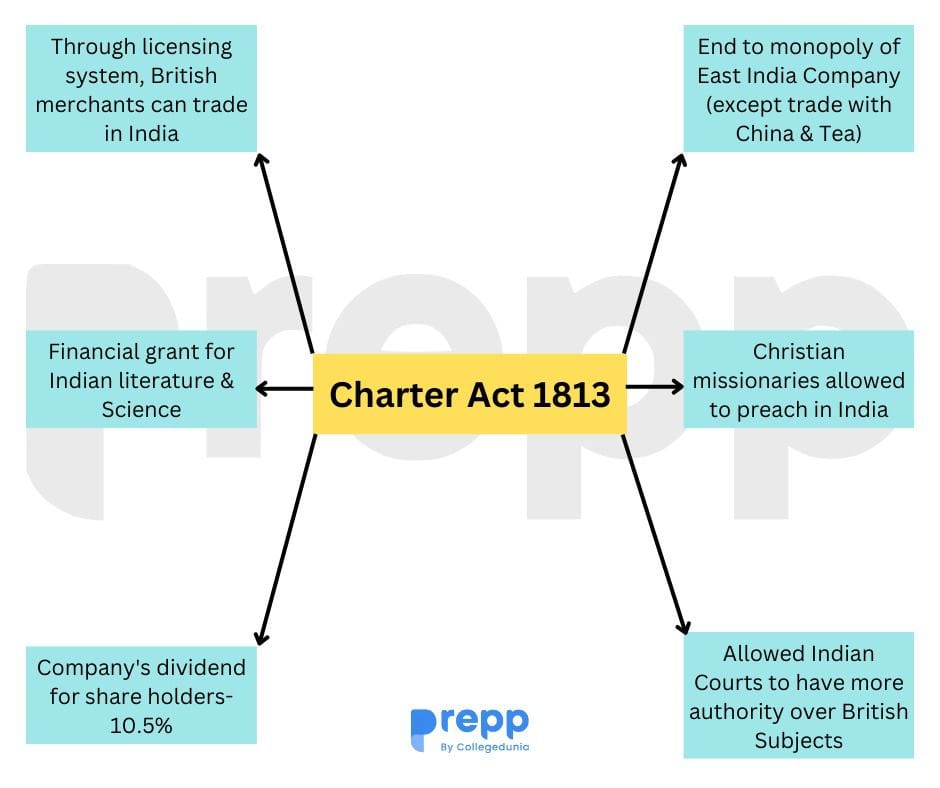
- Finally, under the Charter Act of 1813, British merchants were allowed to trade in India under a strict licensing system, but the company retained its monopoly in trade with China and the tea trade.
- The Act also gave Indian provincial governments and courts greater authority over subjects of the British Empire, and financial resources were made available to encourage the revival of Indian literature and the advancement of science.
Charter Act of 1813 – Objectives
This act's main objective is to extend the Company's control for another 20 years.
Charter Act of 1813 – Provisions
|
" Charter Act of 1813 ended Company's trade monopoly, affirmed Crown’s sovereignty and laid the foundation of modern education in India.” |
- The Crown's jurisdiction over British colonies in India was asserted by this Act.
- The rule of the Company was extended for another 20 years but the monopoly over trade of tea,opium and trade with China was continued.
- It gave local governments the ability to tax those who were under the Supreme Court's jurisdiction, and it set the company's dividend at 10.5 percent.
- The Act allowed Indian courts more authority over European British subjects.
- This act also gave missionaries freedom to enter India and engage in religious proselytization. In accordance with the Act, the missionaries were successful in obtaining the appointment of a Bishop for British India, with his headquarters in Calcutta.
- A sum of one lakh rupees was to be set aside for the revival,promotion and encouragement of literature,science among the Indians.
- Regulations made by Councils of Madras,Bombay and Calcutta were now required to be laid before the British Parliament.The constitutional position of the British territories in India was thus explicitly defined for the first time.
- Separate accounts for commercial transactions and territorial revenues were supposed to be maintained by the Company.
- The power of superintendence and direction of the Board of Control was defined as well as enlarged considerably.
Conclusion
The Board of Control's direction and supervision powers were defined and expanded by the Charter Act of 1813 thus enforced British Crown’s sovereignty. One of the most important provisions of the Charter Act of 1813 was the provision of a sum of rupees one lakh per year for the revival and improvement of literature and science.It laid the foundation of principle of state responsibility for educatio.It was, without a doubt, one of the most significant moves done by the British government in relation to India.
FAQs
Q1: What was the Charter Act of 1813?
Answer: The Charter Act of 1813 was an important act passed by the British Parliament that renewed the charter of the East India Company for another 20 years but significantly curtailed its commercial monopoly, especially in India, allowing other British merchants to trade with India.
Q2: What were the key provisions of the Charter Act of 1813?
Answer: The key provisions included the end of the East India Company’s trade monopoly (except in tea and trade with China), granting missionaries the right to propagate Christianity in India, setting aside funds for the promotion of education in India, and reaffirming the British Parliament’s control over the company’s policies.
Q3: How did the Charter Act of 1813 impact the East India Company’s commercial monopoly?
Answer: The Act ended the East India Company’s monopoly over trade in India, except for tea and trade with China. This opened Indian markets to private British traders, which led to greater commercial competition and economic changes in India.
Q4: What was the significance of the Charter Act of 1813 in terms of education in India?
Answer: The Charter Act of 1813 allocated Rs. 1 lakh annually for the promotion of education in India. Though the amount was small, it was the first time that the British government had taken responsibility for educating Indians.
Q5: Did the Charter Act of 1813 allow religious activities in India?
Answer: Yes, the Act permitted missionaries to enter India and engage in religious activities, including the propagation of Christianity, marking a significant change in British policy.
MCQs
- Which of the following monopolies of the East India Company was retained under the Charter Act of 1813?
a) Monopoly over trade with India
b) Monopoly over trade in tea and trade with China
c) Monopoly over textile manufacturing
d) Monopoly over the Indian Ocean trade
Answer: (B) See the Explanation
- What amount was allocated for the promotion of education under the Charter Act of 1813?
a) Rs. 50,000
b) Rs. 1 lakh
c) Rs. 2 lakh
d) Rs. 5 lakh
Answer: (B) See the Explanation
- Which of the following rights was granted to missionaries by the Charter Act of 1813?
a) The right to trade in India
b) The right to own land in India
c) The right to propagate Christianity in India
d) The right to appoint Indian governors
Answer: (C) See the Explanation
- The Charter Act of 1813 was significant because it:
a) Introduced local self-governance in India
b) Abolished the British East India Company
c) Marked the beginning of British government’s role in Indian education
d) Ended the East India Company’s monopoly in all aspects
Answer: (C) See the Explanation
- Which year was the Charter Act of 1813 passed?
a) 1810
b) 1813
c) 1820
d) 1833
Answer: (B) See the Explanation
GS Mains Questions and Model Answers
Q1. Discuss the significance of the Charter Act of 1813 in the context of British economic and religious policies in India.
Answer: The Charter Act of 1813 was a turning point in the history of British policies in India, both economically and religiously. Economically, it marked the end of the East India Company’s monopoly over trade in India, except for tea and trade with China, allowing private British traders to engage in commercial activities in India. This change had far-reaching effects, leading to increased competition and greater British involvement in the Indian economy.
Religiously, the Act allowed Christian missionaries to enter India and propagate Christianity. This was a significant policy shift, as the British government had previously refrained from allowing missionary activities in India. The Act also laid the foundation for the British government’s role in education, allocating Rs. 1 lakh for the promotion of education in India. This marked the beginning of British efforts to influence Indian society not only through economic control but also through cultural and religious interventions.
Q2. Analyze the impact of the Charter Act of 1813 on the East India Company’s role in India.
Answer: The Charter Act of 1813 had a profound impact on the role of the East India Company in India. While the Act renewed the Company’s charter for another 20 years, it significantly curtailed its commercial monopoly, allowing private British merchants to trade freely in India, except in tea and China trade. This marked the gradual decline of the Company’s commercial power and increased the influence of private British enterprises in India’s economy.
The Act also reaffirmed the British Parliament’s authority over the Company’s policies, further eroding its autonomy. In addition, the Act required the Company to spend Rs. 1 lakh annually on the promotion of education, thus beginning its role in shaping Indian education. The Charter Act of 1813, therefore, represented the beginning of the Company’s transition from a purely commercial entity to one with increasing political and administrative responsibilities under the direct supervision of the British government.
Q3. Evaluate the long-term effects of the Charter Act of 1813 on the Indian education system.
Answer: The Charter Act of 1813 marked the first official step taken by the British government towards educating Indians by allocating Rs. 1 lakh annually for the promotion of education. Although the sum was small and the implementation was slow, the Act laid the foundation for future educational reforms in India.
In the long term, this Act paved the way for subsequent educational policies, such as Macaulay’s Minute on Education (1835), which emphasized the need for an education system based on English language and Western knowledge. The Act also signaled the British government’s intent to influence Indian society through cultural and educational interventions, leading to the establishment of schools and colleges in India. Though the immediate impact was limited, the Charter Act of 1813 set in motion a process that eventually transformed the Indian education system under British rule.
Previous Year Questions on Charter Act of 1813
1. UPSC CSE Mains 2017
Question. Discuss the economic and political significance of the Charter Act of 1813 in the British administration of India.
Answer: The Charter Act of 1813 was economically significant as it marked the end of the East India Company’s monopoly over trade in India, except for tea and trade with China. This allowed private British merchants to engage in trade, leading to the commercialization of Indian markets and the establishment of new economic relations between Britain and India. It also heralded the shift from the Company’s dominance in trade to increased British government intervention in India’s economic affairs.
Politically, the Act reaffirmed Parliament’s control over the Company’s activities, ensuring that the Company would now operate under greater supervision from the British government. This was a precursor to the eventual decline of the Company’s administrative autonomy and the rise of direct British rule in India. Furthermore, by allowing missionaries to enter India and propagate Christianity, the Act demonstrated the British government’s intention to exert cultural and religious influence on Indian society, making it a key moment in the evolution of British imperial policy in India.
2. UPSC CSE Mains 2018
Question. How did the Charter Act of 1813 influence the entry of missionaries in India, and what were its implications?
Answer: The Charter Act of 1813 played a significant role in allowing missionaries to enter India legally and propagate Christianity. Prior to this Act, the East India Company was reluctant to allow missionaries into India, fearing that religious activities might disturb the socio-political balance. However, under the Charter Act, the British government officially permitted Christian missionaries to spread their faith and establish schools and missionary institutions.
This had profound implications for Indian society. Missionaries not only propagated Christianity but also played a role in education, especially in promoting the English language and Western ideals. While the missionary activity led to social tensions in some regions, it also contributed to social reforms, including efforts to abolish sati and promote women’s education. The entry of missionaries under the Act thus marked the beginning of a complex interaction between British imperialism, religion, and Indian society, influencing social and cultural transformations in the 19th century.
*email: contactus@prepp.in
Download the PREPP App and attempt FREE IAS Exam Mock Tests and get complete study material!

Full Test - 04: UPSC CSE Prelims CSAT (Paper-II)
Full Test - 03: UPSC CSE Prelims CSAT (Paper-II)
UPSC CSE Prelims 2026 GS Paper 1 Question Paper (24-May-2026)
UPSC CSE Prelims 2026 CSAT Paper 2 Question Paper (24-May-2026)

17 February 2025 | The Hindu Must Read Articles | Current Affairs

16 February 2026 | The Hindu Must Read Articles | Current Affairs

13 February 2026 | The Hindu Must Read Articles | Current Affairs









Comments