Government of India Act 1935 - Indian Polity Notes
Government of India Act 1935 was the longest legislation passed by the British Parliament for India. White paper which was published after the Round Table Conference became the basis for Government of India Act 1935. It introduced dyarchy at the Centre and responsible government in the provinces. The topic “Government of India Act (1935)” which is discussed in this article is an important part of the UPSC/IAS Exam’s Polity and Governance syllabus for prelims,mains as well as optional subjects such as Public Administration and Political Science.
|
Table of Contents |

Government of India Act (1935) – Historical Background
- The Government Act of 1919 was not satisfactory at all and was too short in its provisions for the self-government.
- Indian politicians were frustrated at that time because they thought that the areas they had official control over were still in the hands of the British officials with full control over them.
- So the task to review this matter and to make changes to it had been given to the Simon Commission.
- When the Simon Commission Report came out it was seen that the report was not satisfactory which would lead to the consultation with the then-Indian Community Representatives at the Round Table conference, held in London
- The Round Table Conferences were a failure because they were unable to fulfill their goal.
- However, in 1933, a white paper was released based on the recommendations of the Round Table Conferences, and work on India's constitution began.
- A committee was set up under the chairmanship of Lord Linlithgow, the viceroy of India, to consider the recommendations of the white paper.
- The committee's report was published in 1934 and contained in a bill of law.
- The report along with the bill was passed in the British Parliament. After the Royal assent, the Act was enforced in the country as the Government of India Act 1935.
- The Government of India Act, of 1935, laid down a federal form of Government for India.
- The Government of India Act, 1935 derived material from four key sources viz. Report of the Simon Commission, discussions at the Third Round Table Conference, the White Paper of 1933 and reports of the Joint select committees.
|
We are provided with a car, all brakes and no engine – Jawaharlal Nehru
|
Government of India Act (1935) - Objective
- This act ended the system of dyarchy introduced by the GOI Act 1919
- The Government of India Act of 1935 called for the formation of an Indian Federation made up of the Governor's Provinces and Chief Commissioner's Provinces in British India, as well as any Indian States that voluntarily joined it.
- However, the federation was never formed because it lacked the required number of princely states.
- The primary objective was to provide Indians with the responsible government they needed.
- With the help of this Act, an effort was made for the first time to unite and link the princely states of India to the country's constitutional framework. The Act did not, however, contain a preamble.
Government of India Act (1935) - Key Provisions
All India Federation
- The Act established an All-India Federation, which included both British Indian Provinces and the Indian States. The Instrument of Accession specified the conditions under which a state might join the federation.
- It was at the discretion of the state whether it wanted to join the federation that was given by the Government of India Act, 1935.
- According to this act, India would become a federation if 50% of Indian states decided to join it. However, the provisions with regard to the federation were not implemented as the required number of princely states did not join it.
Provincial Autonomy
- One redeeming feature of the new Act was that it marked the beginning of Provincial Autonomy.
- The provinces were allowed to act as autonomous units of administration in their defined spheres.
- Furthermore, the Act established responsible governments in provinces, which compelled the governor to act on the advice of ministers who were accountable to the provincial legislature.
- This came into effect in 1937 and was discontinued in 1939.
- This, however, does not mean that the Act of 1935 established a full-fledged responsible Government in the Provinces.
- Ministers did not have complete control over how their departments were handled.
- The Governors retained a range of overriding powers, though they were rarely used.
Division of Subjects
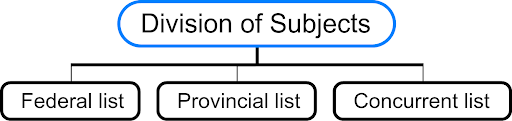
- The approach to forming the federation and implementing provincial autonomy paved the way for the division of subjects between the Centre and the Provinces.
- The division of subjects that were given by the Government of India Act, 1919 was revised, and added some more subjects in it by this Act of 1935 and included three lists.
![Division of subjects]()
- Federal list- 59 items
- Provincial list- 54 items
- Concurrent list- 36 items
- The subjects which were of all-India interest and demanded uniform treatment were put on the Federal list. Only the Federal Legislature could make laws on Federal subjects.
- Subjects mainly of local interest were placed on the Provincial list and were wholly within the jurisdiction of the Provincial Legislatures for the purpose of the legislation.
- The third list is known as the Concurrent list, and which contained 36 items, included subjects that were primarily Provincial interests but at the same time required uniformity of treatment all over the country.
- As a result, the Act empowered both the federal and provincial legislatures to enact legislation on certain topics. In the event of a disagreement, federal law would take precedence
- Residuary Power: For the subjects not mentioned in any of the list, the Governor General had the discretion to make laws on such subjects.
Dyarchy at the Centre
- The Act of 1935 abolished dyarchy at the Provincial level and introduced it at the Centre. There were two categories of federal subjects:
| Reserved Subjects | Transferred Subjects |
|---|---|
|
|
- The Governor-General remained overall in charge of both the Reserved and Transferred subjects.
Bicameral legislature
- Under the Government of India Act, 1935, the Central Legislature was bicameral, consisting of the Federal Assembly and Council of States.
- The Council of States was to be an upper house and a permanent body with one-third of its members retiring every 3rd year. It was to be composed of 260 members of which 156 were to be representatives of British India and 104 of the Indian states.
- The Federal Assembly was the lower house with a tenure of five years. It was to be made of 375 members, out of which 250 were to be representatives of British India and not more than 125 members from the princely states.
- While nominated members were to fill the seats designated for princely states, the provinces were allotted various numbers of seats.
- An indirect election to the Federal Assembly was planned. The assembly's mandate was five years, but it could be dissolved early if necessary.
- Bicameralism was also implemented in six of the eleven provinces. As a result, the legislatures of Bengal, Bombay, Madras, Bihar, Assam, and the United Seven Provinces became bicameral, with a legislative council (upper chamber) and a legislative assembly (lower house).
- They were, however, subject to several restrictions.
Retention of Communal Electorate
- It further extended the principle of communal representation by providing separate electorates for depressed classes (scheduled castes), women, and labour (workers).
- The Muslims got 33% (⅓ of the seats) in the Federal Legislature although their number was much less than one-third of the total population of British India.
- Even the workers and women got separate representation although they had not asked for it.
Federal Court
- The Government of India Act, 1935 provided for the establishment of a Federal Court which would interpret the Act and adjudicate disputes relating to federal matters(exclusive original jurisdiction.)
- Provision for Chief Justice and no more than eighty-six judges.
- Appeals from High Courts to the Federal Court and from the Federal Court to the Privy Council were made possible.
- The Federal Court might also issue Special Leave to Appeal, although such appeals required a certificate from the High Court.
Reorganization of provinces
- This Act also did some kind of restructuring or reorganization of the provinces. A new province was created out of Bombay and named Sindh.
- From Bihar, Orissa was separated and established as separate province.
- Therefore, Sindh and Orissa as two new provinces were established by this Act.
Separation of Burma
- The Simon Commission proposed to the Government of India to separate Burma from India and this proposal was accepted by this Act.
- In 1935, the Burma Act was passed and its separation from India was done after two years of this Act i.e., in 1937.
- The Burma Act proposed for a new Burma office that had the power to establish Burma as a separate colony.
Supremacy of the Parliament
- The 1935 Act was very rigid. It could not be changed or amended by any Indian legislature, whether federal or temporary.
- British Government alone had the authority to make modifications.
- By submitting a resolution to the constitution, the Indian legislature may at most pray for a constitutional amendment. It was an imposition on India by the British parliament.
Abolition of the Indian Council of the Secretary of State
- The Government of India Act 1935 abolished the Council of the Secretary of State for India, which was created in 1858.
- The Secretary of State was to have advisers in their place. With the introduction of provincial autonomy, the control of the Secretary of State over Transferred Subjects was greatly diminished.
- His control, however, remained intact over the powers of the Governor General and Governors.
Federal railway authority
- This Act placed control of the railway in the hands of a new body known as the Federal Railway Authority.
- The members of this body numbered seven, and they were not subject to the jurisdiction of councilors or ministers.
- The Governor-General received direct reports from the authority. The primary goal of establishing this authority was to reassure British stakeholders that their investment in the railway was secure.
Other Provisions
- It provided for the establishment of a Reserve Bank of India to control the currency and credit of the country.
- It also provided for the establishment of not only a Federal Public Service Commission but also a Provincial Public Service Commission and Joint Public Service Commission for two or more provinces.
Government of India Act (1935) - Significance
- The Government of India Act 1935 curtailed the power concentrated in the hands of the Central Government and distributed it among the decentralised form of government.
- Separate electorates for women, despite the fact that they had not asked for it, were beneficial to women's advancement in the decision-making process. Workers had their own representation as well, which aided in the progress of the working class.
- This Act was the first attempt to give the provinces an autonomous status by freeing them from external interference.
- It provided voting rights to more people than were given under the Government of India Act, 1919.
- This Act also suggested the establishment of a federal government that would allow princes to participate in India's political activities.
- Furthermore, the drafters of the Indian Constitution took into account those characteristics of the Government of India Act that were well-suited to a free India.
- The Constitution of India also borrowed the feature that every state should have a Governor who would be elected by the Central Government.
- The Public Service Commission that we see in Article 315 of the Indian Constitution had also been taken from the Government of India Act, 1935.
Government of India Act (1935) - Criticism
- The new Act armed the Governors and Governor-General with tremendous discretionary powers and thus reduced Provincial Autonomy to a farce.
- The proposed formation of the Federation was also fundamentally defective. Entry into the Federation was compulsory for the Provinces but voluntary for the Princely States.
- Besides, the States were to be represented in the Federal Legislature not by the elected representatives of the States but by the nominees of the native rulers.
- The act failed to provide a proper federal structure, the majority of the power was with the Governor-General.
- It not only retained the system of Communal Electorate but also extended its application in the case of Harijans, labour and women.
- In the name of preserving minorities against Hindu tyranny, the Governor-General and the Governor were given broad powers by the Act of 1935.
- Until 1947, the British Parliament and the Secretary of State for India were the de facto rulers of the country. As a result, it's not unexpected that the Act of 1935 was met with disdain and resentment.
- The legislation failed to provide individuals with constitutional flexibility in terms of amending their rights because the British government had the ability to adjust or alter any right, while Indians were unable to do anything in accordance with their demands.
Conclusion
Government of India Act of 1935 marked a pivotal moment in British India's constitutional history. While it expanded Indian representation and introduced provincial autonomy, its limitations and the onset of World War II hindered effective implementation. Despite these challenges,It also laid the groundwork for Indian leaders to create their own Constitution after independence by defining what a Constitution or Act should look like.
FAQs
Question: What was the main objective of the Government of India Act 1935?
Answer: The main objective of the Government of India Act 1935 was to introduce constitutional reforms in British India by establishing provincial autonomy, proposing an All-India Federation, and expanding electoral representation.
Question: What is meant by provincial autonomy under the Government of India Act 1935?
Answer: Provincial autonomy under the Act meant that provinces could legislate and administer on subjects allotted to them without interference from the central government, although governors retained certain discretionary powers.
Question: Why was the All-India Federation under the Government of India Act 1935 never implemented?
Answer: The All-India Federation proposed by the Act was never implemented because many princely states refused to join, fearing loss of their autonomy.
Question: How did the Government of India Act 1935 impact the legislative structure in India?
Answer: The Act introduced a bicameral legislature at the center, consisting of a Federal Assembly and a Council of States, and expanded the franchise to a larger number of Indians.
Question: What was the significance of diarchy at the central government level in the Government of India Act 1935?
Answer: The introduction of diarchy at the center was significant because it separated subjects into reserved (controlled by the Governor-General) and transferred (administered by Indian ministers) lists, though it was an unpopular feature.
MCQs
- Which of the following features was introduced by the Government of India Act 1935?
A. Provincial Autonomy
B. Unitary Government
C. Independent Judiciary
D. Adult Franchise
Answer: (A) See the Explanation
The Government of India Act 1935 introduced Provincial Autonomy, which allowed provinces to function as separate administrative units with the power to legislate on certain subjects.
- The Government of India Act 1935 provided for the establishment of which of the following at the center?
A. Unitary Legislature
B. Bicameral Legislature
C. Judiciary
D. Sovereign Government
Answer: (B) See the Explanation
The Act established a bicameral legislature at the center, consisting of a Federal Assembly and a Council of States.
- Why was the All-India Federation under the Government of India Act 1935 not implemented?
A. Lack of interest from Indian leaders
B. Refusal of princely states to join
C. Opposition from the British Parliament
D. Conflict with the Indian National Congress
Answer: (B) See the Explanation
The All-India Federation was not implemented because many princely states refused to join, fearing they would lose their autonomy under the proposed system.
- Which of the following is true about the diarchy introduced by the Government of India Act 1935?
A. It was introduced only at the provincial level
B. It separated subjects into reserved and transferred categories at the center
C. It gave Indian ministers full control over all subjects
D. It was completely abolished in the provinces
Answer: (B) See the Explanation
The Act introduced diarchy at the center, separating subjects into reserved (controlled by the Governor-General) and transferred (administered by Indian ministers) categories.
- What was the main limitation of the electoral franchise under the Government of India Act 1935?
A. Only Europeans could vote
B. It allowed universal adult suffrage
C. It was limited to a small percentage of the population
D. Only people from princely states could vote
Answer: (C) See the Explanation
The electoral franchise under the Act was limited to a small percentage of the population, as the criteria for voting rights were based on property, income, and other qualifications.
GS Mains Questions and Model Answers
Q1: Discuss the significance of the Government of India Act 1935 in shaping India’s constitutional framework.
Answer: The Government of India Act 1935 was a landmark in India’s constitutional history as it introduced several key features that laid the foundation for India's future constitutional structure. The Act introduced provincial autonomy, allowing provinces to function independently with legislative powers. It also proposed an All-India Federation, although it was never implemented. The Act established a bicameral legislature at the center and expanded the electoral franchise. Although the Act was criticized for retaining significant powers in the hands of the Governor-General and British authorities, it served as the basis for the Indian Constitution of 1950, especially regarding the federal structure and provincial autonomy.
Q2: Analyze the reasons for the failure of the All-India Federation proposed under the Government of India Act 1935.
Answer: The All-India Federation proposed under the Government of India Act 1935 failed to materialize primarily because many princely states refused to join the federation. These states feared that joining the federation would result in the loss of their autonomy and powers, as the federation required them to cede certain powers to the central government. Additionally, Indian political leaders, especially from the Indian National Congress, were dissatisfied with the limited nature of the reforms and the retention of significant powers by the Governor-General and British officials, further undermining support for the federation. The lack of consensus among key stakeholders ultimately led to the failure of the federation.
Q3: How did the Government of India Act 1935 contribute to the eventual framing of the Indian Constitution?
Answer: The Government of India Act 1935 played a crucial role in shaping the Indian Constitution by introducing key features that were later incorporated into the constitutional framework. The Act’s provisions for provincial autonomy and a bicameral legislature were precursors to India’s federal structure and parliamentary system. The division of powers between the center and provinces, as outlined in the Act, became the basis for the distribution of powers in the Indian Constitution. Additionally, the Act’s introduction of a bicameral legislature at the center was retained in independent India’s Parliament. Despite its limitations, the Act provided a foundation for India’s journey toward democratic governance.
Previous Year Questions on Government of India Act 1935
1. UPSC CSE Prelims 2020
Question: Which of the following was a feature of the Government of India Act 1935?
A. Unitary Government
B. Provincial Autonomy
C. Universal Adult Franchise
D. Sovereignty of India
Answer: B
Explanation: The Government of India Act 1935 introduced provincial autonomy, allowing provinces to function as separate administrative units with legislative powers, though certain powers were still retained by the British authorities.
*email: contactus@prepp.in
Download the PREPP App and attempt FREE IAS Exam Mock Tests and get complete study material!

Live Test : UPSC CSE Prelims CSAT (Paper-II) (Oct 08 - 11)
Full Test - 04: UPSC CSE Prelims CSAT (Paper-II)
Full Test - 03: UPSC CSE Prelims CSAT (Paper-II)
UPSC CSE Prelims 2026 GS Paper 1 Question Paper (24-May-2026)
UPSC CSE Prelims 2026 CSAT Paper 2 Question Paper (24-May-2026)

17 February 2025 | The Hindu Must Read Articles | Current Affairs

16 February 2026 | The Hindu Must Read Articles | Current Affairs

13 February 2026 | The Hindu Must Read Articles | Current Affairs









Comments