Indian Councils Act 1892 - Indian Polity Notes
Indian Councils Act of 1892 was passed with the objective of increasing the size of legislative councils in India thereby increasing the engagement of Indians with respect to the administration in British India. Following the foundation of the Indian National Congress, the Indian Councils Act of 1892 represents a significant milestone in India's constitutional and political history. The UPSC Indian Polity and Governance Syllabus includes Indian Councils Act of 1892 which is described in this article.
|
Table of Contents |
Indian Councils Act 1892 - Historical Background
- Following the Great Revolt of 1857, British realised that it needed to ensure the help of its Indian subjects in administering India.
- In addition, as nationalism grew in popularity, Indians became more cognizant of their rights.
- Following the founding of the Indian National Congress, the Indian Councils Act of 1892 represents a significant milestone in India's constitutional and political history.
- After the Act of 1861, the growth of the Indian Constitution is essentially a story of political discontent and agitation interspersed with Council Reforms.
- The reforms that were reluctantly accepted were always found to be insufficient, resulting in dissatisfaction and a demand for more reforms.
- During the 1885-1889,as a result of the growing nationalism, the Indiana National Congress raised several demands through its sessions.
The following were the main demands:
- An ICS test was to be held simultaneously in England and India.
- Expansion of the Legislative Councils, including the adoption of the election-in-place-of-nomination basis.
- Opposition to Upper Burma's annexation.
- Military spending should be reduced
- Ability to have previously forbidden financial chats.
Lord Dufferin, the Viceroy at the time, convened a commission to investigate the situation. On the other side, the Secretary of State opposed the idea of a direct election. However, he agreed to indirect electoral representation.
The Indian Councils Act 1892 - Objective
Increase in the size of various legislative councils in India thereby increasing the engagement of Indians with respect to the administration in British India.
|
Indian Councils Act of 1892 was passed with the objective of increasing the size of legislative councils in India.
|
Indian Council Act 1892 - Key Provisions
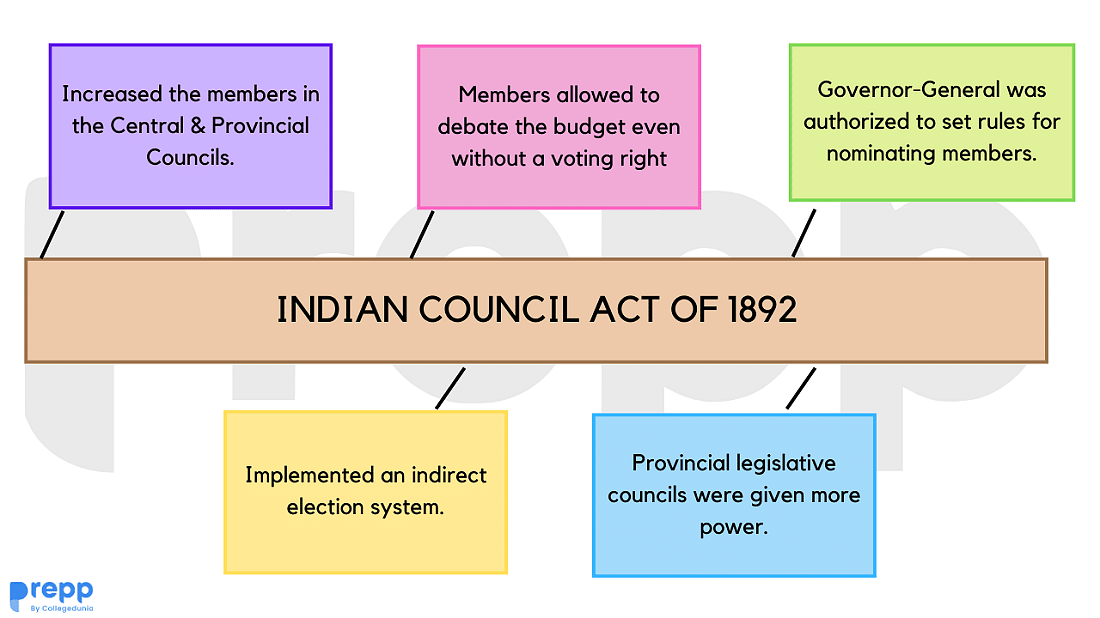
- It raised the number of (non-official) members in the Central and Provincial Legislative Councils while keeping the official majority.
- Bombay - 8
- Madras - 20
- Bengal - 20
- North Western Province -15
- Oudh - 15
- Central Legislative Council minimum - 10, maximum 16
- The Act made it clear that the members appointed to the council were not there as representatives of any Indian body, but as nominees of the Governor-General.
- Members could now debate the budget without voting right. They were also barred from asking follow-up questions.
- The elected members were permitted to discuss official and internal matters.
- The Governor General in Council was given the authority to set rules for member nomination, subject to the approval of the Secretary of State for India.
- To elect members of the councils, an indirect election system was implemented.
- Members of provincial councils could be recommended by universities, district boards, municipalities, zamindars, and chambers of commerce.
- Provincial legislative councils were given more powers, including the ability to propose new laws or repeal old ones with the Governor General's assent.
Indian Councils Act 1892 - Significance
- It was the first step toward a representative system of government in contemporary India.
- The number of Indians increased, which was a good thing.
- Despite the fact that Indians did not have the power to veto the majority, their opinions were heard.
- The principle of election, which was accepted in 1892, allowed non-officials to have a free and open discussion on the government's financial strategy. As a result, the administration had an opportunity to clear up misconceptions and respond to criticism.
- The statute gave members of the council the authority to issue interpellations on subjects of public concern.
Indian Council Act 1892 - Limitations
- Despite being the first step toward a representative government in modern India, this act provided no benefits to the common man.
- This act created the stage for the development of numerous revolutionary forces in India because the British only made a minor concession.
- Many leaders, including Bal Gangadhar Tilak, faulted Congress's moderate strategy of petitions and persuasions for the lack of significant progress and called for a more assertive policy against British rule.
Conclusion
The Indian Councils Act, 1892 is a significant milestone in India's constitutional and political history. The act increased the size of various legislative councils in India thereby increasing the engagement of Indians with respect to the administration in British India. The Indian Councils Act, 1892 was the first step towards the representative government in modern India. The act created the stage for the development of revolutionary forces in India because the British only made a minor concession.
FAQs
Question: What was the Indian Councils Act of 1892?
Answer: The Indian Councils Act of 1892 was a legislative measure that expanded the powers of the Indian Legislative Councils and introduced some representative elements in their composition.
Question: What were the key features of the Indian Councils Act of 1892?
Answer: The Act increased the number of additional members in the Central and Provincial Legislative Councils and allowed for indirect elections by local bodies to nominate members.
Question: How did the Indian Councils Act of 1892 affect legislative powers?
Answer: The Act expanded the councils' ability to discuss budgets and address questions to the executive but did not allow for a full-fledged legislative authority.
Question: What was the role of local bodies in the Indian Councils Act of 1892?
Answer: Local bodies such as municipalities and district boards were granted the right to recommend members to the legislative councils, marking a step towards representation.
Question: Why was the Indian Councils Act of 1892 significant?
Answer: The Act was an early attempt at introducing representative government in India, laying the groundwork for later constitutional reforms like the Indian Councils Act of 1909.
MCQs
- Which of the following was introduced by the Indian Councils Act of 1892?
a) Direct elections for legislative councils
b) Introduction of a parliamentary system
c) Indirect elections through local bodies
d) Universal adult franchise
Answer: (C) See the Explanation
The Indian Councils Act of 1892 introduced the concept of indirect elections, allowing local bodies like municipalities and district boards to recommend members to the legislative councils.
- What was a key limitation of the Indian Councils Act of 1892?
a) No financial powers to the councils
b) Complete legislative authority to councils
c) Universal adult suffrage
d) Introduction of communal representation
Answer: (A) See the Explanation
The Act allowed limited discussions on budgets but did not grant legislative councils any financial powers or the ability to enact laws independently.
- Which of the following councils was expanded by the Indian Councils Act of 1892?
a) Central Legislative Council
b) Provincial Executive Council
c) Privy Council
d) Indian National Congress
Answer: (A) See the Explanation
The Indian Councils Act of 1892 increased the number of additional members in both the Central and Provincial Legislative Councils.
- The Indian Councils Act of 1892 was passed during the reign of which British Viceroy?
a) Lord Ripon
b) Lord Dufferin
c) Lord Curzon
d) Lord Minto
Answer: (B) See the Explanation
The Indian Councils Act of 1892 was passed during the tenure of Lord Dufferin, who served as Viceroy of India from 1884 to 1888.
- Which provision was NOT included in the Indian Councils Act of 1892?
a) Introduction of indirect elections
b) Ability to discuss budgets
c) Right to introduce bills
d) Increased number of council members
Answer: (C) See the Explanation
The Act allowed for discussions on budgets and questions to the executive but did not grant the right to introduce bills in the legislative councils.
GS Mains Questions and Model Answers
Q1: Analyze the impact of the Indian Councils Act of 1892 on the growth of representative institutions in India.
Answer: The Indian Councils Act of 1892 marked a significant step toward the development of representative institutions in India. It introduced the concept of indirect elections through local bodies, allowing limited Indian representation in the Central and Provincial Legislative Councils. While the Act granted the right to discuss budgets and question the executive, it stopped short of providing full legislative powers. The Act was a precursor to more substantial reforms in the Indian political system, leading to the eventual establishment of a broader representative framework in subsequent years.
Q2: Critically assess the limitations of the Indian Councils Act of 1892 in the context of Indian political aspirations.
Answer: Although the Indian Councils Act of 1892 expanded representation in legislative councils, it fell short of fulfilling Indian political aspirations. The Act allowed for only indirect elections and restricted the legislative councils to discussing budgets and asking questions, without granting them the power to introduce laws or control finances. Indian nationalists criticized the Act for not providing enough opportunities for real political participation. Despite these limitations, the Act laid the foundation for subsequent reforms that gradually expanded Indian involvement in governance, culminating in the Government of India Act, 1909.
Q3: Discuss the role of the Indian Councils Act of 1892 in the development of early Indian nationalism.
Answer: The Indian Councils Act of 1892, while limited in scope, played a role in the early stages of Indian nationalism by increasing the number of Indian members in the legislative councils and allowing for limited discussions on governance issues. This created a platform for emerging nationalist leaders to voice concerns about British policies. The Act’s shortcomings, particularly its failure to grant real legislative power, fueled demands for greater political participation and set the stage for more radical nationalist movements in the early 20th century. It highlighted the growing desire for self-governance and political rights among Indians.
Previous Year Questions on Indian Councils Act 1892
1. UPSC CSE Prelims 2018:
Question: What was the primary change introduced by the Indian Councils Act of 1892?
A. Direct elections for the Indian Legislative Council
B. Increased number of council members and limited indirect representation
C. Creation of a federal structure
D. Introduction of bicameralism
Answer: B
Explanation: The Indian Councils Act of 1892 increased the number of members in the legislative councils and allowed limited representation through indirect elections via local bodies.
2. UPSC CSE Mains 2016 (GS Paper 2):
Question: Discuss the significance of the Indian Councils Act of 1892 in the evolution of legislative institutions in British India.
Answer: The Indian Councils Act of 1892 was a critical step in the evolution of legislative institutions in British India. It increased the number of members in the Central and Provincial Legislative Councils and allowed for indirect representation through local bodies like municipalities and district boards. Although the councils were granted limited powers to discuss budgets and ask questions, they did not have legislative authority or financial control. Despite its limitations, the Act was significant in introducing the principle of representation, which laid the groundwork for more extensive reforms in the future.
3. UPSC CSE 2019
Question: Analyze the limitations of the Indian Councils Act of 1892 and how they influenced the political developments in India.
Answer: The Indian Councils Act of 1892 had several key limitations, which had a profound impact on political developments in India. While it allowed for the expansion of legislative councils and introduced indirect elections, the elected Indian representatives had no significant legislative power. Their role was largely advisory, with limited authority to influence decisions or pass laws. This lack of real power frustrated Indian political leaders, who sought greater participation and self-governance. The Act’s restrictive nature and failure to meet Indian aspirations contributed to the growing demand for political reforms, leading to the rise of movements such as the Indian National Congress, which began advocating for more extensive constitutional changes. These limitations highlighted the need for more substantial political reforms, eventually paving the way for future acts like the Morley-Minto Reforms of 1909.
*email: contactus@prepp.in
Download the PREPP App and attempt FREE IAS Exam Mock Tests and get complete study material!

Live Test : UPSC CSE Prelims CSAT (Paper-II) (Oct 08 - 11)
Full Test - 04: UPSC CSE Prelims CSAT (Paper-II)
Full Test - 03: UPSC CSE Prelims CSAT (Paper-II)
UPSC CSE Prelims 2026 GS Paper 1 Question Paper (24-May-2026)
UPSC CSE Prelims 2026 CSAT Paper 2 Question Paper (24-May-2026)

17 February 2025 | The Hindu Must Read Articles | Current Affairs

16 February 2026 | The Hindu Must Read Articles | Current Affairs

13 February 2026 | The Hindu Must Read Articles | Current Affairs









Comments