Mixed Farming - Agriculture Notes
A "mixed farming" system includes agricultural production, livestock, poultry, fisheries, beekeeping, and other activities on a single farm in order to support and meet the farmer's needs in as many ways as possible. The major objective of mixed farming is subsistence. Higher profitability without compromising the ecological balance is crucial for this farming system. This article will explain to you about Mixed Farming which will be helpful in preparing the Agriculture Syllabus for the UPSC Civil Service exam.
|
Table of Contents |
What is Mixed Farming?
- Crop production, agricultural allied activities, and animal rearing are all practised concurrently in mixed farming to maximise mutual benefits.
- Mixed farming is defined as the cultivation of crops alongside the rearing of animals for meat, eggs, or milk. Mixed farming entails both the harvesting of crops and the keeping of animals.
- In India, for example, cattle dung is used as manure, and in times of low productivity, these cattle could be used for milk, meat, and so on. It provides farmers with consistent income.
- The cropping system is a critical component of mixed farming. A proper cropping system could be achieved with the help of mixed farming, such as the use of domesticated animal manure (organic farming), the combination of fisheries with different crops (rice-fish in Eastern parts of India), and so on.
- It provides a high return on agricultural labor because every product is utilized.
- Mixed farming can take many different forms depending on external and internal factors.
- Weather patterns, market prices, political stability, technological developments, and so on are examples of external factors.
- Internal factors include local soil characteristics, family composition, and farmer ingenuity.
- Farmers can choose mixed enterprises when they want to save resources by reusing them on the farm, for example,
- they allow for wider crop rotations and thus reduce reliance on chemicals,
- they consider mixed systems to be more natural,
- they allow for diversification for better risk management.
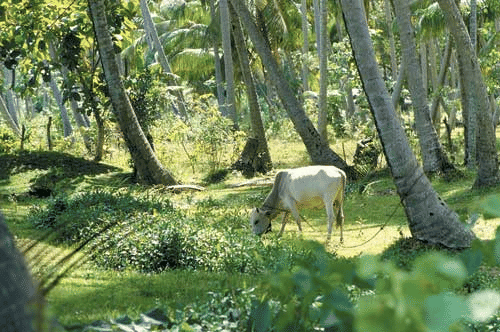
Crop-Livestock Integration
|
|
|
|---|---|
| Wetland farming | Diversified Farming |
| Dry land farming | Rain fed farming |
| Farming Systems | Specialized Farming |
Mixed Farming - Distribution
- Mixed Farming can be found all over Europe, from Ireland in the west to Russia through Central Europe.
- It can also be found in Argentina's "pampas", Southeast Australia, South Africa, New Zealand, and North America.
- In general, mixed farming is related to densely populated, urbanized, and industrialized civilizations.
- It is reliant on high incomes for the selling of its goods and on the manufacturing industry for the supply of its inputs.
Mixed Farming - Characteristics
- Animals are raised and crops are grown on the same site. The size of farms is average.
- A plot of land is generally reserved for the livestock field and the farmer may choose to keep his animals in unusually designed facilities, to raise animals or produce animal feed.
- Grain is produced from the extra crops. After harvesting, the farmer uses the surplus production, conserving some money to buy animal feed and give the animals high-quality yearly products like meat and milk.
- Animal manure is used as fertilizer to get the soil ready for planting.
- A farmer can increase his or her production and income by keeping animals since they give manure that can be applied to the soil to increase soil fertility.
Mixed Farming - Types
- Subsistence Farming: In small holdings, farming takes place when farmers harvest food to take care of their families needs. With nearly no excess, this farming strives to achieve farm yield for resilience and typically local prerequisites.
- Shifting Agriculture: It is a farming system in which land portions are quickly created. But at that time, they dispersed as the cultivator moved on to another plot and the neglected vegetation was allowed to unrestrictedly thrive after the unsettling influence.
- Plantation Agriculture: In plantation agriculture, a single yield is produced throughout the year. This type of farming demands a significant amount of labor and resources. The yield creation may also be managed on the farm where it is created, in nearby production lines, or in small-scale businesses.
- Intensive Farming: Intensive farming, sometimes known as intensive cultivation, traditional farming, or modern farming, is a type of agribusiness that produces plants and animals with higher yields per unit of agricultural area.
- Dry Agriculture: For the development of harvests without the use of water, dry agriculture and dryland farming explicitly combine rural methods. The practice of dryland farming is related to these areas, which are characterized by a chilly, wet season followed by a warm, dry season. Additionally, they are linked to locations that are chronically dry, prone to dry periods, and lacking in water resources.
- Mixed and Multiple Agriculture: In horticulture, mixed agriculture or multi cropping is the practise of growing at least two yields in a similar real estate during one growing season rather than just one harvest. Intercropping occurs when multiple yields develop at the same time.
- Crop Rotation: Crop rotation is the act of establishing multiple harvests on a similar plot of land in order to improve soil wellbeing, streamline supplements in the soil, and reduce weed pressure. A short rotation may include a few harvests, whereas a complex rotation may include at least twelve.
- Terrace Cultivation: Terrace Cultivation is made up of various "steps" that are created in various locations all over the world. This farming technique involves incorporating "steps" into the side of a mountain or slope. Planting yields vary by level. When it rains, rather than washing away all the supplements in the soil, the supplements are conveyed down to a lower level.
Mixed Farming - Advantages
- The farmers may rely on the animals when the yield is low or the costs change.
- Farmers consistently receive income. If animal husbandry is planned out throughout time, the farmer's income remains constant.
- When compared to crop cultivation alone or animal raising alone, the combined compensation from selling crop collection and animal products is more.
- It keeps the farmer constantly occupied. Following the gathering, the farmer concentrates on breeding animals that ensure reliable income.
- Utilizing surplus harvest as grain saves money for its purchase.
- Utilizing animal compost ensures supported crop production, saves money and enhances soil health.
Mixed Farming - Disadvantages
- Possible Limitation on Capacity of Productivity: The practice of mixed farming may become less suited when there is insufficient land owing to a shortage of space since, despite the fact that the yield would be abundant, the production capacity would be significantly reduced.
- Crops and Animals on the Same Land: Crops and animals sharing the same land might cause problems for each other in a mixed farming system. Crops can be stampeded by animals and used as food.
- Since animals can always leave their confined zone when they find their way, this is still possible even when they are restrained.
- No Shifting Cultivation: Shifting cultivation is less likely to occur in a mixed farming system, especially in areas with smaller amounts of land.
- When tilling and cultivation of a specific piece of land are delayed for a few years, shifting cultivation is encouraged since it helps the soil restore its full nutritional capacity.
- Additionally, if shifting cultivation is not used, soil nutrients become depleted.
- No Use of Machines: Machines can't be used because the crops are different from one another. This is due to the differences in their periods of production and yielding caused by these inequalities.
- Additionally, the employment of machinery in a mixed farming system would have some impact on the animals due to the machinery's release of gases. Additionally, machinery may affect some delicate crops.
Conclusion
Due to its proximity to urban markets, excellent transportation infrastructure, and ability to receive rain, mixed farming produces relatively high agricultural returns. In numerous undulating tracts and low flat lands, the cool, moist summers and somewhat moderate, moist winters encourage the growth of hay crops and grasses. Large flocks of sheep and herds of cattle are grazed on the grasslands, which are always fresh.
FAQs
Question: What is mixed farming?
Answer: Mixed farming involves growing crops and rearing animals on the same land simultaneously, optimizing resources for sustainability and profitability.
Question: Why is mixed farming beneficial?
Answer: It helps optimize resources like manure, ensures soil fertility, diversifies income, and reduces risks associated with crop failures.
Question: Where is mixed farming practiced?
Answer: It is commonly practiced in Europe, India, South America, and parts of Africa, among other regions.
Question: What role do livestock play in mixed farming?
Answer: Livestock provide manure for crops, and their products like milk and meat supplement a farmer’s income.
Question: Can mixed farming improve soil fertility?
Answer: Yes, using livestock manure as fertilizer improves soil health and sustainability.
MCQs
1. What does mixed farming primarily combine?A. Fruits and Vegetables
B. Crops and Livestock
C. Forestry and Agriculture
D. None of the above
Answer: (B) See the Explanation
Mixed farming involves both crop production and livestock rearing on the same farm.
A. Dependency on synthetic fertilizers
B. Reduced risk of complete crop failure
C. Single income stream
D. Focus solely on crop production
Answer: (B) See the Explanation
Mixed farming diversifies income streams, reducing the risk of complete loss due to crop failure.
A. Urban areas
B. Europe and parts of Africa
C. Deserts
D. Polar regions
Answer: (B) See the Explanation
Mixed farming is widely practiced in Europe, South America, and parts of Africa.
A. Chemical fertilizers
B. Manure from livestock
C. Synthetic pesticides
D. None of the above
Answer: (B) See the Explanation
Livestock manure is a key resource used in mixed farming to improve soil fertility.
A. Urbanization
B. Sustainable income generation
C. Complete reliance on market inputs
D. Intensive chemical use
Answer: (B) See the Explanation
The goal of mixed farming is to ensure sustainable, diversified income while reducing external input reliance.
GS Mains Questions and Model Answers
Q1: Discuss the advantages of mixed farming in terms of sustainability and resource optimization.
Answer: Mixed farming promotes sustainability by integrating crop and livestock activities. The efficient use of manure as fertilizer, crop residues for animal feed, and diversification of income streams reduces dependency on external inputs. This system ensures higher resource optimization and provides better risk management, fostering long-term agricultural sustainability.
Q2: Examine the role of mixed farming in enhancing soil fertility and reducing environmental degradation.
Answer: Mixed farming enhances soil fertility through the use of organic manure from livestock. By integrating multiple farming activities, it reduces the need for chemical fertilizers, thereby lessening soil degradation and water pollution. This system maintains the ecological balance, ensuring a more sustainable agricultural model.
Q3: Evaluate the challenges and opportunities of mixed farming in India.
Answer: Mixed farming in India faces challenges like limited access to resources and market fluctuations. However, it offers opportunities to optimize land use, increase income stability, and promote sustainable practices. The integration of livestock with crop production can lead to better nutrient cycling and improved soil health.
Previous Year Questions on Mixed Farming
1. UPSC CSE Prelims 2018
Question: What is mixed farming?
A. Growing only cash crops
B. Growing crops and keeping livestock
C. Growing horticultural crops only
D. Industrial farming practices
Answer: B
Explanation: Mixed farming involves the simultaneous cultivation of crops and rearing of animals on the same farm.
2. UPSC CSE Mains 2020 (GS Paper 3)
Question: "Discuss the relevance of mixed farming in ensuring food security and agricultural sustainability."
Answer: Mixed farming ensures food security by diversifying food sources (crops and livestock) while promoting sustainability through efficient resource utilization. Livestock provides manure, reducing the need for synthetic fertilizers, while crop residues can be used for feed, ensuring minimal waste. The practice offers long-term benefits by reducing dependency on external inputs, enhancing soil fertility, and ensuring stable income for farmers.
Download the PREPP App and attempt FREE IAS Exam Mock Tests and get complete study material!
Live Test : UPSC IAS : GS - Indian Geography - Subject Knowledge Test

Live Test : UPSC CSE Prelims CSAT (Paper-II) (Oct 08 - 11)
Full Test - 04: UPSC CSE Prelims CSAT (Paper-II)
Full Test - 03: UPSC CSE Prelims CSAT (Paper-II)
UPSC CSE Prelims 2026 GS Paper 1 Question Paper (24-May-2026)
UPSC CSE Prelims 2026 CSAT Paper 2 Question Paper (24-May-2026)

17 February 2025 | The Hindu Must Read Articles | Current Affairs

16 February 2026 | The Hindu Must Read Articles | Current Affairs

13 February 2026 | The Hindu Must Read Articles | Current Affairs









Comments