Diversified Farming - Agriculture Notes
Diversified Farming is a collection of techniques and equipment designed to provide food in a sustainable manner by utilizing ecological diversity at the plot, field, and landscape dimensions. In diversified farming, there are various production activities or income streams, but none of them generates more than 50% of the overall income. It is also known as general farming. This article will explain to you about Diversified Farming which will be helpful in preparing the Agriculture Syllabus for the UPSC Civil Service exam.
|
Table of Contents |
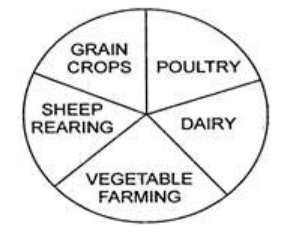
Diversified Farming
What is Diversified Farming?
- A diversified farm is one that has several production enterprises or sources of income, but no source of income equals more than 50% of total income from that source. Farmers on such farms rely on multiple sources of income.
- Eg: Crop production + dairy + poultry + fishing + Fruit production + Sheep farming
- This farming method makes better use of land, labour, and capital while lowering business risk from a single crop failure.
- Aside from that, various enterprises provide consistent returns.
- Diversified Farming Systems around the world rely on various cultures, customs, and governmental frameworks to sustain their locally tailored management systems.
- Diversified Farming enables vital ecosystem services, including pest control and pollination, to be generated and regenerated within the agroecosystem, assisted by human knowledge to sustain those processes.
- This is done by sustaining a complex fabric of natural and human ecologies.
|
|
|
|---|---|
| Wetland farming | Farming Systems |
| Dry land farming | Rain fed farming |
| Mixed Farming | Specialized Farming |
Diversified Farming - Key Features
- Diversified farming emphasizes local production, agroecological practices, and indigenous knowledge, as well as whole systems, and approaches to agriculture that supports ecological variety and ecosystem services from the field to the landscape scale.
- For instance, polycultures (several crops and/or varieties) and the incorporation of fish or cattle into crop fields allow for the more effective utilization of nutrients.
- In both rural and urban settings, agroecological methods and diverse farming systems can promote smallholder livelihoods and lower poverty and hunger rates.
- The ultimate objective of diversified farming is to contribute to the development of a resilient, socially just, and secure global food system.
Diversified Farming - Advantages
- Better Utilization of Resources: Better utilization of land, labor, and capital is achieved in diversified farming through the use of crop rotations, steady employment of farm and family labor, and more profitable equipment use.
- Diversity of Tasks: The farmer and his workers are engaged in a variety of year-round tasks.
- Less Risk to Crop Failure: In diversified farming, there is a lower likelihood of crop failure and product market price due to varied specialization.
- Effective Utilization: As cattle, poultry, birds, and other livestock are raised alongside crop production, the farm's byproducts can be used effectively.
- Consistent Returns: Various activities in diversified farming provide regular and speedier returns.
- Reduced Risk for Soil Erosion: By keeping land under cultivation throughout the year, soil erosion can be stopped.
- Increased Soil Fertility: Since land is continuously cultivated, soil fertility may be evaluated.
- Less Risky: Diversified farming techniques are less riskier than specialized farming and also allow for optimum utilization of all resources.
Diversified Farming - Disadvantages
- No Desired Profit: As long as there is no cooperative marketing facility, they do not generate desired profit.
- Uncertainty: It is challenging to properly inspect various businesses.
- Less Maintenance: Farmers are unable to keep up with the maintenance of every type of equipment needed for various crops.
- Identification of Farm Waste: In diversified farming, it is challenging to identify farm waste at any farm.
Conclusion
Diversified Farming offers the chance to increase farmer income and ensure national food security, despite some problems. Agricultural emissions can also be reduced by more effective livestock management, technology-enabled fertilizer application monitoring, straightforward field layout adjustments, and other agricultural practices.
FAQs
Question: What is diversified farming, and how does it benefit farmers?
Answer: Diversified farming refers to the practice of growing multiple types of crops and raising various types of livestock on the same farm. Unlike monoculture, which involves the cultivation of a single crop, diversified farming aims to spread risks by incorporating a variety of agricultural products. The benefits of diversified farming include reduced risk of crop failure, improved soil fertility through crop rotation, increased income stability due to multiple income streams, and better pest control as biodiversity on the farm can naturally regulate pest populations. This approach is also environmentally friendly, as it reduces the overuse of chemicals and encourages more sustainable farming practices.
Question: What are the different forms of diversified farming?
Answer: Diversified farming can take many forms, depending on the region and the type of farming practices in place. Some common forms include: 1. Crop-Livestock Diversification: Combining crop production with livestock rearing, where the farm produces both food crops and animals. 2. Agroforestry: Integrating trees and shrubs with crops and livestock, which enhances biodiversity and provides additional income through timber or fruit production. 3. Intercropping: Growing two or more crops together on the same land at the same time, improving land use efficiency and reducing pest infestations. 4. Polyculture: Planting a variety of crops in the same field, which helps prevent soil depletion and supports the growth of complementary crops.
Question: How does diversified farming improve soil health?
Answer: Diversified farming improves soil health by reducing soil degradation through practices like crop rotation, intercropping, and agroforestry. By planting different types of crops in succession, farmers can prevent soil exhaustion that occurs when the same crop is grown repeatedly in monoculture. Some crops, like legumes, even have the ability to fix nitrogen in the soil, which naturally enriches the soil’s nutrient content. Additionally, the presence of trees and other plants in agroforestry systems can help in preventing soil erosion, improving water retention, and enhancing overall soil structure, leading to more sustainable farming practices over time.
Question: What are the economic benefits of diversified farming?
Answer: The economic benefits of diversified farming include: 1. Income Diversification: Farmers benefit from having multiple income streams, such as crops, livestock, and possibly timber or fruit, which stabilizes their earnings and reduces the impact of market fluctuations or crop failure. 2. Higher Profit Margins: By producing a variety of products, farmers can capitalize on higher value crops or organic farming, potentially increasing their overall profitability. 3. Lower Input Costs: Diversification can reduce the need for synthetic fertilizers and pesticides, as different crops may have complementary needs, reducing farming costs. 4. Improved Resilience: Diversified farms are more resilient to climatic and economic shocks because the risk is spread across different products.
Question: How does diversified farming contribute to environmental sustainability?
Answer: Diversified farming contributes to environmental sustainability in several ways: 1. Reduced Pesticide Use: By planting a variety of crops, farmers can naturally control pest populations through biodiversity, reducing the need for chemical pesticides. 2. Enhanced Soil Fertility: Practices like crop rotation and agroforestry enhance soil health and reduce soil erosion. 3. Water Conservation: Diversified farming systems can improve water retention and reduce water wastage through practices like agroforestry and intercropping. 4. Improved Biodiversity: A diverse range of crops and animals supports a more resilient ecosystem, increasing the farm's ability to adapt to climate change and other challenges.
MCQs
1. What is the main advantage of diversified farming over monoculture farming?
A) Increased reliance on chemical pesticides
B) Reduced economic stability
C) Reduced risk of crop failure
D) Higher water usage
Answer: (C) See the Explanation
Explanation: Diversified farming reduces the risk of crop failure because it involves growing multiple crops and raising different types of livestock, thus spreading the risks.
2. Which of the following is a type of diversified farming?
A) Monoculture
B) Polyculture
C) Single crop production
D) Irrigation farming
Answer: (B) See the Explanation
Explanation: Polyculture is a form of diversified farming where multiple crops are grown together, enhancing land use and biodiversity.
3. What is the main environmental benefit of agroforestry as a form of diversified farming?
A) Increases water pollution
B) Reduces soil erosion
C) Promotes monoculture
D) Increases carbon emissions
Answer: (B) See the Explanation
Explanation: Agroforestry helps to reduce soil erosion by planting trees alongside crops, which act as windbreaks and protect the soil from degradation.
4. How does intercropping contribute to soil health in diversified farming?
A) It depletes soil nutrients
B) It reduces plant competition
C) It improves soil nutrient content
D) It decreases plant biodiversity
Answer: (C) See the Explanation
Explanation: Intercropping improves soil nutrient content by allowing complementary crops to grow together, enhancing nutrient cycling and reducing soil depletion.
5. Which of the following is a disadvantage of diversified farming?
A) Increased risk of crop failure
B) Greater environmental sustainability
C) Requires more knowledge and management
D) Higher water retention
Answer: (C) See the Explanation
Explanation: Diversified farming requires more knowledge and management to handle different crops and livestock, which can be more complex than monoculture farming.
GS Mains Questions and Model Answers
Q1: Analyze the economic and environmental impacts of diversified farming systems in India.
Answer: Diversified farming systems in India offer both economic and environmental benefits. Economically, they provide farmers with multiple income streams, reducing the risk of financial instability caused by fluctuating crop prices or poor harvests. This is particularly important in India, where agriculture is highly dependent on seasonal factors like rainfall. Environmentally, diversified farming promotes soil health through crop rotation, improves water retention, and enhances biodiversity by incorporating a variety of plants and animals. This method also helps in controlling pests naturally, reducing the need for chemical pesticides. However, challenges such as the need for higher knowledge and management skills, increased labor costs, and the difficulty in accessing market infrastructure for diversified products remain. To overcome these, targeted support and training for farmers, as well as better market access, can significantly enhance the effectiveness of diversified farming systems.
Q2: Discuss the role of diversified farming in addressing the challenges of climate change in Indian agriculture.
Answer: Diversified farming plays a crucial role in adapting to the challenges of climate change, especially in India, where agriculture is vulnerable to erratic weather patterns, droughts, and floods. By growing a variety of crops, farmers can mitigate the risks of crop failure due to unpredictable rainfall or extreme temperatures. Additionally, the use of agroforestry and intercropping practices helps to protect soil from erosion and improves its water retention capacity, which is vital during periods of drought. Diversified farming also reduces dependency on chemical fertilizers and pesticides, promoting sustainability. By enhancing biodiversity and ecosystem resilience, diversified farming contributes to the long-term stability of agricultural production in the face of climate change.
Q3: Evaluate the potential of diversified farming systems in enhancing food security in India.
Answer: Diversified farming systems hold significant potential for enhancing food security in India. By growing a variety of crops, farmers are not reliant on a single crop, which ensures that food production remains stable even in the face of challenges like pests, diseases, or unfavorable weather. This approach not only increases food availability but also improves dietary diversity, which is essential for better nutrition. Diversified farming can also contribute to local food systems by increasing the production of seasonal fruits, vegetables, and grains that are often neglected in monocultural farming systems. Furthermore, integrating livestock with crop farming can provide additional sources of protein and income. However, the widespread adoption of diversified farming requires government support in terms of education, access to resources, and market access to ensure its success across different regions.
Previous Year Questions on Diversified Farming
1. UPSC CSE Prelims 2018:
Question: What is the primary advantage of polyculture in diversified farming?
A) It increases the risk of pest outbreaks
B) It promotes the use of chemical fertilizers
C) It enhances biodiversity and reduces soil depletion
D) It reduces crop yield
Answer: (C)
Explanation: Polyculture enhances biodiversity by growing different crops together, reducing soil depletion, and promoting natural pest control.
2. UPSC CSE Mains 2020 (GS Paper 3):
Question: "How does diversified farming contribute to the sustainability of Indian agriculture?"
Answer: Diversified farming contributes to the sustainability of Indian agriculture by improving soil health, reducing dependence on chemical inputs, and enhancing the resilience of farming systems to climatic shocks. By incorporating a variety of crops and livestock, farmers can reduce the financial risk associated with crop failures and market price fluctuations. The approach also promotes water conservation, improves biodiversity, and helps prevent the overuse of natural resources. Furthermore, diversified farming supports the creation of local food systems and encourages agricultural practices that are in harmony with the environment, leading to long-term agricultural sustainability.
Download the PREPP App and attempt FREE IAS Exam Mock Tests and get complete study material!

Full Test - 04: UPSC CSE Prelims CSAT (Paper-II)
Full Test - 03: UPSC CSE Prelims CSAT (Paper-II)
UPSC CSE Prelims 2026 GS Paper 1 Question Paper (24-May-2026)
UPSC CSE Prelims 2026 CSAT Paper 2 Question Paper (24-May-2026)

17 February 2025 | The Hindu Must Read Articles | Current Affairs

16 February 2026 | The Hindu Must Read Articles | Current Affairs

13 February 2026 | The Hindu Must Read Articles | Current Affairs









Comments