Dry Land Farming - Agriculture Notes
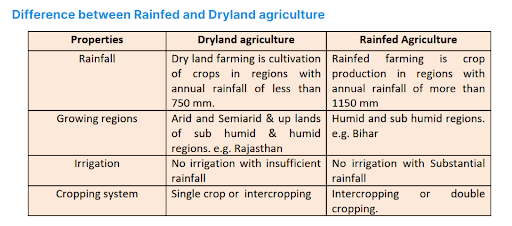
Dryland Farming is a method of growing crops that solely rely on rainfall and soil moisture retention. It is used in regions with annual rainfall levels of less than 750mm. The crops may experience frequent moisture stress as a result of the monsoon's unpredictable distribution or failure. Because of this, farming in these locations requires a better cultivation technique that conserves the most amount of land and water possible. This article will explain to you about Dry Land Farming which will be helpful in preparing the Agriculture Syllabus for the UPSC Civil Service exam.
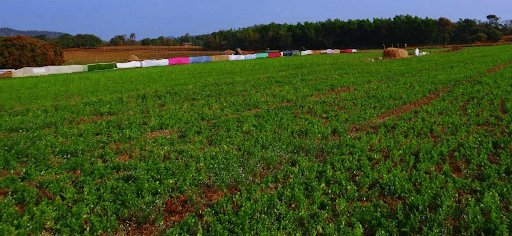
Dry Land Farming of Horse Gram Crop
What is Dry Land Farming?
- Dryland farming is a term used to describe a region or a particular type of farming that is carried out in sub-humid to arid conditions with inefficient hydrology, a lack of irrigation facilities, total reliance on monsoon rainfall, and typical cropping patterns of coarse grains, millets, and oilseeds, pulses, cotton, etc.
- Dryland farming relies on choosing crops and growth techniques that make the most of the land's limited moisture as well as on effective soil moisture storage.
- The usual practices involve tilling the ground soon after harvest and maintaining it free of weeds, but in some latitudes, stubble is left in the fields after harvest to catch snow.
- Weed removal and runoff mitigation make up the majority of moisture control measures used during crop growth.
- The ideal soil surface is devoid of weeds but contains enough clouds or decayed plant material to slow runoff and stop erosion.
|
|
|
|---|---|
| Wetland farming | Diversified Farming |
| Farming Systems | Rain fed farming |
| Mixed Farming | Specialized Farming |
Features of Dry Land Farming
- Annual rainfall in these areas is unpredictable, unevenly distributed, and scarce.
- In these areas, widespread climatic hazards such as drought and flooding occur.
- The soil surface in these areas is undulating and farmers have extensive and large land holdings in these areas.
- Farmers practise extensive agriculture alongwith the prevalence of mono cropping.
- Farmers in these areas cultivate crops that are similar.
- Crop yields in these areas are extremely low.
Dry Land Farming - Suitable Crops
- Grapes, tomatoes, pumpkins, beans, and other summer crops are examples of dry-farmed crops.
- Wheat, corn, millet, rye, and other grain-producing grasses are examples of dryland grain crops.
- Instead of relying on rainfall throughout the growing season, these crops thrive using the winter water stored in the soil.
- Winter wheat, maize, beans, sunflowers, and even watermelon are examples of crops grown in dryland regions.
- The timing of the predominant rainfall in relation to the seasons affects crop choice.
- For instance, places with heavier winter rainfall are better suitable for winter wheat, whereas areas with rainy summers may be better suited for summer-growing crops like sorghum, sunflowers, or cotton.
Dry Land Farming - Advantages
- Simple Approach: Dry Land Farming is a simple strategy for food production.
- Less Dependency: Less dependence is placed on regional water supplies and contemporary irrigation technologies.
- Fewer Weeds: Due to the absence of moisture, weeds are also less of a problem, and annoying insects and fungi also tend to stay away from dry plantings, which is another advantage.
- Undiluted & Strong Flavor: Despite the fact that the crop will likely look half-dead and your soil will appear dry as a sand dune when harvest time rolls around, some claim that the flavor in produce is sweeter, denser, and more robust since it is less diluted.
- Less moisture in the soil translates to less water in the crop, which results in a more strong flavor.
Dry Land Farming - Disadvantages
- Low yields and the possibility of crop failure are two significant drawbacks.
- While these results are possible when cultivating crops with a conventional irrigation system, the dry approach may present additional difficulties and failures, particularly if faulty planning or insufficient rainfall are present throughout the growing season.
- The potential for erosion brought on by wind and slopes is another aspect.
- Installing windbreaks and covering sensitive soil mulches to prevent weeds may sometimes prove to be expensive.
Dry Land Farming in India
- Major dryland farming crops include millets like jowar, bajra, and ragi; oilseeds like mustard and rapeseed; and pulse crops including pigeon pea, grams, and lentils.
- Nearly 80% of the maize, 90% of the bajra, almost 95% of the pulses, and 75% of the oilseeds grown in India come from dryland farming.
Need for Dryland Farming in India
- India's land area is divided into three distinct climate zones: arid, subhumid, and humid. As a result, dryland farming has more land than wet agriculture.
- It employs 40% of the workforce and takes up 66% of the land. By raising these regions' productivity, the ratio needs to be corrected.
- Dryland farming needs to be prioritized for the balanced growth of the nation.
- Industrial crops like cotton, groundnuts, oilseeds, pulses, and tobacco are the foundation of dryland farming systems.
- A higher focus on dryland farming is crucial for the growth of the agro-processing industries and to make Indian agriculture more export-oriented.
- Hardy and nutritious crops including Jowar, bajra, ragi, pulses, oilseeds, cotton seeds, sunflower, and safflower are typically produced by dryland agriculture.
- In order to combat the issues with nutrition and malnutrition in underdeveloped areas, dryland agriculture is a viable option.
- Dryland farming involves cash crops. For instance, growing Jatropha helps lessen the severity of the oil crisis because the liquid it produces can be added to petroleum goods without affecting their efficiency.
- Dryland farming has the capacity to provide cattle feed and fodder. It can therefore aid in the white revolution.
Dryland Farming Technology
To increase agricultural production in dryland areas, the following farming technology is required.
- Timely preparation and seeding operations, including soil moisture conservation.
- Improved crop varieties that can withstand stress should be used. Deep tillage, surface cultivation, and stubble mulching are all necessary practises for soil moisture conservation.
- Combination of rainfall, surface, and ground water.
- Water harvesting for use during dry periods. A watershed is a natural hydrological unit that can be used to harvest water. Proper watershed management can prevent further ecosystem degradation while also restoring degraded lands.
- Soil conservation through contour bunding, terracing, land sloping, and land levelling, as well as conservation tillage (zero tillage and minimum tillage).
- To save water, use drip irrigation.
- Canal lining to reduce water loss.
- Agronomic practises such as mixed cropping and crop rotation, which increase crop yield, must be implemented.
- To maintain soil fertility, integrated nutrient management must be practised, with a special emphasis on the use of bio-fertilizers.
- To control weeds and pests, respectively, integrated weed management and integrated pest management must be used.
- For a successful dryland farming system, alley cropping, pasture management, tree farming, silvi-pastoral management systems, and agro-horticultural systems that are more relevant to dryland situations must be used.
Dry Land Farming in India - Measures to be Taken
- It is necessary to develop drought-resistant crops.
- Soil erosion is a problem that these areas frequently experience. In order to manage such places, it is, therefore, possible to stabilize the soils through forestry and pasture with controlled grazing.
- Since dryland farming provides the majority of India's protein needs, it is necessary to adapt technologies from nations like Israel, which has extensive knowledge and experience in this field.
- Agronomic methods include proper tillage, the timing of sowing, fertilizer management, crop systems selection that are appropriate for the region, such as double cropping and alley cropping, usage of a better crop pattern for certain regions, and effective weed control and plant protection measures.
Dry Land Farming - Government Initiatives
- The National Mission for Sustainable Agriculture (NMSA): One of the eight missions included in the National Action Plan on Climate Change (NAPCC), the NMSA aims to solve problems related to climate change.
- Sub-Mission on Agroforestry: The National Mission for Sustainable Agriculture (NMSA) launched a sub-mission on agroforestry during 2016–17 for a four-year period (2016-17 to 2019-20).
- National Agroforestry Policy 2014: The National Agroforestry Policy was developed to create coordination, convergence, and synergy amongst the numerous aspects of agroforestry that are dispersed throughout the government's existing missions, programs, and schemes.
- Pradhan Mantri Krishi Sinchayee Yojana (PMKSY): With the slogan "Har Khet Ko Paani," the Pradhan Mantri Krishi Sinchayee Yojana (PMKSY) was introduced on July 1st, 2015 with the goal of offering complete solutions for the irrigation supply chain, including water sources, a distribution network, and farm level applications.
- Agriculture Contingency Plan: In partnership with state agricultural institutions, CRIDA, ICAR has created district-level agriculture contingency plans to address abnormal monsoon conditions that cause drought and floods, and extreme events that negatively impact crops, livestock, and fisheries.
- Year of Millets: In order to promote dryland crops like millets, the Indian government has designated 2018 as the Year of Millets.
Conclusion
With climate change likely to exacerbate the situation, the scope of dry land agriculture is being threatened by water scarcity. Furthermore, in order to meet the food security needs of over a billion Indians while also limiting the extent of land degradation, Dry Land Agriculture Management has become critical. To meet the nation's developmental needs, the area under cultivation is shrinking day by day. As a result, the future will be determined by how effectively Dry Land Agriculture is managed.
FAQs
Question: What is dry land farming?
Answer: Dry land farming refers to agricultural practices carried out in regions with low rainfall (less than 750 mm annually), where irrigation is not possible. It primarily relies on moisture conservation techniques and the cultivation of drought-resistant crops.
Question: What are the key features of dry land farming?
Answer: Key features of dry land farming include reliance on rainwater, drought-resistant crops, moisture conservation practices, low input farming methods, and the use of early maturing crop varieties to minimize water requirements.
Question: Which regions in India practice dry land farming?
Answer: Dry land farming is commonly practiced in arid and semi-arid regions of India, including parts of Rajasthan, Maharashtra, Madhya Pradesh, Gujarat, Andhra Pradesh, and Karnataka.
Question: What are the major challenges of dry land farming?
Answer: Major challenges of dry land farming include inadequate and erratic rainfall, poor soil fertility, lack of irrigation facilities, soil erosion, and low crop yields.
Question: What measures can improve dry land farming productivity?
Answer: Measures to improve dry land farming include soil conservation techniques, rainwater harvesting, use of drought-resistant crop varieties, improved water management practices, and adoption of modern agricultural technologies.
MCQs
- Which of the following crops is commonly grown in dry land farming regions?
a) Rice
b) Sugarcane
c) Millets
d) Tea
Answer: (C) See the Explanation
Millets such as jowar, bajra, and ragi are commonly grown in dry land farming regions due to their ability to withstand drought conditions.
- In dry land farming, what is the primary source of water for crop cultivation?
a) Groundwater
b) Rainwater
c) Irrigation canals
d) Rivers
Answer: (B) See the Explanation
Dry land farming relies primarily on rainwater for crop cultivation, as irrigation facilities are often unavailable in these regions.
- Which of the following techniques is used to conserve soil moisture in dry land farming?
a) Mulching
b) Flood irrigation
c) Hydroponics
d) Chemical fertilizers
Answer: (A) See the Explanation
Mulching involves covering the soil with organic or inorganic materials to conserve moisture and reduce water evaporation, making it an essential practice in dry land farming.
- Which Indian state practices dry land farming on a large scale?
a) Kerala
b) Maharashtra
c) Punjab
d) West Bengal
Answer: (B) See the Explanation
Maharashtra is one of the states in India where dry land farming is practiced on a large scale, particularly in its drought-prone regions.
- What is a key advantage of using drought-resistant crops in dry land farming?
a) Higher water requirements
b) Reduced soil fertility
c) Resistance to water scarcity
d) Increased pest attacks
Answer: (C) See the Explanation
Drought-resistant crops are better suited to dry land farming as they can thrive with limited water, reducing the risk of crop failure due to water scarcity.
GS Mains Questions and Model Answers
Q1: "Dry land farming is essential for ensuring food security in arid and semi-arid regions." Discuss the challenges and suggest ways to enhance its productivity.
Answer: Dry land farming is vital for ensuring food security in regions where water resources are limited. It supports a significant portion of India’s agricultural output, particularly in states like Rajasthan, Maharashtra, and Karnataka. However, challenges such as erratic rainfall, poor soil quality, low productivity, and limited access to irrigation hinder its full potential. Enhancing productivity requires a combination of government support, improved farming techniques, and water management strategies. Promoting drought-resistant crop varieties, expanding irrigation coverage, increasing access to credit and technology, and strengthening soil health management can help dry land farmers increase yields and contribute to national food security.
Q2: Analyze the role of government policies in promoting sustainable dry land farming practices in India.
Answer: Government policies play a crucial role in promoting sustainable dry land farming practices in India. Programs like the Pradhan Mantri Krishi Sinchayee Yojana (PMKSY) focus on improving water use efficiency and expanding irrigation infrastructure, while the National Mission for Sustainable Agriculture (NMSA) promotes climate-resilient farming practices. These policies aim to address the specific challenges of dry land farming, such as water scarcity and soil degradation. By encouraging the use of modern farming techniques, providing financial assistance, and investing in infrastructure, government policies help enhance the sustainability and productivity of dry land farming in India, ensuring that farmers can cope with changing environmental conditions.
Q3: Discuss the environmental and economic benefits of promoting dry land farming in India.
Answer: Dry land farming offers several environmental and economic benefits for India. Environmentally, it encourages the cultivation of drought-resistant crops, which require less water and are more suited to arid and semi-arid regions, reducing pressure on water resources. Soil conservation techniques like contour plowing and mulching prevent soil erosion and improve soil health. Economically, dry land farming supports millions of small and marginal farmers, contributing to rural livelihoods and food security. By adopting sustainable practices, dry land farming can increase productivity, reduce dependency on monsoon rains, and enhance resilience against climate change, ultimately benefiting the agricultural economy.
Previous Year Questions on Dry Land Farming
1. UPSC CSE 2019
Q1: Discuss the challenges of dry land farming in India and suggest measures to overcome them.
Answer: Dry land farming in India faces several challenges, including erratic rainfall, poor soil fertility, and lack of irrigation facilities. Other issues include soil erosion, low productivity, and limited access to modern farming technologies. To overcome these challenges, measures such as the adoption of drought-resistant crop varieties, implementation of rainwater harvesting techniques, and soil conservation methods like mulching and contour farming should be promoted. Additionally, providing better access to credit, improving market linkages, and supporting farmers with modern agricultural practices can enhance productivity in dry land regions.
2. UPSC CSE 2020
Q2: Examine the importance of dry land farming in the context of India’s agricultural economy.
Answer: Dry land farming is crucial for India’s agricultural economy as it supports the livelihoods of millions of farmers, particularly in arid and semi-arid regions. It contributes to the production of important food grains like millets and pulses, which are staples in many rural areas. Despite its significance, dry land farming faces challenges due to water scarcity and poor soil conditions. Promoting sustainable farming practices, improving access to drought-tolerant seeds, and enhancing soil and water conservation techniques are essential to improving productivity and ensuring food security in these regions.
Download the PREPP App and attempt FREE IAS Exam Mock Tests and get complete study material!

Full Test - 04: UPSC CSE Prelims CSAT (Paper-II)
Full Test - 03: UPSC CSE Prelims CSAT (Paper-II)
UPSC CSE Prelims 2026 GS Paper 1 Question Paper (24-May-2026)
UPSC CSE Prelims 2026 CSAT Paper 2 Question Paper (24-May-2026)

17 February 2025 | The Hindu Must Read Articles | Current Affairs

16 February 2026 | The Hindu Must Read Articles | Current Affairs

13 February 2026 | The Hindu Must Read Articles | Current Affairs









Comments