GSLV D5 / GSAT 14 – Science & Technology Notes
The Indian Space Research Organisation (ISRO) achieved another milestone when the Geo-synchronous Satellite Launch Vehicle (GSLV-D5) was successfully launched from the Satish Dhawan Space Centre in Sriharikota, Andhra Pradesh. The GSLV launch was a huge accomplishment because it used an indigenously developed cryogenic engine. In this article, we will discuss in detail regarding GSLV D5 / GSAT 14 which will be helpful for UPSC exam preparation.
Table of Contents
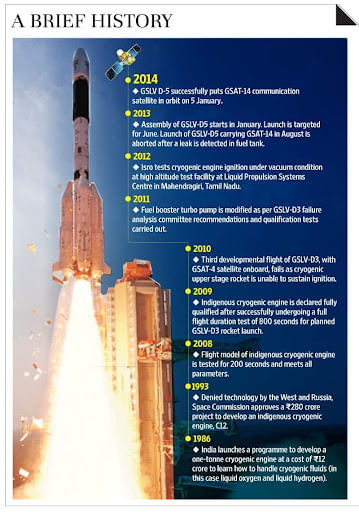
Brief History of GSLV-D5
What is GSLV D5?
- The eighth flight of India's Geosynchronous Satellite Launch Vehicle (GSLV) is GSLV-D5. It is also GSLV's fourth developmental flight.
- The first and second stages of the GSLV-D5 vehicle are similar to those used in previous GSLV missions.
- The Indigenous Cryogenic Stage is the third stage.
- For GSLV-D5, a metallic payload fairing with a diameter of 3.4 metres is used.
- GSLV-D5 performance monitoring, tracking, range safety / flight safety, and Preliminary Orbit Determination (POD) are all made possible by S-band telemetry and C-band transponders.
- On January 5, 2014, GSLV-D5 was launched from the Second Launch Pad (SLP) at Satish Dhawan Space Centre SHAR in Sriharikota.
- GSAT-14, a communication satellite weighing 1982 kg, will be launched into Geosynchronous Transfer Orbit (GTO) by GSLV-D5.
- GSAT-14 will use its own propulsion system to reach its geostationary orbital home at 74o East longitude after reaching GTO.
- GSAT-14 will assist the country in providing many satellite-based communication services, such as tele-education and telemedicine.
- GSLV-D5 performance monitoring, tracking, range safety / flight safety, and Preliminary Orbit Determination (POD) are all made possible by S-band telemetry and C-band transponders.
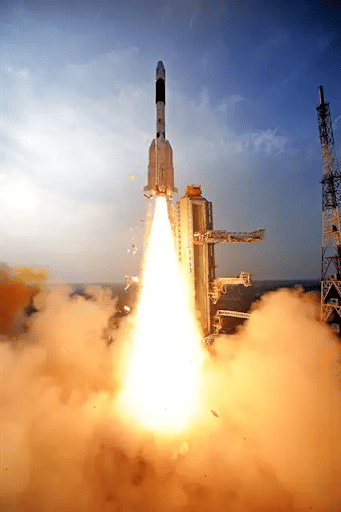
GSLV-D5

GSLV-D5 Flight Profile
Indigenous Cryogenic Engine and Stage
- When compared to solid and earth-storable liquid propellant rocket stages, a cryogenic rocket stage is more efficient and provides more thrust per kilogramme of propellant burned.
- Specific impulse (a measure of efficiency) achieved with cryogenic propellants (liquid Hydrogen and liquid Oxygen) is significantly higher than with earth-storable liquid and solid propellants, providing a significant payload advantage.
- However, due to the use of propellants at extremely low temperatures and the associated thermal and structural problems, the cryogenic stage is a technically very complex system when compared to solid or earth-storable liquid propellant stages.
- At -183 degrees Celsius, oxygen liquefies, and at -253 degrees Celsius, hydrogen liquefies. At these low temperatures, the propellants will be pumped using turbo pumps running at around 40,000 rpm.
- It also includes complex ground support systems such as propellant storage and filling systems, cryo engine and stage test facilities, cryo fluid transportation and handling, and safety aspects.
- ISRO's Cryogenic Upper Stage Project (CUSP) envisioned the design and development of an indigenous Cryogenic Upper Stage to replace the Russian-supplied stage used in GSLV flights.
- CUS's main engine and two smaller steering engines produce a nominal thrust of 73.55 kN in vacuum. CUS fires for a nominal duration of 720 seconds during the flight.
- Individual booster pumps deliver liquid oxygen (LOX) and liquid hydrogen (LH2) from the respective tanks to the main turbopump, ensuring a high flow rate of propellants into the combustion chamber.
- Two independent regulators are used to control thrust and mixture ratio.
- During the thrusting phase, the stage is controlled by two gimballed steering engines.
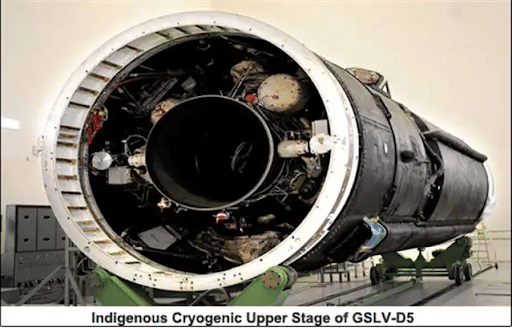
Indigenous Cryogenic Upper Stage of GSLV D5
What is GSAT 14?
- ISRO's GSAT-14 is India's twenty-third geostationary communication satellite.
- The primary goals of the GSAT-14 mission are as follows:
- To increase the in-orbitcapacity of Extended C and Ku-band transponders
- To provide a platform for new experiments
- The cuboid-shaped GSAT-14 has a lift-off mass of 1982 kg and a dry mass of 851 kg.
- ISRO's 2 tonne class platform (I-2K satellite bus) serves as the foundation for the GSAT-14 structure.
- GSAT-14's two solar arrays (each with two panels) generate approximately 2600 W of power, while the light weight Lithium-Ion Batteries provide power during the eclipse period.
- Following are some of the new experiments being flown on GSAT-14:
- Fibre Optic Gyro
- Active Pixel Sun Sensor
- Ka band beacon propagation studies
- Thermal control coating
- After GSLV-D5 injects GSAT-14 into Geosynchronous Transfer Orbit (GTO), ISRO's Master Control Facility (MCF) at Hassan takes control and performs the initial orbit raising manoeuvres in three steps, firing the satellite's Liquid Apogee Motor (LAM) and finally placing it in the circular Geostationary Orbit.
- Following that, the antennae will be deployed, and the satellite will be stabilised on three axes.
- GSAT-14 will be located at 74 degrees east longitude, alongside the INSAT-3C, INSAT-4CR, and KALPANA-1 satellites.
- The 12 communication transponders onboard GSAT-14 will add to the INSAT/GSAT system's capacity.
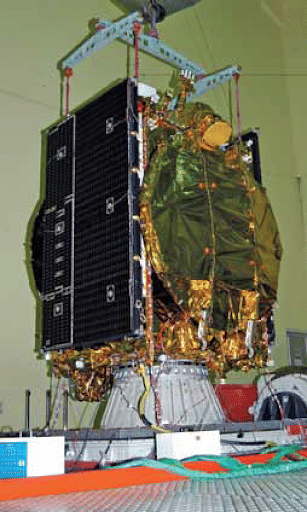
GSAT 14
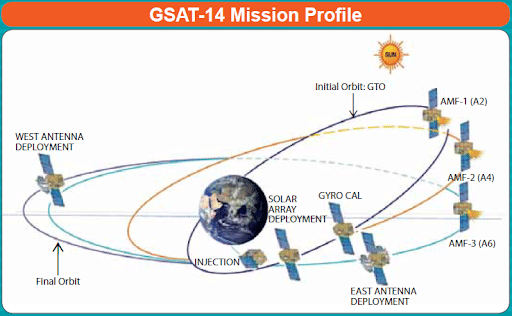
GSAT-14 Mission Profile
Conclusion
Indian researchers conducted the first operational cryogenic engine test in 2003, followed by the successful launch of the "Maiden" in 2014. ISRO is working on a number of future projects, including PS2/GS2 connectivity, semi-cryo superstructure manufacturing, and cryo and semi-cryo engine manufacturing, for which the necessary infrastructure and equipment are nearly complete. In the future, India is likely to become a satellite space power, and the government intends to implement policies that encourage scientific and technological research.
| Other Relevant Links | |
|---|---|
| Science & Technology Policy in India | Scientific Policy Resolution 1958 |
| Science & Technology Policy of 1983 | Science & Technology Policy of 2003 |
| Science, Technology and Innovation Policy 2013 | New Initiatives Aligned with the National Agenda |
| India and World collaboration in science projects | National Intellectual Property Rights Policy |
FAQs
Question: What is the significance of the GSLV-D5 launch for India’s space program?
Answer: The GSLV-D5 launch was a significant milestone for India’s space program as it successfully placed the GSAT-14 communication satellite into geostationary orbit. This marked a major achievement for ISRO, demonstrating the reliability and capability of the GSLV (Geosynchronous Satellite Launch Vehicle) series in carrying heavier payloads into space.
Question: What is GSAT-14 and what are its primary functions?
Answer: GSAT-14 is a communication satellite launched by ISRO to augment the capacity of the Indian National Satellite System (INSAT). It provides services in telecommunications, broadcasting, and meteorological services. The satellite is equipped with transponders that allow the transmission of data and communication across the country, enhancing connectivity and services.
Question: How does the GSLV-D5 contribute to India’s space exploration capabilities?
Answer: The successful launch of the GSLV-D5 has enhanced India’s space exploration capabilities by demonstrating the ability to launch heavier payloads. This boosts India’s capacity to deploy advanced satellites for communications, Earth observation, and scientific exploration, and strengthens ISRO’s position in the global space industry.
Question: What were the challenges faced in the GSLV-D5 mission, and how were they overcome?
Answer: One of the main challenges faced during the GSLV-D5 mission was ensuring the reliability of the indigenous cryogenic upper stage. Previous missions had experienced issues with the cryogenic engine, but the successful operation of the cryogenic engine in GSLV-D5 marked a major achievement in overcoming this hurdle. ISRO engineers implemented improvements in the cryogenic stage, leading to the successful launch of GSAT-14.
Question: How does the GSLV-D5 and GSAT-14 contribute to India's strategic goals?
Answer: The GSLV-D5 launch and the deployment of GSAT-14 contribute significantly to India’s strategic goals in communications, national security, and technological advancement. By enhancing the capacity for telecommunications and broadcasting, GSAT-14 supports government services, national security, and disaster management. The successful launch also boosts India’s credibility as a space power.
MCQs
1. What was the main achievement of the GSLV-D5 mission?
A) Launch of India’s first Mars mission
B) Successful deployment of GSAT-14 satellite
C) First successful launch of GSLV rocket
D) Launch of Chandrayaan-1 satellite
Answer: (B) See the Explanation
The GSLV-D5 mission successfully deployed the GSAT-14 satellite into geostationary orbit, marking a major achievement for ISRO’s space program in enhancing satellite communication capabilities.
2. What is the role of GSAT-14 in India’s space program?
A) Earth observation
B) Communication and broadcasting
C) Space exploration
D) Satellite navigation
Answer: (B) See the Explanation
GSAT-14 is primarily used for communication and broadcasting purposes, augmenting the capacity of the INSAT system and supporting telecommunications, broadcasting, and meteorological services across India.
3. Which of the following was a challenge in the GSLV-D5 mission?
A) Failure of satellite payload
B) Malfunctioning cryogenic engine
C) Delays in satellite construction
D) Lack of telemetry data
Answer: (B) See the Explanation
The major challenge faced during the GSLV-D5 mission was the reliability of the cryogenic engine, which had caused issues in previous launches. However, improvements to the engine technology led to the success of the mission.
4. How does the GSLV-D5 mission enhance India’s satellite launch capabilities?
A) By testing a new launch vehicle
B) By providing more power to the cryogenic upper stage
C) By using the latest technology in communication systems
D) By launching satellites for foreign nations
Answer: (B) See the Explanation
The GSLV-D5 mission enhanced India’s satellite launch capabilities by successfully utilizing an improved cryogenic upper stage, which enabled the deployment of heavier payloads, such as the GSAT-14 satellite.
5. What is the significance of the GSLV-D5 mission for ISRO?
A) It marked ISRO’s first space mission
B) It demonstrated India’s ability to launch larger payloads into geostationary orbit
C) It provided navigation data for India’s GPS system
D) It initiated the Mars exploration program
Answer: (B) See the Explanation
The GSLV-D5 mission was significant for ISRO as it demonstrated India’s capability to launch larger payloads into geostationary orbit, further advancing the nation’s space exploration capabilities.
GS Mains Questions and Model Answers
Q1: Analyze the role of GSLV-D5 in strengthening India’s space exploration and satellite communication capabilities.
Answer: The GSLV-D5 mission plays a pivotal role in strengthening India’s space exploration by enabling the successful deployment of heavy communication satellites, such as GSAT-14. The mission marked a significant achievement in ISRO’s development of reliable launch vehicles capable of carrying heavier payloads into geostationary orbit. This enhances India’s satellite communication infrastructure, which is critical for telecommunications, broadcasting, and emergency communication services. The success of GSLV-D5 has placed India in a stronger position to compete in the global space industry, allowing ISRO to meet the growing demands for satellite launches both domestically and internationally.
Q2: Discuss the challenges faced in the development of GSLV-D5 and how ISRO overcame them.
Answer: The GSLV-D5 mission faced several challenges, primarily related to the reliability of the indigenous cryogenic upper stage. Previous missions had experienced issues with the cryogenic engine, which could not perform as expected, leading to mission failures. To overcome these challenges, ISRO engineers made significant improvements in the cryogenic technology, ensuring better performance and safety. This included enhancing the engine’s performance and conducting extensive tests before the launch. The successful deployment of GSAT-14 was a testament to the improvements and ISRO’s ability to troubleshoot and innovate in space technology.
Q3: How does the success of GSLV-D5 impact India’s participation in the global space economy?
Answer: The success of the GSLV-D5 mission has boosted India’s position in the global space economy by demonstrating ISRO’s ability to launch heavy communication satellites with high reliability. This success allows India to cater to an increasing demand for satellite launches, not only within the country but also for foreign nations. By showcasing its capabilities, ISRO has positioned itself as a competitive player in the commercial space launch market, offering cost-effective and reliable satellite deployment services to international customers. This expansion of services is crucial for India’s space diplomacy and economic growth.
Previous Year Questions on Space Technology
1. UPSC CSE Prelims 2020:
Question: Which of the following is the primary purpose of GSAT-14?
A) To enhance satellite communication services
B) To monitor climate change
C) To conduct interplanetary exploration
D) To provide high-resolution Earth imaging
Answer: (A)
Explanation: GSAT-14’s primary purpose is to enhance India’s satellite communication services, providing better telecommunication, broadcasting, and meteorological support.
2. UPSC CSE Mains 2021 (GS Paper 3):
Question: "Examine the significance of GSLV-D5 for India’s space ambitions and its implications for future satellite launches."
Answer: The GSLV-D5 mission significantly advanced India’s space ambitions by demonstrating the reliability of ISRO’s cryogenic engine, crucial for heavier payloads. This successful launch of GSAT-14 marked a major step forward in ISRO’s ability to deploy advanced communication satellites. The mission not only strengthens India’s space infrastructure but also positions ISRO as a competitive player in the global satellite launch market. It lays the foundation for future space missions, including more complex satellite deployments and interplanetary exploration projects, contributing to India’s global space strategy.
Download the PREPP App and attempt FREE IAS Exam Mock Tests and get complete study material!

Full Test - 04: UPSC CSE Prelims CSAT (Paper-II)
Full Test - 03: UPSC CSE Prelims CSAT (Paper-II)
UPSC CSE Prelims 2026 GS Paper 1 Question Paper (24-May-2026)
UPSC CSE Prelims 2026 CSAT Paper 2 Question Paper (24-May-2026)

17 February 2025 | The Hindu Must Read Articles | Current Affairs

16 February 2026 | The Hindu Must Read Articles | Current Affairs

13 February 2026 | The Hindu Must Read Articles | Current Affairs









Comments