Launch Vehicle Technology – Science & Technology Notes
Launchers, also known as launch vehicles, are used to transport spacecraft into orbit. Satellites are the primary instruments for space applications, but they must be placed in precise orbits to be useful. For this purpose, a variety of rocket systems have been developed. Satellite and other spacecraft launch vehicles must be far more powerful than other types of rockets because they transport more cargo farther and faster than other rockets. The Polar Satellite Launch Vehicle (PSLV), Geosynchronous Satellite Launch Vehicle (GSLV), and Geosynchronous Satellite Launch Vehicle Mk-III (LVM3) are the three active operational launch vehicles in India. In this article, we will discuss in detail regarding Launch Vehicle Technology which will be helpful for UPSC exam preparation.
Table of Contents
What is a Launch Vehicle?
- A launch vehicle is a rocket-powered vehicle that transports a spacecraft beyond the Earth's atmosphere, either into orbit around the Earth or to another destination in outer space.
- Since the 1950s, launch vehicles have been used to send crewed spacecraft, uncrewed space probes, and satellites into space.
- The development of launch vehicles in India began in the early 1970s.
- In 1980, the first experimental Satellite Launch Vehicle (SLV-3) was developed.
- ASLV, an augmented version of this, was successfully launched in 1992.
- To achieve high accuracy in satellite placement, a combination of accuracy, efficiency, power, and meticulous planning is required.
- ISRO's Launch Vehicle Programme is spread across several centres.
- The Vikram Sarabhai Space Centre in Thiruvananthapuram is in charge of the design and development of launch vehicles.
- The liquid and cryogenic stages for these launch vehicles are developed by the Liquid Propulsion Systems Centre and the ISRO Propulsion Complex, which are located in Valiamala and Mahendragiri, respectively.
- Satish Dhawan Space Centre, SHAR, is India's space port and is in charge of launcher integration. It houses two operational launch facilities for the launch of ISRO's launch vehicles.
| Other Relevant Links | |
|---|---|
| Dark Web (Darknet): Definition, Access, and Threats | Orbits Type |
| Satellite Launching Systems | Terminologies Related to the Space Science |
| Cryogenic Technology | GSLV D5, GSAT 14 |
| India’s Reusable Launch Vehicle (RLV) | Earth Observation Systems |
| Satellite Communication in India | Remote sensing applications - IRS Systems |
| INSAT Satellite Application | GSAT Satellite Application |
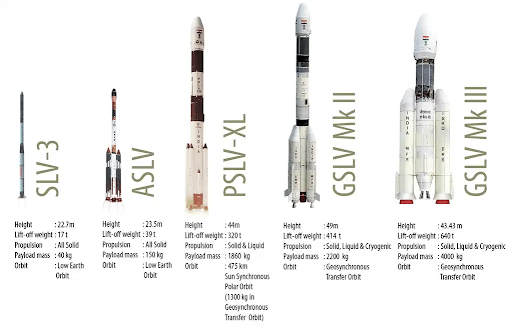
Launch vehicles of ISRO
Propellants used in Launch Vehicle Technology
- A propellant is a chemical mixture composed of a fuel and an oxidizer that is burned to produce thrust in rockets.
- For propulsion, fuel is a substance that burns when combined with oxygen-producing gas.
- An oxidizer is a substance that releases oxygen for use in conjunction with a fuel. The mixture ratio refers to the oxidizer-to-fuel ratio.
- The states of propellants are classified as liquid, solid, or hybrid.
Liquid Propellants
- In a liquid propellant rocket, the fuel and oxidizer are stored in separate tanks and fed to a combustion chamber via a system of pipes, valves, and turbopumps, where they are combined and burned to produce thrust.
- There are three types of liquid propellants used in rocketry: petroleum, cryogens, and hypergolic.
- Petroleum fuels are refined from crude oil and are a complex mixture of hydrocarbons, which are organic compounds that only contain carbon and hydrogen. The petroleum used as rocket fuel is a refined form of kerosene.
- Cryogenic propellants are liquefied gases stored at extremely low temperatures, with liquid hydrogen (LH2) serving as the fuel and liquid oxygen (LO2 or LOX) serving as the oxidizer. At temperatures of -253°C (-423°F), hydrogen remains liquid, while oxygen remains liquid at temperatures of -183°C (-297°F).
- Hypergolic propellants and oxidizers that spontaneously ignite on contact and do not require an ignition source. Hypergolics are ideal for spacecraft manoeuvring systems due to their ease of start and restart.
Solid Propellants
- Solid propellant rockets are the most basic of all rocket designs.
- They are made up of a casing, usually made of steel, that is filled with a mixture of solid compounds (fuel and oxidizer) that burn quickly, expelling hot gases from a nozzle to produce thrust.
- When ignited, a solid propellant burns from the centre outward towards the casing's sides.
- Solid propellants are classified into two types: homogeneous and composite. Both are dense, stable at room temperature, and easily stored.
- Composites are mostly made up of granules of solid oxidizers like ammonium nitrate, ammonium dinitramide, ammonium perchlorate, or potassium nitrate mixed with a polymer binding agent.
- Single-, double-, or triple-bases are homogeneous mixtures of one to three primary ingredients (depending on the number of primary ingredients).
Hybrid Propellants
- These engines fall somewhere between solid and liquid propellant engines.
- One of the substances is solid, usually the fuel, and the other is liquid, usually the oxidizer.
- The liquid is injected into the solid, which also serves as a fuel reservoir and a combustion chamber.
- The main benefit of such engines is that they have high performance, comparable to solid propellant engines, but the combustion can be moderated, stopped, or even restarted.
- Because it is difficult to apply this concept to very large thrusts, hybrid propellant engines are rarely built.
Types of Launch Vehicles
1) Polar Satellite Launch Vehicle (PSLV)
- The Polar Satellite Launch Vehicle (PSLV) is India's third generation launch vehicle. It is the first Indian launch vehicle to have liquid stages.
- PSLV has four stages that alternate between solid and liquid propulsion systems.
- PSLV emerged as India's dependable and versatile workhorse launch vehicle after its first successful launch in October 1994, with 39 consecutive successful missions by June 2017.
- Between 1994 and 2017, the vehicle launched 48 Indian satellites and 209 satellites for international customers.
- Furthermore, the vehicle successfully launched two spacecraft - Chandrayaan-1 in 2008 and Mars Orbiter Spacecraft in 2013 - that later travelled to the Moon and Mars.
- PSLV earned the nickname "the workhorse of ISRO" by reliably delivering various satellites to Low Earth Orbit, particularly the IRS series of satellites.
- It can carry up to 1,750 kg of payload to 600 km altitude sun-synchronous polar orbits.
- PSLV has also been used to launch various satellites into geosynchronous and geostationary orbits, such as satellites from the IRNSS constellation, due to its unrivalled dependability.
- The PS4 is the PSLV's final stage, consisting of two Earth-storable liquid engines.
2) Geosynchronous Satellite Launch Vehicle (GSLV)
- The Geosynchronous Satellite Launch Vehicle (GSLV) is capable of launching 2 ton-class satellites into Geosynchronous Transfer Orbit (GTO), such as the INSAT and GSAT series of communication satellites.
- The Geosynchronous Satellite Launch Vehicle Mark-II (GSLV Mk II) is India's largest launch vehicle currently in operation.
- This fourth-generation launch vehicle, the GSLV Mk-II, is capable of launching satellites with a lift-off mass of up to 2,500 kg to GTO and satellites with a lift-off mass of up to 5,000 kg to LEO.
- The GSLV Mk-II is a three-stage vehicle that stands 49 metres tall and has a lift-off mass of 416 tonnes.
- The first stage is made up of an S139 solid booster and four liquid strap-on motors weighing 40 tonnes each.
- The second stage (GS2) is a liquid engine with a propellant capacity of 37.5 tonnes.
- The third stage is the Cryogenic Upper Stage (CUS), which is built in-house and uses approximately 15 tonnes of cryogenic propellants (Liquid Hydrogen (LH2) as fuel and Liquid Oxygen (LOX) as oxidiser).
3) Geosynchronous Satellite Launch Vehicle Mark III (GSLV MkIII)
- The Geosynchronous Satellite Launch Vehicle Mark III (GSLV MkIII), also known as LVM3, is ISRO's next generation launcher for achieving self-reliance in the launch of 4 tonne class communication satellites to Geosynchronous Transfer Orbits (GTO).
- The GSLV Mk-III is a three-stage vehicle that stands 43.43 metres tall and has a lift-off mass of 640 tonnes.
- The launcher is intended to be a versatile launcher capable of launching payloads to other orbits as well, with a payload capability of more than 10 tonnes to Low Earth Orbits (LEO).
- The GSLV Mk III's powerful cryogenic stage allows it to place heavy payloads into Low Earth Orbits of 600 km altitude.
- The CE-20, India's largest cryogenic engine, designed and developed by the Liquid Propulsion Systems Centre, powers the Cryogenic Upper Stage (C25).
- The massive thrust required for liftoff is provided by two S200 solid rocket boosters on the GSLV Mk III. Vikram Sarabhai Space Centre created the S200.
- It will enable India to achieve complete self-sufficiency in satellite launch as –
- It will be able to launch 4-tonne Geosynchronous satellites into GTO.
- X`It will be capable of launching satellites weighing up to 8 tonnes into low-Earth orbit (LEO).
- The Indian Space Research Organisation successfully launched Chandrayaan-2 & Chandrayaan-3 from Satish Dhawan Space Centre aboard an LVM3-M1 & LVM3-M4 rocket respectively.
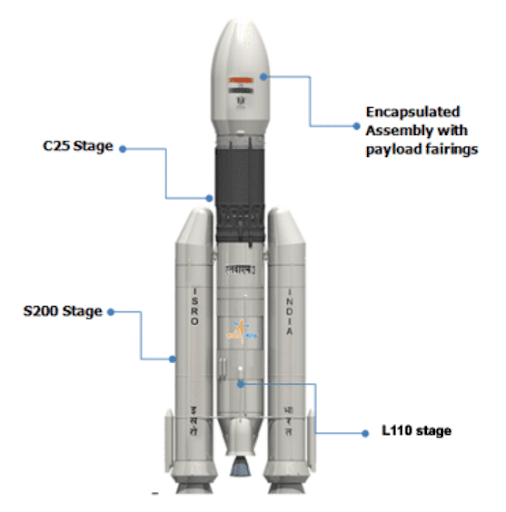
GSLV MKIII Vehicle Configuration
4) Small Satellite Launch Vehicle
- The much-anticipated Small Satellite Launch Vehicle (SSLV) has been developed by the Indian Space Research Organisation (ISRO).
- Previously, small satellites were launched alongside larger ones via PSLV (Polar Satellite Launch Vehicle), which added an unprecedented amount of waiting time for small satellite developers.
- The SSLV aims to serve the rapidly expanding market for the launch of small satellites into LEO (Earth's low orbits), which has recently emerged to meet the needs of developing countries, universities/institutions for small satellites, and private firms.
- SSLV is a three-stage vehicle capable of launching up to 500 kg satellites into 500 km LEO and 300 kg into Sun Synchronous Orbit (SSO).
- In all stages of flight, the launch vehicle runs on solid fuel.
- It is ideal for simultaneously launching multiple microsatellites and supports multiple orbital drop-offs.
- SSLV production is the responsibility of ISRO's commercial arm, NSIL (New Space India Limited).
- SSLV, ISRO's lightest launch vehicle, weighs approximately 110 tonnes.
- In contrast to the PSLV's 70-day integration time, the SSLV takes only 72 hours.
- SSLV requires only six people to integrate.
- In addition, the vehicle has both vented and closed interstages.
- SSLV's key characteristics include low cost, quick turn-around time, flexibility in accommodating multiple satellites, launch on demand capability, minimal launch infrastructure requirements, and so on.
5) Reusable Launch Vehicle - Technology Demonstrator (RLV-TD)
- The Reusable Launch Vehicle - Technology Demonstrator (RLV-TD) is one of ISRO's most technologically challenging projects aimed at developing critical technologies for a fully reusable launch vehicle to enable low-cost access to space.
- The RLV-TD's configuration is similar to that of an aircraft, combining the complexity of both launch vehicles and aircraft.
- The winged RLV-TD is designed to serve as a flying testbed for various technologies such as hypersonic flight, autonomous landing, and powered cruise flight.
- This vehicle will be scaled up in the future to become the first stage of India's reusable two-stage orbital launch vehicle.
- The fuselage (body) of the RLV-TD is made up of a nose cap, double delta wings, and twin vertical tails. It also has Elevons and Rudder, which are symmetrically placed active control surfaces.
- A conventional solid booster (HS9) designed for low burn rate propelled this technology demonstrator to Mach 5.
- The selection of materials such as special alloys, composites, and insulation materials for developing an RLV-TD and crafting its parts is extremely complex and necessitates the use of highly skilled labour.
- This vehicle was built with a lot of high-tech machinery and testing equipment.
Conclusion
With the operationalization of the Polar Satellite Launch Vehicle (PSLV) and Geosynchronous Satellite Launch Vehicle (GSLV), India has made tremendous strides in launch vehicle technology to achieve self-reliance in the satellite launch vehicle programme.
| Other Relevant Links | |
|---|---|
| Science & Technology Policy in India | Scientific Policy Resolution 1958 |
| Science & Technology Policy of 1983 | Science & Technology Policy of 2003 |
| Science, Technology and Innovation Policy 2013 | New Initiatives Aligned with the National Agenda |
| India and World collaboration in science projects | Technology Vision Document 2035 |
FAQs
Question: What is a launch vehicle?
Answer: A launch vehicle is a rocket used to propel spacecraft or satellites into space, overcoming Earth's gravity and reaching the desired orbit or trajectory.
Question: Why is launch vehicle technology crucial for space missions?
Answer: Launch vehicle technology is essential as it enables the deployment of satellites, crewed spacecraft, and scientific missions into space by providing the necessary propulsion.
Question: What are the main types of launch vehicles?
Answer: The main types of launch vehicles are expendable launch vehicles (ELVs), reusable launch vehicles (RLVs), and partially reusable vehicles (PRVs).
Question: How do reusable launch vehicles (RLVs) differ from expendable launch vehicles (ELVs)?
Answer: RLVs can be used multiple times after refurbishment, reducing costs, while ELVs are discarded after a single mission.
Question: Which countries are leaders in launch vehicle technology?
Answer: The United States, Russia, China, and India are the leading countries in launch vehicle technology, with active space programs and advancements in satellite and space exploration missions.
MCQs
1. What is the primary function of a launch vehicle?
A) To carry astronauts to space
B) To launch satellites into orbit
C) To land on the moon
D) To provide space tourism
Answer: (B) See the Explanation
Explanation: A launch vehicle is primarily used to transport satellites and other payloads into space, allowing them to reach their intended orbit.
2. What type of launch vehicle can be used multiple times?
A) Expendable launch vehicle (ELV)
B) Reusable launch vehicle (RLV)
C) Solid propellant vehicle
D) Ion thruster vehicle
Answer: (B) See the Explanation
Explanation: Reusable launch vehicles (RLVs) are designed to be used multiple times, making them more cost-effective compared to expendable launch vehicles (ELVs), which are discarded after each mission.
3. Which of the following is a key characteristic of expendable launch vehicles (ELVs)?
A) They can be used multiple times
B) They are cheaper than reusable vehicles
C) They are discarded after each mission
D) They are always smaller in size
Answer: (C) See the Explanation
Explanation: Expendable launch vehicles (ELVs) are designed for single-use, and they are discarded after each mission, making them less cost-efficient compared to reusable launch vehicles (RLVs).
4. Which of the following space agencies has developed reusable launch vehicles?
A) NASA
B) ISRO
C) Roscosmos
D) All of the above
Answer: (D) See the Explanation
Explanation: NASA, ISRO, and Roscosmos have all made advancements in reusable launch vehicle technology, with each having their own successful projects like Space Shuttle (NASA), GSLV Mk III (ISRO), and Buran (Roscosmos).
5. What is a significant challenge in the development of launch vehicles?
A) High cost
B) Lack of scientific knowledge
C) Limited satellite technology
D) Inefficient fuel use
Answer: (A) See the Explanation
Explanation: The high cost of developing and launching launch vehicles remains a significant challenge, especially in the context of reusable launch vehicles, which require complex and expensive technology.
GS Mains Questions and Model Answers
Q1: Discuss the advancements in launch vehicle technology and their impact on space exploration and satellite deployment.
Answer: The advancements in launch vehicle technology, particularly the development of reusable launch vehicles (RLVs), have significantly reduced the cost of space exploration and satellite deployment. RLVs like SpaceX’s Falcon 9 and ISRO’s GSLV Mk III are designed to be reused, thus lowering the cost per launch. Moreover, advancements in materials, propulsion systems, and automation have improved the efficiency and reliability of launch vehicles. These developments have made space missions more accessible, accelerated the deployment of communication, Earth observation, and weather satellites, and increased the frequency of space missions. The growing capabilities of launch vehicles have also supported human space exploration, such as crewed missions to low Earth orbit and future lunar missions.
Q2: Examine the role of India’s space agency ISRO in the development of launch vehicles and its significance in global space missions.
Answer: The Indian Space Research Organisation (ISRO) has been a key player in the development of launch vehicles, contributing significantly to space exploration. ISRO’s development of the Polar Satellite Launch Vehicle (PSLV) and the Geosynchronous Satellite Launch Vehicle (GSLV) has enabled the deployment of multiple satellites for communication, Earth observation, and navigation. ISRO’s success with its low-cost launch vehicles has positioned India as a leading space-faring nation. Moreover, ISRO’s achievements in launching satellites for other countries have strengthened its global position. With the ongoing development of the GSLV Mk III, ISRO aims to increase its payload capacity, making it a significant player in global space missions and paving the way for future lunar and Mars missions.
Q3: What are the environmental concerns associated with the use of launch vehicles and how can they be mitigated?
Answer: Launch vehicles contribute to environmental pollution through the emission of gases and particulate matter during the launch process. The combustion of rocket propellants releases pollutants, including carbon dioxide, carbon monoxide, and unburned hydrocarbons, which may affect the ozone layer and contribute to climate change. Additionally, solid rocket propellants can release harmful chemicals into the upper atmosphere. To mitigate these impacts, there is a growing focus on developing environmentally friendly, green propellants that produce fewer pollutants. Moreover, the use of reusable launch vehicles reduces the need for frequent launches and minimizes the overall environmental footprint of space missions. Sustainable practices, such as using cleaner propellants and optimizing launch vehicle designs for minimal environmental damage, are essential for the future of space exploration.
Previous Year Questions on Launch Vehicle Technology
1. UPSC CSE Mains 2019 (GS Paper 3):
Question: "Discuss the role of India’s space program in the global context and the advancements in launch vehicle technology that have supported this growth."
Answer: India’s space program, led by ISRO, has gained global recognition due to its cost-effective satellite launches and successful space missions. The advancements in launch vehicle technology, such as the development of PSLV and GSLV, have been pivotal in ensuring India’s success in deploying satellites for both national and international clients. These developments have made India one of the leading nations in space technology, offering satellite launching services to several countries and actively participating in global space exploration projects.
2. UPSC CSE Mains 2021 (GS Paper 3):
Question: "Evaluate the significance of reusable launch vehicle technology and its potential impact on future space exploration missions."
Answer: Reusable launch vehicle technology has the potential to revolutionize space exploration by drastically reducing launch costs. The ability to reuse components such as rocket stages and boosters can make space missions more affordable and frequent, ultimately opening up space to private players and international collaborations. This technology is expected to make human missions to the Moon, Mars, and beyond more feasible and sustainable in the long term, enhancing our understanding of space and the universe.
Download the PREPP App and attempt FREE IAS Exam Mock Tests and get complete study material!

Full Test - 04: UPSC CSE Prelims CSAT (Paper-II)
Full Test - 03: UPSC CSE Prelims CSAT (Paper-II)
UPSC CSE Prelims 2026 GS Paper 1 Question Paper (24-May-2026)
UPSC CSE Prelims 2026 CSAT Paper 2 Question Paper (24-May-2026)

17 February 2025 | The Hindu Must Read Articles | Current Affairs

16 February 2026 | The Hindu Must Read Articles | Current Affairs

13 February 2026 | The Hindu Must Read Articles | Current Affairs









Comments