Satellite Communication in India – Science & Technology Notes
Satellite communication (Satcom) is a boon for providing ubiquitous connectivity in all terrains and the country's most remote areas. The Satcom industry in India has the potential to drive the next big telecom revolution. Satcom remains the best-suited technology for providing data connectivity in remote and rural areas due to its rapid deployment, reliability, consistency, flexibility, and scalability of services across all regions and terrains, and it also complements mobile network connectivity. In this article, we will discuss in detail regarding Satellite Communication in India which will be helpful for UPSC exam preparation.
Table of Contents
What is a Satellite?
- A satellite is an object that orbits the sun, Earth, or any other massive body.
- When it comes to satellites, there are two major classifications: natural and man-made.
- Satellites are classified into four types based on their applications and purposes:
- Geostationary Satellites (Communication) - INSAT, GSAT, EDUSAT, and HAMSAT
- Earth Observation Satellites - IRS series, CARTOSAT, RESOURCESAT, OCEANSAT, and RISAT, ASTROSAT (Astronomy related)
- Navigation satellites - GAGAN and IRNSS (now NAVIC)
- Space missions - MOM, Gaganyaan, and Chandrayaan 2
- Small Satellites - Jugnoo (Nanosatellite)
| Other Relevant Links | |
|---|---|
| Dark Web (Darknet): Definition, Access, and Threats | Orbits Type |
| Satellite Launching Systems | Terminologies Related to the Space Science |
| Cryogenic Technology | GSLV D5, GSAT 14 |
| India’s Reusable Launch Vehicle (RLV) | Earth Observation Systems |
| Remote sensing applications - IRS Systems | INSAT Satellite Application |
| GSAT Satellite Application | Launch vehicle Technology |
What is Satellite Communication (SATCOM)?
- Satellite communication is any communication link that uses an artificial satellite as part of its propagation path.
- Satellite communications are essential in modern life.
- Over 2000 artificial satellites are in use.
- They are found in geostationary, Molniya, elliptical, and low Earth orbits and are used for traditional point-to-point communications, mobile applications, and TV and radio programme distribution.
- High-frequency signals are commonly used in satellite communications.
Working of Satellite Communication
- Communication satellites are similar to space mirrors that help us bounce signals like radio, internet data, and television from one side of the planet to the other.
- There are three stages involved in explaining how satellite communications work. They are as follows:
- Uplink
- Transponders
- Downlink
- Consider the example of signals from a television. The signal from the television broadcast on the other side of the earth is first beamed up to the satellite from the earth's ground station in the first stage. This is referred to as uplink.
- Transponders such as radio receivers, amplifiers, and transmitters are used in the second stage. These transponders boost the incoming signal and change its frequency without affecting the outgoing signals. The transponders differ depending on the incoming signal sources.
- The data is then sent to the other end of the receiver on Earth via a downlink in the final stage. It is critical to understand that there is usually one uplink and multiple downlinks.
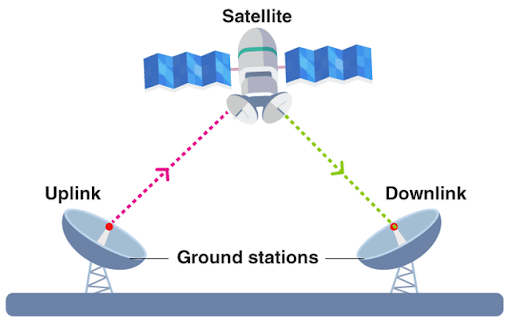
Working of Satellite Communication
Indian National Satellite (INSAT)
- With nine operational communication satellites in Geo-stationary orbit, the Indian National Satellite (INSAT) system is one of the largest domestic communication satellite systems in the Asia-Pacific region.
- With the launch of INSAT-1B in 1983, it launched a major revolution in India's communications sector that has since been sustained.
- With over 200 transponders in the C, Extended C, and Ku bands, the INSAT system supports telecommunications, television broadcasting, satellite newsgathering, societal applications, weather forecasting, disaster warning, and Search and Rescue operations.
List of Communication Satellites
| Satellite | Launch Date | Launch Vehicle | Application |
|---|---|---|---|
| CMS-01 | Dec 17, 2020 | PSLV-C50/CMS-01 | Communication |
| GSAT-30 | Jan 17, 2020 | Ariane-5 VA-251 | Communication |
| GSAT-31 | Feb 06, 2019 | Ariane-5 VA-247 | Communication |
| GSAT-7A | Dec 19, 2018 | GSLV-F11 / GSAT-7A Mission | Communication |
| GSAT-11 Mission | Dec 05, 2018 | Ariane-5 VA-246 | Communication |
| GSAT-29 | Nov 14, 2018 | GSLV Mk III-D2 / GSAT-29 Mission | Communication |
| GSAT-6A | Mar 29, 2018 | GSLV-F08/ GSAT-6A Mission | Communication |
| GSAT-17 | Jun 29, 2017 | Ariane-5 VA-238 | Communication |
| GSAT-19 | Jun 05, 2017 | GSLV Mk III-D1/ GSAT-19 Mission | Communication |
| GSAT-9 | May 05, 2017 | GSLV-F09 / GSAT-9 | Communication |
| GSAT-18 | Oct 06, 2016 | Ariane-5 VA-231 | Communication |
| GSAT-15 | Nov 11, 2015 | Ariane-5 VA-227 | Communication, Navigation |
| GSAT-6 | Aug 27, 2015 | GSLV-D6 | Communication |
| GSAT-16 | Dec 07, 2014 | Ariane-5 VA-221 | Communication |
| GSAT-14 | Jan 05, 2014 | GSLV-D5/ GSAT-14 | Communication |
| GSAT-7 | Aug 30, 2013 | Ariane-5 VA-215 | Communication |
| GSAT-10 | Sep 29, 2012 | Ariane-5 VA-209 | Communication, Navigation |
| GSAT-12 | Jul 15, 2011 | PSLV-C17/ GSAT-12 | Communication |
| GSAT-8 | May 21, 2011 | Ariane-5 VA-202 | Communication, Navigation |
| INSAT-4CR | Sep 02, 2007 | GSLV-F04 / INSAT-4CR | Communication |
| INSAT-4B | Mar 12, 2007 | Ariane5 | Communication |
| INSAT-4A | Dec 22, 2005 | Ariane5-V169 | Communication |
| HAMSAT | May 05, 2005 | PSLV-C6/CARTOSAT-1 /HAMSAT | Communication |
| EDUSAT | Sep 20, 2004 | GSLV-F01 / EDUSAT(GSAT-3) | Communication |
| INSAT-3E | Sep 28, 2003 | Ariane5-V162 | Communication |
| GSAT-2 | May 08, 2003 | GSLV-D2 / GSAT-2 | Communication |
| INSAT-3A | Apr 10, 2003 | Ariane5-V160 | Climate & Environment, Communication |
| KALPANA-1 | Sep 12, 2002 | PSLV-C4 /KALPANA-1 | Climate & Environment, Communication |
| INSAT-3C | Jan 24, 2002 | Ariane5-V147 | Climate & Environment, Communication |
| GSAT-1 | Apr 18, 2001 | GSLV-D1 / GSAT-1 | Communication |
| INSAT-3B | Mar 22, 2000 | Ariane-5G | Communication |
| INSAT-2E | Apr 03, 1999 | Ariane-42P H10-3 | Communication |
| INSAT-2C | Dec 07, 1995 | Ariane-44L H10-3 | Communication |
| INSAT-2B | Jul 23, 1993 | Ariane-44L H10+ | Communication |
| INSAT-2A | Jul 10, 1992 | Ariane-44L H10 | Communication |
| INSAT-1D | Jun 12, 1990 | Delta 4925 | Communication |
| INSAT-1B | Aug 30, 1983 | Shuttle [PAM-D] | Communication |
Application of Satellite Communication
Direct To Home (DTH)
- India is both the most competitive and largest market for DTH services. DTH payers can now serve the Indian market, which has more than 70 million active subscribers, thanks to space segment capacity on the INSAT/GSAT fleet.
Digital Satellite News Gathering (DSNG) Services
- NSIL enables news channels to provide live coverage from the source and pitch-in to nearly 185 million television sets across the country. Outdoor broadcasting services are available in the C and Ku bands.
VSAT Services
- VSAT services play an important role in strengthening the country's telecom infrastructure by providing connectivity solutions to banks, ATMs, oil and gas companies, financial institutions, telcos, and enterprises, as well as connecting remote areas where terrestrial networks are difficult to reach.
Private TV Uplinking / Commercial Teleport Operations
- ISRO's commercial arm enables some private TV channels to uplink their content on the INSAT/GSAT fleet via their own teleports and ground stations located throughout the country.
Tele-education
- The tele-education project aims to provide satellite-based distance education to the entire country at the school, college, and university levels.
Telemedicine
- Telemedicine is assisting rural health services by bringing Super-Specialty doctor services to outlying areas.
Mobile Satellite Services-MSS
- They have been critical in India for national disaster management and strategic application needs.
- One-way text message and position reporting applications are now operational and widely used. The same system has also been upgraded to support two-way data communication.
- ISRO established a Satcom-based broadband Virtual Private Network (VPN) for disaster management support in 2008. The network is operational on the GSAT-12 satellite in the Ext-C band.

Applications of Satellite Communications
Benefits of Satellite Communication for India
- Can reach inaccessible areas: An estimated 20-25% of India's population lives in areas that are difficult to reach by terrestrial telecom and lack mobile and internet access. These areas are easily accessible via satellite.
- Lesser Cost of reaching difficult terrain areas: Terrestrial telecom rollout in difficult terrain can cost up to 15 times more than in more accessible areas.
- Furthermore, such areas are frequently under-populated, with low average revenue per user.
- Satcom has the potential to significantly improve backhaul for mobile service providers in these areas.
- Enhanced dependability and quality: Only about 35% of mobile base stations are connected to fibre. Satellite connectivity outperforms microwave technology and is more practical in difficult terrain than fibre.
- As a result, Satcom could improve the dependability and quality of existing mobile networks.
- Satellite communication has the potential to transform the rural economy by enabling village connectivity, education and skill development programmes, healthcare and telemedicine, warehousing, public distribution systems, and a variety of other applications in far-flung and remote locations.
- In the future, satellite communication will enable new-age data communications between machines and sensors to deliver smart services such as connecting IoT devices, tracking cargo, vehicles, railway safety systems, traffic signals, mapping soil conditions, monitoring oil/gas pressures in vast industrial pipeline systems, and so on.
- Satellite communication is also essential in military operations, coastal security, border surveillance, disaster management, and other mission-critical operations and strategic applications.
Concerns Regarding Satellite Communication
- Satellite communication is costly.
- Establishing ground stations or gateways would necessitate regulatory approvals in each country, which could be hampered by conservative regulators.
- There is no specific policy on Universal Licence (UL) that allows international internet gateways.
Conclusion
Satellite communications is emerging as an important component of India's plans to expand access to high-quality internet across the country. Satellite communications is crucial to the digital economy and India's growing clout in the global technology landscape. As a result, satellites and space will play an important role in the overall mission to ensure internet delivery and the goal of connecting people to the digital economy.
| Other Relevant Links | |
|---|---|
| Science & Technology Policy in India | Scientific Policy Resolution 1958 |
| Science & Technology Policy of 1983 | Science & Technology Policy of 2003 |
| Science, Technology and Innovation Policy 2013 | New Initiatives Aligned with the National Agenda |
| India and World collaboration in science projects | Technology Vision Document 2035 |
FAQs
Question: What is satellite communication?
Answer: Satellite communication involves the use of artificial satellites to transmit signals and data between various locations on Earth. This form of communication enables long-distance transmission of data, voice, and video through the use of satellite links in space.
Question: What are the applications of satellite communication in India?
Answer: Satellite communication in India is used for a wide range of applications, including telecommunication, television broadcasting, weather forecasting, disaster management, remote sensing, navigation, and internet connectivity in remote areas. It plays a crucial role in bridging the digital divide across diverse geographies.
Question: Which organization is primarily responsible for satellite communication in India?
Answer: The Indian Space Research Organisation (ISRO) is primarily responsible for satellite communication in India. It has launched various communication satellites, such as the INSAT (Indian National Satellite System) and GSAT (Geostationary Satellite) series, to support communication and broadcasting services.
Question: What is the significance of the INSAT series of satellites?
Answer: The INSAT (Indian National Satellite) series of satellites form the backbone of India’s satellite communication infrastructure. Launched by ISRO, these satellites support telecommunications, television broadcasting, meteorology, disaster warning, and other applications, significantly enhancing communication capabilities across the country.
Question: How does satellite communication benefit remote areas in India?
Answer: Satellite communication benefits remote areas in India by providing telecommunication and internet services where traditional infrastructure is limited or unavailable. It bridges the connectivity gap, enables access to educational content, healthcare services, and emergency communication, and supports government schemes like telemedicine and digital literacy initiatives.
MCQs
- What is the primary role of the Indian Space Research Organisation (ISRO) in satellite communication?
A) Conducting agricultural research
B) Launching and managing communication satellites
C) Developing nuclear power technologies
D) Monitoring oceanic activity
Answer: (B) See the Explanation
ISRO is responsible for launching and managing India's communication satellites, providing essential services such as telecommunication, broadcasting, and remote sensing.
- Which satellite series forms the core of India’s satellite communication network?
A) GPS
B) INSAT
C) EDUSAT
D) Galileo
Answer: (B) See the Explanation
The INSAT series forms the core of India’s satellite communication network, providing telecommunication, broadcasting, and meteorological services.
- How does satellite communication support disaster management in India?
A) By predicting economic trends
B) By providing weather forecasts, emergency warnings, and coordination support
C) By facilitating fashion shows
D) By solely broadcasting entertainment channels
Answer: (B) See the Explanation
Satellite communication helps in disaster management by providing timely weather forecasts, emergency alerts, and coordination support during disasters.
- What is the role of GSAT satellites in India’s communication network?
A) Supporting agricultural research
B) Providing geostationary communication services
C) Observing wildlife
D) Generating energy for space missions
Answer: (B) See the Explanation
GSAT (Geostationary Satellite) satellites provide geostationary communication services, supporting telecommunications, broadcasting, and internet connectivity.
- How does satellite communication bridge the digital divide in India?
A) By providing internet services to rural and remote areas
B) By focusing exclusively on urban development
C) By developing new fashion trends
D) By eliminating radio services
Answer: (A) See the Explanation
Satellite communication helps bridge the digital divide in India by offering telecommunication and internet connectivity to rural and remote regions where traditional infrastructure is lacking.
GS Mains Questions and Model Answers
Q1: Discuss the role of satellite communication in India’s socio-economic development.
Answer: Satellite communication plays a pivotal role in India's socio-economic development by providing seamless connectivity across diverse geographical regions, including remote and rural areas. It supports telecommunication, internet access, television broadcasting, and disaster management. Communication satellites like the INSAT and GSAT series launched by ISRO enable critical services such as telemedicine, tele-education, and e-governance, bridging the digital divide and improving the quality of life. Satellite connectivity ensures timely weather forecasts, disaster alerts, and emergency communication, reducing the impact of natural calamities. It also boosts economic activities by enhancing business communication, facilitating digital transactions, and supporting industrial sectors such as agriculture, meteorology, and logistics. By promoting digital inclusion and providing access to information, satellite communication fosters inclusive growth and strengthens national integration, making it a crucial tool for India's overall socio-economic advancement.
Q2: Explain the significance of the INSAT series in the development of satellite communication in India.
Answer: The INSAT (Indian National Satellite) series, developed by ISRO, is of immense significance in the development of satellite communication in India. Launched in 1983, the series marked a major milestone in the country’s communication capabilities, providing a platform for telecommunication, television broadcasting, meteorological observation, and disaster warning services. INSAT satellites facilitate nationwide connectivity, enabling live broadcasting, weather forecasting, and emergency alerts. They support tele-education and telemedicine initiatives, improving access to healthcare and education in remote areas. By offering communication services to diverse sectors, the INSAT series has played a vital role in fostering socio-economic development, bridging the digital divide, and promoting national integration. The success of the INSAT series laid the foundation for subsequent satellite initiatives, strengthening India's position as a leader in space technology and satellite-based communication services.
Q3: Analyze the impact of satellite communication on disaster management in India.
Answer: Satellite communication significantly enhances disaster management capabilities in India by providing real-time data, early warnings, and coordination support during emergencies. Communication satellites offer timely weather forecasts, track cyclones, and monitor natural disasters such as floods, landslides, and earthquakes, enabling authorities to issue alerts and evacuate at-risk populations. ISRO's satellites play a critical role in disseminating information to remote areas, ensuring effective communication during crises. Satellite-based connectivity facilitates the coordination of relief operations, resource allocation, and damage assessment, minimizing the impact of disasters on human lives and infrastructure. Additionally, satellite technology supports post-disaster recovery efforts by providing continuous monitoring and connectivity for affected regions. By integrating satellite communication into disaster management frameworks, India has strengthened its ability to respond swiftly and efficiently, reducing vulnerability and enhancing resilience to natural and man-made calamities.
Previous Year Questions on Satellite Communication in India
1. UPSC CSE 2019
Question: Discuss the role of satellite communication in bridging the digital divide in India.
Answer: Satellite communication plays a crucial role in bridging the digital divide in India by providing connectivity to rural, remote, and underserved regions where conventional terrestrial networks are unavailable or limited. Through communication satellites like the INSAT and GSAT series, India has extended telecommunication, internet access, and broadcasting services to previously disconnected areas. Satellite-based internet connectivity enables e-governance, tele-education, telemedicine, and online financial services, improving access to essential services and reducing socio-economic disparities. By connecting remote communities, satellite communication empowers individuals with information, education, and opportunities, fostering social inclusion and economic growth. The technology also supports government initiatives aimed at digital literacy and inclusion. Despite challenges such as high costs and limited bandwidth, satellite communication remains a vital tool for promoting equitable development and ensuring that all citizens benefit from the digital revolution, thereby contributing to a more inclusive society.
2. UPSC CSE 2020
Question: Analyze the significance of ISRO’s communication satellites in India’s technological and economic development.
Answer: ISRO’s communication satellites have been instrumental in India’s technological and economic development. By launching and managing satellites like the INSAT and GSAT series, ISRO has transformed telecommunication, broadcasting, internet connectivity, and disaster management services across the country. These satellites enable tele-education, telemedicine, e-governance, and digital services, bridging the digital divide and fostering socio-economic inclusion. Communication satellites facilitate the delivery of critical services to remote and rural areas, improving access to healthcare, education, and emergency communication. They also contribute to economic growth by enhancing business communication, supporting industrial sectors, and boosting digital transactions. ISRO’s satellite initiatives have positioned India as a leader in space technology, driving innovation, research, and international collaboration. The impact of these satellites extends beyond communication, strengthening the nation’s resilience, connectivity, and competitiveness on the global stage.
Download the PREPP App and attempt FREE IAS Exam Mock Tests and get complete study material!

Full Test - 04: UPSC CSE Prelims CSAT (Paper-II)
Full Test - 03: UPSC CSE Prelims CSAT (Paper-II)
UPSC CSE Prelims 2026 GS Paper 1 Question Paper (24-May-2026)
UPSC CSE Prelims 2026 CSAT Paper 2 Question Paper (24-May-2026)

17 February 2025 | The Hindu Must Read Articles | Current Affairs

16 February 2026 | The Hindu Must Read Articles | Current Affairs

13 February 2026 | The Hindu Must Read Articles | Current Affairs









Comments