India’s Reusable Launch Vehicle (RLV) – Science & Technology Notes
The Reusable Launch Vehicle-Technology Demonstration (RLV-TD) Programme is envisioned as a series of technology demonstration missions that will serve as a first step towards realising a fully reusable Two Stage To Orbit (TSTO) vehicle. A Winged RLV-TD has been configured to serve as a flying test bed for evaluating various air breathing propulsion technologies. These technologies will be developed in stages via a series of test flights. In this article, we will discuss in detail regarding India’s Reusable Launch Vehicle (RLV) which will be helpful for UPSC exam preparation.
Table of Contents
What is a Reusable Launch Vehicle (RLV)?
- RLVs are spacecraft that are designed to be reused multiple times for launching payloads into space, as opposed to traditional rockets, which are discarded after a single launch.
- They are seen as a more cost-effective and environmentally friendly option for space launches because they eliminate the need to manufacture new rockets for each mission.
- They are typically made up of a reusable orbiter, similar to a space shuttle, and a reusable booster that provides the initial thrust required to launch the orbiter and payload into space.
- Following the release of the payload into orbit, the orbiter and booster return to Earth and land on a runway, where they can be refurbished and reused for future launches.
| Other Relevant Links | |
|---|---|
| Dark Web (Darknet): Definition, Access, and Threats | Orbits Type |
| Satellite Launching Systems | Terminologies Related to the Space Science |
| Cryogenic Technology | GSLV D5, GSAT 14 |
| Earth Observation Systems | Satellite Communication in India |
| Remote sensing applications - IRS Systems | INSAT Satellite Application |
| GSAT Satellite Application | Launch vehicle Technology |
What is ISRO’s Reusable Launch Vehicle – Technology Demonstrator (RLV-TD)?
- The Reusable Launch Vehicle - Technology Demonstrator (RLV-TD) is one of ISRO's most technologically challenging projects aimed at developing critical technologies for a fully reusable launch vehicle to enable low-cost access to space.
- The RLV-TD's configuration is similar to that of an aircraft, combining the complexity of both launch vehicles and aircraft.
- The winged RLV-TD was designed to serve as a flying test bed for various technologies such as hypersonic flight, autonomous landing, and powered cruise flight.
- This vehicle will be scaled up in the future to become the first stage of India's reusable two-stage orbital launch vehicle.
- RLV-TD successfully flew from SDSC SHAR Sriharikota on May 23, 2016, validating critical technologies such as autonomous navigation, guidance and control, reusable thermal protection system, and re-entry mission management.
- ISRO's RLV has only two stages that will propel the vehicle into orbit.
- When the fuel in the first stage is depleted, the vehicle will shed it and proceed to the second stage.
- Once shed, the first stage will re-enter the atmosphere and land autonomously at a predetermined location.
- It will be ready for use after some maintenance.
Features of RLV-TD
- The fuselage (body) of the RLV-TD is made up of a nose cap, double delta wings, and twin vertical tails.
- Elevons and Rudder, which are symmetrically placed active control surfaces, are also included.
- A conventional solid booster (HS9) designed for low burn rate propelled this technology demonstrator to Mach 5.
- The selection of materials such as special alloys, composites, and insulation materials for developing an RLV-TD and crafting its parts is extremely complex and necessitates the use of highly skilled labour.
- This vehicle was built with a lot of high-tech machinery and testing equipment.
Objectives of RLV-TD
- Hypersonic aero thermodynamic characterisation of wing body
- Evaluation of autonomous Navigation, Guidance and Control (NGC) schemes
- Integrated flight management
- Thermal Protection System Evaluation
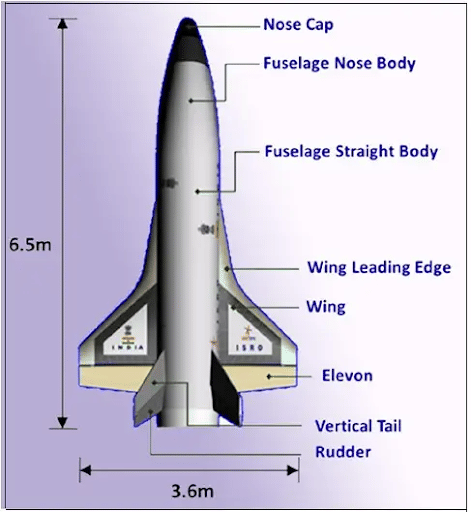
ISRO’s RLV-TD
ISRO’s Landing Mission (RLV-LEX)
- On April 2, 2023, the Indian Space Research Organisation (ISRO) successfully completed the landing experiment of the Reusable Launch Vehicle-Technology Demonstration (RLV-TD) programme, bringing it one step closer to a fully reusable launch vehicle.
- The landing experiment was carried out by ISRO at the Aeronautical Test Range in Challakere, Chitradurga.
- An Indian Air Force (IAF) Chinook helicopter dropped the RLV from a height of 4.5 kilometres.
- The vehicle performed approach and landing manoeuvres on the runway autonomously, under conditions similar to those encountered by a re-entry vehicle from space — at high speed and without human input to achieve a stable landing.
- The success of this test represents yet another step forward in ISRO's mission to develop a fully reusable launch vehicle as part of its vision to enable low-cost space exploration.
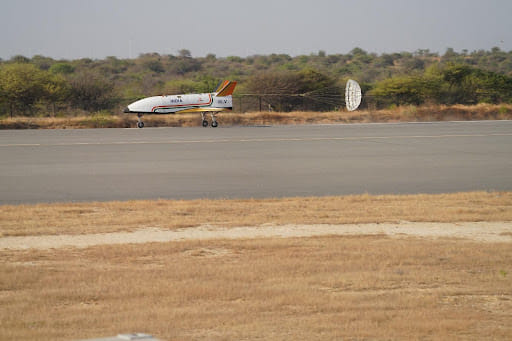
RLV landing on a runway
What next for ISRO?
- ISRO is currently working on RLV Orbital Re-entry Experiment (ORE).
- In ORE, a wing body called the Orbital Re-entry Vehicle (ORV) will be launched into orbit by an ascent vehicle derived from the existing GSLV and PSLV stages, stay in orbit for a predetermined period, then re-enter and land autonomously on a runway equipped with landing gear.
Significance of Reusable Launch Vehicle
- ISRO's other operational launch vehicles get a boost: ISRO developed localised navigation systems based on pseudolite systems, instrumentation and sensor systems, and so on. The adaptation of modern technologies developed for RLV LEX makes ISRO's other operational launch vehicles more cost-effective.
- More experiments are planned to ensure that the RLV successfully delivers payloads to low-Earth orbit, as ISRO plans to cut the cost of the process by 80%.
- The high cost of access to space is a major impediment to space exploration and utilisation. A reusable launch vehicle is the undisputed solution for low-cost, dependable, and on-demand space access.
Other Agencies Using RLV Technology
- NASA: NASA’s space shuttles have completed dozens of human space flight missions using reusable space vehicles for a long time.
- Space X: Since 2017, the private space launch services provider Space X has demonstrated partially reusable launch systems with its Falcon 9 and Falcon Heavy rockets, reviving the use case for reusable space launch vehicles.
- SpaceX is also developing Starship, a fully reusable launch vehicle system.
- Others: Several private launch service providers and government space agencies around the world are collaborating with ISRO to develop reusable launch systems.
Conclusion
The RLV programme is a game changer because it has the potential to significantly reduce the cost of launching satellites and other spacecraft into orbit. Accelerating RLV development could not come at a better time for ISRO, as all of the world's major space agencies strive to improve their satellite launch capabilities. The goal is affordability, as well as launch frequency: how quickly a space agency can prepare for its next launch. In this regard, the RLV gives ISRO an advantage by not only reducing launch costs by nearly 80%, but also allowing the agency to conduct back-to-back launches with minimal turnaround time.
| Other Relevant Links | |
|---|---|
| Science & Technology Policy in India | Scientific Policy Resolution 1958 |
| Science & Technology Policy of 1983 | Science & Technology Policy of 2003 |
| Science, Technology and Innovation Policy 2013 | New Initiatives Aligned with the National Agenda |
| India and World collaboration in science projects | Technology Vision Document 2035 |
FAQs
Question: What is India's Reusable Launch Vehicle (RLV)?
Answer: India’s Reusable Launch Vehicle (RLV) is a space vehicle developed by ISRO, designed to be reused for multiple missions, similar to the Space Shuttle. It aims to reduce the cost of launching satellites and spacecraft.
Question: What are the benefits of the Reusable Launch Vehicle (RLV)?
Answer: The RLV will significantly reduce launch costs, increase the frequency of space missions, and enable more efficient use of resources by reusing components like the spaceplane and rocket boosters.
Question: How does India's RLV differ from other global space programs?
Answer: India’s RLV is unique because it is designed to be a low-cost alternative to traditional expendable launch vehicles. It also emphasizes simplicity, efficiency, and cost reduction, distinguishing it from other space programs like NASA’s Space Shuttle.
Question: Which organization is responsible for the development of the RLV in India?
Answer: The Indian Space Research Organisation (ISRO) is responsible for the development and testing of the Reusable Launch Vehicle (RLV).
Question: How does the RLV benefit India's space exploration ambitions?
Answer: The RLV will enable India to conduct space exploration more frequently and affordably, supporting the country’s ambitions in launching satellites, crewed space missions, and interplanetary exploration like Mars and the Moon.
MCQs
1. What is the primary purpose of India's Reusable Launch Vehicle (RLV)?
A) To reduce the cost of launching satellites
B) To explore Mars
C) To replace the Space Shuttle
D) To serve as a passenger spacecraft
Answer: (A) See the Explanation
Explanation: The primary purpose of India's RLV is to reduce the cost of launching satellites and spacecraft by reusing the vehicle components, which cuts down on the need for manufacturing new vehicles for each mission.
2. Who is responsible for the development of the Reusable Launch Vehicle (RLV) in India?
A) ISRO
B) NASA
C) Roscosmos
D) SpaceX
Answer: (A) See the Explanation
Explanation: The Indian Space Research Organisation (ISRO) is responsible for the development and testing of India’s Reusable Launch Vehicle (RLV).
3. How does the RLV aim to reduce the cost of space missions?
A) By reusing spacecraft components
B) By using nuclear propulsion
C) By reducing satellite payloads
D) By eliminating the need for rockets
Answer: (A) See the Explanation
Explanation: The RLV aims to reduce the cost of space missions by reusing spacecraft components, which eliminates the need for manufacturing new vehicles for every mission, thereby saving on production costs.
4. What makes the RLV unique compared to traditional expendable launch vehicles?
A) It uses reusable rocket boosters
B) It is made from solid materials
C) It can only be used once
D) It is a passenger vehicle
Answer: (A) See the Explanation
Explanation: The RLV uses reusable rocket boosters, unlike traditional expendable launch vehicles, which are discarded after each launch. This makes the RLV more cost-effective for future space missions.
5. How will the RLV contribute to India's space exploration efforts?
A) By providing a platform for future space tourism
B) By reducing the frequency of launches
C) By enabling more frequent and affordable space missions
D) By focusing on space exploration only
Answer: (C) See the Explanation
Explanation: The RLV will enable more frequent and affordable space missions by reducing the cost per launch, allowing India to conduct more satellite launches, crewed space missions, and interplanetary exploration.
GS Mains Questions and Model Answers
Q1: Discuss the potential advantages of India’s Reusable Launch Vehicle (RLV) for space exploration.
Answer: India’s Reusable Launch Vehicle (RLV) offers several potential advantages, including significantly reducing the cost of space missions by reusing components such as the spaceplane and rocket boosters. This not only lowers operational costs but also enables more frequent space missions, increasing India’s ability to deploy satellites and undertake interplanetary missions. The development of RLV will enhance India’s capabilities in space exploration, particularly in crewed space programs, Mars exploration, and even the moon missions. Additionally, by cutting down on the need for new vehicles for every mission, India can divert resources to other aspects of its space program, thereby advancing its global position in space technology.
Q2: How does the development of India’s RLV contribute to the country's goal of space self-reliance?
Answer: The development of the RLV is a significant step toward India’s goal of space self-reliance. By creating a reusable spacecraft, ISRO can reduce dependence on foreign space programs for access to space. This technological advancement enables India to conduct space missions more independently and frequently. Moreover, the reduced cost of launches will make it easier for India to establish its presence in global space markets, provide satellite launch services for other countries, and undertake complex space missions such as manned missions to the Moon and Mars. Ultimately, India’s RLV is a milestone in its ambition to become a major player in space exploration and technology.
Q3: Evaluate the role of India’s Reusable Launch Vehicle (RLV) in the context of global space programs.
Answer: India’s Reusable Launch Vehicle (RLV) holds significant promise in the context of global space programs. While countries like the USA (with its Space Shuttle program) and China have made strides in reusable launch technologies, India’s RLV offers a cost-effective alternative. By significantly reducing the cost per launch, ISRO can not only carry out frequent satellite deployments but also compete with other global players in the space industry. Furthermore, India’s focus on a simple, low-cost reusable vehicle allows it to focus on missions that require high levels of precision and cost-efficiency, such as interplanetary missions and crewed space programs. The RLV positions India to play a more central role in global space exploration, providing services to other countries while contributing to advancing space science and technology globally.
Previous Year Questions on India's Reusable Launch Vehicle
1. UPSC CSE Mains 2020 (GS Paper 3):
Question: "What are the potential benefits of developing reusable launch vehicles in India? Discuss how they could impact India’s space missions."
Answer: The development of reusable launch vehicles (RLVs) in India is expected to bring significant benefits, such as reducing launch costs, enabling more frequent space missions, and boosting India’s self-reliance in space technology. These vehicles will allow ISRO to conduct missions more efficiently and affordably, advancing India’s capabilities in satellite deployment, crewed space missions, and interplanetary exploration.
2. UPSC CSE Mains 2021 (GS Paper 3):
Question: "Analyze the significance of India’s Reusable Launch Vehicle (RLV) technology and its implications for the future of space exploration."
Answer: India’s RLV technology represents a breakthrough in reducing the cost of space exploration. With the ability to reuse components like spaceplanes and rocket boosters, RLVs provide a cost-effective way for India to increase its frequency of missions and expand its capabilities in space exploration. This technology will support both national and international satellite launches, crewed missions, and future projects like Mars exploration, placing India at the forefront of global space exploration efforts.
Download the PREPP App and attempt FREE IAS Exam Mock Tests and get complete study material!
UPSC IAS : GS - Indian Economy - Subject Knowledge Test

Live Test : UPSC CSE Prelims CSAT (Paper-II) (Sep 20 - 23)
Full Test - 03: UPSC CSE Prelims CSAT (Paper-II)
Full Test - 02: UPSC CSE Prelims CSAT (Paper-II)
UPSC CSE Prelims 2026 GS Paper 1 Question Paper (24-May-2026)
UPSC CSE Prelims 2026 CSAT Paper 2 Question Paper (24-May-2026)

17 February 2025 | The Hindu Must Read Articles | Current Affairs

16 February 2026 | The Hindu Must Read Articles | Current Affairs

13 February 2026 | The Hindu Must Read Articles | Current Affairs









Comments