Dark Web (Dark Net): Definition, Access, and Threats – Science & Technology Notes
The dark web or dark net is a hidden network of internet sites that can only be accessed through a specialised web browser. It is used to keep internet activity private and anonymous, which can be useful in both legal and illegal applications. While some people use it to avoid government censorship, it has also been used for highly illegal activity. In this article, we will discuss in detail regarding Dark Web (Dark Net) which will be helpful for UPSC exam preparation.
Table of Contents
Dark Web / Dark Net – Background
- The dark web first appeared in the early 2000s, alongside the development of Freenet, which was created by Ian Clarke to protect users from government intervention and cyber attacks.
- The system, which is still in use today, allows users to express themselves freely online without fear of being tracked.
- The Onion Router (TOR) project was funded by the US Naval Research Laboratory.
- TOR enabled intelligence sources to communicate easily and securely, especially in hostile environments where personal safety is critical.
- It is now one of the most popular browsers for accessing the dark web, using databases to help people navigate and find the information they need.
What is a TOR?
|
What is Dark Web?
- The dark web is defined as encrypted online content that is not indexed by standard search engines.
- To access the dark web, you must use specialised browsers such as Tor Browser.
- The dark web searches for websites using information that isn't publicly available, such as bank accounts, email accounts, and databases.
- People who use the dark web can maintain their anonymity while freely expressing their opinions.
- It is also known for being associated with illegal and unethical activities.
- With the rise of cryptocurrencies, the dark web has grown in popularity, particularly among cybercriminals.
- This is due to the fact that digital currencies frequently provide a high level of anonymity for people who buy and sell on the dark web.
- The dark web has been called for regulation due to its association with certain illegal activities.
- For example, both the G20 and the Financial Action Task Force (FATF) have called on cryptocurrency companies to provide information on buyers and sellers in online transactions.
- This is especially important, they claim, in assisting law enforcement in tracking down criminal organisations and illicit activities.
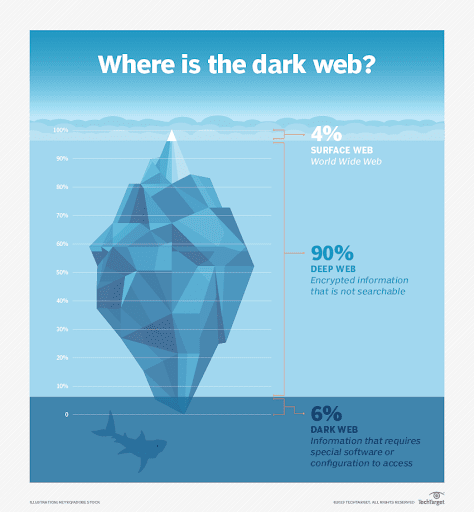
Dark Web
Surface Web vs Deep Web vs Dark Web
| Features | Surface Web | Deep Web | Dark Web |
|---|---|---|---|
| Accessibility | Freely accessible | Requires login credentials and a website’s exact URL | Requires a special browser and a website’s exact URL |
| Browser-Friendliness | Can be visited using any browser | Can be visited using any browser | Can only be visited using a special browser |
| Search Engine-Friendliness | Can be found on various search engines (e.g., Google, Yahoo, Bing) | Can’t usually be found on search engines | Can’t be found on search engines |
| Examples | Facebook, Amazon, VPNOverview | Confidential databases and employee pages of corporations, universities, and organizations | Black markets, Tor-exclusive email services |
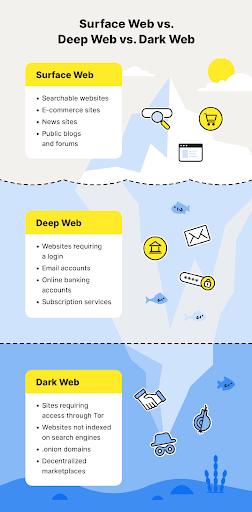
Surface Web vs Deep Web vs Dark Web
Accessing the Dark Web
- The dark web cannot be accessed using standard browsers such as Firefox or Chrome. It is only accessible through a specialised, anonymous browser, such as Tor or the Invisible Internet Project (I2P).
- This web browser conceals the identity of the user by routing web page requests through a series of proxy servers, rendering an IP address untraceable.
- The naming structure of websites on the dark web is unusual. As a result, users must know the URL they want to access ahead of time. Furthermore, dark web search engines lack the effectiveness and visibility of Google.
- Dark web URLs typically end in.onion, a special-use domain suffix, rather than.com or other common suffixes.
- URLs on dark web sites are also a mix of letters and numbers, making them difficult to find and remember.
Benefits of Dark Web
The dark web has a bad reputation, but there are some advantages to using it.
- Dissidents, for example, who fear political prosecution from their governments may use the dark web to communicate with one another.
- As many as 70.79% of users claim to use the Tor browser for anonymity, 62.28% for added security, and 27.07% for curiosity about the dark web.
- Because there is no way to track users, communicating on the dark web provides the highest level of security and privacy. This is critical for individuals such as:
- Journalists and whistleblowers collaborate to expose corporate and government corruption.
- Citizens of oppressive or authoritarian governments who require access to news sources critical of their governments that traditional web browsers have blocked.
- Political protestors who wish to remain anonymous while criticising their government's actions.
- Users looking for medical advice without disclosing their identity.
- Journalists conducting interviews with sources who must remain anonymous.
- The dark web can also benefit ordinary internet users. Anonymity and increased security can be beneficial for activities such as:
- Gaining access to free academic research
- Making use of ad-free search engines
- Accessing geo-restricted content
- Protecting cryptocurrency wallets
- Using social media without being watched by the government
- Finding niche content, such as blogs about secret underground tunnels or anonymous chess games
- Using anonymous chat rooms
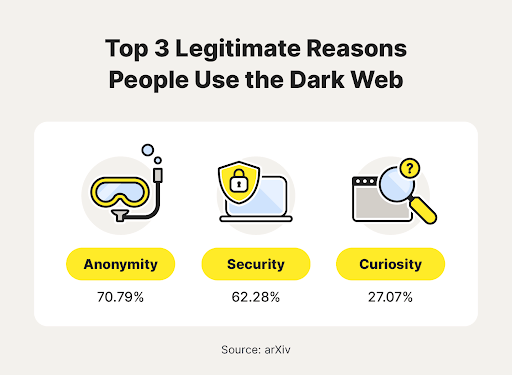
Top Reasons for using Dark Web
Threats and Risks of Dark Web
- Criminals: There is a chance that you will come across websites run by criminals. Aside from selling illegal goods and services, they may attempt to exploit and steal from you.
- Breaking the law: You may face legal consequences for your actions on the dark web. It is critical to act in a proper and legal manner.
- Suspicious links: If you click on any of the links, you may be directed to content that you do not want to see. Clicking a link or downloading a file could also infect your device with malware.
- Law enforcement: Officials from law enforcement agencies use the dark web to track down criminals. Law enforcement, like everyone else on the dark web, can work anonymously.
- Viruses: Some websites may infect your devices with viruses, and there are numerous types of viruses to be aware of. Never download anything from a website you do not trust.
- Hackers: On the dark web, you can find hacker forums and hire computer hackers to do illegal activities. Unsurprisingly, many of these individuals would be willing to hack your devices as well.
- Webcam hijacking: A dark web website may attempt to install a remote administration tool (also known as a "RAT") on your device. This can result in someone hijacking your webcam, allowing them to see what you're doing through your device's camera lens.
- Terrorism: Terrorists use the dark web to share information with other terrorists, recruit and radicalise new recruits, spread propaganda, raise funds, and coordinate actions and attacks. Terrorists also use the darknet to purchase illegal explosives and weapons using virtual currencies such as Bitcoin and other crypto-currencies.
- Child pornography: The Darknet has been used for human trafficking, child pornography, and other illegal activities.
Is the Dark Web Illegal?
- No, the dark web is not illegal in and of itself, but it can serve as a platform for illegal activity.
- There are several legitimate companies and entities with a presence on the dark web, and private users may also have legitimate reasons to access the dark web.
- Law enforcement and threat intelligence agencies are two examples of ethical uses for the dark web. These professionals may scour the dark web for indications of cybersecurity or data breaches, illegal activity, scams, or other emerging threats.
- The dark web also hosts a large amount of content that is not available anywhere else on the internet. This includes prohibited books, news article collections, and discussion forums.
- Six law enforcement agencies, including the FBI and Europol, collaborated in July 2017 to shut down two of the largest dark web marketplaces.
- The AlphaBay Market was the first, a darknet black market that ran on the Tor network. AlphaBay was eventually shut down by Operation Bayonet, a multinational law enforcement sting that seized the site's infrastructure and arrested its creator and administrator, Alexandre Cazes.
- The Silk Road, a black market created by Ross Ulbricht that became famous for hosting a forum for buying and selling illegal drugs, was the second dark web marketplace to be shut down that year.
Dark Web and India
- According to a 2019 survey, Indians make up 26% of all dark net users. It makes India the largest dark net marketplace.
- Access to the dark web is completely legal in India because it is simply another part of the internet, which is protected under Article 21 of the Indian constitution, which provides for the right to access the internet.
- Cybercrime on the dark or surface net is dealt with under the same legal framework in India, which includes the Information Technology Act of 2000, various sections of the Indian Penal Code 1860, the POCSO Act of 2012, and so on.
- The Centre has directed all law enforcement agencies to keep a close eye on foreign-based data and metadata content providers, as well as to make legislative changes to provide immunity for cyber hackers, which law enforcement agencies use to combat Dark web transactions.
- The Information Technology Act in India addresses cybercrime and is administered by the Ministry of Electronics and Information Technology. Cybercrime is addressed in only six sections of the law.
- The Centre for Advanced Computing is collaborating with the CSIR to create a darknet telescope-based cyber security monitoring and interference framework.
- This will aid law enforcement in tracking cyber criminals who sell illegal goods and services on such platforms, as well as tracking terrorism-related communications and activities.
Way Forward
- Nodal agency: As cryptocurrency becomes more mainstream, it will be used to facilitate dark web transactions more frequently. To prevent or reduce this, a nodal agency must be established to monitor crypto transactions used for criminal purposes.
- Cybercrime units around the world must be kept up to date on advancements in the darknet society, giving them the authority to handle and combat any illegal activity on the darknet. To address the issue, international cooperation is required.
- The Kerala Police Department's Cyberdome initiative, a premier facility dedicated to preventing cybercrime and mitigating cybersecurity threats to the state's critical information infrastructure, is a step in the right direction from which other concerned authorities across the country can learn.
Conclusion
When you consider the history of the internet as a whole, the dark web is a relatively new concept. If you want to express yourself freely, you can use it to remain anonymous without fear of repercussions. However, this level of privacy has contributed to its negative reputation as a forum for those looking to engage in illegal activities. It's as simple as installing a private browser, using a VPN, and keeping your computer safe and secure if you want to use the dark web.
| Other Relevant Links | |
|---|---|
| Science & Technology Policy in India | Scientific Policy Resolution 1958 |
| Science & Technology Policy of 1983 | Science & Technology Policy of 2003 |
| Science, Technology and Innovation Policy 2013 | New Initiatives Aligned with the National Agenda |
| India and World collaboration in science projects | National Intellectual Property Rights Policy |
FAQs
Question: What is the Dark Web?
Answer: The Dark Web is a hidden part of the internet, accessed via specific software like Tor, which allows users to remain anonymous.
Question: How does one access the Dark Web?
Answer: To access the Dark Web, users need special software like Tor or I2P to ensure anonymity and to access encrypted websites with .onion or .i2p domains.
Question: What are some threats associated with the Dark Web?
Answer: The Dark Web poses threats such as cybercrime, illegal activities, scams, hacking, and exposure to malicious content like malware.
Question: Is the Dark Web illegal?
Answer: Accessing the Dark Web itself is not illegal; however, engaging in illegal activities like buying drugs or weapons is against the law.
Question: What is the difference between the Deep Web and the Dark Web?
Answer: The Deep Web refers to parts of the internet not indexed by traditional search engines, whereas the Dark Web is a small, encrypted part of the Deep Web requiring specific tools for access.
MCQs
1. What is the primary purpose of the Tor network?
A) To access websites anonymously
B) To index websites
C) To host websites
D) To monitor internet traffic
Answer: (A) See the Explanation
Explanation: The Tor network allows users to access websites anonymously by routing internet traffic through multiple encrypted layers, hiding the user's IP address.
2. Which of the following domains is typically associated with Dark Web websites?
A) .com
B) .org
C) .onion
D) .gov
Answer: (C) See the Explanation
Explanation: Websites on the Dark Web typically use the .onion domain, which is accessible only through Tor or similar networks.
3. Which of the following is a key threat associated with the Dark Web?
A) Freedom of speech
B) Malware and scams
C) Political activism
D) Open-source software development
Answer: (B) See the Explanation
Explanation: The Dark Web is notorious for hosting illegal activities such as cybercrime, and a common threat is the spread of malware, scams, and fraudulent services.
4. How does accessing the Dark Web affect a user's online anonymity?
A) It decreases anonymity
B) It increases anonymity
C) It has no effect on anonymity
D) It makes the user visible to government agencies
Answer: (B) See the Explanation
Explanation: Using Tor or similar tools to access the Dark Web significantly increases the user's anonymity, protecting their identity and location.
5. What distinguishes the Dark Web from the Surface Web?
A) Dark Web is accessible to anyone
B) Dark Web is illegal
C) Dark Web requires specific software and is hidden from regular search engines
D) Dark Web contains only educational resources
Answer: (C) See the Explanation
Explanation: The Dark Web is not indexed by traditional search engines and requires specific software (like Tor) to access. It is hidden and cannot be accessed by regular web browsers.
GS Mains Questions and Model Answers
Q1: Discuss the implications of the Dark Web on global cybersecurity. How can countries address the risks associated with it?
Answer: The Dark Web has significant implications for global cybersecurity, as it is often used for illegal activities, including cybercrime, hacking, and the sale of illegal goods. Its anonymity features make it difficult for authorities to track down criminals, presenting a challenge for law enforcement agencies. Countries can address these risks by strengthening international cooperation in cybercrime investigations, improving cybersecurity laws, and implementing measures to monitor and disrupt illegal activities on the Dark Web. Moreover, investing in advanced cybersecurity technologies can help identify vulnerabilities and prevent the misuse of the Dark Web for malicious purposes. Legal frameworks that balance privacy and security are also crucial in mitigating the dangers posed by the Dark Web.
Q2: How does the existence of the Dark Web challenge traditional regulatory frameworks? Discuss potential solutions to regulate it effectively.
Answer: The Dark Web presents a challenge to traditional regulatory frameworks because it operates in an anonymous and decentralized manner, making it difficult for authorities to regulate content and activities. It allows individuals to conduct illegal transactions, including the trade of drugs, weapons, and stolen data, often bypassing conventional legal mechanisms. To regulate the Dark Web, governments could collaborate internationally to enforce cybersecurity laws, monitor illegal activities, and enhance law enforcement's capabilities to trace cybercriminals. A mix of proactive and reactive strategies, such as real-time monitoring of suspicious activities and tracking cryptocurrency transactions, can help curb illegal activities. Furthermore, ensuring that privacy protection does not overshadow the need for security can create a balanced regulatory framework.
Q3: Explain the role of encryption and anonymity in facilitating illegal activities on the Dark Web. What measures can be taken to prevent such misuse?
Answer: Encryption and anonymity are key factors that enable illegal activities on the Dark Web. The use of tools like Tor allows individuals to hide their identity and location, making it easier to engage in illegal activities such as selling drugs, weapons, or stolen data. While these tools can promote privacy, they also pose a significant risk as they shield perpetrators from detection. To prevent such misuse, governments should focus on improving international collaboration to track illegal activities while respecting privacy rights. Additionally, stronger cybersecurity measures, such as the development of advanced tracking systems and real-time surveillance, can help monitor and control illegal transactions. Education on cybersecurity, along with promoting secure but legal practices, is also essential to minimizing risks on the Dark Web.
Previous Year Questions on Dark Web
1. UPSC CSE Prelims 2020:
Question: Which of the following is a significant feature of the Dark Web?
A) It is indexed by search engines
B) It requires specific software for access
C) It contains only academic resources
D) It is regulated by international bodies
Answer: (B)
Explanation: The Dark Web requires specific software such as Tor to access, and it is not indexed by traditional search engines.
2. UPSC CSE Prelims 2018:
Question: Which of the following is the primary use of the Tor network?
A) To access deep web resources
B) To monitor internet traffic
C) To access the Dark Web securely
D) To conduct educational research
Answer: (C)
Explanation: Tor is primarily used to access the Dark Web securely and anonymously by hiding the user's location and activities.
Download the PREPP App and attempt FREE IAS Exam Mock Tests and get complete study material!
UPSC IAS : CSAT - Mini Live Test

Live Test : UPSC CSE Prelims CSAT (Paper-II) (Sep 20 - 23)
Full Test - 03: UPSC CSE Prelims CSAT (Paper-II)
Full Test - 02: UPSC CSE Prelims CSAT (Paper-II)
UPSC CSE Prelims 2026 GS Paper 1 Question Paper (24-May-2026)
UPSC CSE Prelims 2026 CSAT Paper 2 Question Paper (24-May-2026)

17 February 2025 | The Hindu Must Read Articles | Current Affairs

16 February 2026 | The Hindu Must Read Articles | Current Affairs

13 February 2026 | The Hindu Must Read Articles | Current Affairs









Comments