Cryogenic Technology – Science & Technology Notes
Cryogenic technology refers to the tools and processes that aid in the creation of low-temperature environments for the storage and transportation of liquefied gases. While this discipline has been evolving since the nineteenth century, it is currently experiencing unprecedented growth as a result of increased demand for cryo technology by a variety of industries. In this article, we will discuss in detail regarding Cryogenic Technology which will be helpful for UPSC exam preparation.
Table of Contents
- Cryogenic Technology – Background
- Cryogenic Technology
- Methods of Producing Cryogenic Temperatures
- Cryogenic Engine
- Semi Cryogenic Engine
- Advantages of Cryogenic Engine
- Cryogenic Technology and India
- Significance of Cryogenic Technology for India
- Application of Cryogenic Technology
- Challenges Related to Cryogenic Technology
- Conclusion
- FAQs
- MCQs
Cryogenic Technology – Background
- It all started in 1877, when Cailletet and Pictet successfully liquefied oxygen.
- Experiments were in full swing at the time, and liquid versions of other gases appeared quickly. For example, hydrogen was the first gas to be converted into a mist in 1884.
- Sir James Dewar invented a vacuum-insulated vessel for storing cryogenic liquids in 1892, making it easier to work with liquefied gases.
- In the years that followed, scientists were able to liquefy an increasing number of gases, including the last in line, helium. This gas was first used in liquid form in 1908.
- By 1945, Michael Faraday had succeeded in liquefying almost every known gas, except oxygen, hydrogen, nitrogen, carbon monoxide, methane, and nitric oxide.
- Lord Kelvin described the discovery of absolute zero (the lowest temperature possible). He then established the Kelvin scale, in which -459°F or -273°C corresponds to 0K, indicating the absence of heat energy.
- Heike Kammerling Onnes performed the liquefaction of helium gas, which has the lowest boiling point of any known substance (4.2K or -452°F).
What is Cryogenic Technology?
- The term "cryogenic technology" is derived from the Greek word "Kryos" (o), which means "cold."
- It is the science of producing, storing, transporting, and using materials at extremely low temperatures.
- Cold temperatures can cause interesting chemical reactions. Cooling, for example, causes substances to change from gas to liquid or solid.
- Cryogenic technology involves the use of extremely cold rocket propellants.
- For rocket engines that require a large amount of thrust, the combination of liquid oxygen and liquid hydrogen provides the highest energy efficiency.
- However, oxygen remains a liquid only at temperatures below -183 degrees Celsius, and hydrogen at temperatures below -253 degrees Celsius.
- Because liquid oxygen is highly reactive and combustible, it can be used as a propellant to transport large loads.
- It can be used to lift objects in space, store medicines and drugs at low temperatures, and so on. It is employed in the final stage of speed launch vehicles, or SPVs.
- Constructing a rocket stage with an engine powered by such propellants entails overcoming engineering challenges.
Methods of Producing Cryogenic Temperatures
- Heat conduction: It occurs when samples are immersed in cryogenic liquids or cryogenic atmospheres.
- Evaporative cooling: This method uses the energy released by water evaporation to cool the surrounding atmosphere.
- Cooling by rapid expansion (the Joule-Thompson effect): This effect provides a temperature drop when pressure is applied by rapidly expanding the volume of a valve or porous plug.
- Adiabatic demagnetization: Paramagnetic salts are used to absorb heat in this process.
- Laser cooling: It is a more recent procedure that uses lasers instead of electromagnets to help reduce energy in elements and thus provide cooling.
What is a Cryogenic Engine?
- A cryogenic engine or cryogenic stage is the final stage of a space launch vehicle that uses cryogenics.
- Cryogenics is the study of the production and behaviour of materials at extremely low temperatures (less than -150°C) in order to lift and place heavier objects in space.
- Its propellants are liquid oxygen (LOx) and liquid hydrogen (LH2).
- They are one of the most difficult to develop, and only six countries have them so far: the United States, China, Russia, France, Japan, and India.
- Cryogenic fuel is used in the upper stage of India's heaviest launch vehicles, the GSLV and GSLV Mk III.
What is Semi Cryogenic Engine?
|
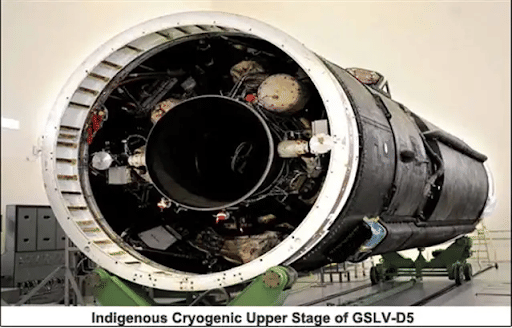
Cryogenic Upper Stage
Advantages of Cryogenic Engine
- When compared to solid and earth-storable liquid propellant rocket stages, it is more efficient and provides more thrust per kilogramme of propellant burned.
- Using a cryogenic upper stage instead of a solid fuel stage increases a rocket's payload carrying capacity.
- Both fuels (LOx and LH2) are less harmful to the environment than other solid, semi-cryogenic, and hypergolic propellants used in the rocket industry.
- Cryogenic propulsion systems (liquid Hydrogen and liquid Oxygen) have a significantly higher specific impulse (a measure of efficiency) than ground storage liquid and solid propellants, providing a significant payload advantage.
- The cryogenic stage is a technically complex device when compared to ground storage based liquid and solid propellants due to the use of propulsion systems at freezing temperatures as well as the attendant thermomechanical difficulties.
Cryogenic Technology and India
- The GSLV D5 is a rocket (launch vehicle) used to launch the satellite GSAT 14. The cryogenic rocket engine used in this launch vehicle used cryogenic propellants at low temperatures.
- India has already successfully launched numerous satellites using launch vehicles from the PSLV and GSLV series.
- However, this was the first time India successfully launched a satellite using an indigenously developed cryogenic engine.
- We used Russian cryogenic engines in previous GSLV missions. However, we have mastered cryogenic technology and emerged as a major space power.
- The GSLV is a three-stage launch vehicle that consists of solid, liquid, and cryogenic stages.
- It is intended to launch 2 Tonne communication satellites into Geosynchronous Transfer Orbit (GTO).
- The first and second stages of the GSLV-D5 vehicle are similar to those used in previous GSLV missions. The indigenous cryogenic stage is the third stage.
- CE-7.5 is the name of India's indigenous cryogenic engine. This cryogenic rocket engine powers the GSLV's upper stage.
- As part of the Cryogenic Upper Stage Project (CUSP), the engine was created. It will take the place of the KVD-1 (RD-56) that currently powers the upper stage of the GSLV.
- C32 LH2 is Hindustan Aeronautics Limited's largest cryogenic propellant tank to date. It was recently delivered to ISRO.
- It is intended to boost the payload capacity of ISRO's Geosynchronous Satellite Launch Vehicle Mark III (GSLV Mk III) from 4 to 6 tonnes.
- The goal is to achieve self-sufficiency in terms of transporting heavier communication satellites into space.
- An MoU was signed in 2013 between the Indian Space Research Organisation (ISRO) and Hindustan Aeronautics Limited (HAL) to establish a facility for the manufacturing of cryogenic engine modules at HAL's Aerospace Division.
- This MoU was amended in 2016 to include a Rs.208 crore investment in the establishment of the Integrated Cryogenic Engine Manufacturing Facility (ICMF).
- It houses more than 70 high-tech machines and testing facilities for the production of cryogenic (CE20) and semi-cryogenic (SE2000) engines for Indian rockets.
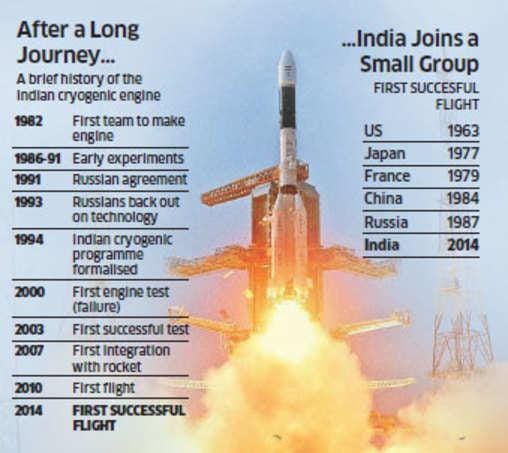
Timeline of Cryogenic Engine
Significance of Cryogenic Technology for India
- After the United States, France, Japan, China, and Russia, India is only the sixth country to develop a cryogenic engine.
- It is an important technology for India because it allows India to launch heavy satellites (weighing more than 2500-3000kg) using cryogenic engines, which is critical for the success of the GSLV programme.
- The technology is also significant in light of the fact that India was denied this technology by the United States in the 1990s, when India was negotiating a technology transfer agreement with a Russian agency.
- With this technology, India no longer needs to rely on other space agencies.
- It will not only allow ISRO to explore deeper into space, but it will also generate additional revenue, allowing it to conduct commercial launches of heavier satellites.
- By providing cost-effective and dependable services, India can gain access to the Asian and African space markets, which are looking to India in this regard.
Application of Cryogenic Technology
Automotive
Cold shrink technology is widely used in the automotive industry. This advanced technology ensures that individual engine components temporarily freeze and shrink slightly, allowing them to be pressed into the engine with a light force during assembly. The part will expand and become firmly anchored in the engine as it warms up again.
Electronics
Extremely cold liquid gases are primarily used in the testing of electronic devices. Liquid nitrogen is commonly used to determine whether equipment can withstand cold temperatures in normal use.
Food
- Liquid gases are used in the food industry for cryogenic cooling and product safety packaging.
- The processing speed and the fact that products are preserved for a long time while maintaining their shape are two advantages of cryogenic technology in this industry.
LNG
- LNG (Liquefied Natural Gas) has some environmental benefits for the shipping and road transport sectors and is thus becoming more popular as a fuel.
- LNG must be stored at -162 °C to remain liquid, which necessitates advanced cryogenic infrastructure.
Marine
- In the marine industry, LNG is used and stored in a variety of ways. Some ships use the gas to power their engines, while others transport it in large storage tanks (bunkers).
- LNG storage facilities, known as LNG-plants, can also be found in port areas.
Medical
In the medical field, liquid nitrogen is especially popular. This liquid gas is used to perform specific medical treatments as well as to preserve complex biological structures (cryopreservation is a method used to preserve blood, cells, organs, DNA, and sperm).
Pharmaceutical
- Liquid nitrogen is also used extensively in the pharmaceutical industry.
- This liquid gas is commonly used to cool cryogenic storage vessels and to shape medications into pills.
Scientific Research
- Cryogenic gases, in addition to being extremely cold, can generate enormous power. As a result, these gases are frequently studied in physics.
- Because helium is one of the coldest and most powerful liquid gases, it is widely used to cool particle accelerators.
Space
- Cryogenic gases are frequently used in the space industry, in part due to the enormous power they can generate.
- Cryogenic techniques, for example, are used to launch satellites and vehicles; liquid gas serves as fuel (for a cryo engine).
- Simultaneously, cryogenics is frequently used in scientific experiments in the space industry.
Hydrogen
- Hydrogen is a versatile, clean, and safe energy carrier that can be used as a "fuel" in a fuel cell or as an industrial feedstock.
- Only (water) vapour is released when hydrogen is burned. In terms of sustainability, this makes hydrogen a one-of-a-kind fuel.
- In the coming years, hydrogen will play an increasingly important role in the marine industry, the industrial sector, and the space industry.
Air Separation
Air separation occurs in air separation units, which purify air for the bulk production of nitrogen, oxygen, argon, and some noble gases.
Challenges Related to Cryogenic Technology
Injury caused by extreme cold
The cold vapours and gases emitted by cryogenic liquids can cause skin irritation. When exposed to cryogenic materials for an extended period of time, the skin can freeze completely and then thaw, leaving behind an irritating abrasion that resembles a severe burn.
Toxic substances are dangerous
When gases are highly concentrated, they have a negative impact on health. For example, liquid carbon monoxide can emit carbon monoxide gas, which can be fatal.
Fire and explosion hazards
A large number of gases are flammable and explode when they come into contact with fire. Hydrogen, methane, liquefied natural gas (LNG), and carbon monoxide are all flammable gases.
Rapid expansion leads to explosion
Not only can fire cause liquid gases to explode, but so can pressure. Huge pressure can build up in cryogenic storage vessels or within a pipeline if ventilation or overpressure relief devices are not properly functioning. This can cause a BLEVE (boiling liquid expanding vapour explosion).
Loss of high value gases
- The loss of cryogenic gases is a final risk when working with them. Gas must be kept at the proper temperature at all times in order to remain liquefied.
- Loss in gaseous form can occur when it accidentally warms up or deteriorates in infrastructures.
Conclusion
Indian researchers conducted the first operational cryogenic engine test in 2003, followed by the successful launch of the "Maiden" in 2014. ISRO is working on a number of future projects, including PS2/GS2 connectivity, semi-cryo superstructure manufacturing, and cryo and semi-cryo engine manufacturing, for which the necessary infrastructure and equipment are nearly complete. In the future, India is likely to become a satellite space power, and the government intends to implement policies that encourage scientific and technological research.
| Other Relevant Links | |
|---|---|
| Science & Technology Policy in India | Scientific Policy Resolution 1958 |
| Science & Technology Policy of 1983 | Science & Technology Policy of 2003 |
| Science, Technology and Innovation Policy 2013 | New Initiatives Aligned with the National Agenda |
| India and World collaboration in science projects | National Intellectual Property Rights Policy |
FAQs
Question. What is cryogenic technology?
Answer: Cryogenic technology involves the production and use of extremely low temperatures (below -150°C) to liquefy gases, which have applications in industries such as space exploration, medical fields, and energy storage.
Question. What are some applications of cryogenic technology?
Answer: Cryogenic technology is used in space exploration (rocket propulsion), medical applications (cryopreservation), liquefied natural gas (LNG) production, and various industrial processes that require low temperatures.
Question. How is cryogenic technology used in space exploration?
Answer: In space exploration, cryogenic technology is used in rocket propulsion systems, where liquid oxygen and liquid hydrogen are used as propellants for efficient space travel.
Question. What role does cryogenic technology play in medical applications?
Answer: Cryogenic technology is used in cryopreservation, where biological materials like blood, tissues, and embryos are preserved at low temperatures for future use.
Question. Why is cryogenic technology important for energy storage and transportation?
Answer: Cryogenic technology helps in the liquefaction of natural gas (LNG), making it easier to store and transport gas over long distances. It also has potential applications in energy storage solutions, helping store energy for later use.
MCQs
- What is the main application of cryogenic technology in space exploration?
A) Rocket propulsion systems
B) Data transmission systems
C) Communication systems
D) Solar energy storage
Answer: (A) See the Explanation
Cryogenic technology is essential in rocket propulsion, where liquid oxygen and liquid hydrogen are used as propellants in rocket engines.
- Which of the following gases are typically used in cryogenic technology?
A) Hydrogen and helium
B) Oxygen and nitrogen
C) Methane and ammonia
D) All of the above
Answer: (D) See the Explanation
Cryogenic technology uses gases such as oxygen, nitrogen, hydrogen, and others, which are liquefied at extremely low temperatures for various applications.
- What temperature is typically considered in cryogenic technology?
A) Below -50°C
B) Below -150°C
C) Below -200°C
D) Below -100°C
Answer: (B) See the Explanation
Cryogenic technology typically involves temperatures below -150°C, where gases like oxygen, nitrogen, and hydrogen can be liquefied.
- How does cryogenic technology contribute to the liquefied natural gas (LNG) industry?
A) By using high-pressure systems for gas storage
B) By liquefying natural gas for easier transportation and storage
C) By converting LNG into solid form for storage
D) By increasing the combustion efficiency of LNG
Answer: (B) See the Explanation
Cryogenic technology allows for the liquefaction of natural gas, making it more efficient for storage and transportation over long distances.
- What is the role of cryogenics in cryopreservation?
A) To store large quantities of energy for medical treatments
B) To preserve biological materials at very low temperatures
C) To create artificial organs
D) To improve the efficiency of medical devices
Answer: (B) See the Explanation
Cryogenic technology is used in cryopreservation, where biological materials like blood, tissues, and embryos are stored at extremely low temperatures for future use.
GS Mains Questions and Model Answers
Q1: Explain the significance of cryogenic technology in space exploration.
Answer: Cryogenic technology plays a crucial role in space exploration by enabling efficient rocket propulsion systems. In space missions, liquid oxygen (LOX) and liquid hydrogen are used as propellants in cryogenic engines due to their high energy efficiency. These engines have a higher specific impulse, meaning they provide more thrust per unit of fuel, making them ideal for space travel. The use of cryogenic propellants in rocket engines allows for longer missions and more fuel-efficient launches, which is essential for sending spacecraft farther into space. Additionally, cryogenic technology enables liquid hydrogen storage, which is vital for the operation of spacecraft during long-duration missions. The development of cryogenic systems has also led to innovations in materials science, including the development of high-strength, low-temperature resistant materials. Overall, cryogenic technology has revolutionized space exploration, making it possible to send spacecraft on distant missions and deep space exploration.
Q2: Discuss the role of cryogenic technology in medical applications and its impact on modern healthcare.
Answer: Cryogenic technology has made a significant impact in modern healthcare, particularly in cryopreservation, where biological materials are stored at extremely low temperatures for future use. Cryopreservation plays a vital role in preserving blood, tissues, embryos, and even organs for transplantation, ensuring that these materials remain viable for medical treatments. This technology has revolutionized fertility treatments, where embryos are stored and preserved before being implanted in patients. Cryogenic storage is also used for preserving sperm, eggs, and stem cells, providing patients with the opportunity to maintain their fertility or undergo medical procedures later in life. In surgical treatments, cryogenic techniques are used in cryosurgery, where extreme cold is applied to destroy abnormal or diseased tissue, such as cancerous cells. The advancement of cryogenic technology has enhanced the capabilities of modern medicine, improving the quality of medical procedures and expanding the possibilities for life-saving treatments.
Q3: Evaluate the impact of cryogenic technology on energy storage and environmental sustainability.
Answer: Cryogenic technology has significant potential for improving energy storage and contributing to environmental sustainability. One of the most promising applications is in the storage and transportation of liquefied natural gas (LNG). By cooling natural gas to its liquid form, cryogenic technology allows for efficient storage and transportation over long distances, making it more feasible to use natural gas as a cleaner alternative to traditional fossil fuels. In terms of energy storage, cryogenic energy storage systems, also known as liquid air energy storage, use liquefied air or nitrogen to store energy. This energy can be released on demand, providing a sustainable solution for renewable energy storage from sources like solar and wind. The efficiency of cryogenic systems in storing and releasing energy helps reduce reliance on carbon-intensive energy sources and supports the transition to green energy. As a result, cryogenics contributes significantly to reducing greenhouse gas emissions and promoting sustainable energy solutions.
Previous Year Questions on Cryogenic Technology
1. UPSC CSE 2020
Question: "How does cryogenic technology contribute to the development of rocket propulsion systems?"
Answer: Cryogenic technology enables the use of liquid oxygen and liquid hydrogen as propellants in rocket propulsion systems, providing high energy efficiency and a higher specific impulse. This makes cryogenic engines ideal for space exploration by allowing spacecraft to travel greater distances while using less fuel.
2. UPSC CSE 2019
Question: "Discuss the role of cryogenics in medical science and its applications in healthcare."
Answer: Cryogenics plays a key role in medical science through cryopreservation, which preserves biological materials such as blood, tissues, and embryos for future medical use. It is also used in cryosurgery for treating tumors, making it an essential tool for modern healthcare and reproductive medicine.
Download the PREPP App and attempt FREE IAS Exam Mock Tests and get complete study material!

Full Test - 04: UPSC CSE Prelims CSAT (Paper-II)
Full Test - 03: UPSC CSE Prelims CSAT (Paper-II)
UPSC CSE Prelims 2026 GS Paper 1 Question Paper (24-May-2026)
UPSC CSE Prelims 2026 CSAT Paper 2 Question Paper (24-May-2026)

17 February 2025 | The Hindu Must Read Articles | Current Affairs

16 February 2026 | The Hindu Must Read Articles | Current Affairs

13 February 2026 | The Hindu Must Read Articles | Current Affairs









Comments