Duration of Rajya Sabha – Indian Polity Notes
The Rajya Sabha, also known as the Upper House of Parliament, is a permanent body that cannot be dissolved. The Rajya Sabha is the body in the Indian Parliament that represents the states. In this article, we will discuss more the Duration of the Rajya Sabha.
|
Table of Contents |
Duration of Rajya Sabha
- The term of office of Rajya Sabha members is not specified in the Constitution and is left to the discretion of the Parliament.
- As a result, the Parliament provided in the Representation of the People Act (1951) that Rajya Sabha members' term of office shall be six years.
- The act also gave the President of India the authority to shorten the terms of members elected to the first Rajya Sabha.
- In the first batch, it was decided by lottery who should retire.
- Furthermore, the act empowered the President to make provisions governing the order of retirement of Rajya Sabha members.
- In accordance with this, the president issued the Rajya Sabha (Term of Office of Members) Order, 1952.
- However, every second year, one-third of its members retire.
- At the start of every third year, new elections and presidential nominations are held to fill their seats.
- Re-election and renomination are available to retiring members any number of times.
- A member elected to fill a mid-term vacancy, on the other hand, serves only for the remainder of the term.
|
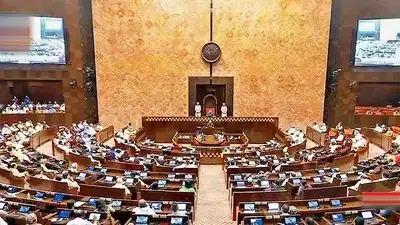
"The Rajya Sabha, as the Council of States, serves as the voice of the states in the Indian Parliament.” |
Conclusion
Aside from the coordinated powers it shares with the Lok Sabha, the Constitution gives the Rajya Sabha some special powers to carry out its federal mandate as it represents states and union territories in Parliament. Such special powers bolster its standing as an Upper House in comparison to the Lok Sabha.The upper house also acts as a safety valve and a check system for all the functions of the lower house.
FAQs
Question. What is the Rajya Sabha and what is its duration in Indian polity?
Answer: The Rajya Sabha, also known as the Council of States, is the upper house of the Indian Parliament. It represents the states and union territories of India. The Rajya Sabha is a permanent body and is not subject to dissolution. The members of the Rajya Sabha are elected for a term of six years, with one-third of its members retiring every two years. This system ensures that the Rajya Sabha is a continuous body and always has a combination of experienced and newly elected members.
Question. How is the Rajya Sabha different from the Lok Sabha in terms of duration?
Answer: The main difference between the Rajya Sabha and the Lok Sabha in terms of duration lies in the dissolution and election process:
- The Rajya Sabha is a permanent body, and it is not dissolved at the end of each term. Its members serve for six years with one-third of the members retiring every two years.
- The Lok Sabha, on the other hand, is dissolved after its five-year term, and fresh elections are held to form a new Lok Sabha.
Question. How are members elected to the Rajya Sabha?
Answer: Members of the Rajya Sabha are elected through a single transferable vote system in proportional representation by the elected members of the State Legislative Assemblies, and by the members of the electoral college for Union Territories, using the system of indirect election. Additionally, the President of India can nominate up to 12 members from fields like literature, science, art, and social services.
Question. What happens when members of the Rajya Sabha retire?
Answer: When members of the Rajya Sabha retire, a process of re-election or nominations takes place. Since one-third of the members retire every two years, the remaining members continue their terms, ensuring that the Rajya Sabha always has members with experience. New members are elected to replace the retiring members, and the President may also nominate new members to fill the vacancies created.
Question. What is the significance of the Rajya Sabha's duration and its system of re-election?
Answer: The duration and the system of re-election in the Rajya Sabha are significant because they help maintain stability and continuity in the functioning of the upper house of Parliament. By having a non-dissolvable body and a system where only one-third of members retire at any given time, the Rajya Sabha ensures that there is always a balance between experienced legislators and new members. This system facilitates a more measured and reflective approach to legislation, as opposed to the Lok Sabha, which is subject to a complete renewal every five years.
MCQs
- For how many years are members of the Rajya Sabha elected?
A) 4 years
B) 5 years
C) 6 years
D) 7 years
Answer: (C) See the Explanation
The members of the Rajya Sabha are elected for a term of six years.
- What is the main difference between the Rajya Sabha and Lok Sabha in terms of duration?
A) The Rajya Sabha is dissolved every 5 years
B) The Rajya Sabha is a permanent body
C) The Rajya Sabha is dissolved every 6 years
D) The Lok Sabha is a permanent body
Answer: (B) See the Explanation
The Rajya Sabha is a permanent body, unlike the Lok Sabha, which is dissolved after every five-year term.
- Which of the following is true about the Rajya Sabha?
A) It is elected by the people directly
B) It is dissolved every 5 years
C) It is a permanent body with members retiring every two years
D) It has a term of 4 years for its members
Answer: (C) See the Explanation
The Rajya Sabha is a permanent body with one-third of its members retiring every two years.
- How are members of the Rajya Sabha elected?
A) By direct elections from the public
B) By the President
C) By the members of the State Legislative Assemblies through proportional representation
D) By the Parliament
Answer: (C) See the Explanation
Members of the Rajya Sabha are elected by the members of the State Legislative Assemblies through proportional representation.
- Who nominates members to the Rajya Sabha from fields such as literature and art?
A) The Prime Minister
B) The President of India
C) The Chief Justice of India
D) The Speaker of the Lok Sabha
Answer: (B) See the Explanation
The President of India can nominate 12 members to the Rajya Sabha from fields such as literature, art, science, and social services.
GS Mains Questions and Model Answers
Q1: Explain the role of the Rajya Sabha in the Indian Parliament and discuss its significance in maintaining a balance of power in the legislature.
Answer: The Rajya Sabha, or Council of States, is the upper house of the Indian Parliament. It plays a critical role in maintaining a balance of power in the Indian legislative system. Unlike the Lok Sabha, which represents the people directly, the Rajya Sabha represents the states and union territories. Its six-year term, with one-third of its members retiring every two years, ensures continuity in the legislative process, allowing for careful deliberation of bills and policies. The Rajya Sabha serves as a revising body, reviewing and amending legislation passed by the Lok Sabha. Its non-dissolvable nature ensures that there is always a group of experienced legislators, providing a stable and reflective approach to lawmaking. The Rajya Sabha’s role in representing states also ensures that smaller states are not overshadowed by larger states, maintaining the federal balance within the Indian Union.
Q2: Discuss the advantages and disadvantages of the Rajya Sabha being a permanent body with a non-dissolvable structure.
Answer: The fact that the Rajya Sabha is a permanent body with a non-dissolvable structure offers both advantages and disadvantages:
- Advantages: The primary advantage is continuity. Since only one-third of members retire every two years, the Rajya Sabha maintains a stable and experienced membership. This allows the house to perform its duties without disruption, facilitating a more measured approach to legislation. Moreover, this structure provides an opportunity for a long-term perspective in discussions, as seasoned members can guide new entrants.
- Disadvantages: On the other hand, the Rajya Sabha’s unelected nature and the fact that its members are not directly accountable to the public can lead to criticisms of undemocratic functioning. Additionally, its role in scrutinizing bills might delay the legislative process, particularly in times of political urgency. The absence of complete renewal may also result in less dynamic membership compared to the Lok Sabha, which is dissolved and reconstituted regularly, allowing fresh mandates and perspectives.
Q3: Evaluate the process of re-election in the Rajya Sabha and its impact on legislative processes.
Answer: The process of re-election in the Rajya Sabha is distinct because only one-third of its members retire every two years, ensuring that the body remains partially renewed at all times. This system allows for a balance between fresh perspectives and experienced legislators, ensuring both stability and dynamism in the legislative process. The continuous nature of the Rajya Sabha helps in maintaining a long-term legislative view, particularly in revising and scrutinizing bills passed by the Lok Sabha. The re-election process also ensures that regional representation remains robust, as members are elected from state assemblies, reflecting the federal nature of India’s political structure. However, this process may also limit the opportunity for complete change, potentially leading to stagnation or delay in addressing newer issues or political ideologies. Nevertheless, the re-election process ensures that the Rajya Sabha remains an important revising body that can balance the political dynamics in the country’s governance.
Previous Year Questions Duration of Rajya Sabha
1. UPSC 2020
Question: Discuss the role of the Rajya Sabha in the legislative process and its significance in Indian democracy.
Answer: This question required candidates to explain the role of the Rajya Sabha in the Indian legislative process, particularly its function as a revising and deliberative body that ensures a more measured approach to passing laws. The significance of its permanent nature and the representation of states was also emphasized.
2. UPSC 2019
Question: Examine the structure and functioning of the Rajya Sabha in comparison to the Lok Sabha.
Answer: This question required an examination of the structural differences between the Rajya Sabha and the Lok Sabha, particularly their composition, duration, and functions. The unique feature of the Rajya Sabha being permanent and non-dissolvable was discussed in comparison to the Lok Sabha, which is dissolved every five years.
*email: contactus@prepp.in
Download the PREPP App and attempt FREE IAS Exam Mock Tests and get complete study material!

Live Test : UPSC CSE Prelims CSAT (Paper-II) (Oct 20 - 23)
Full Test - 04: UPSC CSE Prelims CSAT (Paper-II)
Full Test - 03: UPSC CSE Prelims CSAT (Paper-II)
UPSC CSE Prelims 2026 GS Paper 1 Question Paper (24-May-2026)
UPSC CSE Prelims 2026 CSAT Paper 2 Question Paper (24-May-2026)

17 February 2025 | The Hindu Must Read Articles | Current Affairs

16 February 2026 | The Hindu Must Read Articles | Current Affairs

13 February 2026 | The Hindu Must Read Articles | Current Affairs









Comments