Difference Between Lok Sabha and Vidhan Sabha – Indian Polity Notes
Lok Sabha deals with national legislation and policies, while Vidhan Sabha deals with state-specific legislation and policies. Both are directly elected by the public. In this article we will discuss more about the Difference Between Lok Sabha and Vidhan Sabha which is important for UPSC Examination.
|
Table of Contents |

Constitutional Provisions
Lok Sabha
| Article 75 | Council of Ministers are collectively accountable to the Lok Sabha. |
| Article 81 | Provisions for changing the size of the Lok Sabha. |
| Article 81(3) | States that the number of Lok Sabha seats cannot be changed until after 2026. |
| Article 83(2) | States that the Lok Sabha will be in session for a period of five years, unless sooner dissolved, beginning on the date set for its first meeting and ending on the date set for its last meeting, and the expiration of that period will result in the dissolution of the house. |
| Article 85 | President of India has the authority to dissolve the Lok Sabha. |
| Article 94 | Speaker can be removed by a resolution passed with an effective majority, i.e., more than 50%of the members of the house. |
| Article 326 | Lok Sabha elections will be on the basis of adult suffrage. |
| Article 331 | Provides for representation of the Anglo-Indian Community.(recently removed) |
Vidhan Sabha
- Article 168 states that the legislature of each state consists of the Governor and one or two Houses.
- Article 170 states the composition of the Legislative Assembly.
- Article 174 states that the Governors shall from time to time summon the Legislature to meet at such time and place as he thinks fit.
- However, no more than six months should elapse between its last sitting in one session and the date set for its next sitting.
- Article 191 states the terms on which a person is ineligible/disqualified to be elected to the State Legislature of a State.
- Article 333 states that the state's Legislative Assembly would have a maximum of 500 members and a minimum of 60 members.
- The 42nd Amendment Act of 1976 increased the term of the legislative assembly of states from five to six years.
- The 44th Amendment Act of 1978 restored the State Legislative Assemblies' terms to five years.
|
Lok Sabha deals with national legislation and policies, while Vidhan Sabha deals with state-specific legislation and policies. |
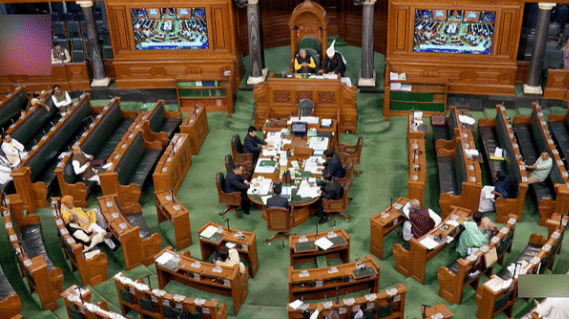
Difference Between Lok Sabha and Vidhan Sabha
| Lok Sabha | Vidhan Sabha |
|---|---|
| The Lok Sabha is India's lower house of parliament, which is bicameral. | The Vidhan Sabha is the legislative body of India's states and union territories. |
| The maximum strength of Lok Sabha prescribed by the Constitution of India is 550 with 530 members representing the States and 20 representing the Union Territories. | According to the Indian Constitution, the Vidhan Sabha must have at least 60 members and no more than 500 members. For states and union territories with fewer than 60 members, exceptions are made by an Act of Parliament. |
| The President can dissolve the Lok Sabha in a state of emergency. | The Governor of any state may dissolve the Vidhan Sabha at the request of the Chief Minister during a state of emergency. |
| Only in the Lok Sabha can a motion of no confidence against the government be introduced and passed. If a majority vote is obtained, the Prime Minister and the Council of Ministers resign collectively. | Only in the Vidhan Sabha can a motion of no confidence against the state government be introduced and passed. If a majority vote is obtained, the Chief Minister and the Council of Ministers resign collectively. |
| Money Bills can only be introduced in the Lok Sabha, and once passed, they are sent to the Rajya Sabha for 14 days of debate. If there is no rejection after 14 days, the bill is considered passed. | Only the Vidhan Sabha has the authority to introduce a money bill. They can be sent to the Vidhan Parishad (State Legislative Council) for 14 days of deliberation in a bicameral setup. |
| If the Lok Sabha is dissolved before or after a declaration of national emergency, the Rajya Sabha becomes the country's sole parliamentary authority. | The Vidhan Sabha can form or dissolve the Vidhan Parishad by passing a resolution with a majority of at least two-thirds of the members voting. |
Conclusion
The Lok Sabha and Vidhan Sabha are integral components of India's legislative framework, each serving distinct yet complementary roles at different levels of government. The Lok Sabha focuses on shaping policies and laws that affect the entire country and Vidhan Sabha operates at the state level, addressing region-specific issues and ensuring localized governance through its directly elected representatives.
FAQs
Question: What is the difference between Lok Sabha and Vidhan Sabha?
Answer: The Lok Sabha is the lower house of the Parliament of India, representing the entire country, while the Vidhan Sabha (Legislative Assembly) is the lower house of the state legislature, representing the people of a specific state. The Lok Sabha deals with national issues, while the Vidhan Sabha focuses on state matters.
Question: How are the members of Lok Sabha elected?
Answer: Members of the Lok Sabha are directly elected by the people of India through general elections, which are held every five years. The elections are conducted based on the first-past-the-post system in single-member constituencies across the country.
Question: How is the Vidhan Sabha different from the Lok Sabha in terms of legislative powers?
Answer: The Vidhan Sabha has legislative powers on matters enumerated in the State List of the Constitution, whereas the Lok Sabha handles issues in the Union List and Concurrent List. However, the Lok Sabha holds more authority on matters of national importance, including budgetary matters.
Question: What is the role of the Speaker in the Lok Sabha?
Answer: The Speaker of the Lok Sabha is responsible for maintaining order during debates, ensuring that the proceedings are conducted in a fair manner, and deciding on matters such as admissibility of questions, motions, and resolutions. The Speaker is elected by the members of the Lok Sabha.
Question: What is the role of the Vidhan Sabha in the state's governance?
Answer: The Vidhan Sabha plays a crucial role in the governance of the state by passing laws, approving budgets, and holding the state government accountable. It debates and discusses matters related to state policies, law enforcement, and welfare of the people in the state.
MCQs
1. Which of the following houses deals with national issues in India?
A) Rajya Sabha
B) Lok Sabha
C) Vidhan Sabha
D) Panchayat
Answer: (B) See the Explanation
Explanation: The Lok Sabha is responsible for handling national issues, while the Vidhan Sabha handles state-specific matters.
2. How are the members of the Vidhan Sabha elected?
A) By the President
B) Through indirect elections
C) By the people of the respective states
D) By the members of the Lok Sabha
Answer: (C) See the Explanation
Explanation: The members of the Vidhan Sabha are directly elected by the people of the respective state through general elections held every five years.
3. Which of the following is the correct jurisdiction of the Lok Sabha?
A) National issues and matters related to the Union List
B) Only state matters
C) Matters related to public health
D) Only environmental issues
Answer: (A) See the Explanation
Explanation: The Lok Sabha has jurisdiction over national issues and matters related to the Union List in the Constitution, while the Vidhan Sabha deals with state-specific issues.
4. What is the maximum tenure of a Vidhan Sabha?
A) 3 years
B) 5 years
C) 6 years
D) 4 years
Answer: (B) See the Explanation
Explanation: The maximum tenure of a Vidhan Sabha is 5 years, after which fresh elections are held, unless dissolved earlier by the Governor.
5. Who is responsible for maintaining order in the Lok Sabha?
A) The President of India
B) The Speaker of the Lok Sabha
C) The Prime Minister
D) The Vice President of India
Answer: (B) See the Explanation
Explanation: The Speaker of the Lok Sabha is responsible for maintaining order during the proceedings and ensuring that the rules and procedures are followed.
GS Mains Questions and Model Answers
Q1: Discuss the constitutional powers and functions of the Lok Sabha. How does it differ from the Vidhan Sabha in terms of its jurisdiction and powers?
Answer: The Lok Sabha, as the lower house of Parliament, holds significant powers, including the ability to introduce and pass national legislation, approve budgets, and hold the government accountable. Its powers extend to matters mentioned in the Union List and Concurrent List of the Constitution. In contrast, the Vidhan Sabha, as the state legislature, deals with issues related to the State List and has legislative authority over matters confined to the state. The Lok Sabha also plays a critical role in the selection of the Prime Minister and in discussions related to national defense, foreign policy, and economic policies.
Q2: Explain the role of the Vidhan Sabha in the governance of states in India. What challenges does the Vidhan Sabha face in performing its functions?
Answer: The Vidhan Sabha, as the state legislature, plays a vital role in the governance of the state by enacting laws, scrutinizing the state budget, and holding the executive accountable. It discusses important state matters like agriculture, health, education, and infrastructure development. However, challenges faced by the Vidhan Sabha include lack of adequate powers in comparison to the Union government, issues related to political instability in some states, and difficulties in addressing complex state-level issues within the available legislative time frame.
Q3: Analyze the Speaker's role in the Lok Sabha. How does the Speaker ensure the smooth functioning of the house?
Answer: The Speaker of the Lok Sabha plays an essential role in ensuring the smooth functioning of the house by maintaining order, managing debates, and deciding on points of order. The Speaker decides on the admissibility of questions, motions, and resolutions and ensures that debates are conducted according to parliamentary procedures. Additionally, the Speaker has the authority to take disciplinary actions against members who disrupt the proceedings. The Speaker also represents the Lok Sabha in its relations with the President of India and other external bodies.
Previous Year Questions on Lok Sabha and Vidhan Sabha
1. UPSC CSE Prelims 2021:
Question: The Lok Sabha of India can be dissolved by which of the following?
A) The President
B) The Prime Minister
C) The Chief Justice of India
D) The Vice President
Answer: (A)
Explanation: The President of India has the authority to dissolve the Lok Sabha, which leads to general elections being held.
2. UPSC CSE Mains 2019 (GS Paper 2):
Question: "Evaluate the functioning of the Lok Sabha and Vidhan Sabha in maintaining democracy in India. What are the similarities and differences in their powers and functions?"
Answer: Both the Lok Sabha and Vidhan Sabha play significant roles in ensuring democratic governance in India. The Lok Sabha represents the entire nation, while the Vidhan Sabha represents individual states. While the Lok Sabha has authority over national matters and plays a pivotal role in electing the Prime Minister and passing crucial national laws, the Vidhan Sabha is more focused on state-level legislation. The challenge lies in balancing powers between these legislative bodies and ensuring that states' interests are also effectively represented.
*email: contactus@prepp.in
Download the PREPP App and attempt FREE IAS Exam Mock Tests and get complete study material!

Live Test : UPSC CSE Prelims CSAT (Paper-II) (Oct 20 - 23)
Full Test - 04: UPSC CSE Prelims CSAT (Paper-II)
Full Test - 03: UPSC CSE Prelims CSAT (Paper-II)
UPSC CSE Prelims 2026 GS Paper 1 Question Paper (24-May-2026)
UPSC CSE Prelims 2026 CSAT Paper 2 Question Paper (24-May-2026)

17 February 2025 | The Hindu Must Read Articles | Current Affairs

16 February 2026 | The Hindu Must Read Articles | Current Affairs

13 February 2026 | The Hindu Must Read Articles | Current Affairs









Comments