Composition of Lok Sabha – Indian Polity Notes
The maximum strength of Lok Sabha prescribed by the Constitution of India is 550 with 530 members representing the States and 20 representing the Union Territories. At present, the Lok Sabha has 543 seats filled by elected representatives. Lok Sabha had two reserved seats for an Anglo-Indian community, nominated by the President However, in 2020, by 104th Constitutional Amendment Act, 2019, reservation of these seats was abolished for Parliament as well as State Legislatures. This Article explains that the Composition of Lok Sabha and The Constitutional provisions are important topics for the UPSC IAS exam preparation.
|
Table of Contents |

Composition Of Lok Sabha
| Details | Description |
|---|---|
| Constitutional Provision |
|
| Strength |
|
| Current Strength |
|
| Presiding officer |
|
| Absence of Speaker |
|
| Removal of Speaker and Deputy Speaker |
|
|
"The Lok Sabha is a vibrant reflection of India's democratic spirit, comprising directly elected representatives from across the nation's constituencies, it embodies the diverse voices and aspirations of over a billion citizens” |
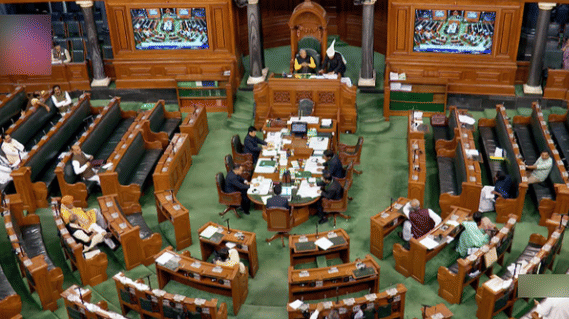
Representation in Lok Sabha
- Representation of Scheduled Castes and Scheduled Tribes: This provision was initially made for ten years from the start of the Constitution, but it has been extended several times for another ten years by various constitutional amendments.
- The 79th Amendment extended it for sixty years from the date of commencement of the Constitution.
- Representation of States: State representatives in the Lok Sabha are elected directly by the people from territorial constituencies within the states.
- The election is based on the universal adult franchise principle.
- Every Indian citizen over the age of 18 who is not disqualified by the provisions of the Constitution or any law is eligible to vote in such an election.
- The 61st Constitutional Amendment Act of 1988 reduced the voting age from 21 to 18 years.
- Representation of Union Territories: The Parliament is empowered by the Constitution to prescribe the manner in which union territory representatives are elected to the Lok Sabha.
- As a result, the Union Territories (Direct Election to the House of the People) Act, 1965, was passed by the Parliament, and members of the Lok Sabha from union territories were also elected directly.
- Nominated Members:
- Between 1952 and 2020, Lok Sabha had two reserved seats for an Anglo-Indian community,nominated by the President on the Government's recommendation from the Anglo-Indian community.
- However, in 2020,by 104th Constitutional Amendment Act, 2019, reservation of these seats is abolished for Parliament as well as State Legislatures.
Constitutional Provisions
- Article 81 deals with the Lok Sabha's composition.
- Article 84 of the Indian Constitution specifies the qualifications required to become a member of parliament. The qualifications are as follows:
- He/she must be an Indian citizen.
- In the case of the Upper House (Rajya Sabha), he/she must be at least 30 years old, and in the case of the Lower House (Lok Sabha), he/she must be at least 25 years old.
- He/she must also meet other qualifications imposed by law under the Indian Parliament.
- According to Article 85 of the Indian Constitution, the President of India has the authority to dissolve the Lok Sabha.
- Articles 94 and 96 states that a speaker can be removed by a resolution passed with an effective majority, i.e., more than 50%of the members of the house.
- He/she can also be removed under the Representation of the People Act and when the Speaker incorrectly certifies a bill as a money bill.
- Article 331 of the Constitution provides for representation of the Anglo-Indian Community. It states that the President may appoint not more than two members of the Anglo-Indian community to the House of People if he believes that the Anglo-Indian community is underrepresented in the House of People.
Conclusion
According to the Constitution, the Indian Parliament is divided into three division: the House of the People, the Council of States, and the President. The Lok Sabha has maintained its status as a beacon of political and social ideas and a melting pot of cultural variety despite the ups and downs of Indian politics. It represents India's independent, socialist, secular, and democratic republic with the Rajya Sabha.
FAQs
Q1: What is the Lok Sabha?
Answer: Lok Sabha is the lower house of the Indian Parliament, representing the people of India. Members of the Lok Sabha are directly elected by the citizens of the country.
Q2: How many members constitute the Lok Sabha?
Answer: The maximum strength of the Lok Sabha is 552 members. Currently, the total number of elected members is 543, with 2 members nominated from the Anglo-Indian community (though this provision has been removed post-104th Amendment).
Q3: What is the tenure of the Lok Sabha?
Answer: The tenure of the Lok Sabha is five years from the date of its first sitting, unless dissolved earlier by the President.
Q4: How are seats in the Lok Sabha allocated to different states?
Answer: Seats in the Lok Sabha are allocated based on the population of each state. Larger states like Uttar Pradesh have more seats, while smaller states like Sikkim have fewer seats.
Q5: Who presides over the sessions of the Lok Sabha?
Answer: The Speaker of the Lok Sabha presides over its sessions and ensures the smooth conduct of proceedings. In the absence of the Speaker, the Deputy Speaker performs these duties.
MCQs
- What is the maximum strength of the Lok Sabha as per the Constitution of India?
a) 500
b) 545
c) 552
d) 560
Answer: (C) See the Explanation
- How many members are currently elected to the Lok Sabha?
a) 543
b) 545
c) 550
d) 552
Answer: (A) See the Explanation
- Who can dissolve the Lok Sabha before its term ends?
a) President of India
b) Prime Minister
c) Chief Justice of India
d) Parliament
Answer: (A) See the Explanation
- Which state has the highest number of Lok Sabha seats?
a) Maharashtra
b) West Bengal
c) Uttar Pradesh
d) Bihar
Answer: (C) See the Explanation
- Who conducts the elections for the Lok Sabha?
a) Supreme Court
b) Parliament
c) Election Commission of India
d) Comptroller and Auditor General
Answer: (C) See the Explanation
GS Mains Questions and Model Answers
Q1: Explain the significance of the Lok Sabha in the Indian political system.
Answer: The Lok Sabha plays a crucial role in the Indian political system, as it represents the voice of the people. Being the directly elected house of Parliament, it exercises control over the executive through various means, including question hours, motions of no-confidence, and budgetary approvals. It is also responsible for the passage of laws, which requires the majority approval of its members. Additionally, the Lok Sabha holds the power to influence policies through debates and discussions. The composition of the Lok Sabha ensures proportional representation, with seats allocated based on the population of states and union territories. This makes it a cornerstone of India's democratic framework.
Q2: Discuss the process of seat allocation in the Lok Sabha.
Answer: Seats in the Lok Sabha are allocated to states and Union Territories based on their population. The larger a state’s population, the more seats it holds in the Lok Sabha, as seen in the case of Uttar Pradesh, which has 80 seats. Delimitation exercises are conducted periodically to adjust the boundaries of constituencies to reflect changes in population distribution. Union Territories like Delhi and Puducherry are allocated seats based on their population, with Delhi holding 7 seats. The current composition ensures proportional representation, maintaining the federal character of the Parliament.
Q3: Evaluate the role of the Speaker in maintaining order and decorum in the Lok Sabha.
Answer: The Speaker of the Lok Sabha plays a pivotal role in maintaining order and decorum during proceedings. As the presiding officer, the Speaker ensures that debates are conducted fairly and that members adhere to parliamentary rules and procedures. The Speaker has the authority to allow or disallow questions, motions, and discussions. In cases of disruptions, the Speaker can adjourn the session or take disciplinary action, including suspending members. The impartial conduct of the Speaker is crucial for the smooth functioning of the Lok Sabha, enabling productive legislative activity.
Previous Year Questions on Composition of Lok Sabha
1. UPSC CSE Prelims 2017
Question: What is the maximum term of the Lok Sabha according to the Constitution?
a) 4 years
b) 5 years
c) 6 years
d) 7 years
Answer: b) 5 years
Explanation: The Constitution of India specifies a five-year term for the Lok Sabha from the date of its first sitting. However, it can be dissolved earlier by the President.
2. UPSC CSE Mains 2020
Question: Analyze the role of the Lok Sabha in ensuring accountability of the government to the people. (150 words)
Answer: The Lok Sabha ensures government accountability through several mechanisms, including question hours, adjournment motions, and no-confidence motions. Members of the Lok Sabha can raise questions to scrutinize the actions of the executive. Important decisions and policies are debated, giving representatives a chance to hold the government accountable. The passage of the budget and financial bills requires approval from the Lok Sabha, which acts as a check on the government’s spending. Additionally, the government can only remain in power as long as it enjoys the confidence of the majority in the Lok Sabha. In case of a no-confidence motion, the government must resign if it loses majority support. Thus, the Lok Sabha plays a pivotal role in ensuring that the executive remains answerable to the people.
*email: contactus@prepp.in
Download the PREPP App and attempt FREE IAS Exam Mock Tests and get complete study material!
UPSC IAS : CSAT - Mini Live Test

Live Test : UPSC CSE Prelims CSAT (Paper-II) (Oct 20 - 23)
Full Test - 04: UPSC CSE Prelims CSAT (Paper-II)
Full Test - 03: UPSC CSE Prelims CSAT (Paper-II)
UPSC CSE Prelims 2026 GS Paper 1 Question Paper (24-May-2026)
UPSC CSE Prelims 2026 CSAT Paper 2 Question Paper (24-May-2026)

17 February 2025 | The Hindu Must Read Articles | Current Affairs

16 February 2026 | The Hindu Must Read Articles | Current Affairs

13 February 2026 | The Hindu Must Read Articles | Current Affairs









Comments