Composition of Rajya Sabha - Indian Polity Notes
Rajya Sabha, also called as the "Council of States" is the upper house of the Indian Parliament. Its maximum strength according to Article 80 is 250, of which 238 are elected by the legislatures of the states and union territories by the method of proportional representation and 12 members are nominated by the President for their contributions in the field of art, literature, science, and social service. This article explains the topic Composition of the Rajya Sabha which is important for UPSC IAS exam preparation.
|
Table of Contents |

Constitutional Provisions
- Article 80 deals with Rajya Sabha's composition.
- Article 80 (1) of the Indian Constitution specifies the method by which these members are elected.
- It states that the members would be chosen by the elected members of the respective state legislatures in accordance with the proportionate representation of each state.
- As a result, this provision reflects the federal nature of the Council of States, in which each state is represented proportionally.
- Article 84 of the Indian Constitution specifies the qualifications for becoming a member of the Rajya Sabha, which includes:
- having Indian nationality;
- not holding any profit-making office; and
- being at least 30 years old.
- Article 102 of the Indian Constitution specifies the conditions under which a person may be disqualified from serving in either house. It states that a member of the house must be disqualified if,
- he/she holds any profit-making office;
- he/she is of unsound mind;
- he/she has been discharged insolvently;
- he/she is not a citizen of India and has voluntarily accepted the nationality of other nations;
- he/she is disqualified under any law enacted by Parliament.
- The fourth schedule of the Constitution deals with the allocation of Rajya Sabha seats to states and union territories.
|
A Second Chamber facilitates a second look at legislations that may sometimes be the result of purely political compulsions of the ruling majority in the Lok Sabha. |
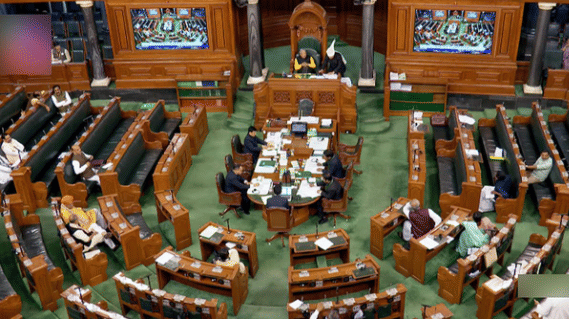
Composition of Rajya Sabha
- The Rajya Sabha has a maximum strength of 250 members, of which 238 are representatives of states and union territories (elected indirectly) and 12 are nominated by the president for their excellence in the field of literature, science, art, and social service.
- The Rajya Sabha currently has 245 members.
- The states are represented by 229 members, the union territories are represented by 4 members, and the president appoints 12 members.
- Vice-President of India is also the ex-officio chairman of Rajya Sabha. He or she presides over Rajya Sabha meetings.
- In his absence, the meeting of the House is presided over by the Deputy Chairman, who is elected by its members from among themselves.
- The Deputy Chairman can be removed by a majority of all Rajya Sabha members at the time.
Representation of States
- The Rajya Sabha's representatives are elected by the members of state legislative assemblies.
- The election is held using a single transferable vote in accordance with the proportional representation system.
- The Rajya Sabha seats are allocated to the states based on population. As a result, the number of representatives varies by state.
Representation of Union Territories
- The representatives of each union territory in the Rajya Sabha are indirectly elected by members of a special electoral college.
- This election is also held in accordance with the proportional representation system through the use of a single transferable vote.
- Only three of the eight union territories (Delhi, Puducherry, and Jammu, and Kashmir) have representation in Rajya Sabha.
- The other five union territories' population is too small to have a representative in the Rajya Sabha.
Nominated Members
- The president appoints 12 Rajya Sabha members from among those with special knowledge or practical experience in art, literature, science, and social service.
- The rationale behind this nomination principle is to give eminent people a seat in the Rajya Sabha without going through the election process.
Conclusion
- Aside from the coordinated powers it shares with the Lok Sabha, the Constitution gives the Rajya Sabha some special powers to carry out its federal mandate as it represents states and union territories in Parliament.
- Such special powers bolster its standing as an Upper House in comparison to the Lok Sabha.
- The upper house also acts as a safety valve and a check system for all the functions of the lower house.
MCQs
Question: Rajya Sabha has equal powers with Lok Sabha in (UPSC 2021)
(a) the matter of creating new All India Services
(b) amending the Constitution
(c) the removal of the government
(d) making cut motions
Answer: (b) See the Explanation
Rajya Sabha has equal power with the Lok Sabha in the following matters
- Introduction and passage of ordinary bills, Constitutional amendment bills, and financial bills involving expenditure from the Consolidated Fund of India.
- Election and impeachment of the President.
- Making recommendations to the President for the removal of the Chief Justice and judges of the Supreme Court and High courts, Chief Election Commissioner, and Comptroller and Auditor General.
- Approval of ordinances issued by the President.
- Approval of proclamation of all three types of emergencies by the President.
- Selection of ministers, including the Prime Minister.
- Consideration of the reports of the constitutional bodies like the Finance Commission, Union Public Service Commission, Comptroller and Auditor General, etc.
- Enlargement of the jurisdiction of the Supreme Court and the Union Public Service Commission.
Therefore (b) is the correct answer.
Question: The Parliament of India acquires the power to legislate on any item in the State List in the national interest if a resolution to that effect is passed by the(UPSC 2016)
(a) Lok Sabha by a simple majority of its total membership
(b) Lok Sabha by a majority of not less than two-thirds of its total membership
(c) Rajya Sabha by a simple majority of its total membership
(d) RajyaSabha by a majority of not less than two-thirds of its members present and voting
Answer: (d) See the Explanation
Under Article 249, Parliament of India acquires the power to legislate on any item in the State List in the national interest if a resolution to that effect is passed by the RajyaSabha by a majority of not less than two-thirds of its members present and voting.
Therefore (d) is the correct answer.
Question: The resolution for removing the Vice-President of India can be moved in the: [UPSC 2004]
(a) Lok Sabha alone
(b) Either House of Parliament
(c) Joint Sitting of Parliament
(d) Rajya Sabha alone
Answer: (d) See the Explanation
The resolution for removing the Vice-President of India can be moved in the Rajya Sabha alone.
Therefore, option (d) is the correct answer.
Question: Which of the following special powers have been conferred on the Rajya Sabha by the Constitution of India? [UPSC 2012]
(a) To change the existing territory of a State and to change the name of a State
(b) To pass a resolution empowering the Parliament to make laws in the State List and to create one or more All India Services
(c) To amend the election procedure of the President and to determine the pension of the President after his/her retirement
(d) To determine the functions of the Election Commission and to determine the number of Election Commissioners
Answer: (b) See the Explanation
The Rajya Sabha has the authority to accomplish the following things: It has the power to direct the parliament to pass legislation on a subject included in the state list (Art.249). It has the authority to ask parliament to create a new All India service that is shared by both the union and states (Art.312).
Therefore, option (b) is the correct answer.
FAQs
Question: What is the composition of the Rajya Sabha?
Answer: The Rajya Sabha, the upper house of the Indian Parliament, consists of a maximum of 250 members. Out of these, 238 members are elected by the legislative assemblies of states and union territories using a single transferable vote system, while 12 members are nominated by the President for their expertise in fields such as literature, science, art, and social service.
Question: How are members of the Rajya Sabha elected?
Answer: Members of the Rajya Sabha are elected by the elected members of the State Legislative Assemblies and Union Territory legislatures through a single transferable vote system, which ensures proportional representation.
Question: What is the term duration for a Rajya Sabha member?
Answer: A member of the Rajya Sabha serves a term of six years. One-third of its members retire every two years, ensuring that the house is never entirely dissolved and maintains continuity.
Question: Who presides over the Rajya Sabha?
Answer: The Vice President of India is the ex-officio Chairman of the Rajya Sabha. In the absence of the Chairman, the Deputy Chairman, elected from among the members of the Rajya Sabha, presides over the sessions.
Question: What are the special powers of the Rajya Sabha?
Answer: The Rajya Sabha has special powers, such as the authority to pass a resolution allowing the Parliament to make laws on subjects in the State List for national interest and approving the creation of All-India Services by passing a resolution supported by two-thirds of its members present and voting.
MCQs
1. How many members can the President nominate to the Rajya Sabha?
A) 10
B) 12
C) 15
D) 14
Answer: (B) See the Explanation
Explanation: The President of India can nominate up to 12 members to the Rajya Sabha based on their expertise in fields such as literature, science, art, and social service.
2. What is the tenure of a Rajya Sabha member?
A) 5 years
B) 6 years
C) 4 years
D) 7 years
Answer: (B) See the Explanation
Explanation: Members of the Rajya Sabha have a tenure of six years, with one-third of the members retiring every two years to maintain continuity.
3. Which body elects the members of the Rajya Sabha?
A) The President
B) The Lok Sabha
C) The Legislative Assemblies of States and Union Territories
D) The Prime Minister
Answer: (C) See the Explanation
Explanation: Members of the Rajya Sabha are elected by the Legislative Assemblies of States and Union Territories through a single transferable vote system.
4. Who is the ex-officio Chairman of the Rajya Sabha?
A) The President of India
B) The Prime Minister
C) The Vice President of India
D) The Chief Justice of India
Answer: (C) See the Explanation
Explanation: The Vice President of India serves as the ex-officio Chairman of the Rajya Sabha, presiding over its sessions.
5. How often does one-third of the Rajya Sabha retire?
A) Every year
B) Every two years
C) Every three years
D) Every four years
Answer: (B) See the Explanation
Explanation: One-third of the members of the Rajya Sabha retire every two years, ensuring that the house is never fully dissolved and maintains continuity.
GS Mains Questions and Model Answers
Q1: Discuss the significance of the Rajya Sabha in India's parliamentary system. How does it contribute to the legislative process and federal structure?
Answer: The Rajya Sabha plays a crucial role in India's parliamentary system as the upper house of Parliament. It represents the interests of the states and union territories, thereby strengthening the federal structure of the country. The Rajya Sabha acts as a revising chamber, reviewing and suggesting amendments to bills passed by the Lok Sabha, ensuring a more comprehensive legislative process. It also has special powers to allow Parliament to make laws on state subjects in national interest, thereby maintaining the balance of power between the Centre and the States. Additionally, it approves the creation of All-India Services, contributing to the administrative framework. The continuous nature of the Rajya Sabha, with one-third of its members retiring every two years, ensures stability and continuity in the legislative process. This chamber plays a significant role in safeguarding state interests, preventing hasty legislation, and providing experienced insights through its nominated members.
Q2: Analyze the role of the Vice President as the ex-officio Chairman of the Rajya Sabha. What are the challenges associated with this dual responsibility?
Answer: The Vice President of India, as the ex-officio Chairman of the Rajya Sabha, holds the responsibility of presiding over the sessions of the upper house, maintaining order, and facilitating legislative discussions. This role is significant as it ensures the smooth functioning of the house and upholds parliamentary procedures. However, the dual responsibility poses challenges. The Vice President is elected with political support, which may create a perception of bias when presiding over politically charged debates. Additionally, the non-legislative nature of the Vice President's role can limit their influence on legislative matters, as they do not vote in the house except in the case of a tie. Balancing the impartial conduct of the house while managing political expectations is another challenge. Effective performance as the Chairman requires a deep understanding of parliamentary rules and an ability to remain neutral and fair.
Q3: Evaluate the process of electing members to the Rajya Sabha. How does the single transferable vote system ensure proportional representation?
Answer: The election process for members of the Rajya Sabha involves the use of the single transferable vote system, which is a form of proportional representation. This system ensures that the representation of different political parties and groups within the State Legislative Assemblies is reflected in the composition of the Rajya Sabha. Members of State Legislative Assemblies cast their votes by ranking candidates in order of preference. The counting process involves allocating votes based on these preferences and redistributing surplus votes to other candidates as necessary, ensuring that candidates with widespread support are elected. This method helps prevent domination by a single party and allows for a more balanced representation of various political and social groups. It ensures that minority opinions within state legislatures can still find representation in the upper house, contributing to a more inclusive legislative process that reflects the diversity of the Indian polity.
Previous Year Questions on Composition of Rajya Sabha
1. UPSC CSE Prelims 2021:
Question: Who among the following presides over the Rajya Sabha in the absence of the Chairman?
A) The President
B) The Prime Minister
C) The Deputy Chairman
D) The Speaker of the Lok Sabha
Answer: (C)
Explanation: In the absence of the Chairman (the Vice President), the Deputy Chairman, who is elected from among the Rajya Sabha members, presides over the sessions.
2. UPSC CSE Mains 2020 (GS Paper 2):
Question: "Examine the role and significance of the Rajya Sabha in the Indian parliamentary system. How does its composition ensure a balance between national and regional interests?"
Answer: The Rajya Sabha, as the upper house of the Indian Parliament, holds significant importance in maintaining the balance between national and regional interests. Its composition, with members elected by State Legislative Assemblies and nominated experts, ensures that the legislative process incorporates both national perspectives and regional voices. The Rajya Sabha's role as a revising chamber helps prevent hasty legislation and encourages detailed scrutiny of bills. It also serves as a platform for states to express their concerns, contributing to the federal nature of governance. The proportional representation system used for electing members ensures that political diversity is maintained, allowing various parties to contribute to the legislative process. By bridging the gap between state and central interests, the Rajya Sabha strengthens India's federal structure and upholds democratic values.
*email: contactus@prepp.in
Download the PREPP App and attempt FREE IAS Exam Mock Tests and get complete study material!
UPSC IAS : CSAT - Mini Live Test

Live Test : UPSC CSE Prelims CSAT (Paper-II) (Oct 20 - 23)
Full Test - 04: UPSC CSE Prelims CSAT (Paper-II)
Full Test - 03: UPSC CSE Prelims CSAT (Paper-II)
UPSC CSE Prelims 2026 GS Paper 1 Question Paper (24-May-2026)
UPSC CSE Prelims 2026 CSAT Paper 2 Question Paper (24-May-2026)

17 February 2025 | The Hindu Must Read Articles | Current Affairs

16 February 2026 | The Hindu Must Read Articles | Current Affairs

13 February 2026 | The Hindu Must Read Articles | Current Affairs









Comments