Proportional Representation - Indian Polity Notes
Proportional representation is the allocation of seats in an election system to the proportion of total votes cast for each party. It attempts to ensure that election results are as proportional as possible by reducing inconsistency in the share of seats and votes. It is a complex system that may work in a small countries but would be difficult to implement in a subcontinental countries like India. But in India, elections for President, Vice President, Rajya Sabha members, and state legislative council members are held using proportional representation. This article explains the Proportional Representation which is important for UPSC Indian Polity Preparation.
Table of Contents

Proportional Representation - Concept
- Proportional Representation (PR) refers to electoral systems in which electorate divisions are reflected proportionally in the elected body.
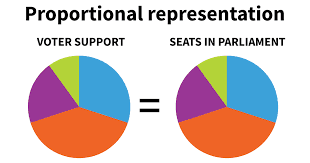
- It states that the number of seats gained by a party or group of candidates is proportional to the number of votes cast.
- If n% of the electorate favours a particular political party, that party will win roughly n% of the seats.
- The essence of such systems is that all votes count toward the outcome, not just a plurality or a simple majority.
- The three most common types of PR electoral systems are:
- Party-list PR
- Single Transferable Vote (STV)
- Mixed-member proportional representation (MMP)
- Proportional representation provides honesty in the election process, both on the part of the candidate, who may freely pick their ideological beliefs, and on the part of the voter, who can freely vote.
Party-list PR
- In Party-list PR, the political parties define the candidate lists and the voters vote for a list.
- The relative vote for each list determines how many candidates are elected from each list.
- Lists can be "closed" or "open," with open lists allowing voters to indicate individual candidate preferences as well as vote for independent candidates.
Single transferable vote system
- The single transferable vote system employs multi-member districts, with voters casting only one vote but ranking individual candidates in order of preference (by providing backup preferences).
- As candidates are elected or eliminated during the count, surplus or discarded votes are transferred to other candidates based on preferences, forming consensus groups that elect surviving candidates.
- STV allows voters to vote across party lines, to select the most preferred of a party's candidates, and to vote for independent candidates.
- The voters know that if the candidate is not elected, the voter's vote will not be wasted if backup preferences are marked on the ballot.
Mixed-member proportional representation (MMP)
- It is a two-tier mixed electoral system that combines local non-proportional plurality/majoritarian elections with a compensatory regional or national party list PR election.
- It is also known as the additional member system (AMS).
- Voters usually have two votes: one for their single-member district and one for the party list, with the party list vote determining the balance of parties in the elected body.
|
"Proportional representation ensures that every vote counts, fostering a more inclusive and representative democracy where diverse voices can be heard and respected." |
How It Is Practiced In India
The PR system is used in India on a limited scale for indirect elections.For the election of the President, Vice President, and members of the Rajya Sabha and Vidhan Parishads, the Constitution prescribes a third and more complex variation of the PR system.
Presidential Election
- The election of the President is conducted in accordance with the proportional representation system, with a single transferable vote and voting by secret ballot.
- This system ensures that the winning candidate receives an absolute majority of votes.
- To be declared elected to the office of President, a candidate must receive a certain number of votes.
- The quota of votes is calculated by dividing the total number of valid votes cast by the number of candidates to be elected (in this case, only one candidate is to be elected as President) plus one and adding one to the result.
- The formula is as follows:

Each electoral college member is given only one ballot paper.
- While voting, the voter must indicate his preferences by marking 1, 2, 3, 4, and so on against the names of the candidates. This means that the voter has the option of indicating as many preferences as there are candidates in the running.
- The first preference votes are counted in the first phase. If a candidate obtains the necessary quota in this phase, he is declared elected. Otherwise, the vote-transfer procedure is initiated.
- The ballots of the candidate with the fewest first preference votes are voided, and his second preference votes are transferred to the first preference votes of other candidates.
- This process is repeated until a candidate obtains the required quota.
Rajya Sabha Elections
- For Rajya Sabha elections, the PR variant, the Single Transferable Vote system (STV), is used.
- Each state has a set number of Rajya Sabha seats. The members are chosen by the respective state legislatures.
- The MLAs in that state are elected by the voters.
- Every voter is required to rank the candidates in order of preference.
- To be declared the winner, a candidate must receive a certain number of votes, as determined by a formula:

For example, if 200 MLAs in Rajasthan have to elect 4 Rajya Sabha members, the winner would need (200/4+1= 40+1) 41 votes.
- When the votes are counted, they are counted based on the number of first preference votes secured by each candidate, with the candidate receiving the most first preference votes.
- If, after counting all first preference votes, the required number of candidates fail to meet the quota, the candidate with the fewest first preference votes is eliminated, and his or her votes are transferred to those listed as second preference on the ballot papers.
- This procedure is repeated until the required number of candidates is declared elected.
Proportional Representation - Significance
- Proportional representation (PR) is a form of electoral system in which subgroups of an electorate are represented in the elected body in a proportionate manner.
- The concept mostly pertains to geographical (e.g., states, regions) and political (political parties) divisions of the electorate.
- Proportional representation is clearly behind the FPTP system in terms of vote ease, but it outperforms it in terms of campaign convenience.
- Candidates may simply focus their attention on specific groups to appeal to, and as a result, campaign finance issues are not as significant in the process.
- Proportionate representation attempts to guarantee that election outcomes are as proportional as feasible by reducing inconsistency in the share of seats and votes.
- Constituent may approach any representative of their choosing if they had a complaint.
- It guarantees that minor parties are represented in the legislature, especially when they have a large constituency base.
- It also stimulates the formation of new political parties and the participation of more women and minorities in political campaigns.
Proportional Representation - Drawbacks
- One possible disadvantage of this method is that the bond between a voter and the candidate may be diluted because the candidate is now perceived as representing the party rather than the constituency.
Conclusion
Proportional representation is a cornerstone of a truly inclusive and representative democracy. By ensuring that every vote has an equal impact, this electoral system allows for a diverse array of voices to be heard and respected within the legislative process. It mitigates the distortions often seen in majoritarian systems, where the majority can disproportionately dominate governance, often at the expense of minority groups.
FAQs
Question: What is proportional representation?
Answer: Proportional representation (PR) is an electoral system aimed at ensuring that the representation of various political parties in a legislature reflects their overall support among the electorate. Unlike the winner-takes-all approach used in first-past-the-post systems, PR allocates seats based on the percentage of votes each party receives. This system aims to provide a more accurate reflection of the public’s preferences and can help smaller parties gain representation, thus promoting a multi-party democracy.
Question: How is proportional representation implemented in India?
Answer: In India, proportional representation is primarily used for the elections of the Rajya Sabha (the Upper House of Parliament) and the State Legislative Councils. The system employed is the Single Transferable Vote (STV), which allows voters to rank candidates in order of preference. This method ensures that candidates are elected in a manner that reflects the voters' preferences more accurately, as it considers not only the first-choice votes but also subsequent preferences, thus minimizing wasted votes.
Question: What are the advantages of using proportional representation?
Answer: Proportional representation offers several advantages, including a more equitable representation of diverse political parties and groups, leading to a more inclusive political system. It helps smaller parties gain representation in legislatures, thus enriching the democratic process. Additionally, PR can reduce the prevalence of strategic voting, as voters can express their true preferences without fearing that their vote will be wasted. This system can enhance voter engagement and encourage broader participation in the political process.
Question: What are some criticisms of the proportional representation system?
Answer: Critics of proportional representation argue that it can lead to fragmented legislatures, making it challenging to form stable governments due to the presence of many parties. This fragmentation may result in coalition governments that can be less effective in governance. Additionally, the complexity of the voting process, especially with systems like the Single Transferable Vote, may confuse voters, potentially reducing overall electoral participation. Moreover, there is a concern that PR can empower smaller extremist parties, which might not represent mainstream public opinion.
Question: How does the Single Transferable Vote system work?
Answer: The Single Transferable Vote (STV) system allows voters to rank candidates in order of preference rather than voting for a single candidate. When votes are counted, if a candidate receives more votes than the required quota for election, the excess votes are transferred to the voters' next preferred candidates. If no candidate meets the quota, the candidate with the fewest votes is eliminated, and their votes are also transferred according to voters' next preferences. This process continues until all seats are filled, ensuring that as many votes as possible contribute to the election of a candidate.
MCQs
1. What is the primary objective of proportional representation?
A) To simplify the voting process
B) To ensure representation reflects voter preferences
C) To reduce the number of political parties
D) To enhance the power of the majority party
Answer: (B) See the Explanation
Explanation: The primary objective of proportional representation is to ensure that the representation in the legislature reflects the voters' preferences, allowing for a more accurate representation of diverse political opinions.
2. Which system is primarily used for proportional representation in India?
A) First-Past-The-Post
B) Alternative Vote
C) Single Transferable Vote
D) Block Vote
Answer: (C) See the Explanation
Explanation: The Single Transferable Vote (STV) system is primarily used for proportional representation in India, particularly for elections to the Rajya Sabha and State Legislative Councils.
3. What is one major criticism of the proportional representation system?
A) It encourages majoritarianism
B) It simplifies government formation
C) It can lead to fragmented legislatures
D) It enhances voter participation
Answer: (C) See the Explanation
Explanation: One major criticism of the proportional representation system is that it can lead to fragmented legislatures, making it difficult to form stable governments due to the presence of multiple political parties.
4. Which house in the Indian Parliament uses proportional representation?
A) Lok Sabha
B) Rajya Sabha
C) Both Lok Sabha and Rajya Sabha
D) None of the above
Answer: (B) See the Explanation
Explanation: The Rajya Sabha (the Upper House of Parliament) uses proportional representation for the election of its members, whereas the Lok Sabha (the Lower House) follows the first-past-the-post system.
5. How does the Single Transferable Vote system enhance voter choice?
A) By allowing only one vote
B) By enabling ranking of preferences
C) By limiting the number of candidates
D) By making voting compulsory
Answer: (B) See the Explanation
Explanation: The Single Transferable Vote system enhances voter choice by allowing voters to rank candidates in order of preference, rather than selecting just one, thereby reflecting a wider range of choices.
GS Mains Questions and Model Answers
Q1: Discuss the advantages and disadvantages of proportional representation in the context of Indian democracy.
Answer: Proportional representation (PR) offers several advantages within the context of Indian democracy. Firstly, it allows for a more equitable representation of diverse political parties and groups, ensuring that smaller parties have a voice in the legislature. This fosters a multi-party system, enhancing democratic engagement among citizens. Secondly, PR can minimize wasted votes, as voters can express their true preferences without the fear of supporting a losing candidate. However, the system also has its disadvantages. One major concern is that it can lead to fragmented legislatures, resulting in coalition governments that may lack stability and effectiveness in governance. Additionally, the complexity of the voting process, particularly with the Single Transferable Vote, may confuse voters and reduce electoral participation. Thus, while PR enhances representation, it also presents challenges that need to be addressed to ensure effective governance in a diverse nation like India.
Q2: Analyze the role of the Single Transferable Vote system in elections. How does it work to ensure fair representation?
Answer: The Single Transferable Vote (STV) system is designed to ensure fair representation in elections by allowing voters to rank candidates in order of preference. This system works by initially counting the first-choice votes. If a candidate receives more votes than the required quota for election, any surplus votes are transferred to the voters' next preferred candidates. Conversely, if no candidate meets the quota, the candidate with the least votes is eliminated, and their votes are distributed based on the next preferences indicated on the ballots. This process continues until all available seats are filled. By accounting for voters' preferences beyond their first choice, the STV system enhances representation and ensures that more votes contribute to electing candidates. It effectively minimizes the impact of vote splitting among similar candidates, fostering a more equitable electoral process.
Q3: Evaluate the implications of adopting a proportional representation system for Indian political parties.
Answer: Adopting a proportional representation system in India would have significant implications for political parties and the electoral landscape. It would likely lead to an increase in the number of parties represented in the legislature, as smaller and regional parties would gain greater opportunities for representation. This diversification could enrich democratic discourse by bringing in varied perspectives and interests. However, it may also challenge traditional larger parties, prompting them to adapt their strategies and policies to retain voter support. The necessity for coalition governments might become more prevalent, requiring parties to negotiate and collaborate more frequently, which could lead to more consensus-driven politics. On the downside, the fragmentation of the legislature might result in instability and difficulties in governance, as coalitions can be susceptible to internal conflicts. Therefore, while the adoption of a proportional representation system could enhance representational equity, it would also necessitate adjustments in party dynamics and governance practices in India.
Previous Year Questions on Proportional Representation
1. UPSC CSE Prelims 2021:
Question: Which electoral system is primarily used for the Rajya Sabha elections in India?
A) First-Past-The-Post
B) Alternative Vote
C) Single Transferable Vote
D) Block Vote
Answer: (C)
Explanation: The Single Transferable Vote system is used for the elections of the Rajya Sabha in India, allowing voters to rank candidates and ensuring proportional representation.
2. UPSC CSE Mains 2019 (GS Paper 1):
Question: Discuss the significance of proportional representation in the context of Indian elections. What are its benefits and challenges?
Answer: Proportional representation plays a significant role in Indian elections by ensuring that the representation in the legislature reflects the diverse political preferences of the electorate. Its benefits include enhanced representation for smaller parties, reducing wasted votes, and promoting a multi-party democracy that encourages broader political participation. However, the challenges include the potential for fragmented legislatures that can complicate government formation, making it difficult to achieve political stability. Additionally, the complexity of the voting process may deter some voters. Thus, while proportional representation can enrich democracy, it necessitates careful consideration of its implications on governance and party dynamics.
*email: contactus@prepp.in
Download the PREPP App and attempt FREE IAS Exam Mock Tests and get complete study material!
UPSC IAS : CSAT - Mini Live Test

Live Test : UPSC CSE Prelims CSAT (Paper-II) (Oct 20 - 23)
Full Test - 04: UPSC CSE Prelims CSAT (Paper-II)
Full Test - 03: UPSC CSE Prelims CSAT (Paper-II)
UPSC CSE Prelims 2026 GS Paper 1 Question Paper (24-May-2026)
UPSC CSE Prelims 2026 CSAT Paper 2 Question Paper (24-May-2026)

17 February 2025 | The Hindu Must Read Articles | Current Affairs

16 February 2026 | The Hindu Must Read Articles | Current Affairs

13 February 2026 | The Hindu Must Read Articles | Current Affairs









Comments