De Facto and De Jure - Indian Polity Notes
In the Indian Political System, the words "de jure" and "de facto" are frequently used. India, as a parliamentary democracy, has both de facto and de jure leaders. De facto refers to activities that exist in reality but are not formally recognised by laws. De jure refers to practises that are legally acknowledged regardless of whether the practise occurs in reality. This article explains the De Facto and De Jure which is important for Civil Service Exam, Indian Polity Notes
|
Table of Contents |
What is De Facto?
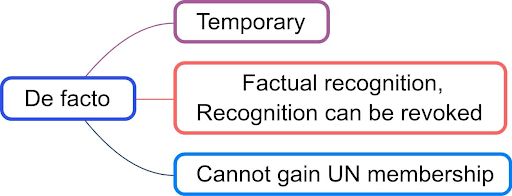
- The phrase de facto refers to a viewpoint or behaviour that exists in actuality.
- This phrase can refer to any practice that is actually existing in any type of governance or legislation.
- De facto practises or stances are nothing more than practises or concepts that are a matter of fact and are founded on factual recognition.
- In Indian democracy, for example, the Prime Minister/Chief Minister is the de-facto leader of a state since he or she has the genuine ability to make choices based on facts.
- De facto government is also known as a government founded by force or authority.
De facto
|
The terms "de jure" and "de facto" are used to distinguish between what is legally recognized and what exists in reality. |

What is De Jure?
- The term de jure is derived from the Latin phrase "legitimate, lawful, or law-abiding."
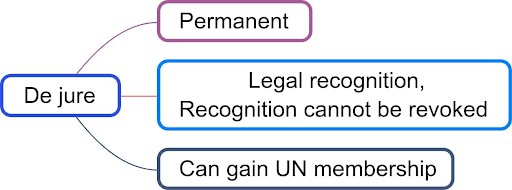
- So, the phrase de-jure can apply to a practise, concept, or political stance that is legally sanctioned by the law and legally recognised by the state, but such practice/notion/position is rarely observed in practise.
- However, such recognition or authorization is permanent and cannot be revoked.
- In Indian democracy, for example, the President/Governor is the de jure leader of a state since he or she lacks the real capacity to make choices based on facts.
- According to Indian law/constitution, the Prime Minister/Governor is the true decision-making power, and decisions are only made in the name of the President/Governor.
- De jure government is also known as a government founded via appropriate observance of the law.
Differences between De Facto and De Jure
| De Facto | De Jure |
|---|---|
| De Facto is a term that refers to the recognition of facts. | De Jure is the legal term for legal recognition. |
| Two alternative governments would exist in the state that has acquired de facto recognition. | There is only one government in a state that has obtained De Jure recognition. |
| De Facto confers recognition on the basis of a factual circumstance rather than a legal process. | De Jure is a legal recognition that is granted once the proper legal procedure has been followed. |
| Diplomatic representatives are rarely dispatched to other countries, and they are rarely received in one's own country under De Facto conditions. | De jure conditions allow for the exchange of diplomatic representation. |
| In De Facto recognition, state succession norms do not apply. This means that if the state's own recognition is De Facto, it cannot invade neighbouring states or impose succession laws. | In the event of a De Jure circumstance, the norms of state succession are relevant and implemented. |
| Membership in the United Nations is not conceivable, even if the majority of governments recognise it de facto. | A state can gain UN membership if the majority of states grant it de jure recognition. |
| In reality the government is unable to collect a state asset or repay a public debt. | A De Jure government has the authority and capacity to recover state assets or debts owed to the government. |
| At any time, de facto recognition can be revoked. | At any point in time, de jure recognition cannot be revoked. |
| Prime Minister/Chief Minister is the de-facto leader | the President/Governor is the de jure leader of a state |
Conclusion
As a parliamentary democracy, India has both de facto and de jure rulers. In law and governance, de facto refers to activities that occur in reality but are not recognised by legislation. De jure is a word used in law and government to describe legally authorised activities, regardless of whether they are actually done. Both de facto and de jure have variances and implications, hence they are widely used in Indian political systems.
FAQs
Question: What is the difference between de facto and de jure?
Answer: De facto means "in fact" and refers to a situation that exists in reality, even if not legally recognized. De jure means "by law" and refers to a situation that is legally established. For instance, a de facto government has control in practice, while a de jure government is recognized by law.
Question: Can a situation be both de facto and de jure?
Answer: Yes, a situation can be both de facto and de jure if it is recognized both in practice and by law. For example, a government that has both legal and actual control over a state would be considered both de facto and de jure.
Question: How does de facto recognition differ from de jure recognition in international law?
Answer: In international law, de facto recognition is a temporary acknowledgment of a government or state without full legal recognition, while de jure recognition is a formal acknowledgment by other states, granting full legal status and rights in the international community.
Question: What is an example of a de facto authority?
Answer: An example of de facto authority is when a group controls a region and functions as the governing body without legal recognition. For instance, if a militia controls a region without being recognized by law, it holds de facto power in that area.
Question: Why is the distinction between de facto and de jure important?
Answer: The distinction is important because it differentiates between what exists in reality and what is recognized by law. This distinction affects legal rights, international recognition, and the legitimacy of authorities or policies, impacting diplomatic relations and internal governance.
MCQs
1. What does de jure mean in legal terms?
A) In fact
B) In law
C) In practice
D) In dispute
Answer: (B) See the Explanation
Explanation: De jure means "in law" and refers to a status that is legally recognized, even if it does not exist in practice.
2. Which term describes a situation that exists in reality but lacks legal recognition?
A) De facto
B) De jure
C) Ultra vires
D) Ipso facto
Answer: (A) See the Explanation
Explanation: De facto describes situations that exist in reality but may lack formal legal recognition, such as a government in control without legal status.
3. In international law, which type of recognition is considered temporary and limited?
A) De facto recognition
B) De jure recognition
C) Legal recognition
D) Full recognition
Answer: (A) See the Explanation
Explanation: De facto recognition in international law is a temporary acknowledgment that does not imply full legal recognition, unlike de jure recognition.
4. Which of the following is an example of de facto authority?
A) A legally recognized government
B) A military group controlling a region
C) A legally elected parliament
D) An international organization
Answer: (B) See the Explanation
Explanation: A military group controlling a region without legal recognition is considered de facto authority, as it has control in practice but lacks de jure status.
5. De jure recognition of a government grants it:
A) Temporary acknowledgment
B) Full legal status
C) Limited control
D) No formal rights
Answer: (B) See the Explanation
Explanation: De jure recognition grants a government full legal status in the international community, establishing its formal and legal rights.
GS Mains Questions and Model Answers
Q1: Explain the significance of de facto and de jure distinctions in the context of governance. How do these concepts influence international relations?
Answer: The distinction between de facto and de jure is critical in governance, as it separates actual control (de facto) from legal recognition (de jure). De facto governments may wield power and administer territories without legal status, while de jure governments are recognized by law and international treaties. This distinction influences international relations, as states may choose to grant de facto recognition to maintain diplomatic flexibility or de jure recognition to endorse legitimacy. For instance, in cases of disputed territories or regimes, the choice between de facto and de jure recognition impacts alliances, trade policies, and diplomatic negotiations, shaping global political dynamics.
Q2: Discuss the implications of de facto recognition in international law. How does it differ from de jure recognition, and why might states prefer one over the other?
Answer: In international law, de facto recognition acknowledges a government's control over a territory without granting full legal status. This type of recognition is often used in situations where stability and control are present but legal legitimacy is disputed. States may prefer de facto recognition to maintain diplomatic relations while avoiding endorsement of controversial governments. De jure recognition, however, is formal and implies full legal status and rights. States may withhold de jure recognition due to political or ethical considerations, allowing them to engage diplomatically without fully legitimizing a regime. This flexibility helps balance interests in complex international scenarios.
Q3: Analyze a historical example where a de facto government operated without de jure recognition. What were the impacts on both internal governance and international relations?
Answer: A historical example of a de facto government without de jure recognition is the Taliban's rule in Afghanistan from 1996 to 2001. Although the Taliban controlled most of Afghanistan, it lacked widespread international recognition, as many countries did not grant it de jure status. This affected its ability to engage in formal diplomacy, trade, and international agreements, isolating the regime. Internally, the lack of legitimacy complicated governance and limited foreign aid, impacting economic stability. Internationally, the de facto status influenced neighboring countries' security policies and global responses to terrorism, underscoring the significance of de jure recognition in securing formal relations and stability.
Previous Year Questions on De Facto and De Jure
1. UPSC CSE Prelims 2021:
Question: What does de facto recognition imply in international law?
A) Full legal acknowledgment
B) Temporary acknowledgment
C) Complete disregard
D) Legalization of informal practices
Answer: (B)
Explanation: De facto recognition implies a temporary acknowledgment of authority or control without granting full legal status, often used in complex or disputed international contexts.
2. UPSC CSE Mains 2020 (GS Paper 2):
Question: "Examine the relevance of de facto and de jure distinctions in contemporary geopolitics. How do these concepts affect international diplomacy and state legitimacy?"
Answer: De facto and de jure distinctions are highly relevant in contemporary geopolitics, as they affect state legitimacy and diplomatic engagement. De facto recognition acknowledges practical control, allowing for diplomatic flexibility, whereas de jure recognition formalizes legitimacy. In cases like Taiwan, de facto recognition allows certain countries to engage economically and politically without compromising formal policies on sovereignty. These distinctions shape alliances, international law, and the status of disputed governments, affecting global stability and the balance of power in geopolitics.
*email: contactus@prepp.in
Download the PREPP App and attempt FREE IAS Exam Mock Tests and get complete study material!
UPSC IAS : CSAT - Mini Live Test

Live Test : UPSC CSE Prelims CSAT (Paper-II) (Oct 20 - 23)
Full Test - 04: UPSC CSE Prelims CSAT (Paper-II)
Full Test - 03: UPSC CSE Prelims CSAT (Paper-II)
UPSC CSE Prelims 2026 GS Paper 1 Question Paper (24-May-2026)
UPSC CSE Prelims 2026 CSAT Paper 2 Question Paper (24-May-2026)

17 February 2025 | The Hindu Must Read Articles | Current Affairs

16 February 2026 | The Hindu Must Read Articles | Current Affairs

13 February 2026 | The Hindu Must Read Articles | Current Affairs









Comments