Executive Powers of President – Indian Polity Notes
Part V of the Constitution (Articles 52 to 78) deal with the Union executive. The Union executive is made up of the President, Vice President, Prime Minister, Council of Ministers, and the Attorney General of India. The Union's executive power is vested in the President, who exercises it either directly or through officers’ subordinate to him in accordance with the Constitution. In this article we will discuss more about the Executive Powers of the President.
|
Table of Contents |

Constitutional Position Of President
- The President's primary responsibility, as stated in his oath of office, is to preserve, protect, and defend the Indian constitution(Article 60 of Indian constitution).
- The President serves as the common head of all autonomous constitutional entities.
- All of his actions, recommendations (Article 3, Article 111, Article 274, and so on) and supervisory powers (Article 74(2), Article 78 c, Article 108, Article 111, and so on) over India's executive and legislative entities must be used to uphold the constitution.
- Article 53 delegates powers to the President to carry out the business of government or state affairs, with the exception of functions delegated to any other authority by the Constitution.
- If the President violates any of the Constitution's mandatory provisions, he can be removed through the impeachment process.
- The President exercises his executive powers in accordance with the advice of his cabinet.
|
President of India serve as the head of state and exercising a wide array of executive powers as outlined in the Constitution. |
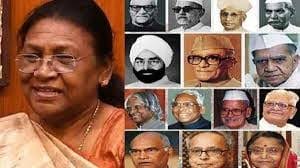
Executive Powers Of President
- All executive actions taken by the Indian government are formally taken in his name.
- He has the authority to make rules governing how orders and other instruments made and executed in his name must be authenticated.
- He has the authority to make rules for the more efficient transaction of Union government business, as well as the allocation of said business among ministers.
- He appoints the prime minister and other cabinet members. They serve during his pleasure.
- He appoints the Attorney General of India and determines his salary. The Attorney General serves during the pleasure of the President.
- He appoints the comptroller and auditor general of India, chief election commissioner and other election commissioners, chairman and members of the Union Public Service Commission, state governors, chairman and members of the Finance Commission, and other officials.
- He can request from the prime minister any information pertaining to the administration of Union affairs, as well as legislative proposals.
- He has the authority to request that the Prime Minister submit to the council of ministers any matter on which a minister has made a decision but which has not been considered by the council.
- He has the authority to appoint a commission to investigate the conditions of SCs, STs, and other backward classes.
- He has the authority to appoint an inter-state council to promote centre-state and inter-state cooperation.
- He administers the union territories directly through administrators he appoints.
- He has the authority to declare any area a scheduled area and to administer scheduled areas and tribal areas.
Conclusion
The executive powers of the President are vast and pivotal for the functioning of the government. As the head of state, the President's role in appointing key officials, including the Prime Minister, Council of Ministers, judges, and other high-ranking officers, ensures the proper functioning and stability of the nation's governance. The President also plays a critical role in the administration by issuing ordinances, granting pardons, and representing India in international affairs. Although many of these powers are exercised on the advice of the Council of Ministers, the President's position is integral to upholding the constitutional framework and ensuring the effective execution of laws and policies.
FAQs
Q1: What are the executive powers of the President of India?
Answer: The executive powers of the President of India include the authority to appoint key officials, administer the Union Government, oversee the implementation of laws, and act as the supreme commander of the armed forces. The President also has the power to summon and prorogue the Parliament, dissolve the Lok Sabha, and appoint the Prime Minister and other ministers.
Q2: How does the President of India exercise their executive powers?
Answer: The President of India exercises their executive powers in accordance with the advice of the Council of Ministers headed by the Prime Minister. Although the President holds significant constitutional powers, they act as a ceremonial figurehead, with real executive authority vested in the elected government.
Q3: What is the role of the President in appointing the Prime Minister?
Answer: The President of India appoints the Prime Minister, who is typically the leader of the majority party or coalition in the Lok Sabha. If no party has a clear majority, the President may invite the leader of the largest party or coalition to form a government, subject to their ability to prove a majority in the Lok Sabha.
Q4: Can the President of India remove a minister?
Answer: The President of India can remove a minister only on the advice of the Prime Minister. Since ministers hold office during the pleasure of the President, it is conventionally the Prime Minister who requests the removal of a minister.
Q5: What is the President’s role in relation to the armed forces?
Answer: The President of India is the supreme commander of the armed forces. This role is largely ceremonial, as operational control and decision-making authority lie with the Cabinet, particularly the Ministry of Defence. However, formal military appointments and the declaration of war and peace are made by the President.
MCQs
- Who advises the President of India in the exercise of their executive powers?
a) Supreme Court
b) Lok Sabha
c) Prime Minister and Council of Ministers
d) Governors of States
Answer: (C) See the Explanation
- Who appoints the Prime Minister of India?
a) Speaker of Lok Sabha
b) Vice President
c) Chief Justice of India
d) President of India
Answer: (D) See the Explanation
- Which article of the Indian Constitution describes the President as the supreme commander of the armed forces?
a) Article 53
b) Article 72
c) Article 77
d) Article 112
Answer: (A) See the Explanation
- Under what condition can the President dismiss a minister from office?
a) On their own discretion
b) On the advice of the Prime Minister
c) By a motion of the Lok Sabha
d) After consulting the Chief Justice
Answer: (B) See the Explanation
- Which of the following is an executive function of the President of India?
a) Conducting elections
b) Presiding over the Lok Sabha
c) Administering the Union territories
d) Appointing the judges of the Supreme Court
Answer: (D) See the Explanation
GS Mains Questions and Model Answers
Q1: Discuss the executive powers of the President of India and their practical limitations.
Answer: The President of India is the head of the executive branch of the government, with their powers enshrined in Articles 52 to 78 of the Indian Constitution. The President appoints the Prime Minister, ministers, judges, and other high-ranking officials, and has the authority to summon and prorogue Parliament, dissolve the Lok Sabha, and issue ordinances. Additionally, the President is the supreme commander of the armed forces.
Despite these vast constitutional powers, the President’s role is largely ceremonial, as they are required to act on the advice of the Prime Minister and the Council of Ministers (Article 74). This makes the President a nominal executive head, with real executive power vested in the elected government. While the President has discretionary powers in certain situations, such as appointing a Prime Minister when no party has a majority, most decisions are bound by ministerial advice. The President's position is thus limited in practice, functioning within a parliamentary system that prioritizes the authority of the Cabinet.
Q2: Analyze the role of the President as the supreme commander of the armed forces in the Indian constitutional framework.
Answer: The President of India, as per Article 53 of the Constitution, is designated as the supreme commander of the armed forces. This title grants the President formal authority over the military, including the power to declare war and make peace, appoint chiefs of the army, navy, and air force, and bestow military honors. However, the President’s role as the supreme commander is primarily ceremonial.
The actual control and decision-making power regarding the armed forces lie with the elected government, specifically the Ministry of Defence and the Cabinet, which is responsible for defense policy and military operations. While military actions require formal approval from the President, these decisions are made by the government. The President’s role as the supreme commander serves as a constitutional safeguard, ensuring that military authority remains under civilian control, preventing the possibility of military dictatorship or undue influence over democratic institutions.
Q3: Examine the discretionary powers of the President of India and their significance in a parliamentary democracy.
Answer: The President of India has certain discretionary powers, although the role is largely bound by the advice of the Prime Minister and the Council of Ministers. Discretionary powers come into play in specific situations where the President can act independently of ministerial advice. These include appointing the Prime Minister when no party has a clear majority in the Lok Sabha, deciding whether to accept the resignation of a government that has lost a vote of confidence, and seeking information from the government on issues of national importance.
In cases of political instability, such as a hung Parliament, the President’s discretion is critical in ensuring a stable government by inviting a party or coalition that is most likely to command a majority in the Lok Sabha. These discretionary powers are significant in a parliamentary democracy as they act as a constitutional check, ensuring that the President can step in during crises to uphold democratic processes while maintaining political neutrality.
Previous Year Questions on Executive Powers of President
1. UPSC CSE 2017
Question: What are the limitations of the President's powers in the Indian parliamentary system?
Answer: In India’s parliamentary system, the President is the head of state, but their powers are limited by the Constitution and the conventions of parliamentary democracy. Article 74 requires the President to act on the advice of the Prime Minister and the Council of Ministers, effectively making the President a ceremonial figurehead with no real executive authority.
The President’s role in governance is largely symbolic, as most powers are exercised indirectly through the elected government. While the President has formal powers such as summoning and proroguing Parliament, appointing key officials, and issuing ordinances, these actions are all based on ministerial advice. The President’s discretionary powers are limited to specific situations, such as appointing a Prime Minister in the event of a hung Parliament or deciding whether to dissolve the Lok Sabha when no party has a majority. Overall, the President’s powers are curtailed by the need to act in accordance with the advice of the Cabinet, maintaining the primacy of elected representatives in governance.
2. UPSC CSE 2019
Question: Discuss the discretionary powers of the President of India and how they are exercised in practice.
Answer: The discretionary powers of the President of India, though limited, play a crucial role in maintaining the balance of power in the parliamentary system. These powers are exercised in situations where the President is not bound by the advice of the Council of Ministers. Such instances include appointing a Prime Minister when no party has a clear majority in the Lok Sabha, sending a bill back to Parliament for reconsideration, and withholding assent to an ordinance when Parliament is not in session.
In practice, the President exercises these powers with caution and in consultation with political leaders and constitutional experts. In the case of a hung Parliament, for example, the President must ensure that the appointed Prime Minister has the best chance of forming a stable government. However, the President’s role remains largely symbolic, as any action that goes against the advice of the Council of Ministers could be challenged politically. Therefore, while the President has discretion in certain situations, these powers are exercised sparingly and with a focus on maintaining political stability and upholding democratic principles.
*email: contactus@prepp.in
Download the PREPP App and attempt FREE IAS Exam Mock Tests and get complete study material!

Full Test - 04: UPSC CSE Prelims CSAT (Paper-II)
Full Test - 03: UPSC CSE Prelims CSAT (Paper-II)
UPSC CSE Prelims 2026 GS Paper 1 Question Paper (24-May-2026)
UPSC CSE Prelims 2026 CSAT Paper 2 Question Paper (24-May-2026)

17 February 2025 | The Hindu Must Read Articles | Current Affairs

16 February 2026 | The Hindu Must Read Articles | Current Affairs

13 February 2026 | The Hindu Must Read Articles | Current Affairs









Comments