Military Power of President - Indian Polity Notes
The President is the supreme commander of the defence forces of India. In that capacity, he appoints the chiefs of the Army, the Navy and the Air Force. He can declare war or conclude peace, subject to the approval of the Parliament. Article 53 clearly specifies that the President is the Supreme Commander of the Union of India's Armed Forces.
The Indian Polity and Governance Syllabus includes the Military Power ofthe President which is described in this article and is important for the UPSC exam.
|
Table of Contents |
Military Powers of President
- The Indian President is the head of the state. He is India's first citizen and a symbol of the country's unity.
- Supreme commander: The President is the Supreme Commander of the Indian Armed Forces.
- Can declare war: The President can declare war or conclude peace, on the advice of the Union Council of Ministers headed by the Prime Minister.
- All Important treaties and contracts are made in the President's name.
- Appointment: Appointment of all officers, including the chiefs of the armed forces
- Court martial: The President has the power to pardon, respite any punishment, and remit or commute the sentence of any person convicted of an offence.
- Article 72 of the Indian Constitution talks about the pardoning powers of the President.
- All those persons can apply for pardon who are convicted of any offence-Where the punishment or sentence is given by a court-martial.
- A court-martial is a judicial court that adjudicates the offences committed by armed services’ members against the military law
- Where the punishment or sentence is given for an offence related to a matter over which the union has the power to make law;Where a death sentence is awarded to the convict for their offence.
|
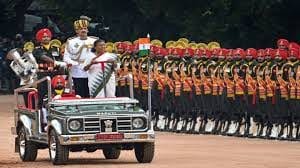
President of India is the supreme command of the Indian Armed Forces as per Article 53(2) of the Constitution of India. |
What is the Constitutional Position of the President?
- The President is the official executive and the head of state. At the centre, every executive activity is said to be taken in his name.
- This authority was granted to him via Article 53(1) of the Constitution, which provides that "executive power shall be vested in the President and shall be exercised by him directly or through subordinate officers."
Conclusion
While these powers are significant, they are exercised based on the advice of the Prime Minister and the Council of Ministers, making the role largely ceremonial in practice. The real decision-making power lies with the elected government.
FAQs
Q1: What is the military power of the President of India?
Answer: The President of India serves as the Supreme Commander of the Armed Forces, possessing significant authority over the military, including the appointment of chiefs of the Army, Navy, and Air Force. The President can declare war or conclude peace with the consultation of the Cabinet.
Q2: How does the President exercise military power?
Answer: The President exercises military power primarily through the Ministry of Defence and in accordance with the advice of the Council of Ministers. Operational control of the military is exercised by the Prime Minister and the Cabinet, ensuring that the President's role is ceremonial and constitutional.
Q3: What role does the President play in the declaration of war?
Answer: The President can declare war or conclude peace under Article 352 of the Constitution, but such decisions must be taken with the approval of the Cabinet, highlighting the collective responsibility of the government.
Q4: What are the limits of the President’s military powers?
Answer: The President's military powers are limited by constitutional provisions that require the advice of the Council of Ministers. Therefore, while the President is the Supreme Commander, actual military operations and decisions are conducted under the guidance of the elected government.
Q5: How is the President's military power relevant in contemporary India?
Answer: The President's military power remains a crucial aspect of national defense policy, serving as a symbol of unity and authority. In modern contexts, this power is exercised in coordination with international treaties and defense agreements, reflecting India's strategic military engagements.
MCQs
- Who is the Supreme Commander of the Armed Forces in India?
(a) Prime Minister
(b) Defence Minister
(c) President
(d) Chief of Defence Staff
Answer: (c) See the Explanation
- Which article of the Indian Constitution relates to the President's powers regarding war?
(a) Article 52
(b) Article 352
(c) Article 123
(d) Article 80
Answer: (b) See the Explanation
- In terms of military operations, the President acts on the advice of which body?
(a) The Supreme Court
(b) The Council of Ministers
(c) The Parliament
(d) The Armed Forces
Answer: (b) See the Explanation
- What is a significant limitation on the President's military powers?
(a) Cannot appoint military chiefs
(b) Requires Cabinet approval for military operations
(c) Cannot declare war
(d) Must consult the opposition
Answer: (b) See the Explanation
- Which of the following is NOT a responsibility of the President concerning military affairs?
(a) Appointing the Chief of the Army
(b) Conducting military operations
(c) Approving the defense budget
(d) Commanding the Armed Forces
Answer: (b) See the Explanation
GS Mains Questions and Model Answers
Q1: Explain the significance of the President's military power in India's governance.
Answer: The President's military power is significant as it embodies the constitutional authority over India's defense forces, serving as a symbol of national sovereignty and unity. As the Supreme Commander, the President plays a crucial role in shaping defense policy and international relations. However, this power is largely ceremonial and operates within a framework defined by the Council of Ministers, ensuring democratic accountability. The President's role in military matters reinforces the principle of collective decision-making, with the Prime Minister and the Cabinet exercising practical control over military operations. This structure allows for a balance between civil-military relations and the effective governance of national security, which is vital in an increasingly complex global landscape.
Q2: Discuss the constitutional limitations of the President's military powers in India.
Answer: The President's military powers in India are constitutionally limited to ensure that the armed forces operate under a civilian authority. Article 52 of the Constitution designates the President as the Supreme Commander, but Article 75 stipulates that the Council of Ministers, headed by the Prime Minister, must advise the President on all matters. This collective decision-making process prevents any unilateral military action by the President, reinforcing the principle of parliamentary democracy. Furthermore, significant military decisions, including declarations of war or peace, require Cabinet approval, reflecting the government's accountability to Parliament. This framework ensures that military powers are exercised in a manner consistent with democratic values, preventing the misuse of authority.
Q3: Analyze the role of the President in maintaining civil-military relations in India.
Answer: The President of India plays a vital role in maintaining civil-military relations, which is essential for democratic governance. As the Supreme Commander of the Armed Forces, the President symbolizes the integration of military and civil authority, promoting the principle that the military is subordinate to the elected government. This relationship is crucial for ensuring that military operations align with national policy objectives. The constitutional provisions requiring the President to act on the advice of the Council of Ministers further emphasize civilian control over the military. By promoting transparency and accountability in defense matters, the President helps build public trust in the military, ensuring that its actions are consistent with the interests of the nation and its democratic values.
Previous Year Questions on Military Powers of President
1. UPSC CSE Prelims 2021
Question: Who has the authority to declare war in India?
(a) Prime Minister
(b) Defence Minister
(c) President
(d) Parliament
Answer: (c) President
Explanation: The President has the authority to declare war under Article 352, but this decision must be made in consultation with the Council of Ministers.
2. UPSC CSE Mains 2020
Question: "The military power of the President is primarily ceremonial in nature." Discuss this statement with reference to the Indian Constitution.
Answer: The military power of the President of India is indeed primarily ceremonial, as outlined in the Constitution. While the President is the Supreme Commander of the Armed Forces, actual military authority and operational control reside with the Prime Minister and the Cabinet, ensuring that military decisions reflect the will of the elected government. The President's role in declaring war or concluding peace is constrained by constitutional provisions requiring the advice of the Council of Ministers. This structure is designed to maintain democratic control over the military, preventing any potential abuse of power. The ceremonial nature of the President's military powers emphasizes the significance of civilian oversight, fostering a democratic ethos within civil-military relations. Thus, the military power is not exercised unilaterally but serves to reinforce the principle of collective responsibility in governance, vital for maintaining accountability and transparency in national security matters.
*email: contactus@prepp.in
Download the PREPP App and attempt FREE IAS Exam Mock Tests and get complete study material!

Full Test - 04: UPSC CSE Prelims CSAT (Paper-II)
Full Test - 03: UPSC CSE Prelims CSAT (Paper-II)
UPSC CSE Prelims 2026 GS Paper 1 Question Paper (24-May-2026)
UPSC CSE Prelims 2026 CSAT Paper 2 Question Paper (24-May-2026)

17 February 2025 | The Hindu Must Read Articles | Current Affairs

16 February 2026 | The Hindu Must Read Articles | Current Affairs

13 February 2026 | The Hindu Must Read Articles | Current Affairs









Comments